Last updated: September 12, 2026
Quick Answer: Western fiction for readers who love moral complexity sits at the intersection of frontier realism and faith-rooted storytelling, where characters face genuine ethical dilemmas, carry real doubt, and find grace only after it costs them something. The best Christian frontier stories don’t deliver sermons; they put a man in an impossible situation and let his faith (or the absence of it) show up in what he chooses to do. If you want clean frontier fiction where the moral stakes are real and the faith is lived rather than lectured, this guide is for you.
Key Takeaways
- Moral complexity in a western comes from characters who face genuine ethical dilemmas with no clean exit, not from graphic content or cynicism.
- The best Christian frontier fiction handles faith the way a good author handles any theme: through character choice and consequence, not narration or scripture-dropping.
- “Inspirational western” and “literary western” are not the same category, and neither fully describes morally complex Christian frontier fiction.
- Readers who want faith represented honestly (not preached) are a distinct, underserved audience within Christian fiction.
- Earned grace, mercy that arrives after real cost, is the structural engine of the strongest faith-rooted westerns.
- A western can carry deep Christian themes without a single character quoting scripture or attending a revival.
- The frontier setting is uniquely suited to faith-under-fire storytelling because law is thin, consequences are immediate, and conscience is the only reliable authority.
- Authors like Silas Bellhaven (The Mercy Line) are building a new category: clean Christian westerns with the moral weight of literary fiction.
What Makes a Western Novel Have Moral Complexity
Moral complexity in a western novel means the protagonist cannot solve the central problem without paying a real price, and the problem itself doesn’t have a clean right answer. It’s not about adding darkness for its own sake. It’s about building situations where justice and mercy pull in opposite directions, where the law and what’s right are not the same thing, and where a character’s faith gets tested by the plot rather than confirmed by it.
The frontier setting does this naturally. When institutional authority is weak or corrupt, individual conscience becomes load-bearing. A territorial marshal holding a warrant he knows is false, a surveyor who sees fraud written into a land plat, a man carrying a labor-credit ledger that has caged someone, these are not abstract moral puzzles. They’re concrete frontier situations where the character has to decide what he actually answers to.
Three markers of genuine moral complexity in frontier fiction:
- The antagonist has a comprehensible motive (not just greed or cruelty)
- The protagonist’s right action carries a real personal cost
- Faith, if present, is tested and doubted, not used as a shortcut to resolution
Literary critics and theological scholars have noted that the western genre carries a fundamentally Christian moral structure, the lone figure who absorbs cost on behalf of others, the question of whether justice without mercy is just violence, even in secular form [2]. When that structure is made explicit and honest, rather than decorative, the result is something readers across both literary and faith-based audiences respond to.
Best Christian Western Fiction That Doesn’t Feel Preachy
The best Christian western fiction that avoids preachiness treats faith as a lived condition rather than a lesson to be delivered. The character believes, or struggles to believe, and that belief shapes what they do under pressure. The reader sees the faith in the choice, not in the explanation.
For readers looking for clean western novels with real moral stakes, Silas Bellhaven’s The Mercy Line series is the clearest current example of this approach. The series is set in the railroad town of Mercy Crossing, where land claims, labor bonds, and buried records decide who gets justice. The conscience line running through every book: “Where law runs out, a man finds what he answers to.”
The Mercy Line titles and their core moral stakes:
| Book | Core Dilemma |
|---|---|
| The False Warrant | A legal seal doesn’t make a custody lawful, what does obedience cost? |
| The Survey Line | A polished plat hides a disputed truth, who pays when the record lies? |
| The Orchard Claim | A debt that was never a man’s gets quietly copied into the family ledger |
| The Ash Ledger | A fire-loss claim that doesn’t add up, truth must be spoken before it hardens |
| The Bond Book | A labor-credit ledger hides an old cage, will a man let another be caught in it? |
None of these books open with a sermon. They open with a problem, a record, and a man who has to decide what he’s actually worth. The faith is in the deciding.
For a broader reading guide, the Christian Western Fiction Reading Guide for Kindle Unlimited covers additional titles and series with strong moral stakes.
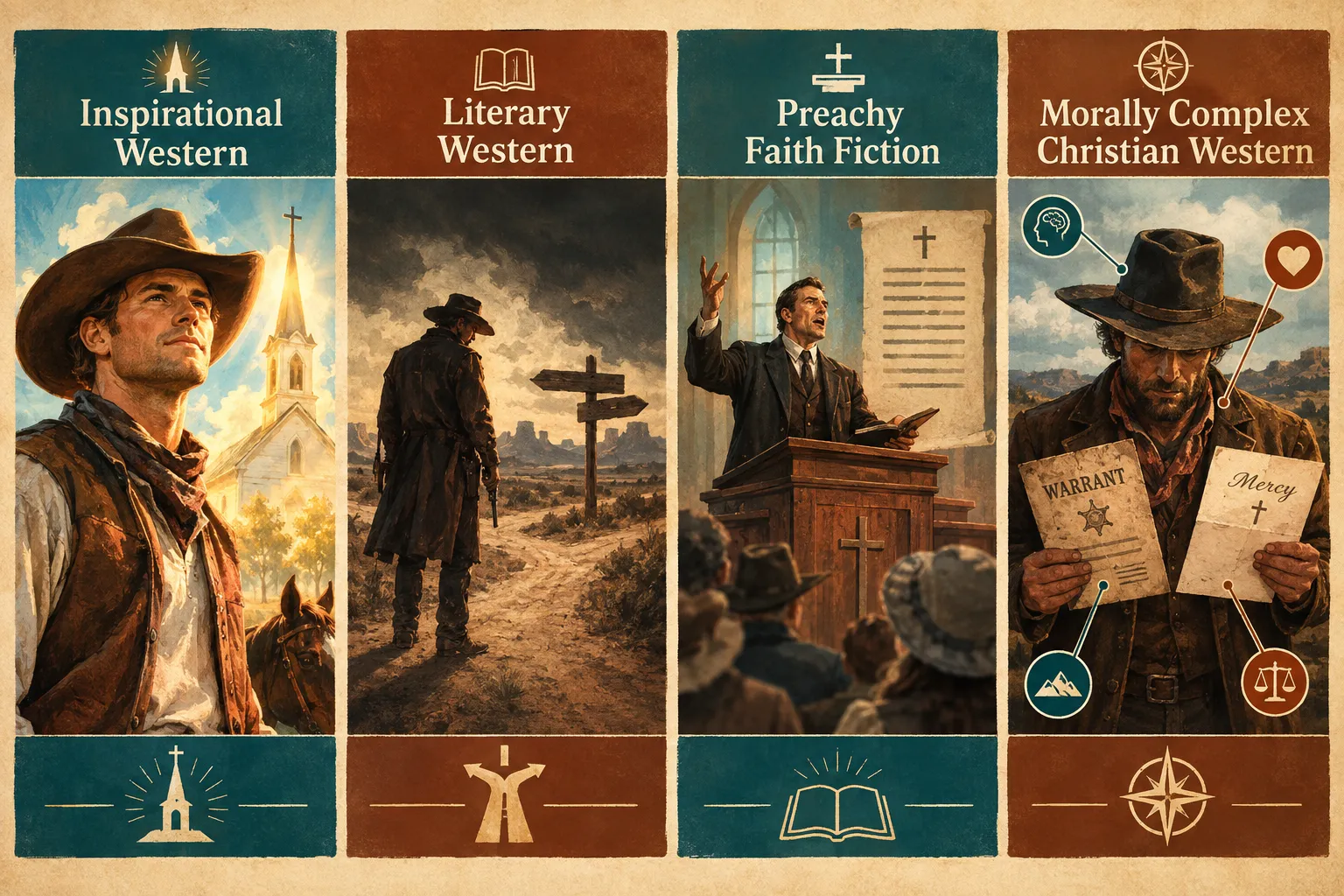
The Difference Between Inspirational Westerns and Literary Westerns
Inspirational westerns prioritize emotional uplift and faith affirmation, the protagonist’s belief is confirmed by the end, the community is restored, and the tone stays warm throughout. Literary westerns prioritize moral honesty, the protagonist may win, but something is lost, and the world doesn’t fully heal. Neither is better. They serve different readers.
Christian frontier fiction for readers who love moral complexity sits in a third space: it carries the emotional honesty of literary fiction and the clean content standards of inspirational fiction, but it doesn’t sacrifice either for the other. The stakes are real. The faith is real. The grace is earned, not given as a consolation prize.
“Walking with them, not talking at them”, this is the line that separates morally complex Christian frontier fiction from inspirational fiction that uses the frontier as backdrop. One puts the reader inside the moral struggle. The other resolves it from the outside.
Publishing industry observers in 2026 have noted that Christian fiction is expanding beyond its traditional inspirational lane, with editors specifically highlighting the moral (not merely doctrinal) appeal of faith-rooted westerns [4]. That shift reflects what readers have been asking for: stories that take both faith and consequence seriously.
How Do Authors Balance Faith and Realism in Frontier Stories
Authors balance faith and realism in frontier stories by letting the setting do the theological work. The frontier is already a place where institutional safety nets are gone, where a man’s word is his bond because there’s no court to enforce anything else, and where death is close enough to make every choice feel final. That environment makes faith feel necessary rather than decorative.
The practical craft move is to show faith through consequence, not commentary. When a character chooses mercy over advantage and pays for it, loses the land, loses the contract, loses the easy road, the reader understands something about what that faith costs without being told what to think about it [10].
What this looks like in practice:
- A character prays, but the prayer isn’t answered the way he expected
- A man does the right thing and the town doesn’t thank him for it
- Grace arrives, but it arrives after the cost has already been paid, not instead of it
- Doubt is present and honest, not resolved by a dramatic conversion scene
This approach aligns with what literary religion scholars call “postsecular” storytelling, religious themes embedded in genre fiction in ways that feel organic rather than imposed [9]. The faith is load-bearing, not decorative.
For a deeper look at how this works across genres, see Faith in Fiction Without Preaching: How Christian Authors Keep Story First.
Western Novels With Flawed Christian Characters, and Why They Work
Flawed Christian characters work in western fiction because the frontier strips away the social structures that let people maintain a respectable faith without testing it. A man who attends church every Sunday in a settled town can keep his beliefs comfortable. The same man, alone on a railroad survey line with a fraudulent deed in his saddlebag and a widow’s farm in the balance, finds out what he actually believes.
The best flawed Christian protagonists in frontier fiction carry specific, earned failures, not generic “I’m not a perfect man” disclaimers. They’ve made a wrong call that cost someone else. They carry that. The faith doesn’t erase the failure; it gives them a framework for what to do with it.
Common failure types that create genuine moral complexity:
- Complicity, the character knew something was wrong and stayed quiet
- Cowardice disguised as prudence, chose the legal path because it was safer, not because it was right
- Pride in justice, pursued what was right but with a hardness that became its own wrong
- Misplaced loyalty, protected an institution or a man past the point where it was honest
These aren’t character flaws added for texture. They’re the engine of the story. The character’s faith is what makes the failure matter, and what makes the reckoning cost something real. That’s earned grace, not cheap grace.
Can You Have a Western With Christian Themes but No Religion Talk
Yes, and the strongest examples prove it. A western can carry deep Christian moral structure (sacrifice, mercy, the weight of bearing witness, the cost of truth-telling) without a single character quoting scripture, attending a church service, or naming God directly.
The moral architecture of the genre already carries those themes. When a man chooses to absorb a cost that isn’t legally his because it’s the right thing to do, that’s a theological act whether or not the narrative labels it as one. When a character refuses to let a false record stand even though correcting it will ruin him, that’s a story about bearing witness, one of the oldest Christian moral categories, without the word “witness” ever appearing [2].
This is why western fiction for readers who love moral complexity crosses over so naturally into faith-rooted territory. The genre’s DNA is already asking the questions faith cares about: What does a man owe? What does mercy cost? Is justice enough without it?
For readers curious about how this plays out across the full Silas Bellhaven catalog, the Christian Western Fiction vs. Secular Westerns comparison breaks down exactly what changes when faith is load-bearing rather than background noise.
Who Reads Christian Fiction but Wants Authentic Storytelling
The core audience for morally complex Christian frontier fiction is readers, primarily women 35-65 and men who read genre fiction, who want their faith represented honestly rather than flattered. They’ve read inspirational fiction that felt too tidy. They’ve tried secular westerns that handled moral questions well but treated faith as either absent or embarrassing. They’re looking for a third option.
These readers share a few specific frustrations:
- Too-clean resolution, the villain repents, the community heals, the protagonist’s faith is never seriously threatened
- Faith as decoration, a cross on the wall, a grace before meals, a pastor who shows up to comfort someone, but none of it connected to the actual moral stakes
- Preachiness, a character who explains what the story means, or a narrator who editorializes about the right spiritual response
What they want instead is fiction that walks with them rather than talks at them. They want to sit inside a hard situation alongside a character who believes, doubts, pays a cost, and finds something that looks like grace on the other side, without being told how to feel about it.
Publishing data in 2026 reflects this: faith-inflected storytelling is identified as a major emerging trend, with readers specifically seeking moral depth rather than doctrinal reassurance [4]. The Why Christian Readers Love Frontier Westerns article covers the genre appeal in more detail.
Common Mistakes in Writing Faith-Based Westerns
The most common mistake in faith-based westerns is using faith to resolve tension rather than create it. When a character’s belief is what gets him out of trouble, rather than what puts him in trouble, the faith becomes a plot device rather than a load-bearing element of the story.
Other frequent mistakes:
- The conversion climax, the antagonist has a dramatic change of heart in the final act, which resolves the moral problem without earning it
- The pastor as oracle, a church figure appears to explain the theme or deliver comfort at exactly the right moment
- Faith without cost, the protagonist’s belief is affirmed by events rather than tested by them
- Moral simplicity dressed as faith, the “Christian” position is always obviously correct, so there’s no real dilemma
- Scripture as shortcut, a character quotes a verse and the problem clarifies, rather than the verse being one more thing the character is wrestling with
The deeper mistake underneath all of these is treating faith as an answer rather than a condition. Faith doesn’t solve the problem in the best Christian frontier fiction. It’s what the character carries into the problem, and what gets tested, strained, and sometimes broken before something like grace shows up on the other side.
For a craft-level breakdown, How to Write Clean Christian Fiction That Still Grips Readers covers pacing, tension, and emotional stakes in detail.
How Much Religion Is Too Much in a Western Novel
Religion becomes “too much” in a western novel when it stops being part of the character’s interior life and starts being delivered to the reader as instruction. The test is simple: is the faith creating story problems, or is it solving them?
A character who prays before a hard decision, makes the wrong call anyway, and lives with the consequence, that’s faith integrated into story. A character who prays, receives clear guidance, acts on it, and is vindicated, that’s a devotional, not a novel.
A rough calibration guide:
- Faith shapes the character’s choices → correct amount
- Faith shapes the character’s choices AND gets tested by consequences → ideal
- Faith explains the character’s choices to the reader → starting to preach
- Faith resolves the plot’s central tension → too much
The Faith in Fiction Across Genres: How Much Is Too Much? article addresses this calibration across western, mystery, fantasy, and thriller, worth reading for both authors and readers trying to articulate what they’re looking for.
Western Fiction for People Tired of Black-and-White Morality, and Faith That Earns Its Place
Readers tired of black-and-white morality in westerns are often also tired of black-and-white faith, the kind where the righteous are obviously righteous and the wicked are obviously wicked and God is clearly on one side. Real faith under fire looks different. It looks like a man who knows what’s right and isn’t sure he has the courage for it. It looks like mercy extended to someone who doesn’t deserve it, at a cost the merciful person will feel for years.
Western fiction for readers who love moral complexity is specifically built for this reader. The gray areas aren’t moral relativism, there are still genuine wrongs and genuine rights in these stories. But the path between them is hard, and the character who walks it doesn’t come out clean.
Cormac McCarthy’s late-career work is often cited as the secular high-water mark for this kind of moral seriousness in frontier fiction, a writer who took the weight of human action seriously enough that theological critics have read his work as fundamentally spiritual in structure [5]. The Christian frontier fiction that works at the same level carries that same weight, but with the added dimension of a character who has a framework for what the weight means.
The difference isn’t that Christian fiction is easier or more comfortable. It’s that the character has a name for what they’re carrying, and the story takes that name seriously without turning it into a lesson.
FAQ
What is morally complex Christian western fiction? It’s frontier fiction where characters face genuine ethical dilemmas, situations where justice and mercy conflict, where the law and what’s right are not the same thing, and where faith is tested by the plot rather than used to resolve it. The faith is real and load-bearing, but it’s never delivered as a sermon.
Is The Mercy Line series preachy? No. The Mercy Line by Silas Bellhaven handles faith through character choice and consequence, not narration or scripture-dropping. The series conscience line, “Where law runs out, a man finds what he answers to”, tells you everything about the approach: faith shows up in what a man does when the institutional authority runs out, not in what he says about it.
What’s the difference between clean Christian fiction and inspirational fiction? Clean Christian fiction maintains content standards (no graphic violence, language, or explicit content) and handles faith as lived experience. Inspirational fiction typically also affirms faith emotionally and resolves toward uplift. Morally complex Christian westerns are clean but not necessarily uplifting in the traditional sense, the resolution is earned, not given.
Can a western be morally complex without being dark or violent? Yes. Moral complexity comes from genuine ethical dilemmas and real consequences, not from graphic content. A story about a fraudulent land record, a false warrant, or a labor-credit ledger that traps a family can carry enormous moral weight without a single scene of graphic violence.
Who is the target reader for The Mercy Line? Primarily readers who want frontier justice stories with real conscience, men and women who appreciate the western genre’s moral architecture and want faith represented honestly rather than decoratively. Kindle Unlimited subscribers looking for clean western fiction with literary-level stakes are the core audience.
What makes earned grace different from cheap grace? Earned grace means mercy arrives after the cost has already been paid, the character has lost something real, made a hard choice, or absorbed a consequence that wasn’t theirs to absorb. Cheap grace means forgiveness or resolution arrives without cost, as a plot convenience. The best Christian frontier fiction runs on earned grace.
Are there Christian westerns that explore faith crisis? Yes. The strongest examples put characters in situations where their faith is genuinely threatened, not just tested in ways that confirm it, but situations where the evidence against God’s goodness is real and present. The character’s faith may survive, but it comes out changed, not merely confirmed.
How do I find more Christian western fiction on Kindle Unlimited? The Christian Western Fiction Reading Guide for Kindle Unlimited is the best starting point for curated recommendations with strong moral stakes.
Conclusion
The frontier has always been a place where easy answers run out. That’s what makes it the right setting for fiction that takes both faith and moral complexity seriously, not as competing values, but as the same demand, approached from different angles.
Western fiction for readers who love moral complexity: Christian frontier stories without the preaching is not a niche within a niche. It’s a response to a real gap: readers who want the moral seriousness of literary fiction, the clean content standards of Christian fiction, and the earned quality of grace that costs something before it arrives.
The Mercy Line by Silas Bellhaven is the clearest current example of this category done right. Start with The False Warrant, a territorial seal that doesn’t make a custody lawful, and a man who has to decide what obedience is actually worth. The faith is in the deciding.
For readers ready to build a full reading list, the Christian Western Fiction Reading Guide for Kindle Unlimited is the right next stop. And for readers who find themselves drawn to moral complexity across genres, not just westerns, the full Silas Bellhaven catalog (mystery, psychological thriller, epic fantasy, LitRPG) runs on the same conviction: God is real, stories matter, and grace is never cheap.
References
[1] Stories That Gleam Like Lightning – https://www.thegospelcoalition.org/themelios/article/stories-that-gleam-like-lightning/
[2] Wheeler1959 – https://2024.sci-hub.se/3913/80056abbd720cfba027dcc7e70e09cb8/wheeler1959.pdf
[4] The Quiet Resurgence Of Faith Why Faith Is Becoming One Of The Most Provocative Stories In Publishing – https://schandraliterature.online/the-quiet-resurgence-of-faith-why-faith-is-becoming-one-of-the-most-provocative-stories-in-publishing/
[5] Cormac Mccarthys Surprising Turn To Spirituality – https://pres-outlook.org/2023/03/cormac-mccarthys-surprising-turn-to-spirituality/
[9] 13537903.2023 – https://www.tandfonline.com/doi/full/10.1080/13537903.2023.2247699
[10] Dark Fantasy Novels Scream Theology – https://www.christiancentury.org/voices/dark-fantasy-novels-scream-theology