
Last updated: August 15, 2026
Quick Answer: The best Christian epic fantasy series for readers who want deep faith themes without allegory are those where theology lives inside the worldbuilding itself, in covenant systems, spiritual warfare, and the moral cost of characters’ choices, rather than in symbolic stand-ins for Christ or the church. These series treat faith as load-bearing structure, not decorative overlay. Readers who found Narnia too transparent but still want God present in the story will find exactly what they’re looking for here.
Key Takeaways
- Allegory maps real theology onto fictional symbols (Aslan = Christ). Non-allegorical Christian fantasy builds original theological systems that operate by the same logic as Christian doctrine without one-to-one correspondence.
- The best series in this space show faith through character consequence, not narration, a character’s trust in the Maker costs something before it pays anything.
- Silas Bellhaven’s Sarel Chronicles and Kethara Chronicles are strong starting points for readers who want covenant theology woven into original worldbuilding.
- Gene Wolfe, Tolkien, and Christopher Ruocchio are frequently cited as the gold standard for Christian metaphysics in mainstream epic fantasy [3].
- Earned grace, mercy that arrives after real cost, is the theological marker that separates serious Christian fantasy from inspirational fantasy with a cross on the cover.
- These series tend to appeal to secular epic fantasy readers as much as Christian ones, because the faith feels structural rather than pasted on.
- Doubt, moral complexity, and spiritual failure are features, not flaws, in the best entries in this category.
- Readers new to the category should start with a shorter series (three books) before committing to longer multi-volume works.
What Makes a Fantasy Series Christian Without Being Allegory
A fantasy series earns the label “Christian” without being allegorical when its underlying logic, how the world works, what justice costs, what mercy requires, reflects Christian doctrine without requiring a symbolic decoder ring.
Allegory works by substitution: Aslan stands for Christ. Non-allegorical Christian fantasy works by implication: the world operates as if grace is real, as if sin has weight, as if covenant matters, and readers who know Christian theology will feel the resonance without needing a key. Critics increasingly use the term “Christian metaphysics” to describe this approach, distinguishing it from allegory in the same way a novel set in a world with gravity differs from a novel about gravity [3].
The practical markers to look for:
- Covenant structures that carry moral and spiritual weight in the plot
- Prayer or spiritual practice that changes outcomes in ways the narrative takes seriously
- Redemption arcs where grace arrives after genuine cost, not as a shortcut
- Moral failure treated as real, with consequences that can’t be narrated away
- No character who is transparently Jesus, the theological center is structural, not personified
How Is Christian Fantasy Different from Allegorical Fantasy Like Narnia
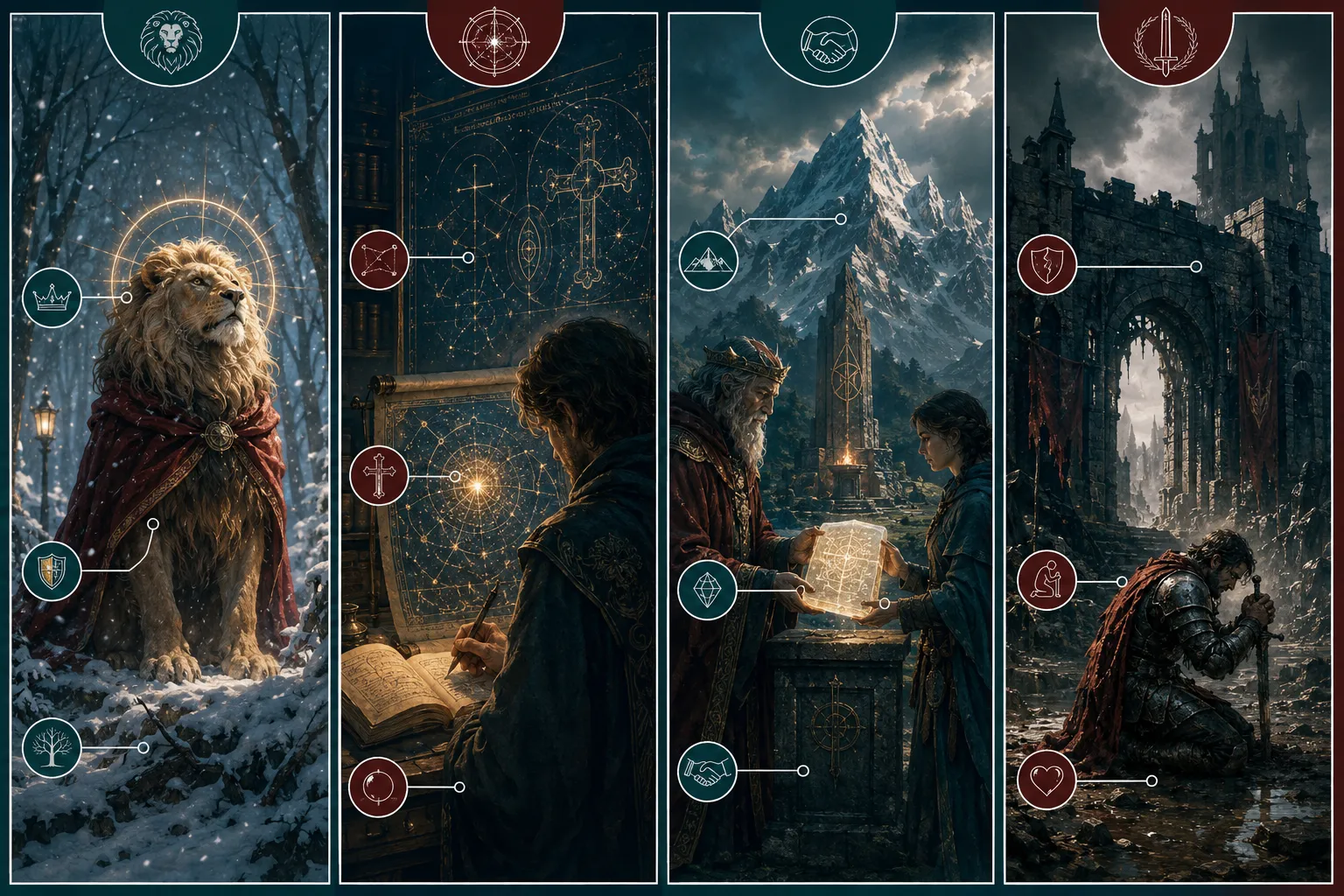
Narnia is the most beloved entry point into Christian fantasy, and also the reason many adult readers feel the category has nothing left to offer them. C.S. Lewis himself was clear that Narnia was not strict allegory but “suppositional”: what if a world like ours needed redemption, and what form might that take? Even so, the symbolic transparency is high enough that many readers feel they’re reading theology illustrated rather than theology lived [6].
The best Christian epic fantasy for adults operates differently. Tolkien’s Middle-earth is the cleaner model: Providence moves through the story, moral weight is real, eucatastrophe (the sudden grace-turn) is structurally present, but no character is Christ, and no event maps cleanly onto Scripture. Readers who want that register, faith present, allegory absent, are looking for what genre commentators now call Tolkienesque theological realism.
Choose allegorical fantasy if: you want the theological parallels made explicit and emotionally immediate.
Choose non-allegorical Christian epic fantasy if: you want faith to feel like gravity, present in every scene, never announced.
Best Christian Epic Fantasy Series for Readers Who Want Deep Faith Themes Without Allegory: The Core List
These series represent the strongest current options across the spectrum from explicitly Christian secondary-world fantasy to mainstream epic SFF with deep Christian metaphysics.
Silas Bellhaven, The Sarel Chronicles
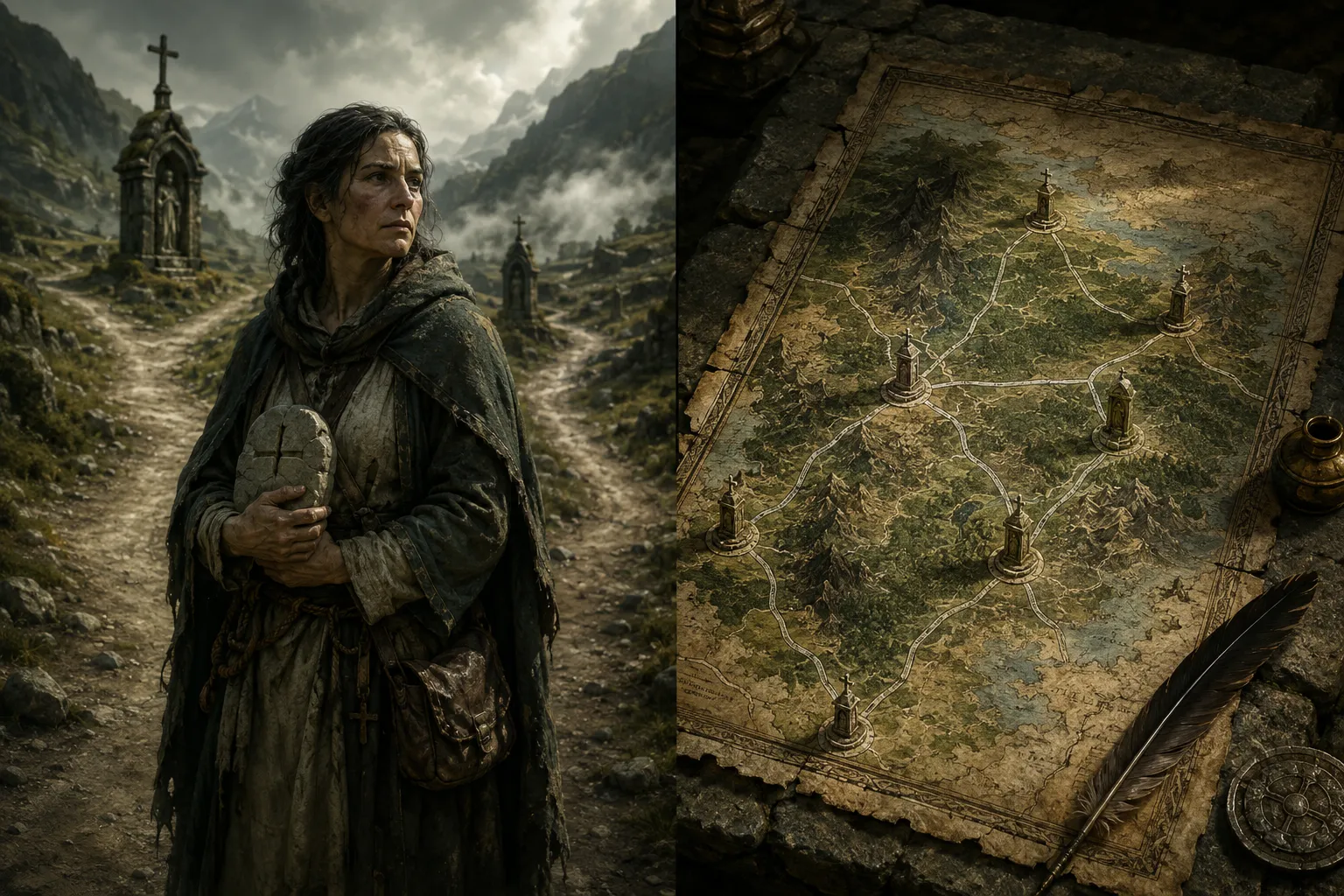
The Map of Unanswered Prayers, The Roads That Lied, and Beyond the Maker’s Map form a complete trilogy set in Sarel, where silver roads mark prayers the Maker-Who-Hears has answered, all certified and kept by the House of Witness. When a black road appears on map-scribe Elya Renn’s skin during the Great Map’s unveiling, belonging to a boy the institution refused to record, the story becomes a sustained meditation on what it means when the official record of grace leaves someone out.
This is rooted in faith without functioning as allegory. The Maker is not God-in-disguise; the covenant system is not the church-in-disguise. The theology operates by Christian logic, faithfulness costs something, mercy extends past institutional limits, the unanswered prayer is not the abandoned prayer, without requiring the reader to translate symbols. Series page
Silas Bellhaven, The Kethara Chronicles
Set in the highlands of Marat-Sol, this series follows Amara and Sela as they carry a covenant word an empire wants counted, contained, and owned. The Stone That Remembered opens with a buried witness-stone breaking through dust bearing a mark no imperial auditor can explain, and the series builds from there into a story about what happens when mercy and justice collide with bureaucratic power.
The faith here is structural: covenant is not metaphor, it is the mechanism by which the plot turns. Series page
J.R.R. Tolkien, The Lord of the Rings
The foundational text for non-allegorical Christian epic fantasy. Tolkien was explicit that he was writing a “fundamentally religious and Catholic work”, but the religion is absorbed into the story’s bones, not its surface. Providence, eucatastrophe, the weight of moral choice, and the cost of grace are all present. No allegory required.
Gene Wolfe, The Book of the New Sun
Wolfe, a Catholic convert, wrote what many consider the most theologically dense Christian epic fantasy in the English language. The series rewards readers who want faith under fire, a narrator who is unreliable, a world where grace is present but not comfortable, and theological depth that takes multiple readings to fully surface [3].
Christopher Ruocchio, The Sun Eater Series
Frequently cited by genre commentators as “deeply infused” with Christian themes while remaining fully accessible to mainstream SFF readers [6]. The series engages with questions of sacrifice, institutional religion, and what it costs a person to act justly in a universe that doesn’t reward it. Not marketed as Christian fiction, which is part of why it works so well for readers who want faith present without the label.
Epic Fantasy Series with Genuine Faith Exploration, Not Just Symbolism
Genuine faith exploration in fiction means the characters actually believe, doubt, pray, fail, and repent, and the narrative takes those actions seriously as plot drivers, not decoration.
The distinction matters because a lot of fantasy uses religious imagery (temples, priests, prophecy) without the story actually caring whether the faith is true. In genuine faith exploration, the question of whether the Maker hears is load-bearing. The answer, or the silence, changes what the characters do next.
What to look for:
- Prayer that costs something or changes something in the plot
- Spiritual doubt treated as a real crisis, not a phase to be resolved quickly
- Characters whose faith shapes their moral choices under pressure, not just their vocabulary
- Redemption arcs where the character earns nothing and receives everything, and knows the difference
The Sarel Chronicles handles this directly: Elya’s faith in the Maker-Who-Hears is tested by the existence of a prayer the House of Witness refused to record. The question isn’t symbolic. It’s structural to every choice she makes across three books.
Christian Fantasy with Morally Gray Characters and Doubt
The best Christian epic fantasy doesn’t protect its characters from hard theology. Doubt is not the enemy of faith in these stories, it’s the condition faith operates in.
Morally gray characters in Christian fantasy work when their ambiguity is moral, not just aesthetic. A character who does wrong things for understandable reasons and carries the weight of that is different from a character who is edgy for atmosphere. The former creates space for genuine redemption; the latter just creates darkness without direction [9].
Silas Bellhaven’s Kethara Chronicles gives readers Amara, a character whose obedience to covenant costs her relationships, reputation, and safety. The doubt she carries isn’t resolved by a dramatic conversion moment. It’s worked through, slowly, by the same logic that drives the plot: earned grace, not cheap grace.
For readers who want this in mainstream epic fantasy, Gene Wolfe’s Severian (Book of the New Sun) is the gold standard, a narrator who is both executioner and potential messiah, whose unreliability is itself a theological statement about the limits of human self-knowledge.
Fantasy Books Exploring Redemption and Grace as Plot Points
Redemption works as a plot point when the character’s return to goodness costs them something they cannot get back. Grace works as a plot point when it arrives unearned, but not un-costly.
The failure mode in weaker Christian fantasy is treating grace as a resolution device: the character repents, the story ends, the cost disappears. In the best entries in this category, grace arrives into the cost, not instead of it. The wound remains. The mercy is real anyway. That’s the theological distinction that separates serious Christian epic fantasy from inspirational fiction with fantasy trappings [7].
Series that handle this well:
- The Sarel Chronicles, Elya’s vindication doesn’t erase what the House of Witness did. The map still has a black road.
- The Lord of the Rings, Frodo is saved, but he cannot stay. The wound from the Morgul blade never fully heals. Tolkien understood that eucatastrophe is not the same as a clean ending.
- The Sun Eater, Ruocchio’s protagonist pays for every act of grace with something he cannot recover.
Best Christian Epic Fantasy for Adults, Not Young Adults
Adult Christian epic fantasy differs from YA in scope, theological complexity, and the willingness to let consequences stand.
YA Christian fantasy tends toward cleaner resolution, shorter arcs, and protagonists whose faith is tested but ultimately confirmed in emotionally satisfying ways. Adult Christian epic fantasy, the best of it, is willing to end a book in the dark, trusting the reader to hold the tension until the next volume, or indefinitely [2].
Recommended entry points for adult readers:
| Series | Author | Length | Faith Depth | Allegory Level |
|---|---|---|---|---|
| The Sarel Chronicles | Silas Bellhaven | 3 books | High | None |
| The Kethara Chronicles | Silas Bellhaven | 3 books | High | None |
| The Book of the New Sun | Gene Wolfe | 4 books | Very High | None |
| The Sun Eater | Christopher Ruocchio | 6+ books | High | None |
| The Lord of the Rings | J.R.R. Tolkien | 3 books | High | Very Low |
Christian Fantasy That Doesn’t Feel Like Christian Fiction
This is the question serious readers in this space are actually asking: can a fantasy series be genuinely, deeply Christian without carrying the tonal markers of the Christian fiction industry, the tidy resolutions, the scripture-drop moments, the characters who speak in testimony language?
The answer is yes, and the key is walking with the reader, not talking at them. Faith shows up in what characters choose when no one is watching, in what the world’s moral logic rewards and punishes, in whether the story believes mercy is real. None of that requires a character to quote Scripture or deliver a conversion speech [9].
Silas Bellhaven’s catalog is built on this exact distinction. The Sarel Chronicles reads as serious epic fantasy first, the covenant system, the House of Witness, the map-scribe protagonist navigating institutional power, and as Christian fiction second, because the faith is structural rather than announced. Readers who came for the fantasy stay for the theology, and readers who came for the theology find the fantasy holds up on its own terms.
For mainstream SFF readers, Ruocchio’s Sun Eater is the clearest example of this in traditionally published fiction: deeply Catholic in its moral architecture, fully readable as secular epic science fantasy [6].
Fantasy Books Where Prayer or Spiritual Warfare Feels Authentic
Prayer and spiritual warfare feel authentic in fiction when they operate by the same rules as the rest of the story’s cause-and-effect logic, when they cost something, change something, or reveal something the character couldn’t have known otherwise.
The failure mode is prayer-as-atmosphere: a character kneels, something vaguely hopeful happens, the scene moves on. The success mode is prayer-as-action: a character kneels, and the choice to trust rather than act costs them something real, and the story takes that cost seriously whether or not the prayer is answered in the way they hoped.
In Beyond the Maker’s Map, Elya carries faithfulness past the point where the Great Map confirms anything. The prayer is unanswered in the institutional sense. The story’s argument is that this doesn’t mean the Maker wasn’t listening, and that argument is made through plot, not narration. That’s hope in the dark, handled honestly.
Christian Fantasy That Appeals to Secular Fantasy Readers Too
The crossover appeal of non-allegorical Christian epic fantasy comes from the same place as its theological depth: the worldbuilding is load-bearing, the characters are complex, and the moral stakes are real.
Secular fantasy readers who bounce off Christian fiction usually do so because the faith feels like an external constraint on the story, characters make choices because they’re Christian, not because the story’s internal logic demands it. In the best Christian epic fantasy, the faith is the internal logic. Remove it and the world doesn’t work [3].
What secular readers respond to in this category:
- Original covenant and theological systems that feel as rigorously built as any magic system
- Moral complexity that isn’t resolved by a character finding God
- Redemption arcs that feel earned rather than granted
- Worlds where the question of whether the divine is real has actual stakes
Tolkien built the template. Wolfe refined it. Ruocchio brought it into science fantasy. Silas Bellhaven’s Sarel and Kethara Chronicles are doing the same work in clean Christian indie fiction, rooted in faith, accessible to anyone who loves serious secondary-world storytelling.
FAQ
What is the difference between Christian fantasy and allegorical fantasy? Allegorical fantasy maps real-world theology onto fictional symbols (a character or event stands for a theological concept). Christian fantasy without allegory builds worlds that operate by Christian moral and theological logic without requiring symbol-to-referent translation. The faith is structural, not symbolic.
Is The Lord of the Rings Christian fantasy? Yes. Tolkien described it as “a fundamentally religious and Catholic work,” but it operates through implication rather than allegory. Providence, grace, moral weight, and eucatastrophe are all present in the story’s structure without any character or event functioning as a direct symbol.
What is “earned grace” in Christian fiction? Earned grace refers to redemption arcs where mercy arrives after genuine cost, the character doesn’t escape consequences, but receives grace into those consequences rather than instead of them. It’s the theological opposite of cheap grace, where forgiveness functions as a plot shortcut.
Are the Sarel Chronicles appropriate for secular fantasy readers? Yes. The Sarel Chronicles reads as serious secondary-world epic fantasy with a rigorously built covenant system and morally complex protagonist. Readers who don’t share the Christian worldview can engage with it as a story about institutional power, faithfulness under pressure, and what it costs to tell the truth.
What makes Gene Wolfe’s Book of the New Sun Christian fantasy? Wolfe, a Catholic convert, built a world where Christian theological logic operates at the level of structure, the protagonist’s arc mirrors sacrificial themes, the world’s history echoes Christian eschatology, and the narrative’s unreliability is itself a statement about human self-knowledge. None of it is allegory; all of it is deeply Catholic.
Is Christian epic fantasy a growing market? Yes. Christian fiction market data from 2026 shows expanding space for faith-forward genre fiction, including fantasy, with steady output of epic-style Christian speculative fiction from both indie and traditional publishers [1][5].
What should I read first if I’m new to non-allegorical Christian fantasy? Start with a complete trilogy rather than an ongoing series. The Sarel Chronicles (three books, complete) or The Lord of the Rings are both strong entry points. The Sarel Chronicles is shorter and more focused; Tolkien’s trilogy is longer but the most foundational text in the category.
Can Christian fantasy include morally gray characters? Yes, and the best of it does. Moral ambiguity in Christian fiction works when it’s genuinely moral, characters doing wrong things with real consequences, not just aesthetic darkness. The theological framework actually requires moral complexity, because grace only means something if the failure was real.
What is “Christian metaphysics” in fantasy? A term used by genre critics to describe fiction where Christian theological assumptions, about the nature of good and evil, the reality of grace, the weight of moral choice, are built into the world’s operating logic, without the story being explicitly evangelistic or allegorical [3].
How long are most Christian epic fantasy series? They range from standalone novels to multi-volume series. The Sarel Chronicles and Kethara Chronicles are each three books. Gene Wolfe’s Book of the New Sun is four volumes. Ruocchio’s Sun Eater is six volumes and ongoing. Three-book trilogies are a good starting point for readers new to the category.
Conclusion
The best Christian epic fantasy series for readers who want deep faith themes without allegory share one quality: the faith is structural. It’s not decorative, not announced, not delivered as a lesson. It’s the reason the world works the way it works, the reason the characters’ choices carry the weight they carry, the reason mercy costs something before it gives anything.
Readers who have felt that Christian fiction talks at them rather than with them will find something different in this category. The Sarel Chronicles and Kethara Chronicles from Silas Bellhaven are strong starting points for readers who want that experience in clean, serious secondary-world fantasy. For readers who want to go deeper into the tradition, Gene Wolfe and Tolkien remain the essential texts, and Ruocchio’s Sun Eater is the best current example of this approach in mainstream epic SFF.
Next steps:
- Start with The Map of Unanswered Prayers (Sarel Chronicles, Book 1) for a complete, self-contained introduction to covenant fantasy with genuine theological depth. View on Amazon
- Browse the full Silas Bellhaven catalog at the author page for additional series across Christian western, mystery, and thriller.
- For mainstream SFF with Christian metaphysics, begin with Tolkien’s The Fellowship of the Ring or Wolfe’s The Shadow of the Torturer.
Faith under fire, grace that costs something, hope in the dark, that’s what this category does at its best. The stories are out there. They’re worth finding.
References
[1] Christian Fiction New Releases October 2025 – https://www.narelleatkins.com/christian-fiction-new-releases-october-2025/ [2] Modern Christian Fantasy Recommendations – https://www.reddit.com/r/Fantasy/comments/11qrqyc/modern_christian_fantasy_recommendations/ [3] Novels With Christian Metaphysics Not Written As – https://www.reddit.com/r/Fantasy/comments/1953s5y/novels_with_christian_metaphysics_not_written_as/ [5] New Releases March 2025 – https://www.iolagoulton.com/new-releases-march-2025/ [6] 10 Must Read Christian Fiction Series Ltn Top Ten – https://lovethynerd.com/10-must-read-christian-fiction-series-ltn-top-ten/ [7] Seven Exceptional Christian Fantasy Authors You Should Read That You’ve Never Heard Of – https://www.danielcamomile.com/seven-exceptional-christian-fantasy-authors-you-should-read-that-youve-never-heard-of/ [9] Any Christian Fantasy Novels That Are Actually – https://www.reddit.com/r/Fantasy/comments/8tsh8f/any_christian_fantasy_novels_that_are_actually/