

Last updated: August 18, 2026
Quick Answer: The best Christian cozy mystery characters work because their faith is lived, not lectured. Readers want a protagonist who prays because she’s scared, doubts because she’s human, and chooses mercy because it costs her something, not a character who delivers scripture at every plot turn. Authentic faith and real flaws aren’t opposites in this genre; they’re the same engine.
Key Takeaways
- A Christian cozy mystery protagonist’s faith should show up in her choices, not her narration or dialogue
- Real flaws, pride, impatience, a tendency to meddle, make faith meaningful because they give it something to work against
- Doubt doesn’t disqualify a character from being a faith-forward protagonist; handled honestly, it deepens reader trust
- The church community functions best as a source of genuine tension and warmth, not a backdrop of perfect people
- “Preachy” happens when faith explains the plot; “authentic” happens when faith costs the character something inside the plot
- Readers of Christian cozy mysteries in 2026 increasingly prefer “faith-centered” over “Christian fiction” as a label, they want values woven in, not announced [5]
- The fastest-growing Christian fiction readers want clean reads that engage real-world struggles, including mental health and moral failure [4]
- A protagonist who never struggles with sin isn’t a character, she’s a mascot
- Show faith through action: she forgives the person she has every right not to forgive; she tells the truth when lying would be easier
- Church community, small-town setting, and recurring secondary characters are structural assets, not decorative ones
What Makes a Christian Cozy Mystery Protagonist Feel Authentic
A Christian cozy mystery protagonist feels authentic when her faith functions as a load-bearing part of her personality, not a label attached to it. She doesn’t quote scripture to fill silence. She reaches for prayer the way someone reaches for a glass of water when their throat is dry, reflexively, because she actually needs it.
The distinction matters more now than it did a decade ago. New series launching in mid-2026 are explicitly positioning their heroines’ faith as “central to character and plot,” not as a marketing qualifier [2][8]. Readers can sense the difference between a character who has faith and a character who is faith-flavored.
What authenticity looks like in practice:
- She attends church and sometimes finds it hollow, and goes anyway
- Her prayer life is inconsistent; she forgets to pray during the easy weeks and can’t stop during the hard ones
- She has a specific, personal faith history, a moment it cost her something, a season she walked away, a verse she returns to not because it’s famous but because it found her
- Her faith shapes her method of investigation: she notices what mercy would require, even when justice is easier
The Mercy House Mysteries series, set in Juniper Gap, Tennessee, builds Nora Bell Hartley this way, she keeps finding bodies where she meant to find donations, and her faith isn’t a comfort blanket. It’s the thing that makes her stay when leaving would be sensible.
How Do You Balance Faith With Character Flaws in Cozy Mysteries
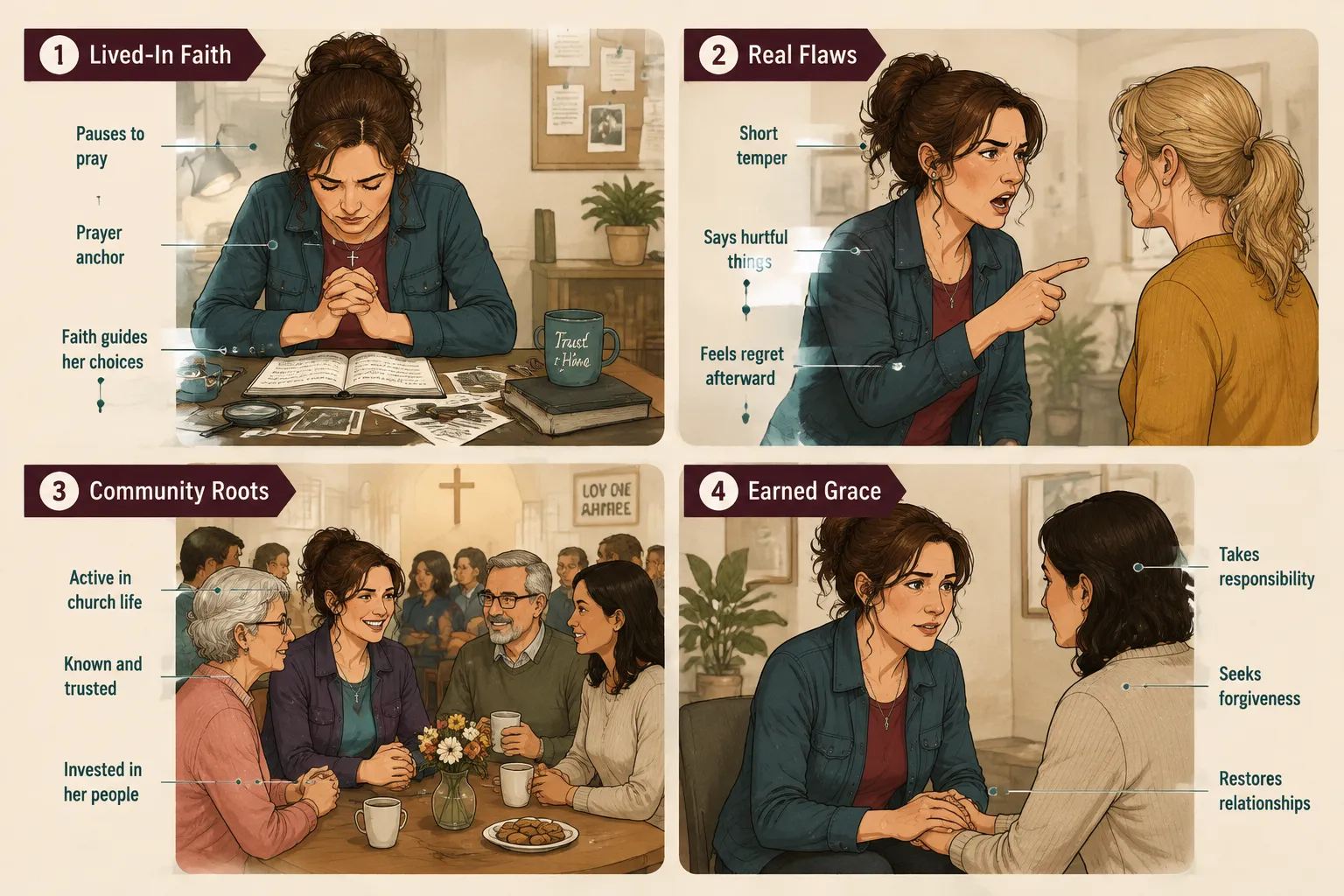
Faith and flaws balance each other when the flaws are specific enough to actually threaten the faith. A protagonist who is “a little too nosy” has a quirk. A protagonist whose need to fix things has driven away her daughter, and who now channels that compulsion into solving murders in her church community, has a flaw with weight.
Flaws that work best for faith-based characters:
| Flaw | Why It Works With Faith |
|---|---|
| Pride / self-sufficiency | Directly resists the posture of dependence faith requires |
| Impatience with slow justice | Creates real tension with “mercy triumphs over judgment” |
| Tendency to withhold forgiveness | Makes every scene involving the killer’s backstory a spiritual test |
| People-pleasing | Corrupts her testimony, she softens truth to keep peace |
| Grief she hasn’t surrendered | Faith can be intellectually intact while the heart is still closed |
The key rule: the flaw must interfere with the investigation at least once. If her pride never costs her a clue, it’s decoration. If her inability to forgive makes her miss the killer’s motive until the final act, the flaw has earned its place in the story.
Craft commentary in 2026 is direct on this point: flawed, internally conflicted Christian protagonists whose faith costs them something are what readers are asking for [5]. Cheap grace, faith that resolves conflict without requiring anything, reads as false, and readers know it.
What’s the Difference Between Preachy and Authentically Faithful Characters
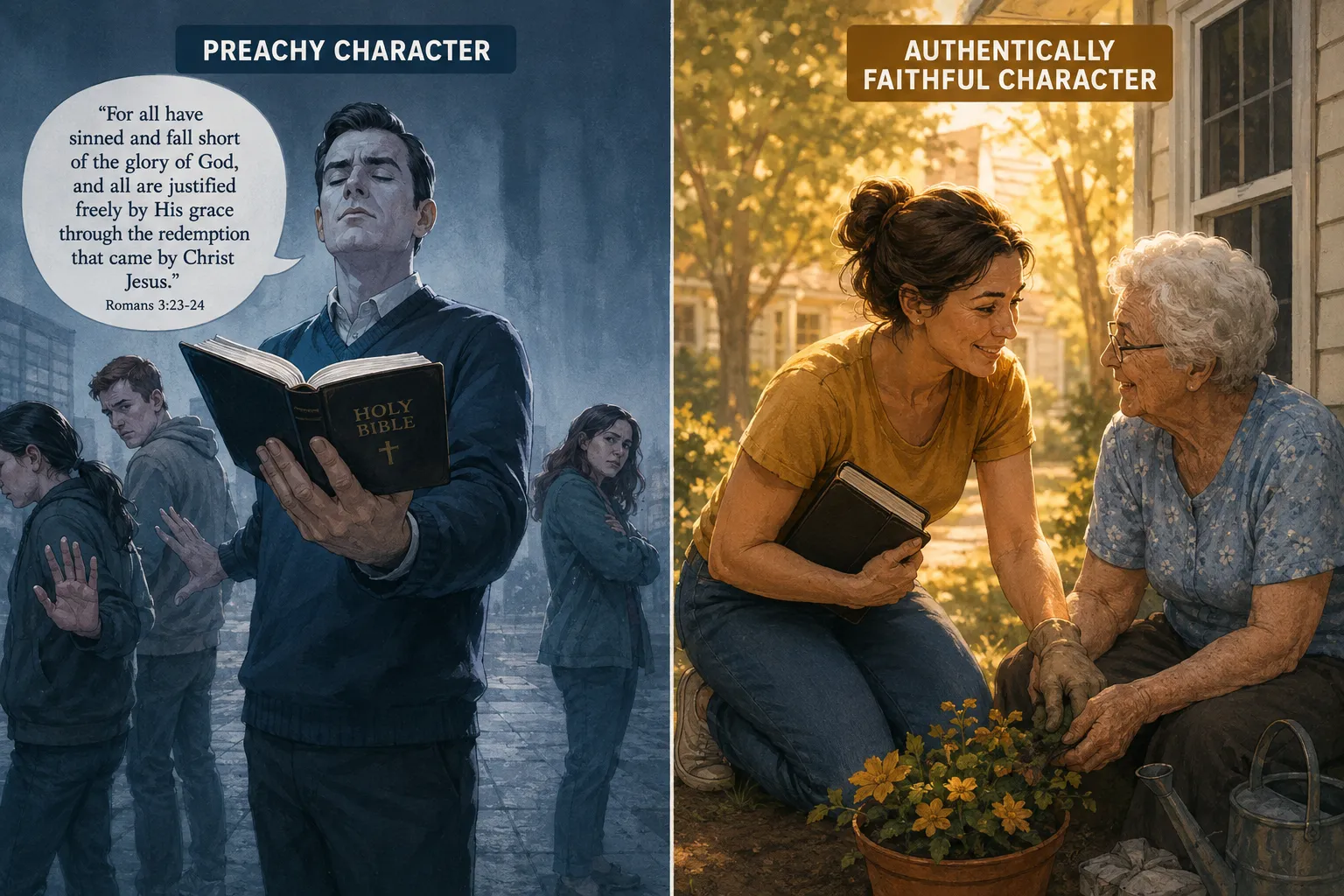
Preachy characters explain faith to the reader. Authentically faithful characters demonstrate faith inside the story’s pressure. The line is almost always about function: is the faith moment serving the character’s arc, or is it serving the author’s message?
A quick diagnostic:
- ✅ She prays before confronting the suspect because she’s genuinely afraid, and the prayer doesn’t make her less afraid, just less alone
- ❌ She explains the doctrine of forgiveness to a grieving widow in three paragraphs before the scene can move forward
- ✅ Her faith makes her extend grace to the person the whole town has already convicted
- ❌ A secondary character exists only to ask spiritual questions so the protagonist can answer them
The brand principle that applies here: stories should walk with the reader, not talk at them. A character who lectures is an author in costume. A character who acts from faith, imperfectly, at personal cost, is a person worth following through ten books.
Can a Christian Protagonist Doubt Their Faith and Still Work in Cozy Mystery
Yes, and in many cases, doubt makes the character more effective, not less. Doubt is not the opposite of faith in a well-built character; it’s evidence that the faith is real enough to be tested.
The cozy mystery genre has room for this because the form itself is built on the restoration of order. A protagonist who doubts whether God is paying attention, and then watches the truth come to light anyway, experiences something more honest than a character whose faith is never troubled.
What doubt looks like without derailing the story:
- She questions whether prayer changes anything during a case that involves a child’s death
- She’s angry at God and doesn’t hide it from herself, but she keeps showing up
- She has a specific theological wound (a prayer that wasn’t answered the way she asked) that shapes how she reads the case
What doesn’t work: doubt as a plot device that resolves in a single conversation with the pastor. That’s not doubt, it’s a speed bump. Real doubt lives in the background of every scene and gets quieter slowly, not all at once.
How Much Should Faith Be Part of the Plot vs. the Character
Faith belongs primarily in the character, and it earns its way into the plot when the mystery’s stakes are genuinely moral. The mistake is forcing faith into plot mechanics, the killer is caught because the protagonist prays, the clue appears after a worship service, rather than letting it shape how the protagonist thinks about what she’s uncovering.
A useful framework:
- Character level (always): How she treats suspects, how she handles guilt, what she does with information that could destroy someone’s reputation
- Community level (often): How the church setting creates access, obligation, and tension that a secular setting wouldn’t
- Plot level (selectively): When the crime itself involves a moral question, a covered-up sin, a false record, a mercy that was weaponized, faith becomes structurally relevant to the mystery’s resolution
Industry positioning in 2026 confirms that successful faith-centered mystery series integrate faith as a character quality first, with plot integration following naturally from who the protagonist is [2][5].
Common Mistakes Writers Make With Religious Characters in Cozy Mysteries
The most common mistake is treating faith as a personality trait rather than a lived relationship. A character who is “religious” in the same way she is “brunette”, as a fixed descriptor, will never feel real.
Mistakes to avoid:
- Scripture as punctuation. Dropping a verse at the end of a tense scene to signal resolution. It doesn’t resolve anything; it just stops the scene.
- The perfect church community. Real church communities have gossip, power struggles, and people who’ve been carrying grudges since 1987. That’s not cynicism, that’s material.
- Conversion as plot reward. The killer repents in the final scene, and it feels unearned because the story didn’t build toward it.
- Faith that never costs anything. If her Christianity makes every social interaction easier, it isn’t Christianity, it’s charm.
- Avoiding hard topics. Craft experts are consistent: Christian fiction fails when it sidesteps realism [5]. Addiction, abuse, financial desperation, these belong in the genre because they belong in the communities the genre depicts.
What Kind of Flaws Work Best for Faith-Based Characters
The flaws that work best are ones with a theological shadow, flaws that a person of genuine faith would recognize as spiritually significant, not just personally inconvenient.
High-value flaws for Christian cozy protagonists:
- Self-righteousness, she knows the right answer and can’t resist saying so, which makes her miss what the “wrong” person is actually carrying
- Fear disguised as caution, she calls it wisdom; it’s actually a failure to trust
- Unforgiveness, the most structurally useful flaw in a mystery, because every investigation eventually requires her to understand a killer’s motive with some degree of compassion
- Compulsive helping, she serves everyone and surrenders nothing, which is a form of control dressed as generosity
These flaws work because they have a redemptive arc available. The character doesn’t have to complete the arc in every book, in a series, the arc can span volumes, but the possibility of earned grace has to be visible.
Who Reads Christian Cozy Mysteries and What Do They Expect
The core audience for Christian cozy mysteries is primarily women between 35 and 65, many of them Kindle Unlimited subscribers who want clean reads with genuine stakes [4][6]. They are not looking for fiction that avoids hard things, they are looking for fiction that handles hard things honestly, from inside a faith framework.
What this audience expects:
- No graphic violence, explicit content, or profanity, but not sanitized reality either
- A protagonist whose faith feels like it belongs to a real person, not a character type
- Community and setting that feel specific, not generic “small-town Christian”
- Stakes that are genuinely moral, not just procedural
- Grace that arrives after cost, not instead of it
Importantly, this audience increasingly resists the “Christian fiction” label and gravitates toward “faith-centered” or “values-driven” descriptions [5]. They’ve read enough formula fiction to know the difference between a story that takes faith seriously and one that uses faith as a marketing category.
How to Show Faith Through Actions, Not Just Dialogue in Cozy Mysteries
Faith shows through action when the protagonist makes a choice that only makes sense if she actually believes what she says she believes. The test: would a non-religious character with the same personality make the same choice? If yes, the faith isn’t doing any work.
Concrete techniques:
- She returns the evidence that would clear her name but implicate someone she’s been protecting, because she can’t build her reputation on a half-truth
- She visits the suspect’s family before the arrest, not after, because she knows what’s coming and they don’t deserve to be blindsided
- She prays specifically, not “Lord, help me” but a prayer that reveals what she actually fears losing
- She extends grace publicly to someone the community has written off, and it costs her social standing
- She keeps a confidence when breaking it would solve the case faster
These moments don’t need to be announced as faith moments. The reader understands. That’s the difference between walking with the reader and talking at them.
What Role Should Church Community Play in a Christian Cozy Mystery
The church community is the genre’s most distinctive structural asset, and its most commonly wasted one. Used well, it provides access (a protagonist embedded in the most information-rich social network in a small town), obligation (she can’t treat suspects as strangers), and genuine tension (the people she loves most are often the ones with something to hide).
What church community offers the plot:
- Access: She knows everyone’s business because she’s been serving alongside them for years
- Obligation: She can’t simply report and walk away, these are her people
- Conflict: Church politics, old wounds, and competing loyalties create pressure without requiring external villains
- Spiritual mirror: The community’s collective response to the crime reflects back on the protagonist’s own faith choices
The Mercy House Mysteries use Juniper Gap’s church community this way, the socials, the donation drives, the quilting circles aren’t atmosphere. They’re the mechanism by which secrets surface and truth gets cornered.
Are There Christian Cozy Mystery Series Worth Studying for Character Building
Yes. Several series demonstrate how to build protagonists with authentic faith and real flaws at different levels of craft and commercial success.
Series worth reading with a writer’s eye:
- The Mercy House Mysteries (Silas Bellhaven), Nora Bell Hartley’s faith is operational, not decorative; the series consistently uses church-community objects (a hymnal, a recipe tin, a seed packet) as both clue and spiritual metaphor. Browse the series
- Guideposts’ Gift Shop Mysteries (launched July 2026), explicitly positions the heroine’s faith as central to both character and plot, with new series architecture designed around “faith + danger + mystery” rather than didactic faith delivery [2][8]
- Mainstream Christian cozy series, the broader 2026 market shows continued growth in mystery/cozy with faith-forward protagonists who are more often non-clergy, more often carrying real-world struggles [4][5]
When studying any of these, track when faith appears in the scene structure. If it appears only at the beginning (prayer before action) or the end (resolution/comfort), the author is using it as bookends. If it appears in the middle, in the moment of decision, when the choice is genuinely hard, the author is using it as architecture.
FAQ
Q: Does my Christian cozy protagonist have to be a churchgoer? A: No, but she needs a specific, active faith life that the reader can observe. A character who “believes in God” without any practice or community is vague, not universal. Ground her faith in something concrete, a habit, a community, a specific spiritual wound or gift.
Q: How often should faith come up in the narrative? A: It should surface whenever the protagonist faces a genuine moral or emotional decision, which, in a well-constructed mystery, is every few scenes. It doesn’t need to be named as faith every time. A choice made from mercy is a faith moment even if the word “God” never appears.
Q: Can my protagonist sin and still be likable? A: Yes, and she should. A protagonist who never sins isn’t relatable; she’s aspirational in a way that creates distance. The question isn’t whether she sins but whether the story takes the sin seriously. Cheap grace (sin without consequence or cost) is the problem, not sin itself.
Q: Is it okay if my protagonist is angry at God? A: Absolutely. Anger at God is one of the most honest expressions of an active faith relationship. It assumes God is real and present enough to be accountable. Handle it with honesty, don’t resolve it too quickly, and don’t punish the character for having it.
Q: How do I avoid making secondary characters into sermon delivery systems? A: Give every secondary character a want that has nothing to do with the protagonist’s spiritual growth. The pastor has his own problems. The church elder has her own agenda. When secondary characters exist only to ask questions the protagonist can answer, readers feel the machinery.
Q: Should the mystery’s resolution involve a spiritual lesson? A: The resolution can contain a spiritual truth without delivering it as a lesson. Let the truth emerge from what happened, not from a character explaining what it means. Trust the reader to draw the connection.
Q: What’s the right amount of scripture in a Christian cozy? A: Less than you think. One or two verses used with specificity and earned weight land harder than a chapter full of references. If a verse appears, it should feel like the character found it, not like the author placed it.
Q: Can a Christian cozy mystery tackle dark topics like addiction or abuse? A: Yes, and the best ones do. The genre’s faith framework doesn’t require sanitized reality. It requires honest reality handled with mercy. Dark topics treated honestly are more faithful to Christian conviction than stories that pretend those topics don’t exist in small-town church communities.
Conclusion
Building a Christian cozy mystery protagonist with authentic faith and real flaws isn’t a balancing act, it’s a single integrated task. The faith is what makes the flaws matter. The flaws are what make the faith cost something. And the cost is what makes the grace, when it finally arrives, feel like it was earned rather than handed out.
Actionable next steps for writers:
- Write a one-page character history that includes one moment her faith was tested and one moment she failed someone she loved, these two events should shape every scene she’s in
- Audit your manuscript for faith moments: mark each one and ask whether it’s doing character work or author work
- Give your church community at least two members with genuine, unresolved conflicts that predate the mystery
- Find one scene where your protagonist could lie or stay silent without consequence, and make her tell the truth anyway, at personal cost
- Read the first book of a series you admire and track where in each scene faith appears, not whether it appears
For readers who want to see these principles in action, the Mercy House Mysteries, beginning with A Donation to Die For, offer ten books of a protagonist whose faith is rooted in lived belief, not formula. Nora Bell Hartley doesn’t have all the answers. She just keeps showing up, which turns out to be the most honest thing a Christian character can do.
References
[2] Coming Soon Cozy Mystery New Releases For July 2026 – https://www.bookfrolic.com/coming-soon/coming-soon-cozy-mystery-new-releases-for-july-2026/
[4] Christian Fiction 14 7 Yearly Surge Dramatic Market Expansion Data – https://www.firmenpresse.de/pressrelease734029/christian-fiction-14-7-yearly-surge-dramatic-market-expansion-data.html
[5] July 2026 New Releases In Christian Fiction – https://sarahhamakerfiction.com/2026/07/08/july-2026-new-releases-in-christian-fiction/
[6] Best Selling Christian Novels 2026 Data Driven Market Analysis Top Titles – https://www.alibaba.com/product-insights/best-selling-christian-novels-2026-data-driven-market-analysis-top-titles.html
[8] New Cozy Mysteries July 2026 – https://www.cozycrimemystery.com/news/books/new-cozy-mysteries-july-2026/