Last updated: August 12, 2026
Quick Answer: Christian cozy mystery tropes in small communities draw their power from the specific rhythms of church life, potlucks, prayer chains, ministry boards, and seasonal traditions that create both intimacy and suspicion. These settings work because everyone knows everyone, faith is load-bearing rather than decorative, and the amateur sleuth is almost always already embedded in the community she’s trying to protect. The result is a whodunit where mercy and justice are always in tension, and the clues hide in plain sight at the fellowship hall table.
Key Takeaways
- Church settings generate cozy mystery tension naturally: shared knowledge, overlapping loyalties, and the weight of public reputation all create motive and opportunity.
- Potlucks, donation drives, quilt circles, seed swaps, and holiday ministries function as plot devices unique to faith-based small-town mysteries.
- The amateur sleuth in a church community has access ordinary investigators don’t, she’s already on the prayer chain, already sorting donations, already trusted.
- Christian cozy mysteries differ from secular cozies in that faith shapes character choices and consequences, not just the backdrop.
- The genre is an emerging niche, not yet at secular cozy sales volumes, but growing steadily with strong digital momentum. [1][6]
- Authentic Christian cozies let doubt, failure, and earned grace show up, they don’t resolve every moral question with a tidy conversion scene.
- Both religious and secular readers can enjoy the genre when faith is handled as lived experience rather than instruction.
- The most underused tropes involve the dark side of church structures: board politics, contested wills, ministry fund disputes, and the weaponization of reputation.
What Are the Main Tropes in Christian Cozy Mysteries?
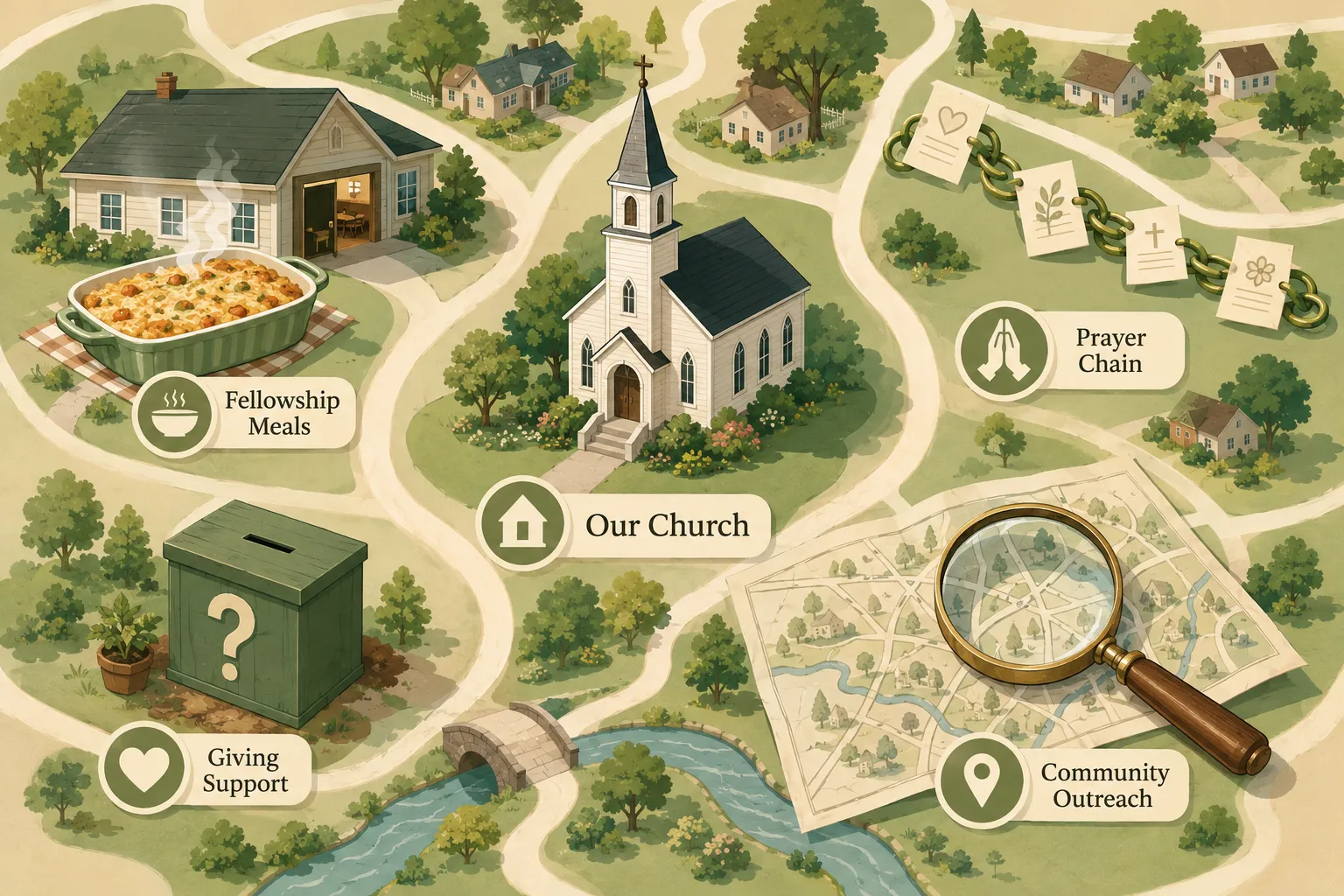
Christian cozy mystery tropes in small communities cluster around the same structures that make church life intimate and occasionally combustible. The core tropes are: the amateur sleuth with a ministry role, the body discovered during a community event, secrets buried in church records or donated objects, and a resolution that costs the protagonist something real.
Common tropes at a glance:
- 🧺 The Donation Box Discovery, A body, a ledger, or a damning letter surfaces inside a charity donation. The ministry context means multiple people handled the box, all with plausible reasons to be there.
- 🍲 The Potluck as Crime Scene, Fellowship meals put the entire congregation in one room. Poisoning, overheard arguments, and witnessed confrontations all become fair game.
- 📖 The Church Record as Evidence, Hymnals with margin notes, family Bibles with altered genealogies, old attendance rolls, and prayer lists become the mystery’s paper trail.
- 🧵 The Quilt Circle / Craft Ministry, Women’s groups that meet regularly become both a source of community intelligence and a place where old grievances surface.
- 📦 The Seasonal Ministry Drive, Backpack blessings, Christmas room projects, flood-relief boxes, and seed swaps give the plot a natural deadline and a reason for unusual activity.
- 🎵 The Choir or Music Ministry, Rehearsal schedules, solo disputes, and access to the building after hours create opportunity and alibi problems.
“In Juniper Gap, Tennessee, Nora Bell Hartley keeps finding bodies where she meant to find donations, and secrets the church socials never sing about.”, Mercy House Mysteries series description
These tropes work because they’re specific. A donation box isn’t just a container, it’s a record of who gave what, when, and why. That specificity is what separates a Christian cozy mystery from a generic small-town mystery with a cross on the cover.
How Do Church Settings Work in Cozy Mystery Novels?
A church setting functions as a closed community with its own hierarchy, its own information networks, and its own rules about what gets said aloud. For cozy mystery purposes, that’s nearly perfect architecture.
The key structural elements a church setting provides:
- A defined cast, Regular attendees, deacons, elders, ministry leaders, and occasional visitors. The reader learns the community gradually, the same way a new member would.
- Built-in information flow, Prayer chains, bulletin boards, and Sunday school classes mean news travels fast and selectively. The sleuth can use this, and so can the killer.
- Reputation as currency, In a small congregation, what people think of you matters enormously. Motive often lives here: protecting a family name, hiding a past, preserving a position.
- Physical access patterns, Who has a key to the fellowship hall? Who volunteers for setup? Who stays late? Church buildings have natural access logic that creates alibi and opportunity questions.
- Seasonal rhythm, Advent, Lent, Vacation Bible School, the annual fundraiser, these create natural story timelines and escalating stakes.
Common mistake: Writers sometimes use the church as pure scenery, a cozy backdrop with no actual structural role. The setting earns its place when the crime could only happen here, because of something specific to how this congregation works.
Why Do Small Communities Make Good Settings for Cozy Mysteries?
Small communities create the conditions cozy mysteries need: everyone knows everyone, secrets are harder to keep, and the stakes feel personal rather than abstract. When the victim is the church treasurer or the woman who ran the quilting circle for thirty years, the loss lands differently than a stranger’s death would.
Small-town church settings add a layer secular small towns don’t always have: moral accountability is built into the social structure. People don’t just fear gossip, they fear being seen as someone who failed their faith. That fear is a rich source of motive.
According to industry reporting, Christian mystery novels, including cozy subgenres focused on community problem-solving, represent one of the fastest-growing segments of religious fiction, with strong digital growth particularly among readers who want clean, low-violence content. [6][3] The small-town church setting is a natural fit for that readership.
What’s the Difference Between Christian Cozy Mysteries and Regular Cozy Mysteries?
The difference isn’t the presence of church buildings or scripture references. It’s whether faith actually shapes what characters choose to do when the pressure is on.
| Element | Regular Cozy Mystery | Christian Cozy Mystery |
|---|---|---|
| Faith role | Backdrop or absent | Load-bearing, shapes choices |
| Moral resolution | Justice served | Mercy and justice in tension |
| Community type | Small town, hobby group | Church, ministry, congregation |
| Protagonist motivation | Curiosity, justice | Calling, conscience, community |
| Tone | Warm, low-stakes | Warm, but honest about hard things |
| Grace | Not a category | Earned, not given cheaply |
A regular cozy might feature a bakery owner who solves crimes. A Christian cozy features someone whose faith is actively tested by what she uncovers, and who has to decide what mercy looks like when she’s holding evidence that could destroy someone she loves.
Publishers Weekly notes that while mysteries are rising in Christian fiction overall, cozy mysteries specifically don’t yet match general-market cozy sales, partly because readers can find secular cozies easily, which may suppress demand for explicitly labeled Christian versions. [1] That gap suggests the genre still has room to grow into its own identity rather than simply mirroring secular cozy conventions.
How Do Church Ministries Create Plot Tension in Mysteries?
Ministries create tension because they involve shared resources, overlapping authority, and the collision of genuine good intentions with human failure. A food pantry sounds like an unambiguously good thing, until someone is skimming donations, or a volunteer discovers the inventory records don’t match, or a longtime ministry leader is found dead the morning after a board dispute.
Ministry-specific tension sources:
- Fund disputes, Who controls the ministry budget? Who approved that expenditure? Financial records in a church context carry both legal and moral weight.
- Volunteer access, Ministries give ordinary community members legitimate reasons to be in unusual places at unusual times. That’s an alibi problem and an opportunity problem simultaneously.
- Board politics, Deacon boards, elder councils, and ministry committees have their own power dynamics. A vote that went wrong three years ago can still be driving someone’s behavior today.
- The record as weapon, Attendance logs, donation records, prayer request files, these can be used to protect someone or destroy them, depending on who’s reading.
In the Mercy House Mysteries series set in Juniper Gap, Tennessee, nearly every book uses a ministry object, a donation box, a backpack blessing drive, a seed swap, a flood-relief collection, as the inciting discovery. The ministry isn’t just atmosphere; it’s the mechanism that puts the clue in the protagonist’s hands.
What Role Do Local Traditions Play in Christian Mystery Stories?
Local traditions function as both setting detail and plot structure. They create natural gathering points, establish who belongs and who’s an outsider, and carry the weight of community memory.
Traditions that work as plot devices:
- Annual quilt auctions, Old fabric, old records, old grievances stitched together literally and figuratively.
- Church homecoming weekends, Former members return, old relationships resurface, and people who’ve been avoiding each other end up in the same room.
- Holiday drives and charity events, Christmas rooms, Thanksgiving food baskets, Easter egg hunts for local kids, these create deadlines and draw in community members who wouldn’t otherwise interact.
- Hymn sings and revival meetings, Emotionally charged gatherings where things get said that wouldn’t be said on an ordinary Sunday.
- The church cookbook, A surprisingly rich source of family history, old feuds, and community record-keeping. Who submitted a recipe? Whose name was left out?
Traditions also establish what’s normal, which makes the abnormal visible. When the woman who’s brought her green bean casserole to every potluck for twenty years doesn’t show up, that absence means something.
How Do Amateur Sleuth Protagonists Work in Church Communities?
The amateur sleuth in a church community works because she already has access, trust, and information that a professional investigator would have to spend weeks building. She’s on the prayer chain. She sorts the donations. She knows which family has been struggling and which deacon has been acting strange.
What makes the church-embedded sleuth effective:
- Earned trust, She’s not an outsider asking questions. She’s a known quantity, which means people talk to her.
- Institutional knowledge, She knows the history: who gave what, who served on which committee, what happened at the 2019 homecoming that nobody talks about.
- Moral stakes, She can’t just hand information to the police and walk away. She knows the people involved. That personal cost is what makes the story worth reading.
- Limits, She can be wrong. She can be manipulated by someone who knows how to use her faith against her. Her goodness is not a superpower; it’s a vulnerability.
Common mistake: Making the amateur sleuth too competent too fast. The church community should push back. People should protect each other, cover for each other, and make her work for every piece of the truth.
What Makes a Cozy Mystery Feel Authentically Christian?
Authentic faith in a cozy mystery shows up in character choices under pressure, not in how many scripture verses appear on the page. A character who prays before acting, who wrestles with whether to expose someone she loves, who extends mercy when she has every right not to, that’s Christian fiction. A character who quotes Proverbs at the killer in the final chapter is not.
Markers of authentic Christian cozy fiction:
- Faith is tested, not performed. The protagonist doubts, questions, and sometimes gets it wrong.
- Grace costs something. Forgiveness doesn’t erase consequences, it comes after them.
- The community reflects real church life: genuine kindness alongside genuine dysfunction.
- The resolution holds mercy and justice in tension rather than collapsing one into the other.
- The faith feels like it belongs to the character, not to the author trying to make a point.
Clean Christian fiction, no graphic violence, no explicit content, faith handled as lived experience, earns its label through tone and texture, not through disclaimers. The reader should feel it before she can name it.
How Do You Balance Faith Themes Without Preaching in a Mystery?
The single most useful rule: show faith through what characters choose to do, not through what they say about it. A character who decides not to burn a piece of evidence because she can’t live with the lie, that’s a faith moment. A character who stops to deliver a three-paragraph reflection on Romans 8 is a sermon interrupting a story.
Practical balance points:
- Let the plot carry the theology. If the story is about whether mercy is possible after betrayal, the reader will feel the answer in the resolution, not from a speech.
- Use community as a mirror. The congregation’s response to the crime reflects the book’s moral landscape. A church that closes ranks to protect reputation is making a theological statement without anyone saying so.
- Trust the reader. Christian fiction readers who want their faith represented honestly don’t need it explained. They need it recognized.
- Reserve scripture for earned moments. A hymn that surfaces at the right moment, a verse a character has carried for years, these land. Quoted scripture as plot punctuation doesn’t.
The brand principle that applies here: walking with them, not talking at them. The story should feel like a companion, not a lesson.
Can Secular Readers Enjoy Christian Cozy Mysteries?
Yes, when the faith is handled as lived experience rather than instruction. Secular readers who enjoy small-town mysteries, character-driven plots, and clean content will find plenty to engage with in a well-written Christian cozy. What they won’t tolerate is being preached at.
The overlap between Christian cozy readers and general cozy readers is larger than the labels suggest. Both audiences want: a protagonist they trust, a community that feels real, stakes that matter, and a resolution that satisfies. The faith dimension adds moral weight to those elements, it doesn’t replace them.
Industry data from 2026 suggests Christian fiction is growing at 8.2% annual unit sales, outpacing general-market fiction, with strong digital readership among younger demographics. [5] That growth includes readers who may not identify as religious but are drawn to clean, values-grounded storytelling.
Choose a Christian cozy if you want: Low violence, a community-centered mystery, moral stakes that go deeper than whodunit, and a protagonist whose conscience is part of the plot.
What Are Some Underused Tropes in Faith-Based Mysteries?
The most underused territory in Christian cozy mysteries is the institutional dark side of church life, the places where genuine faith and human failure collide in ways that are uncomfortable to examine.
Underused tropes worth exploring:
- The contested legacy gift, A large donation to the church comes with conditions nobody wants to honor. Who benefits from the donor’s death?
- The ministry fund audit, Financial irregularities in a beloved outreach program. The person skimming may have had reasons that feel almost sympathetic.
- The prayer request as intelligence, Someone has been using the prayer chain to gather information about vulnerable families. The mechanism of care becomes a mechanism of harm.
- The church split’s aftermath, A congregation divided years ago over doctrine or leadership. The wound never fully healed, and now someone from the old conflict is dead.
- The false testimony, A respected member’s account of events doesn’t hold up. The community’s instinct to believe her is both understandable and dangerous.
- The ministry leader’s hidden past, Not a dramatic crime, but a quiet failure, an old debt, an abandoned family, a record that doesn’t match the story he tells. The question isn’t whether he’s guilty of the murder; it’s whether the truth about him changes everything.
These tropes are underused because they require writers to be honest about the ways church communities can cause harm while still holding genuine faith. That honesty is exactly what makes the fiction worth reading.
Best Christian Cozy Mystery Series with Small-Town Settings
The Mercy House Mysteries by Silas Bellhaven is set in Juniper Gap, Tennessee, and currently runs ten books. Each book uses a specific ministry object or community event as the inciting discovery, a donation box, a Christmas room, a family Bible, a quilt, a flood-relief collection, a backpack blessing drive, a recipe tin, a seed swap, a hymnal margin, a benediction tape. The series is available on Kindle Unlimited.
- A Donation to Die For, Book 1
- The Christmas Room Clue, Book 2
- The Family Bible Secret, Book 3
- A Quilt for the Guilty, Book 4
- The Flood Box Murder, Book 5
The full series page is at amazon.com/dp/B0H37WKQRK.
Conclusion
Christian cozy mystery tropes in small communities work because church life is already a closed world with its own rules, its own records, and its own ways of keeping, and breaking, trust. Potlucks, prayer chains, donation drives, quilt circles, and ministry boards aren’t just atmosphere. They’re the architecture of the story: the reason people are in the same room, the reason secrets get buried, and the reason the amateur sleuth already has more access than she bargained for.
The genre is growing. Market data from 2026 points to Christian fiction expanding steadily, with clean and faith-based content drawing increasing digital readership. [2][6] But the best Christian cozy mysteries won’t grow because they’re labeled correctly, they’ll grow because they’re honest. Honest about the way faith holds and the way it sometimes fails. Honest about mercy that costs something. Honest about the ordinary Tuesday that turns out to matter more than anyone expected.
If you’re a reader: Start with a series that uses the ministry setting as a plot mechanism, not just a backdrop. Look for a protagonist whose faith is tested, not performed.
If you’re a writer: The underused territory is the institutional life of the church, the board disputes, the contested records, the prayer chain used as a tool. Go there. It’s where the real stories live.
Explore the Mercy House Mysteries: amazon.com/dp/B0H37WKQRK
FAQ
What makes Christian cozy mysteries different from regular cozy mysteries? Faith shapes character choices and consequences in Christian cozies, it’s not just a setting detail. The protagonist’s conscience, her community’s moral expectations, and the tension between mercy and justice are all load-bearing elements of the plot.
Do Christian cozy mysteries have to be set in churches? No, but church and ministry settings are the most common because they provide a natural closed community with built-in hierarchy, information networks, and moral stakes. The setting works when the crime could only happen there.
Are Christian cozy mysteries appropriate for non-religious readers? Yes, when faith is handled as lived experience rather than instruction. Readers who want clean content, community-centered plots, and moral stakes will find the genre accessible regardless of their own beliefs.
What is the amateur sleuth’s advantage in a church community? She already has trust, institutional knowledge, and access that an outside investigator would take weeks to build. She’s on the prayer chain, she sorts the donations, she knows the history. That access is both her tool and her burden.
How do you write faith in a cozy mystery without preaching? Show faith through what characters choose to do under pressure, not through what they say about it. Let the plot carry the theology. Reserve scripture for earned moments, not punctuation.
What are the most common ministry objects used as plot devices? Donation boxes, church records, family Bibles, quilts, recipe tins, seed packets, hymnals, and charity drive collections all appear regularly. They work because they carry community history and pass through multiple hands.
Is the Christian cozy mystery market growing? Yes. Christian mystery novels are described as one of the fastest-growing segments of religious fiction in 2026, with strong digital readership. Cozy mysteries specifically don’t yet match secular cozy sales volumes, but the gap is narrowing. [1][6]
What’s the biggest mistake writers make in Christian cozy mysteries? Using faith as decoration rather than structure. If the story would work the same way without the faith element, it’s not a Christian cozy, it’s a cozy with a cross on the cover.
What are some underused tropes in faith-based mysteries? Contested legacy gifts, ministry fund audits, prayer chains used to gather intelligence on vulnerable families, and the long aftermath of a church split. These require honesty about institutional failure, which is exactly why they’re underused and exactly why they’re worth writing.
What’s a good starting point for Christian cozy mystery readers? The Mercy House Mysteries series, starting with A Donation to Die For, uses ministry settings and community objects as core plot mechanisms across ten books set in Juniper Gap, Tennessee.
References
[1] Mysteries On The Rise In Christian Fiction – https://www.publishersweekly.com/pw/by-topic/industry-news/religion/article/100974-mysteries-on-the-rise-in-christian-fiction.html
[2] Christian Fiction 14.7% Yearly Surge Dramatic Market Expansion Data – https://www.firmenpresse.de/pressrelease734029/christian-fiction-14-7-yearly-surge-dramatic-market-expansion-data.html
[3] ChristShare Highlights Clean Fiction as Cozy Mysteries Gain Interest – https://news.marketersmedia.com/christshare-highlights-clean-fiction-as-cozy-mysteries-gain-interest/89191539
[5] The Rise Of Christian Fiction: Market Trends, Regional Dynamics And Future Predictions For 2026 – https://www.alibaba.com/product-insights/the-rise-of-christian-fiction-market-trends-regional-dynamics-and-future-predictions-for-2026.html
[6] Christian Mystery Novels: Why Readers Are Choosing Faith-Based Fiction – https://www.firmenpresse.de/pressrelease737437/christian-mystery-novels-why-readers-are-choosing-faith-based-fiction.html