
Last updated: August 22, 2026
Quick Answer: Christian cozy mysteries combine the gentle puzzle-solving of classic cozy fiction with faith lived honestly through character choices, small-town community, and redemptive consequence. The tropes that define the subgenre, amateur sleuths, church settings, quirky neighbors, and grace that costs something, are not decoration. They are the engine. Readers who know these tropes can find their next series faster; writers who understand them can build stories that hold.
Key Takeaways
- Christian cozy mysteries are defined by clean content, an amateur sleuth, a tight community setting, and faith woven into the plot rather than preached from it
- Small towns (typically 5,000-20,000 residents in craft guidance) give the genre its social pressure and its warmth, everyone knows everyone, which makes secrets both harder to keep and more devastating to reveal [8]
- Quirky supporting characters are not comic relief; they carry the community’s memory and moral texture
- Spiritual themes work best when they show up through character choice and consequence, not through narration or scripture-dropping
- The subgenre skews toward women readers aged 35-65, with strong Kindle Unlimited readership [2]
- Romance is typically present but restrained; some series carry a romance-absent contract entirely
- Dark themes can appear in Christian cozies, grief, betrayal, hidden sin, but graphic violence and explicit content are excluded by the genre’s content contract
- Publishers Weekly has tracked mysteries as a rising category within Christian fiction [2]
- The difference between a regular cozy and a Christian cozy is not a Bible verse on page one, it is whether faith shapes how characters respond to moral jeopardy
- Series like the Mercy House Mysteries (Juniper Gap, Tennessee) demonstrate how ministry-based settings anchor both the mystery plot and the spiritual throughline
What Defines a Christian Cozy Mystery Genre
A Christian cozy mystery is a subgenre of cozy mystery fiction in which faith functions as a load-bearing story element, not a label applied to clean content after the fact. The cozy mystery baseline includes: no graphic violence, no explicit content, an amateur sleuth protagonist, a contained community setting, and a puzzle resolved by the end of the book [8][9]. The Christian layer adds faith as a lived reality that shapes how characters interpret guilt, grace, justice, and mercy.
The subgenre has been formally recognized in library cataloging and recommendation systems, with “religious-theme cozies” now appearing as a distinct tag in curated reading lists [5]. Publishers Weekly has noted mysteries rising within Christian fiction specifically, with editors describing it as a growing niche even if not yet a fully established genre category [2].
What separates it from general-market cozies:
- Faith informs the protagonist’s moral reasoning, not just their vocabulary
- Community is often organized around a church, ministry, or faith-based institution
- Redemption arcs carry weight, grace shows up after cost, not instead of it
- Content is clean by conviction, not just by rating
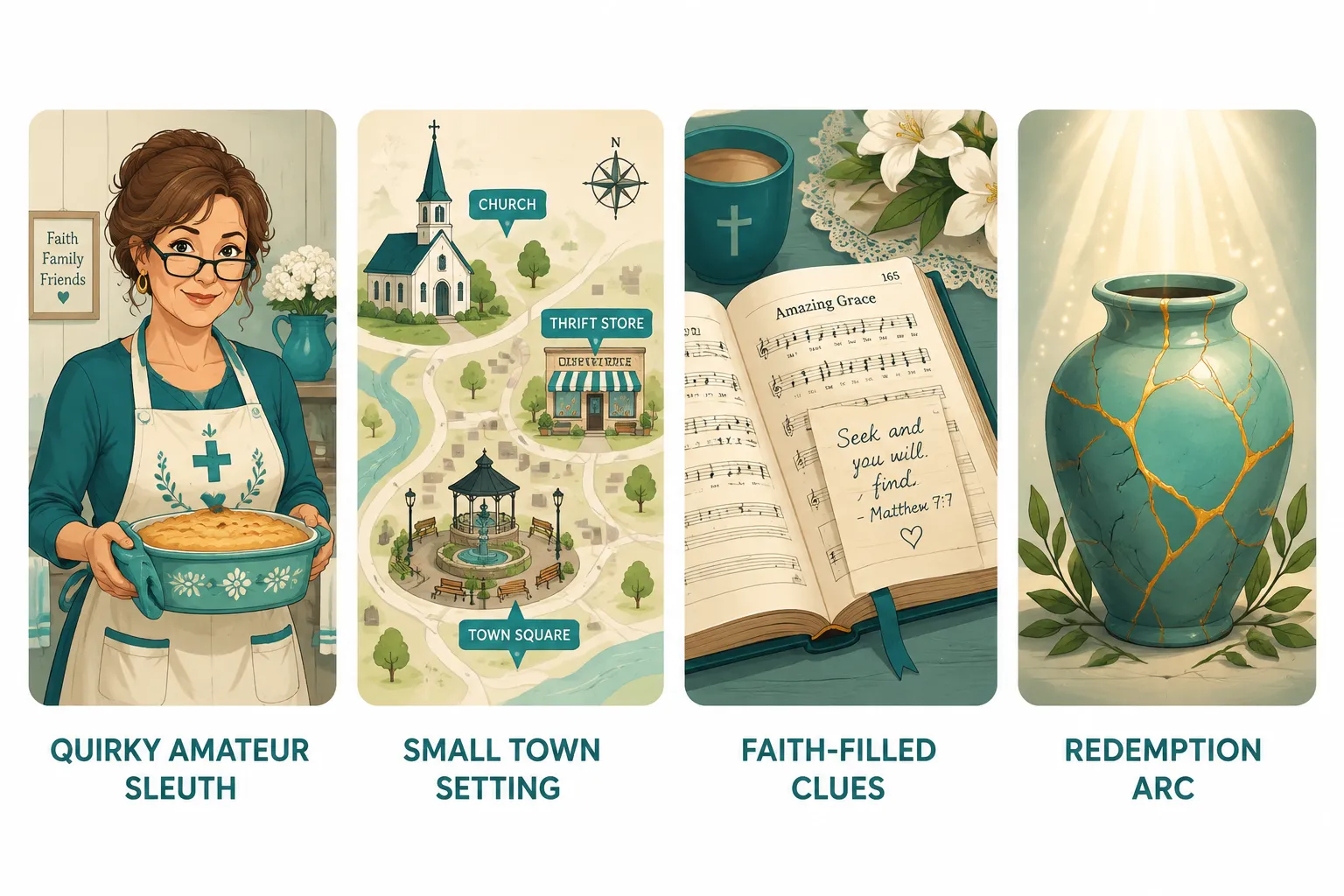
Why Do Readers Love Small-Town Settings in Cozy Mysteries
Small-town settings work in cozy mysteries because they compress social stakes. When the suspect pool is the same group of people who bring you casseroles and sit two pews over on Sunday, every secret has a face attached to it.
Craft guidance for the genre typically places the ideal cozy town between 5,000 and 20,000 residents, large enough to sustain a cast of recurring characters, small enough that a stranger or a scandal registers immediately [8]. In Christian cozies, the town often has a church or ministry at its social center, which tightens the community further and raises the moral temperature of any wrongdoing.
Why small towns serve Christian cozy mysteries specifically:
- Accountability is built in. Characters cannot simply disappear after a moral failure. The community remembers.
- Relationships carry history. A deacon’s hidden ledger or a quilter’s old grudge lands harder when the reader has watched those people share a potluck table.
- The setting mirrors the spiritual theme. Small towns ask the same question faith asks: what will you do with the truth once you’re holding it, and who gets hurt if you don’t?
The Mercy House Mysteries set in Juniper Gap, Tennessee, use exactly this compression, Nora Bell Hartley keeps finding bodies where she meant to find donations, and the town’s social fabric is what makes each discovery matter [see A Donation to Die For].
How Spiritual Themes Work in Cozy Mystery Plots
Spiritual themes work in cozy mystery plots when they drive character decisions rather than pause the story for reflection. The mystery plot and the faith arc should be solving the same problem from different angles.
The most effective approach: let the murder or crime expose a moral fracture in the community, hidden shame, unconfessed wrong, a record someone tried to bury, and let the protagonist’s faith shape how she responds to what she uncovers. Does she protect the guilty to preserve the church’s reputation? Does she pursue justice even when mercy would be easier? Those are faith questions dressed in mystery clothes [6].
Spiritual themes that appear most naturally in Christian cozies:
| Theme | How It Shows Up in Plot |
|---|---|
| Confession and concealment | A character’s secret is the motive or the clue |
| Mercy vs. justice | Protagonist must decide whether to turn in someone she loves |
| Forgiveness with cost | Reconciliation happens, but the consequences don’t disappear |
| Community accountability | The church or ministry is implicated, not just the individual |
| Earned grace | A character’s redemption follows genuine loss, not a tidy prayer |
The key is that faith functions as load-bearing structure, not wallpaper. A hymnal with a margin note (The Hymnal Margin Murder), a family Bible with the wrong names recorded (The Family Bible Secret), a benediction tape holding a man’s last unfinished confession (The Benediction Tape Murder), these are objects that carry spiritual weight precisely because they are embedded in the mystery’s mechanics.
What Makes a Character Quirky in Christian Fiction
Quirky characters in Christian cozy mysteries are not comic relief. They are the community’s memory, its conscience, and sometimes its most reliable moral compass, delivered sideways.
A quirky character in this genre tends to have: an unusual occupation or hobby that gives her access to information, a personality trait that makes her simultaneously endearing and inconvenient, and a faith that shows up in unexpected ways. The town gossip who prays for everyone she talks about. The quilter who stitches old fair ledgers into her squares. The seed-swap organizer who knows every family’s history because she knows what they plant.
What makes a supporting character genuinely quirky (vs. just eccentric):
- Her oddity is useful to the plot, it gives her knowledge or access the protagonist needs
- She has a consistent internal logic, even when her behavior looks strange from the outside
- Her faith, if present, is expressed through action rather than speech
- She carries a specific piece of the community’s history
The best quirky characters in Christian cozies feel like people the reader has actually met, not caricatures, but the specific human being who shows up at every church potluck with the same dish and somehow always knows what happened to the missing offering envelopes.
Difference Between Regular Cozy Mysteries and Christian Cozy Mysteries
The difference is not a Bible verse on page one. It is whether faith shapes how characters respond to moral jeopardy.
A general-market cozy mystery can be perfectly clean, set in a small town, and feature a lovable amateur sleuth, and still have no meaningful spiritual dimension. The Christian cozy mystery is distinguished by faith functioning as the protagonist’s actual moral framework, not just her background detail [5][6].
Side-by-side comparison:
| Element | General-Market Cozy | Christian Cozy Mystery |
|---|---|---|
| Content standard | Clean (varies by author) | Clean by conviction |
| Faith role | Background or absent | Load-bearing story element |
| Community center | Café, bookshop, hobby group | Church, ministry, faith institution |
| Moral resolution | Justice served | Justice served + grace accounted for |
| Romance | Common, sometimes central | Present but restrained; some series romance-absent |
| Redemption arc | Optional | Expected, and it costs something |
Publishers Weekly has noted that demand for “clean, faith-centered mysteries” is a distinct reader request, separate from general clean fiction [2][4].

How Much Romance Should Be in a Christian Cozy Mystery
Romance in Christian cozy mysteries is typically present but secondary to the mystery plot. It should not drive the story’s resolution, and it should stay within the content contract the genre carries, warm, emotionally honest, and without explicit content.
Some series carry a romance-absent contract entirely, particularly those with ensemble casts or ministry-focused settings where a romantic subplot would pull focus from the community dynamic. The Mercy House Mysteries, for example, keep the emotional center on Nora Bell Hartley’s relationship with her community and her faith, not on a romantic arc.
Practical guidance:
- Romance works best as a secondary thread that complicates the mystery (a suspect she’s drawn to, a past relationship that resurfaces)
- It should not resolve the mystery or substitute for the spiritual arc
- Readers in this subgenre generally want emotional warmth, not romantic tension as the primary hook
- If a series carries a romance-absent contract, that should be signaled early and held consistently
Can Cozy Mysteries Have Dark Themes and Still Be Christian
Yes, and the best ones do. The content contract excludes graphic violence, explicit content, and profanity. It does not exclude grief, betrayal, hidden sin, community shame, or the kind of darkness that makes grace necessary.
A Christian cozy mystery that avoids all hard things in favor of cheerful puzzles is not honest about what faith is for. Readers who want hope in the dark, not hope instead of the dark, are the core audience for this subgenre [6]. The darkness should be real enough to make the resolution matter.
What’s excluded vs. what’s allowed:
- ❌ Graphic depictions of violence or death
- ❌ Explicit sexual content
- ❌ Profanity
- ✅ Moral complexity and genuine guilt
- ✅ Characters who doubt, fail, and carry consequences
- ✅ Community sin (corruption, cover-up, institutional failure)
- ✅ Grief and loss rendered honestly
- ✅ Redemption that arrives after real cost
The distinction is not between light and dark, it is between darkness that serves the story’s mercy and darkness that exists for shock.
Why Are Amateur Sleuths Popular in Cozy Mystery Books
Amateur sleuths work in cozy mysteries because they solve crimes through relationship and observation rather than authority. In Christian cozies, this dynamic carries additional weight: the protagonist is embedded in the community she’s investigating, which means every discovery has a personal cost.
A professional detective can maintain emotional distance. An amateur sleuth who runs the church thrift store cannot. When she uncovers that the deacon who died before he could confess was hiding a ledger in a mislabeled donation box (A Donation to Die For), she has to decide what to do with that knowledge inside a community she loves and belongs to. That is a faith question, not just a mystery question [9].
Why the amateur sleuth fits Christian cozy mysteries specifically:
- She has no institutional authority to hide behind, her choices are personal
- Her access to information comes through service and relationship, which mirrors the community values the genre celebrates
- Her amateur status means she can be wrong, afraid, and uncertain, which makes her faith more credible, not less
How Faith Elements Enhance Mystery Storytelling
Faith elements enhance mystery storytelling when they raise the moral stakes of the crime and complicate the resolution. A murder in a church setting is not just a legal problem, it is a rupture in the community’s covenant with itself, and the story has to reckon with that.
The most effective faith elements in Christian cozy mysteries are embedded in objects, institutions, and choices rather than stated in narration. A prayer list with the wrong name on it. A hymnal margin note that points at a secret. A flood-relief donation box that hides more than water damage. These are not decorative, they are the mystery’s mechanism, and the faith is inseparable from the clue [6].
How to recognize strong faith integration in a Christian cozy:
- The spiritual object or institution is the source of the mystery, not just its backdrop
- The protagonist’s faith is tested by what she discovers, not confirmed by it
- Grace arrives at the end of the story because it was genuinely needed, not because it was scheduled
- The community’s faith is shown to be imperfect and real, not a performance of goodness
Best Christian Cozy Mystery Series to Start With
The best entry point depends on what draws a reader to the subgenre, the community setting, the spiritual texture, or the mystery mechanics.
For readers new to Christian cozy mysteries:
- The Mercy House Mysteries (Silas Bellhaven), Start with A Donation to Die For. Set in Juniper Gap, Tennessee, the series uses a church thrift store as its hub and builds its mysteries around objects that carry hidden records: ledgers, quilts, family Bibles, recipe tins. Ten books in the series as of 2026, available on Kindle Unlimited. Series page
- Harlequin Love Inspired Mystery, The Love Inspired line has published clean, faith-centered mysteries for years and remains one of the most accessible entry points for readers new to the subgenre [4]
- Library and recommendation lists now tag “religious-theme cozies” as a distinct category, making it easier to find curated series recommendations through sites like Emily’s Reading Room [5]
Choose based on what you want:
- Ministry-based setting with spiritual objects as clues → Mercy House Mysteries
- Lighter faith touch with strong romance thread → Love Inspired Mystery
- Darker spiritual stakes with psychological weight → Christian psychological thriller (The Gathering Light series)
What Age Group Reads Christian Cozy Mysteries
The core readership for Christian cozy mysteries skews toward women aged 35-65, with strong representation among Kindle Unlimited subscribers who read multiple books per month [2]. This is a reader who wants clean content, real stakes, and faith handled honestly, not preached at her, not sanitized for her.
This audience is not looking for fiction that avoids hard things. She has lived through enough to recognize cheap grace when she sees it. She wants stories that walk with her, not talk at her, characters who doubt, serve, fail, repent, and find mercy in the ordinary Tuesday that suddenly isn’t ordinary anymore.
Reader profile:
- Primary: Women 35-65, faith-practicing, Kindle Unlimited subscribers
- Secondary: Readers of general-market cozies who want faith represented honestly
- Crossover: Readers of inspirational fiction who want more plot tension than the inspirational category typically carries
How to Write a Christian Cozy Mystery with Good Pacing
Good pacing in a Christian cozy mystery requires the mystery plot and the faith arc to move together, not in separate lanes. The most common pacing failure is a mystery that pauses for a spiritual reflection scene, the plot stops, the character thinks about God, then the plot resumes. That structure signals that faith is an interruption rather than a throughline.
Pacing principles that work:
- Open on a contradiction or a cost. The first scene should establish something wrong, not just a body, but a rupture in what the community believed about itself.
- Let clues carry spiritual weight. A recipe tin with a hidden family secret (The Recipe Tin Murder) does double duty, it advances the mystery and asks a question about what families bury and why.
- Use the community as a clock. In small-town settings, social pressure creates natural pacing pressure. The longer the protagonist takes to solve the mystery, the more the community fractures.
- Earn the resolution. The spiritual arc should reach its crisis at the same moment the mystery reaches its revelation, not before, not after [8][9].
- Grace at the end should feel necessary, not scheduled. If the reader could have predicted the exact form of the redemption from chapter two, the story hasn’t done its work.
Common Tropes in Christian Cozy Mysteries Explained
The Christian cozy mystery tropes readers love most are not arbitrary conventions, each one does specific work in the story’s structure.
Core tropes and what they accomplish:
| Trope | What It Does |
|---|---|
| Church or ministry setting | Raises moral stakes; makes sin communal, not just personal |
| Donation drive / charity event as crime scene | Ironizes the gap between public virtue and private wrong |
| Amateur sleuth with a service role | Gives protagonist access and accountability simultaneously |
| Object with hidden record (Bible, ledger, quilt, recipe tin) | Makes the mystery’s clue inseparable from the community’s history |
| Quirky recurring cast | Carries the town’s memory; provides humor without undercutting stakes |
| Redemption arc for a secondary character | Demonstrates that grace is available without making it cheap |
| Gentle humor at community events | Provides tonal relief without dismissing the darkness |
| Faith tested by the investigation | Ensures the spiritual arc has real stakes, not just decorative ones |
These tropes appear across the genre because they work, they create the specific combination of warmth, tension, and moral seriousness that defines clean Christian fiction at its best [6][9].
FAQ
What is a Christian cozy mystery? A Christian cozy mystery is a subgenre of cozy mystery fiction where faith functions as a load-bearing story element, shaping how characters respond to guilt, justice, and mercy, combined with clean content, an amateur sleuth protagonist, and a tight community setting.
Are Christian cozy mysteries only for church-going readers? No. The subgenre appeals to any reader who wants clean fiction with real moral stakes and characters whose faith is lived honestly rather than performed. Many readers come from general-market cozy mystery backgrounds and find the faith dimension adds depth rather than restriction.
Do Christian cozy mysteries always have a happy ending? They resolve the mystery and typically offer hope, but the best ones earn that resolution through genuine cost. Grace shows up because it was needed, not because the genre requires a tidy close.
What is the difference between inspirational fiction and Christian cozy mystery? Inspirational fiction centers emotional and spiritual transformation as the primary arc. Christian cozy mystery uses a crime puzzle as the primary structure, with faith woven through it. The mystery must be solved; the spiritual arc deepens the stakes of solving it.
How long is a typical Christian cozy mystery? Most run between 55,000 and 80,000 words. Series entries tend toward the shorter end to support rapid release and Kindle Unlimited readership patterns.
Is there romance in Christian cozy mysteries? Usually present but secondary. Some series carry a romance-absent contract. When romance appears, it stays within the clean content standard, emotionally warm, not explicit.
Can I read Christian cozy mysteries if I’m not Christian? Yes. The faith is woven into the story’s moral texture, not delivered as a message. Readers who enjoy character-driven mysteries with strong community settings and ethical complexity often find the subgenre satisfying regardless of their own beliefs.
What makes the Mercy House Mysteries a good starting point? The series uses a church thrift store setting and objects with hidden records as its mystery engine, which makes the faith and the plot inseparable rather than parallel. The first book, A Donation to Die For, establishes the community, the protagonist, and the series’ tone efficiently.
Are Christian cozy mysteries available on Kindle Unlimited? Many are, including the Mercy House Mysteries. KU is a primary discovery channel for the subgenre’s core readership.
What’s the biggest mistake writers make in Christian cozy mysteries? Treating faith as a separate track from the plot, pausing the mystery for a spiritual reflection scene rather than letting faith show up through character choice and consequence.
How dark can a Christian cozy mystery get? Dark enough to make grace necessary. Grief, betrayal, community sin, and moral failure are all within bounds. Graphic violence, explicit content, and profanity are not.
What are some spiritual objects commonly used as clues in Christian cozies? Family Bibles with altered records, hymnals with margin notes, prayer lists, donation boxes, quilts with hidden ledger squares, recipe tins, and benediction tapes, objects that carry both personal history and community memory.
Conclusion
The Christian cozy mystery tropes readers love, quirky characters, small-town accountability, spiritual stakes woven into the mystery’s mechanics, are not genre conventions for their own sake. Each one does work. The small town compresses the moral stakes. The quirky cast carries the community’s memory. The faith arc ensures the resolution means something beyond who did it.
Readers looking for their next series should start with what draws them: a ministry-based setting, a protagonist whose faith is tested by what she uncovers, and objects that carry hidden records. The Mercy House Mysteries offer a direct entry point, ten books set in Juniper Gap, Tennessee, where Nora Bell Hartley keeps finding bodies where she meant to find donations, and the town’s secrets are always older than anyone admits.
Actionable next steps:
- Browse the Mercy House Mysteries series page and start with A Donation to Die For
- Check Emily’s Reading Room’s faith-based subgenre tag for curated series recommendations [5]
- If you’re writing in the subgenre, audit your manuscript: is faith showing up through character choice and consequence, or is it pausing the plot to deliver a message?
Rooted in faith, the best Christian cozy mysteries don’t preach. They walk with the reader through the dark until the light is earned.
References
[1] The Top Religion Stories Of 2025 – https://www.publishersweekly.com/pw/by-topic/industry-news/religion/article/99268-the-top-religion-stories-of-2025.html
[2] Mysteries On The Rise In Christian Fiction – https://www.publishersweekly.com/pw/by-topic/industry-news/religion/article/100974-mysteries-on-the-rise-in-christian-fiction.html
[4] Spring 2025 Adult Preview Religion Spirituality – https://www.publishersweekly.com/pw/by-topic/industry-news/religion/article/96839-spring-2025-adult-preview-religion-spirituality.html
[5] Faith Based – https://emilysreadingroom.com/subgenres/faith-based/
[6] What Makes A Thrilling Christian Cozy Mystery Novel – https://podscripts.co/podcasts/ubcnews-business/what-makes-a-thrilling-christian-cozy-mystery-novel-heres-what-the-experts-say
[8] Outline Cozy Mystery – https://www.sararosett.com/outline-cozy-mystery/
[9] How To Write A Cozy Mystery Extract 1 – https://ninaharrington.com/wp-content/uploads/2021/03/HOW-TO-WRITE-A-COZY-MYSTERY-EXTRACT-1.pdf
[10] Christian Cozy Mysteries – https://elleekay.com/christian-cozy-mysteries/