
Last updated: August 30, 2026
Quick Answer: Christian cozy mysteries combine the amateur-sleuth, low-gore structure of traditional cozies with faith that functions as a genuine part of the story, not a sermon bolted onto the plot. The genre works because mercy and justice are already the natural tension inside any whodunit, and Christian values give that tension a moral weight that secular cozies rarely reach. Readers who want clean fiction with real stakes have made this one of the most supply-limited niches in the broader cozy boom of 2026.
Key Takeaways
- Faith integration works when it shapes character decisions, not when it appears as scripture-dropping or monologue.
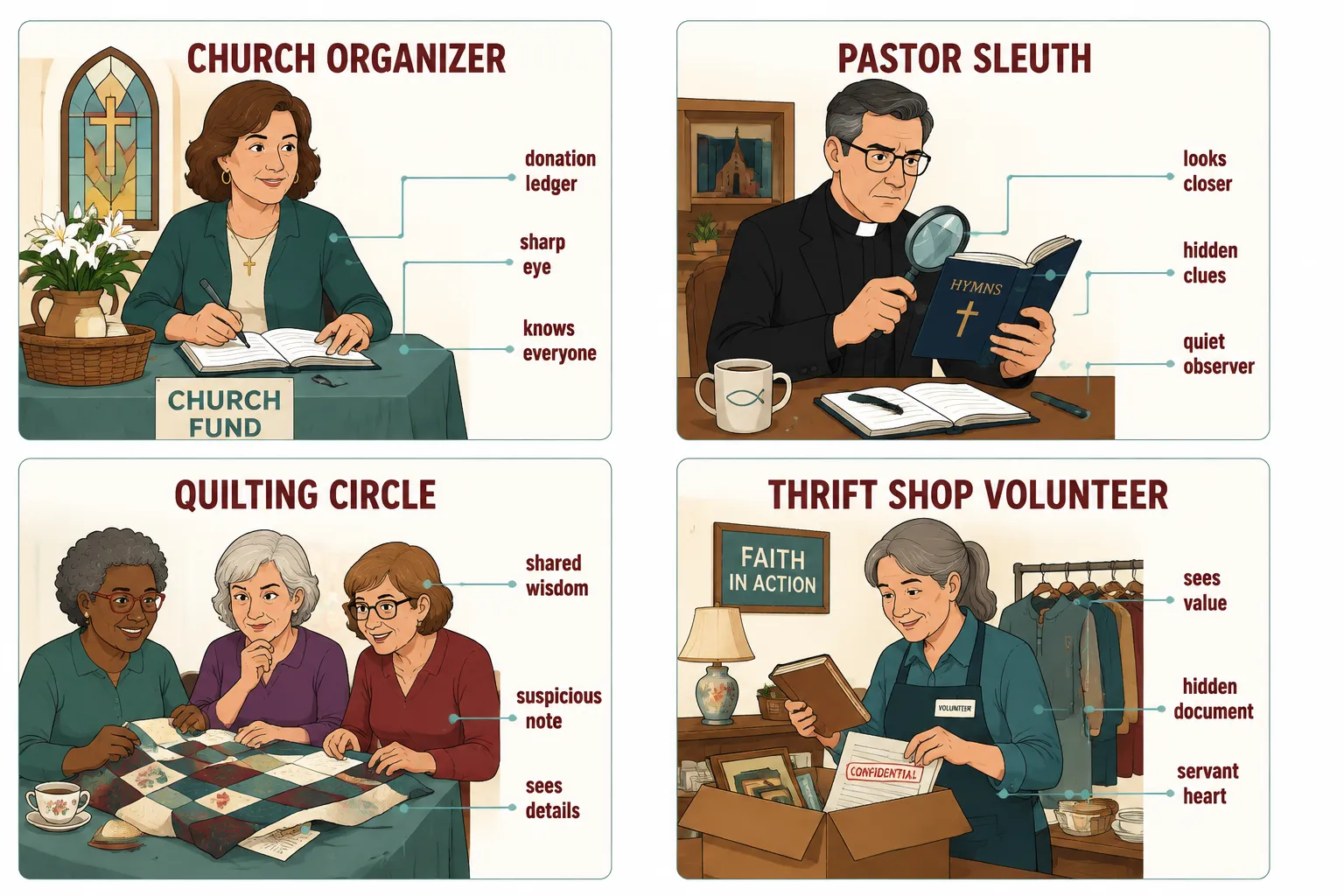
- The amateur sleuth archetype, church volunteer, thrift shop coordinator, quilting circle regular, gives Christian cozies their most reliable reader hook.
- Small-town settings do more than provide atmosphere. They create the closed community, the gossip access, and the “cute town with ugly secrets” tension that drives every plot forward.
- Christian cozies and secular cozies share DNA (low gore, cozy community, likable protagonist) but differ in moral framework, spiritual interiority, and the cost of grace.
- Clean and cozy overlap almost completely in reader expectation, the audience is primarily women 35-65, many of them Kindle Unlimited subscribers [10].
- The genre is supply-limited. General-market cozies dominate reader supply; Christian entries compete directly but are far fewer in number.
- Earned grace is the genre’s secret weapon. When redemption costs the character something real, the faith element stops feeling like decoration and starts feeling like the point.
- Violence and dark themes can exist in Christian cozies, but they’re handled with restraint, off-page, and in service of the moral question, not for shock value.
- Common author mistakes include making faith a reward at the end rather than a pressure throughout, and treating the small town as backdrop rather than as a character.
- The Mercy House Mysteries (set in Juniper Gap, Tennessee) is a working example of these tropes in action, a church thrift coordinator who keeps finding bodies where she meant to find donations.
What Makes a Cozy Mystery Christian vs. Just a Regular Cozy Mystery
A Christian cozy mystery isn’t simply a regular cozy with a church on the cover. The difference is structural: faith functions as a load-bearing element of the story, not as decoration. In a secular cozy, the protagonist solves the crime because she’s clever. In a Christian cozy, she solves it because her conscience won’t let her stop, and that conscience is rooted in something she actually believes about mercy, truth, and what justice costs.
The practical markers that separate the two:
- Moral interiority: The Christian sleuth wrestles with whether to expose someone, not just whether she can. Forgiveness and accountability sit in tension throughout.
- Community as congregation: The close-knit town isn’t just a setting device, it often includes a church, a ministry, or a faith community that shapes how characters relate to each other and to wrongdoing.
- Earned grace: When resolution comes, it carries a cost. Someone confesses. Someone forgives at personal expense. The ending feels like mercy rather than just a solution.
- No cheap exits: Characters don’t get saved from consequences by a convenient conversion moment. Faith under fire means the belief was already there before the crisis, and it gets tested, not installed.
What it doesn’t mean: every chapter includes a Bible verse, the villain gets a dramatic altar call, or the protagonist lectures anyone about their choices. That version reads as preachy, and readers, especially the women 35-65 who make up the core audience [10], recognize it immediately and put the book down.
Best Christian Cozy Mystery Sleuth Characters and Why Readers Love Them
The most effective Christian cozy sleuths share a specific profile: they have legitimate access to gossip, a reason to care about the victim, and a faith that makes them unable to look away when something is wrong.
The archetypes that work best:
| Archetype | Why It Works | Example Context |
|---|---|---|
| Church volunteer / thrift coordinator | Access to donated items, community secrets, financial records | Finds evidence in donation boxes |
| Pastor’s wife or deacon’s spouse | Insider knowledge of congregation dynamics | Hears confessions others don’t |
| Quilting circle or craft group member | Communal setting, long memory, generational secrets | Old patterns hide old crimes |
| Small-business owner near the church | Neutral ground where everyone talks | Overhears what people say between services |
| Ministry administrator | Access to records, finances, and private correspondence | Discovers discrepancies no one else sees |
Readers love these characters because they’re not detectives playing at faith, they’re believers who stumble into a crime and can’t reconcile what they know with what they’re being told. That discomfort is the engine. Nora Bell Hartley, the protagonist of the Mercy House Mysteries, works exactly this way: she runs a church thrift operation in Juniper Gap, Tennessee, and keeps finding bodies where she meant to find donations. Her faith isn’t her superpower. It’s her problem, she can’t let it go.
How Do Small-Town Settings Work in Christian Cozy Mysteries
The small-town setting is not optional in this genre. It’s the mechanism that makes everything else possible. A closed community means everyone knows everyone, secrets have long histories, and the sleuth has plausible access to information without being a professional investigator.
In Christian cozies specifically, the town does extra work:
- The church is the social center. It’s where people gather, where old grievances surface, and where the community’s moral expectations are most visible, and most hypocritical when violated.
- Generational memory is a plot resource. Small towns remember. A quilt square, a family Bible, a recipe tin, a seed packet, objects carry history that urban settings can’t replicate.
- The “cute town with ugly secrets” tension is the genre’s core dramatic irony. The warmth of the setting makes the wrongdoing feel more shocking, not less.
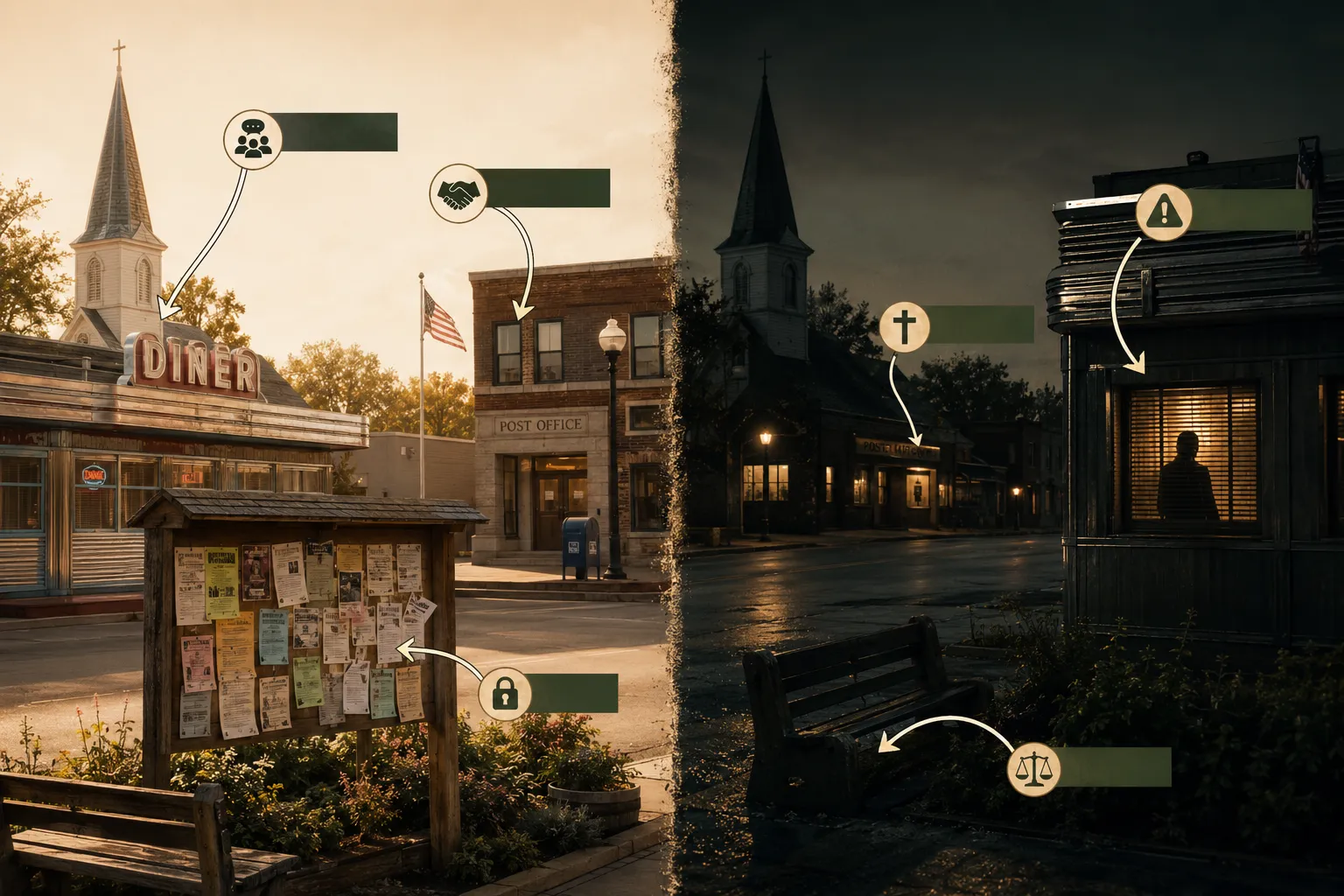
Juniper Gap, Tennessee, the setting of the Mercy House Mysteries, is built on this principle. The town feels warm, specific, and real. The church socials are genuine. The community bonds are genuine. That’s exactly what makes the murders land: the crime isn’t happening despite the community’s goodness, it’s happening inside it.
“A small town in a cozy mystery isn’t a backdrop. It’s a pressure cooker with a casserole on top.”
What Role Does Faith Play in Cozy Mystery Plots
Faith works best in cozy mystery plots when it creates friction, not resolution. The sleuth’s belief in mercy makes her reluctant to expose someone. Her belief in justice makes her unable to stay silent. That tension, mercy and justice pulling in opposite directions, is where the best Christian cozy plots live.
Specific ways faith integrates into plot mechanics:
- The confession problem: A character confesses something to the sleuth in a moment of trust. Now she holds information that could solve the crime, but using it feels like a betrayal. What does faithfulness require?
- The forgiveness question: The killer turns out to be someone the sleuth cares about. Forgiveness is real and required. So is accountability. The plot can’t resolve until both are honored.
- Spiritual guidance as soft clue: A sermon, a hymn lyric, a prayer, these can function as thematic signposts without feeling like sermons. The faith element points the reader toward the answer before the sleuth gets there.
- The cost of truth-telling: In a close-knit community, exposing wrongdoing has social consequences. The sleuth pays a price. That price is what makes the resolution feel earned rather than tidy.
Christian Cozy Mystery vs. Secular Cozy Mystery: Key Differences
Both genres share the same structural DNA: amateur sleuth, low gore, close-knit community, puzzle-driven plot. The differences are in moral framework and interior life.
Where they converge:
- Clean content (no graphic violence, no explicit material)
- Warm, community-centered settings
- Likable protagonist with a specific skill set or social role
- Humor and warmth balanced with genuine stakes
Where they diverge:
- Secular cozy: The protagonist’s motivation is curiosity, justice, or personal connection. Resolution is intellectual and emotional.
- Christian cozy: The protagonist’s motivation includes moral obligation rooted in belief. Resolution involves spiritual reckoning, for the sleuth, the community, or the perpetrator.
- Secular cozy: Community is social fabric.
- Christian cozy: Community is also spiritual accountability.
- Secular cozy: Forgiveness is a character choice.
- Christian cozy: Forgiveness is a theological act with weight and cost.
The ECPA bestseller lists [4][7] track Christian fiction separately from general market precisely because this distinction matters to readers, they’re not just looking for clean content, they’re looking for a specific kind of moral seriousness.
Most Popular Christian Cozy Mystery Series to Read in 2026
The genre is supply-limited relative to reader demand, which means a strong series builds loyal readership fast. Christian fiction bestseller tracking [1][3][5] consistently shows mystery and suspense among the top-performing categories in the faith-based market.
Series worth knowing:
- The Mercy House Mysteries by Silas Bellhaven, Ten books set in Juniper Gap, Tennessee. Protagonist Nora Bell Hartley runs a church thrift ministry and finds that donated objects carry more than secondhand value. Titles like A Donation to Die For, The Family Bible Secret, and The Hymnal Margin Murder show the range of faith-adjacent objects the series uses as plot engines. Series page
- Church-adjacent cozies from Christian publishers, Several traditional Christian publishers have expanded their mystery lines with small-town, ministry-setting titles that borrow directly from cozy conventions.
- Kindle Unlimited Christian cozy collections, KU has become the primary discovery engine for this niche, with backlist promotion and ebook deals driving series readthrough.
How to Write a Christian Cozy Mystery That Feels Authentic
Authentic Christian cozies fail or succeed at the level of character decision, not at the level of faith content. The question isn’t how much faith is in the book, it’s whether the faith is doing real work.
What works:
- Show faith through choice, not narration. The sleuth doesn’t think “as a Christian, I believe…” She hesitates before she acts, and the reader understands why.
- Let the community be genuinely flawed. A church full of perfect people isn’t a cozy, it’s a brochure. Real congregations carry old wounds, financial pressures, and human failure. That’s where the stories live.
- Use faith objects as plot devices. Hymnals, prayer lists, family Bibles, donation records, benediction tapes, these objects carry spiritual weight and narrative function at the same time.
- Earn the resolution. If grace shows up at the end, it should cost someone something before it arrives. Cheap grace reads as false, and readers know it.
What doesn’t work:
- Scripture-dropping as a substitute for character interiority
- Villains who exist only to be converted
- A protagonist whose faith never gets tested or doubted
- Resolution that comes from divine intervention rather than earned human choice
Can You Have Violence and Dark Themes in Christian Cozy Mysteries
Yes, with restraint and purpose. Christian cozy mysteries can and should engage with dark themes, because the genre’s whole premise is that evil exists inside communities that look safe from the outside. The darkness is what makes the light matter.
The working rule: Dark themes are handled off-page or at a distance, in service of the moral question rather than for visceral effect. A character can be murdered. The violence doesn’t need to be described in detail. A character can have experienced abuse, addiction, or profound loss, and that history can drive the plot, without graphic depiction.
What changes in a Christian cozy vs. a thriller:
- The fact of violence is present; the spectacle of it is not.
- Dark backstory informs character motivation without becoming the emotional center of every scene.
- Hope in the dark is a genuine narrative commitment, not a refusal to acknowledge darkness, but a refusal to let darkness have the last word.
Common Mistakes New Christian Cozy Mystery Authors Make
The most common failure point is treating faith as a reward rather than a pressure. When faith only shows up at the end, as a conversion, a prayer answered, a tidy spiritual resolution, it hasn’t been doing any work. Readers feel the difference.
Other frequent mistakes:
- The perfect-church fallacy: Making the faith community uniformly good strips out the dramatic tension the setting is built to provide.
- Preaching through the protagonist: When the sleuth explains what a Bible passage means to another character, the novel stops and a sermon starts.
- Ignoring the cost of truth: In a small town, exposing a killer has social consequences. Authors who skip those consequences skip the most interesting part of the story.
- Underusing the setting: A small town named but not felt. The church mentioned but not inhabited. Settings need emotional specificity, the smell of the fellowship hall, the particular way a congregation goes quiet when something is wrong.
- Faith as backstory only: The protagonist’s belief should be active in the present-tense story, not just referenced as part of her history.
What Readers Expect from Faith Integration in Cozy Mysteries
Readers who seek out Christian cozy mysteries, primarily women 35-65, many of them Kindle Unlimited subscribers [10], are not looking to be preached at. They want fiction that walks with them, not talks at them. The faith element should feel like lived experience, not lesson delivery.
Specific reader expectations:
- Faith that shows up in how the character thinks, not in what she says about faith
- Moral questions that don’t resolve too easily
- A community where belief is real but imperfect
- Clean content, not sanitized, but without gratuitous darkness
- An ending where mercy and justice both get their due
What breaks the contract: a protagonist who quotes scripture at other characters, a plot that punishes non-believers while rewarding believers, or a resolution where faith functions as a magic solution rather than a hard-won anchor.
Are Christian Cozy Mysteries Only for Religious Readers
No. The genre’s appeal extends beyond practicing Christians for the same reason that any fiction rooted in moral seriousness crosses audience lines. Readers who want clean content, community-centered stories, and protagonists who wrestle with real ethical questions don’t need to share the protagonist’s faith to appreciate the story.
Barna research [10] notes that religious book audiences skew toward women and older readers, but the cozy mystery genre’s broader boom in 2026 is pulling in general-market readers who are discovering Christian entries through recommendation algorithms and Kindle Unlimited. The overlap between “clean fiction” readers and “cozy mystery” readers is large enough that many secular cozy fans read Christian cozies without thinking of them as a separate category.
The caveat: readers who actively dislike faith content will find the integration jarring. But the target audience isn’t them, and trying to sand down the faith elements to appeal to everyone produces a book that satisfies no one.
Best Christian Cozy Mystery Tropes That Keep Readers Coming Back
These are the tropes that have proven staying power, the ones readers recognize, seek out, and recommend.
Top recurring tropes in Christian Cozy Mystery:
- The faith object as evidence, A hymnal with margin notes, a family Bible with a hidden record, a recipe tin with a secret inside. Objects that carry both spiritual and narrative weight.
- The ministry setting as crime scene, A donation drive, a church social, a charity backpack program. The crime happens inside an act of service, which deepens the moral irony.
- The confession that isn’t quite a confession, Someone tells the sleuth something that sounds like guilt but could be grief. The ambiguity drives the middle of the book.
- The community secret with generational roots, The crime didn’t start last week. It started thirty years ago, and the present murder is just the latest consequence.
- The sleuth who can’t stop, Not because she’s reckless, but because her conscience won’t let her. Rooted in faith, not in ego.
- Mercy and justice in direct conflict, The killer is someone the community loves. Exposing them costs the sleuth something real.
- The ordinary Tuesday that isn’t, A routine task, sorting donations, attending a seed swap, helping with a quilt, turns into the opening of something much darker.
Where Do Christian Values Naturally Fit Into Mystery Solving
Christian values fit most naturally into the why of mystery solving, not the how. The detective methods (observation, logic, conversation, record-checking) are the same in any cozy. What changes is the moral weight the sleuth assigns to what she finds.
Natural fit points:
- Truth-telling as obligation: The sleuth doesn’t expose the killer because she’s clever, she does it because bearing false witness, even by silence, is something she can’t live with.
- Mercy toward the accused: She considers whether the person deserves grace even as she works toward accountability. These aren’t opposites in a Christian framework, they’re the same question.
- Stewardship of information: What does she do with what she knows? Who gets told? What gets kept private? These are stewardship questions with spiritual weight.
- The record as testimony: In the Mercy House Mysteries, objects like ledgers, tapes, and family Bibles function as testimony, a record that outlives the person who made it and demands a response from whoever holds it now.
This is where clean Christian fiction earns its name: not by avoiding hard things, but by taking them seriously enough to ask what faithfulness requires in the face of them.
Conclusion: What Makes These Tropes Work, and Where to Start Reading
The Christian cozy mystery tropes that readers return to again and again share one quality: they put faith under real pressure. The sleuth archetype works because the character’s belief creates friction, not ease. The small-town setting works because it makes the community’s goodness and its failures equally visible. The faith integration works when it costs something, when mercy and justice don’t arrive together cheaply, but have to be earned through honest reckoning with what happened and why.
Actionable next steps:
- If you’re a reader looking for where to start: A Donation to Die For (Mercy House Mysteries, Book 1) opens in a church thrift room with a mislabeled donation box and a deacon who died just before he could confess. It’s a clean, honest entry point into what this genre does at its best. Find it here.
- If you’re a writer working in this space: audit your manuscript for where faith is doing real work versus where it’s decorating the surface. If the story would be identical without the faith element, the faith element isn’t integrated, it’s appended.
- If you’re new to the genre and unsure whether it’s for you: start with the tropes. A church setting, a community secret, an amateur sleuth who can’t look away, those are the bones. The faith is what gives them a spine.
The genre is supply-limited and reader-hungry. The readers are there. The stories that meet them honestly, rooted in faith, not performing it, are the ones that last.
FAQ
What is a Christian cozy mystery? A Christian cozy mystery is a low-gore, amateur-sleuth mystery set in a close-knit community where faith functions as a genuine part of the protagonist’s moral decision-making, not as a sermon, but as a lived conviction that shapes how she investigates and what she does with what she finds.
Do Christian cozy mysteries have to be set in small towns? Not technically, but the small-town setting is the genre’s most effective tool. It provides the closed community, the generational memory, and the gossip access that make an amateur sleuth’s investigation plausible. Most successful entries in the genre use it.
Is the Mercy House Mysteries series appropriate for non-Christian readers? Yes. The faith is integrated and genuine, not preachy. Readers who want clean fiction with real moral stakes and a warm community setting will find it accessible regardless of their own beliefs.
What’s the difference between “clean” and “Christian” in cozy mysteries? “Clean” describes content standards (no graphic violence, no explicit material, no profanity). “Christian” describes the moral and spiritual framework. A book can be clean without being Christian, but Christian cozies are almost always clean by default.
How much faith content is too much in a Christian cozy mystery? When faith content stops the story to deliver a lesson, it’s too much. Faith should drive character decisions and create moral tension, not pause the plot for theological explanation.
Can the killer be a churchgoing character in a Christian cozy? Yes, and the best ones often are. The irony of wrongdoing inside a faith community is one of the genre’s most powerful tensions. It’s not cynical, it’s honest about human nature.
What makes the Mercy House Mysteries different from other Christian cozies? The series uses faith objects, hymnals, family Bibles, donation records, benediction tapes, as both plot devices and thematic anchors. The crime is always connected to a record someone wanted buried, which gives the series a consistent moral spine across ten books.
Are Christian cozy mysteries popular on Kindle Unlimited? Yes. KU is the primary discovery engine for the genre, and backlist ebook deals drive significant series readthrough. The audience, primarily women 35-65 [10], is highly active on the platform.
What’s the biggest craft mistake in Christian cozy writing? Treating faith as a reward that arrives at the end rather than a pressure that operates throughout. When grace only shows up after the mystery is solved, it hasn’t been doing any work.
Where do Christian values fit most naturally in a mystery plot? In the why of solving the crime, the protagonist’s moral obligation to truth, her tension between mercy and accountability, and her reckoning with what faithfulness requires when she’s holding information that could hurt someone she cares about.
Explore the full Mercy House Mysteries series and the complete Silas Bellhaven catalog at the Amazon author page.
References
[1] Fiction – https://christianbookexpo.com/bestseller/fiction.php?id=0823 [3] Fiction – https://christianbookexpo.com/bestseller/fiction.php?id=BO23 [4] Bestsellers Reporting – https://www.ecpa.org/page/BestsellersReporting [5] Fiction – https://christianbookexpo.com/bestseller/fiction.php?id=1223 [7] ECPA – https://www.ecpa.org/ [10] Religious Books Attract A Diverse Audience Dominated By Women And Boomers – https://www.barna.com/research/religious-books-attract-a-diverse-audience-dominated-by-women-and-boomers/