Last updated: September 9, 2026
Quick Answer: Christian cozy mysteries are clean, faith-rooted whodunits set in tight-knit communities, usually small towns, where an amateur sleuth solves crimes without graphic violence, profanity, or explicit content, and where faith shapes how characters think, act, and find resolution. They share most structural DNA with secular cozy mysteries but differ in one load-bearing way: God is present in the story as a real force, not a decoration. New readers can expect church potlucks, community gossip networks, ministry-based protagonists, and spiritual arcs that cost something before they comfort.
Key Takeaways
- Christian cozy mysteries keep all the warmth of the cozy genre, amateur sleuth, small town, low violence, and add faith as a genuine story element, not a surface label.
- The small-town setting is not just backdrop; the community itself is both the investigative resource and the source of secrets.
- Faith shows up through character choices, not narrated scripture lessons or dramatic conversion scenes.
- Common tropes include church gossip networks, ministry-based careers, potluck clues, family Bible secrets, and gentle spiritual arcs.
- The protagonist is almost always a woman, often middle-aged, whose community role gives her access to information the police don’t have.
- These books are appropriate for most ages, typically suitable for teens and adults, though content varies by author.
- New readers sometimes confuse Christian cozy mysteries with “inspirational mysteries,” which is a publishing category distinction, not always a content difference.
- Major publishers are actively expanding this space: Love Inspired Trade and Bethany House both released or announced new mystery titles in 2026.
- You don’t need to be a Christian to enjoy them, the faith is woven into character and community, not aimed at the reader as instruction.
- Kindle Unlimited carries a strong catalog of these titles, making them easy to sample without commitment.
What Is a Christian Cozy Mystery and How Is It Different from Regular Cozy Mysteries?
A Christian cozy mystery is a low-violence, clean-content whodunit where faith is load-bearing to the story, not a genre label applied after the fact. Both types feature amateur sleuths, small communities, and puzzle-driven plots. The difference is that in the Christian version, the protagonist’s faith genuinely shapes her decisions, her moral reasoning, and often the resolution itself.
Secular cozies can be set in a bakery, a bookshop, or a knitting circle. Christian cozies are often set in those same places, but the community is organized around a church or ministry, and the questions the sleuth wrestles with carry spiritual weight. When she decides whether to expose a killer who is also a deacon, that isn’t just a plot problem, it’s a faith problem.
What stays the same:
- Amateur detective (not a professional investigator)
- No graphic violence or explicit content
- Tight community setting where everyone knows everyone
- Puzzle-style mystery with a satisfying resolution
- Humor, warmth, and a sense of place
What changes:
- Faith is a character motivation, not a background detail
- The moral stakes are framed through a Christian worldview
- Community institutions (churches, ministries, prayer groups) drive the plot
- Grace, mercy, and justice are active themes, not just words
The Mercy House Mysteries set in Juniper Gap, Tennessee are a clear example: protagonist Nora Bell Hartley keeps finding bodies in donation boxes and church closets, and the faith of the community is both the investigative tool and the thing being tested.
What Are the Main Tropes in Christian Cozy Mystery Books?
The core tropes of Christian cozy mysteries combine standard cozy conventions with faith-community specifics. Understanding these up front helps new readers know what they’re reading, and what to look forward to.
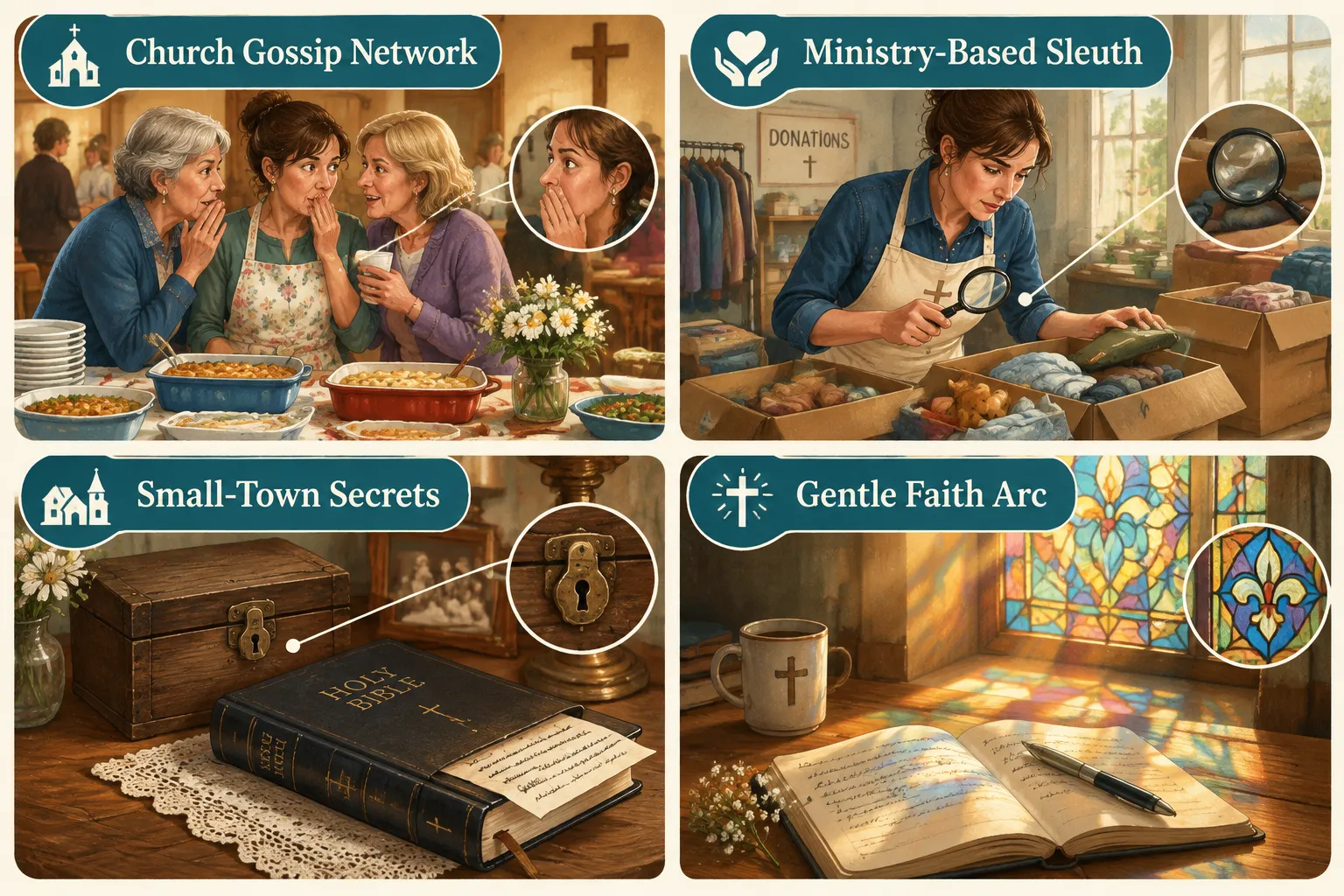
The most reliable tropes:
- Church gossip network as investigative tool. The women’s Bible study, the prayer chain, the Sunday potluck, these aren’t just setting details. They’re the information infrastructure. The sleuth learns things through casserole delivery that a detective never would.
- Ministry-based career or role. Protagonists often run a thrift shop ministry, coordinate a food pantry, organize a church fundraiser, or lead a quilting circle. Their work puts them in contact with the whole community, including whoever is hiding something.
- Object-as-clue with spiritual resonance. A family Bible with names scratched out. A hymnal with a note in the margin. A recipe tin that holds something other than recipes. These objects carry both investigative and spiritual weight. The Hymnal Margin Murder and [*The Family Bible Secret*](https://www.amazon.com/s?k=Silas+Bellhaven+The+Family Bible+Secret) are textbook examples.
- The reluctant sleuth. She didn’t ask to find the body. She was just dropping off a donation.
- Gentle spiritual arc. Someone in the story, often the sleuth herself, moves through doubt, conviction, or forgiveness over the course of the book. It’s earned, not announced.
- Mercy and justice in tension. The killer is often someone the community trusted. Exposing them costs something. That cost is where the faith theme lives.
- Potluck clues. Food is everywhere in these books, and it’s often where information changes hands.
- The outsider who knows too much. A newcomer, a visiting relative, or a returning prodigal who disrupts the community’s comfortable version of its own history.
“Faith under fire doesn’t look like a sermon. It looks like a woman deciding whether to hand over the evidence against her pastor’s wife.”
Why Do Small Towns Matter in Christian Cozy Mysteries?
Small towns are the structural engine of the genre, not just a cozy aesthetic choice. In a small town, everyone has history with everyone else, which means every secret has a web of people who could expose it, and reasons not to.
For Christian cozy mysteries specifically, the small-town setting does three things at once:
- It makes the faith community visible. A church in a small town is a social institution, not just a spiritual one. It’s where people hear news, form alliances, and carry grudges across decades.
- It raises the stakes of exposure. When the killer is your neighbor, your deacon, or the woman who brought you soup when your husband died, justice isn’t clean. The sleuth has to decide what mercy looks like when it costs her something.
- It creates a closed-suspect-pool mystery. The killer is always someone the reader has already met. That’s a structural requirement of the cozy form, and small-town settings make it feel natural rather than contrived.
For more on how Southern small-town settings shape this genre, see small-town Christian mystery series set in the South.
How Does Faith Play a Role in Solving Mysteries in These Books?
Faith functions as both a moral compass and an investigative lens, but in the best books, it’s never a shortcut. The sleuth doesn’t pray and receive a vision that names the killer. Faith shapes how she pursues truth, not whether she finds it.
Practically, faith shows up as:
- A commitment to truth even when the truth is costly
- Reluctance to condemn without evidence (mercy before judgment)
- Awareness that the killer is also a person God made, which doesn’t excuse the crime but shapes how the sleuth handles the confrontation
- Prayer as a character moment, not a plot device
- Community accountability, the church community holds people to standards, which is exactly what the killer has violated
The distinction matters for new readers: faith in these books is not a deus ex machina. The sleuth still has to do the work. She still makes mistakes. She still faces moments where her faith feels thin. That’s what makes the resolution feel earned rather than handed to her.
This same principle, faith tested and proven through the plot, never delivered as a sermon, applies across faith-based fiction that doesn’t feel preachy.
What Makes a Good Christian Cozy Mystery Protagonist?
The best Christian cozy mystery protagonists are ordinary women in community roles that give them extraordinary access to information. They are not former detectives, forensic scientists, or spies. They are the woman who runs the thrift shop, organizes the church rummage sale, or coordinates the holiday food drive.
The traits that make them work:
- Community embeddedness. She knows everyone, and everyone talks to her. Her role, not her skills, is what makes her effective.
- Genuine faith that includes doubt. A protagonist whose faith is a costume doesn’t hold up under pressure. Readers want to see her faith tested, not just displayed.
- A reason she can’t walk away. She found the body. She knew the victim. The wrong person is about to be blamed. Something personal keeps her in the investigation.
- Moral seriousness without self-righteousness. She cares about justice, but she’s not the town’s moral authority. She’s as capable of wrong assumptions as anyone else.
- Warmth without naivety. She sees the good in people, but she’s not blind to what people do in private.
For a deeper look at how faith shapes character construction, see faith-based character development: creating protagonists readers believe in.
How Do Secrets Work in Faith-Based Communities Within These Stories?
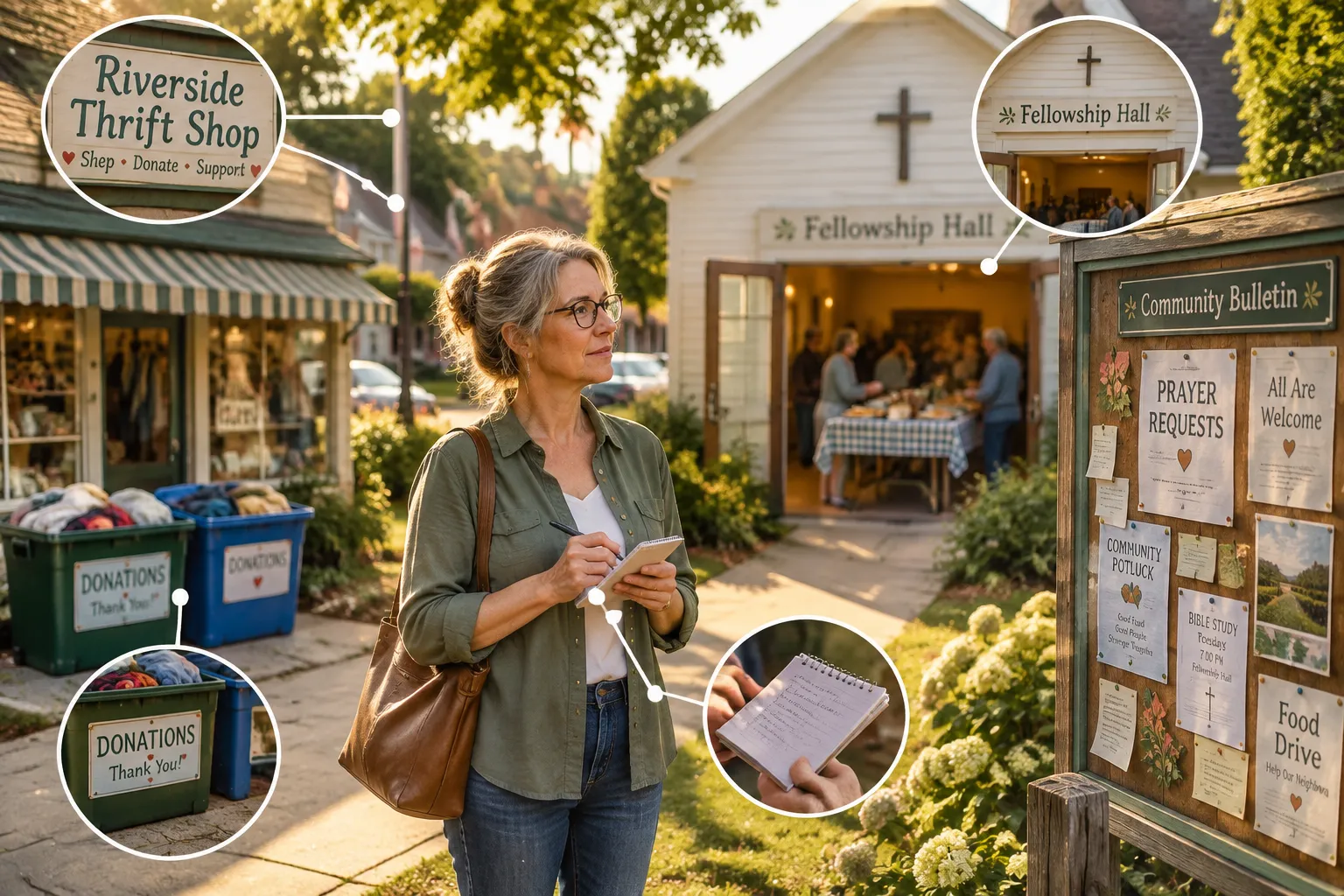
Secrets in Christian cozy mysteries carry extra weight because faith communities are built on trust, and on the assumption that people are who they appear to be on Sunday morning. When that assumption breaks, the damage runs deep.
The most common secret structures in these books:
- The long-buried sin. Something happened decades ago, a theft, an affair, a false accusation, and someone has been paying for it ever since. The murder is the secret finally breaking the surface.
- The reputation protector. Someone killed to keep a secret that would destroy their standing in the community. The killer isn’t evil in every dimension, they’re terrified of exposure.
- The family record. A Bible with names removed. A ledger with altered figures. A will that doesn’t match the story the family has told. These objects are both clue and confession.
- The charitable cover. Ministry work makes an excellent cover for financial wrongdoing. A donation box, a charity account, a food pantry budget, all of these can hide what someone doesn’t want found.
This is why the cozy mystery series set in a thrift shop ministry setting works so well: the ministry itself becomes the site of both the crime and the investigation.
The faith dimension isn’t that secrets are more shameful in a Christian community, it’s that the gap between public witness and private action is more visible, and more painful, when it collapses.
What’s the Difference Between Christian Cozy Mysteries and Inspirational Mysteries?
“Inspirational mystery” is a publishing category label; “Christian cozy mystery” is a genre description. They overlap significantly but aren’t identical.
Inspirational mystery (as used by publishers like Love Inspired and Bethany House) typically means:
- Published by a Christian imprint or self-published with Christian content markers
- Clean content, faith-positive tone
- May include romance as a subplot
- Faith is present but may be lighter in some titles
Christian cozy mystery (as a genre description) means:
- All the structural features of a cozy mystery (amateur sleuth, small community, low violence, puzzle plot)
- Faith is a genuine story element, not just a content filter
- Usually no explicit romance, though warm relationships are common
In practice, most Christian cozy mysteries would also qualify as inspirational mysteries. The distinction matters most when a reader wants to know how central the faith is, not just whether it’s present. Literary agent Rachelle Gardner has noted that Christian mystery as a category “got left behind” compared to romance and romantic suspense in the Christian market, but publishers including Love Inspired Trade are actively correcting that in 2026, with titles like Dana Mentink’s Murders in the Marquee (September 2026) and Naomi Stephens’s Don’t Upstage the Body (June 2026, Bethany House) [22].
Are Christian Cozy Mysteries Appropriate for All Ages?
Most Christian cozy mysteries are appropriate for readers 13 and up, with many suitable for younger teens. They contain no graphic violence, no explicit content, and no profanity, but they do deal with real themes including murder, betrayal, grief, and moral failure.
Age guidance by content type:
| Content Element | Typical Handling in Christian Cozies |
|---|---|
| Violence | Off-page or briefly mentioned; no gore |
| Language | None or very mild |
| Romance | Absent or limited to light, clean courtship |
| Death/grief | Present, treated with honesty and care |
| Moral complexity | Yes, this is a feature, not a warning |
| Faith content | Woven into character; not instructional |
Parents reading with younger teens should check individual titles, as content standards vary by author. The genre’s general commitment to clean Christian fiction makes it one of the safer corners of the mystery genre for family reading.
Can You Enjoy Christian Cozy Mysteries If You’re Not Religious?
Yes, and many non-religious readers do. The faith in these books operates as a worldview and a community structure, not as a message directed at the reader. You don’t have to share the characters’ beliefs to understand why those beliefs matter to them, or to find the moral stakes compelling.
What non-religious readers should expect:
- Prayer, church attendance, and scripture references as natural parts of character life
- Moral reasoning rooted in a Christian framework
- Communities where faith is a social institution as much as a spiritual one
- Resolutions that sometimes hinge on forgiveness or grace
What they won’t find:
- Characters trying to convert the reader
- Narrative voice that lectures about theology
- Plot outcomes that require the reader to accept Christian doctrine
The best writing in this genre follows the principle of walking with readers, not talking at them. Faith is shown through what characters do under pressure, not explained in narration.
How Much Violence or Dark Content Is in Christian Cozy Mysteries?
Very little, by design. Christian cozy mysteries keep violence off-page or handled with restraint, a body is discovered, a cause of death is established, but the act itself is never depicted graphically. This is a genre-level commitment, not just a content filter applied after the fact.
What to expect:
- A murder (or occasionally another serious crime) as the inciting event
- Death treated with gravity and grief, not sensationalism
- No torture, no gore, no graphic injury description
- Psychological tension rather than physical threat as the primary suspense mechanism
- Danger to the sleuth is real but handled with restraint
For readers who want to understand how Christian fiction builds genuine suspense without dark content, non-violent suspense in Christian psychological thrillers covers the craft mechanics in detail.
Best Christian Cozy Mystery Series for Beginners
New readers should start with a series that establishes its setting and protagonist clearly in book one, has a manageable series length to sample, and represents the genre’s core tropes well.
Strong starting points:
- The Mercy House Mysteries by Silas Bellhaven, Set in Juniper Gap, Tennessee. Protagonist Nora Bell Hartley finds bodies in donation boxes and church closets. Book one, A Donation to Die For, opens with a mislabeled donation box holding a ledger and a deacon who died before he could confess. Ten books in the series as of 2026, all available on Kindle Unlimited. The full series page is the easiest entry point.
- Titles from Love Inspired Trade, The imprint has expanded its mystery catalog in 2026, with Shana Asaro (editor at Love Inspired) citing growing reader demand for “clean, faith-centered mysteries” in the Agatha Christie tradition [22].
- Bethany House releases, Naomi Stephens’s Don’t Upstage the Body (June 2026) is a recent example of a major Christian publisher investing in the genre.
What to look for in a first book:
- A clear sense of place established in chapter one
- A protagonist whose community role is defined early
- A mystery that begins before the 10% mark
- Faith woven into character behavior, not announced in narration
For a broader reading list across clean faith-based genres, Kindle Unlimited Christian reads: how to build a clean, faith-filled TBR is a practical starting point.
What Should I Look for When Choosing My First Christian Cozy Mystery?
Choose based on setting affinity, protagonist type, and how central you want the faith element to be. These three factors vary more across the genre than most readers expect.
Decision guide:
- Choose a church/ministry setting if you want faith deeply embedded in the plot mechanics (the community IS the investigation).
- Choose a Southern small-town setting if you want strong sense of place alongside the mystery. See small-town mystery titles for options.
- Choose a longer series (5+ books) if you want to grow with a protagonist over time, the spiritual arc deepens across multiple books.
- Choose a standalone or short series if you want to sample the genre without committing to a long run.
- Avoid titles where the faith content is listed as a content warning rather than a story element, that’s a sign the faith was added after the fact.
Common mistake: New readers sometimes pick a title based on setting alone (a cozy set in a bakery that happens to be Christian) and find the faith element thinner than expected. If the faith element matters to you, look for series where the protagonist’s role is explicitly ministry-connected.
How Do Amateur Sleuths Typically Get Involved in Solving Crimes in These Books?
The amateur sleuth in a Christian cozy mystery gets involved the same way she gets involved in everything: through her community role. She doesn’t seek out crime. Crime finds her through the work she was already doing.
The most common entry points:
- She finds the body herself (often while doing ministry work, sorting donations, setting up a church event, delivering a meal)
- Someone she knows is falsely accused, and she can’t let it stand
- The victim was someone she was responsible for, a volunteer, a recipient of her ministry’s services, a church member in her care
- She stumbles onto evidence in the course of ordinary work and can’t unknow what she knows
The key structural point: her access to information comes from her role, not her skills. She hears things at the potluck that the detective never will. She has keys to the church office. She knows which families have been struggling and which ones are lying about it.
This is why the ministry-based career trope is so durable in this genre, it gives the amateur sleuth both a reason to be involved and a natural information network, without requiring her to be a former FBI agent or forensic specialist.
FAQ
What makes a mystery “Christian” rather than just clean? A clean mystery avoids explicit content. A Christian mystery goes further: faith shapes the protagonist’s moral reasoning, the community is organized around belief, and themes of mercy, justice, and grace are active in the plot, not just absent from the content.
Do Christian cozy mysteries always have a happy ending? The mystery is always resolved, and justice is served in some form. But “happy” is more complicated, the resolution often involves grief, loss, or the painful exposure of someone the community trusted. Hope is present, but it’s earned, not automatic.
Is there romance in Christian cozy mysteries? Sometimes, but it’s typically light and clean, a developing friendship, a hint of courtship, or a long-established marriage. Many series in this genre keep romance minimal or absent entirely.
How long are Christian cozy mystery books? Most run between 55,000 and 80,000 words, shorter than a literary novel, longer than a novella. They’re designed to be read in a few sittings.
Are these books only for women? The primary audience is women 35-65, and most protagonists are women. But the genre’s themes, community, justice, moral accountability, faith under pressure, have broad appeal. Male readers who enjoy puzzle mysteries and faith-based fiction find them accessible.
What’s the difference between a cozy mystery and a thriller? Cozies prioritize puzzle, community, and warmth. Thrillers prioritize threat, pace, and psychological tension. Christian fiction covers both, for the thriller side of faith-based suspense, the psychology of faith in thriller narratives is a useful companion read.
Can I start a series in the middle? Most Christian cozy mystery series are written so each book resolves its central mystery, but character relationships and spiritual arcs develop over time. Starting at book one is always better, but book three or four won’t leave you completely lost.
Why are so many of these books set in the South? Southern small towns have a strong cultural association with church-centered community life, which makes them natural settings for a genre where faith and community are structural. It’s not the only valid setting, but it’s the most common one.
How do I know if a book is actually faith-integrated or just labeled Christian? Look at the protagonist’s role and the plot mechanics. If her faith shapes what she does when no one is watching, not just what she says, it’s integrated. If faith only appears in dialogue or as a content filter, it’s probably a label.
Are these books available on Kindle Unlimited? Many are, including the full Mercy House Mysteries catalog. Kindle Unlimited trends for Christian cozy mysteries in 2026 covers what’s currently available and what readers are borrowing most.
Conclusion
Christian cozy mystery tropes, sleuthing, secrets, and small-town faith communities, form a genre that does something genuinely distinct: it puts faith under pressure and lets it prove itself through the story, not around it. The church gossip network, the ministry-based sleuth, the object-as-clue with spiritual resonance, the mercy-and-justice tension at the resolution, these aren’t decorative features. They’re the load-bearing structure of stories where God is real and the ordinary Tuesday can turn out to matter more than anyone expected.
For new readers, the practical next steps are straightforward:
- Start with book one of a series, character and setting context matters more in this genre than in most.
- Look for a protagonist whose community role drives the plot, not just her personality.
- Give the faith element room, it won’t announce itself. It shows up in what the character does when the choice is hard.
- Sample through Kindle Unlimited if you’re uncertain, the catalog is wide and the commitment is low.
The genre is growing. Major publishers are expanding their mystery lines in 2026, and the self-published catalog on Kindle Unlimited is already substantial. There has never been a better time to find a series that walks with you, not at you.
References
[9] Christian Cozy Mysteries – https://elleekay.com/christian-cozy-mysteries/
[22] Publishers Weekly, “Mysteries on the Rise in Christian Fiction” – https://www.publishersweekly.com/pw/by-topic/industry-news/religion/article/100974-mysteries-on-the-rise-in-christian-fiction.html