
Last updated: August 23, 2026
Quick Answer: Christian epic fantasy with faith-integrated magic systems builds supernatural power around prayer, covenant, and divine will rather than personal mastery or occult ritual. Authors use prophecy as narrative structure, prayer as a non-coercive power mechanic, and miracles as earned story events tied to God’s sovereignty. The result is a magic system that feels distinctly Christian because its source, purpose, and limits all reflect a theology of dependence rather than control.
Key Takeaways
- Faith-integrated magic is defined by its source and submission, not by the word “magic” itself, power that flows from dependence on God differs fundamentally from power seized through forbidden means.
- Prayer-based mechanics are non-deterministic, outcomes are requested, not commanded, which creates genuine narrative tension and reflects biblical faith.
- Prophecy in Christian fantasy functions as both plot engine and theological statement about free will, calling, and the cost of obedience.
- Miracles earn their weight when they arrive after real cost, not as convenient rescues, cheap miracles undermine both story and theology.
- The Christian fiction market is growing, with religion book sales rising and speculative Christian fiction drawing new readers who want faith handled honestly, not decoratively. [4]
- A useful theological framework distinguishes “mediated supernatural actions” into miracles (submitted to God) and magic (subverting God’s authority), a tool authors are actively using to design worldbuilding systems. [8]
- Common mistakes include treating prayer as a spell, resolving prophecy too cleanly, and using miracles to avoid narrative cost.
- Christian epic fantasy is not only for religious readers, the best examples work as literature first, with faith as load-bearing structure rather than surface decoration.
What Is Christian Epic Fantasy and How Does It Differ From Regular Fantasy
Christian epic fantasy is secondary-world fiction built on a theological foundation, God (or a clear God-analog) is real within the story’s cosmology, and that reality shapes how power, morality, and meaning function. It differs from secular epic fantasy in that the supernatural is not morally neutral. Power has a source, and the source matters.
In standard epic fantasy, magic systems often operate like physics, learnable, repeatable, and morally indifferent. In Christian epic fantasy with faith-integrated magic systems, the same question of how power works is inseparable from why it exists and who it serves. A character who heals through prayer and a character who heals through a stolen ritual may produce the same visible result, but the story treats them as categorically different acts.
This distinction is not just theological, it’s structural. It gives the author a built-in moral architecture for the world. [2]
Choose Christian epic fantasy if: you want a secondary world where faith is load-bearing, not decorative, where the cosmology itself reflects a conviction that God is real and that conviction shapes every rule of the world.
Can You Have a Magic System in Christian Fantasy, or Does It Go Against Faith

The answer is yes, with a clear distinction about what kind of power is being depicted. A growing theological framework, articulated in recent Christian writing communities and reviewed at The Gospel Coalition, separates “mediated supernatural actions” into two categories: miracles (submitted to God, operating in the Spirit’s power, for God’s glory) and magic (subverting God’s authority, drawing on fallen powers for self-advancement). [8]
The key is not the word “magic” but the source, purpose, and effect of the supernatural power in question. An author can call something a gift, a covenant power, or even a spell, what matters is whether the character is dependent on God or attempting to go around God.
This framework is being used actively in Christian writing communities as a design checklist for faith-integrated magic systems. [8]
Practical design questions for authors:
- Does the character request power or command it?
- Is the outcome guaranteed, or does it rest in God’s will?
- Does the power serve others or primarily serve the character’s own ambition?
- What is the cost of using it wrongly?
- Does the system point toward God’s character or obscure it?
What Makes a Magic System Feel Authentically Christian in Fantasy
An authentically Christian magic system feels different from secular ones because it is non-coercive and non-deterministic. The character cannot force an outcome. They can be faithful, obedient, and costly in their asking, and still receive a different answer than they wanted.
That’s not a weakness in the system. That’s the system working correctly.
Markers of authentic faith-integration in a fantasy magic system:
| Feature | Christian System | Secular System |
|---|---|---|
| Power source | Divine will, covenant relationship | Personal skill, ambient energy |
| Outcome certainty | Dependent on God’s sovereignty | Predictable if formula is followed |
| Cost of misuse | Spiritual and narrative consequence | Mechanical failure or backlash |
| Who benefits | Others, God’s purposes | Primarily the practitioner |
| Moral weight | Built into the system | External to the system |
The Sarel Chronicles, Silas Bellhaven’s Christian epic fantasy series, illustrates this well: silver roads on the Great Map mark prayers the Maker-Who-Hears has answered, but the map cannot be manipulated, it records what is true, not what is desired. The map-scribe Elya Renn discovers that the House of Witness has been certifying only the prayers it approves of, which is a theological corruption of the system, not the system itself failing. The Map of Unanswered Prayers
How Do Authors Integrate Prayer Into Magic Systems in Fantasy Novels
Prayer-based magic works when it functions as request rather than ritual. The moment prayer becomes a formula that compels a response, it stops functioning as prayer and starts functioning as a spell, and that distinction matters both theologically and narratively.
Authors who handle this well build prayer into their magic systems with these structural choices:
- Uncertainty of outcome, the character prays and does not know what will happen. This is not narrative weakness; it creates genuine suspense.
- Relationship as prerequisite, power flows from a living relationship, not a memorized technique. A character who has been faithless cannot simply recite the right words.
- Cost of asking, prayer in these systems often requires something: time, vulnerability, the willingness to accept an unwanted answer.
- Community and intercession, prayer as a communal act, where characters pray for others, reflects biblical patterns and creates richer story dynamics than solo power use.
The theological concept of “prayer magic”, requests for divine aid rather than rituals demanding compliance, is the right model. Demanding methods resemble what the framework calls demonic supernaturalism; dependent methods mirror biblical faith. [6]
What Role Does Prophecy Play in Christian Fantasy Worldbuilding
Prophecy in Christian fantasy serves three simultaneous functions: it drives plot, it creates theological tension around free will, and it forces characters to decide what obedience costs before they know the outcome.
Done well, prophecy is not a spoiler. It’s a weight. The character knows something is coming and must choose whether to walk toward it, which is a fundamentally different kind of courage than reacting to surprise.
How prophecy functions in Christian epic fantasy worldbuilding:
- As calling, not guarantee, the prophecy names a person or event but does not remove the character’s agency. They must still choose.
- As misread text, prophecies in Christian fantasy often get interpreted wrongly by institutions or leaders, which creates conflict between human authority and divine intention.
- As mercy, forewarning is a gift, even when the content is hard. This reflects a theology of a God who prepares rather than ambushes.
- As test of faith, the character must act on the prophecy before it is confirmed, which is the definition of faith under fire.
How Do Prophecy and Free Will Work Together in Christian Fantasy
This is one of the richest tensions in Christian epic fantasy with faith-integrated magic systems. Prophecy seems to remove choice; free will insists choice is real. The best Christian fantasy holds both without collapsing the tension.
The resolution is not that prophecy overrides free will, but that God’s foreknowledge does not equal human compulsion. A character can refuse a prophetic calling. They can delay, misread, or run from it. The prophecy may still come true, through a different path, at greater cost, or not at all if the character’s refusal is itself part of the story’s moral weight.
This is where Christian fantasy diverges sharply from fate-based secular fantasy. The Maker in these stories is not a cosmic mechanic setting gears in motion. He is a person who speaks, who waits, and who lets the cost of disobedience fall where it falls.
What Is the Difference Between Miracles and Magic in Christian Worldbuilding
The clearest framework available: miracles are submitted to God; magic subverts God’s authority. Both involve supernatural events outside normal nature. The difference is direction, toward God or away from God. [8]
For worldbuilders, this means:
- A character who heals someone through prayer, with no certainty of outcome, is working within a miracle framework.
- A character who heals someone by invoking a spirit-force they’ve bargained with, guaranteeing the result, is working within a magic framework, regardless of whether the story calls it “healing magic” or “a gift.”
- The same visible act can be either, depending on its source and the character’s relationship to divine authority.
This distinction is not about vocabulary. It’s about cosmological architecture. Authors who understand it can write genuinely complex moral situations, a character who starts with miracles and drifts toward magic, for instance, or an institution that has bureaucratized miracle-working until it no longer resembles dependence on God at all.
How to Write Miracles in Fantasy Without Making Them Feel Cheap or Unearned
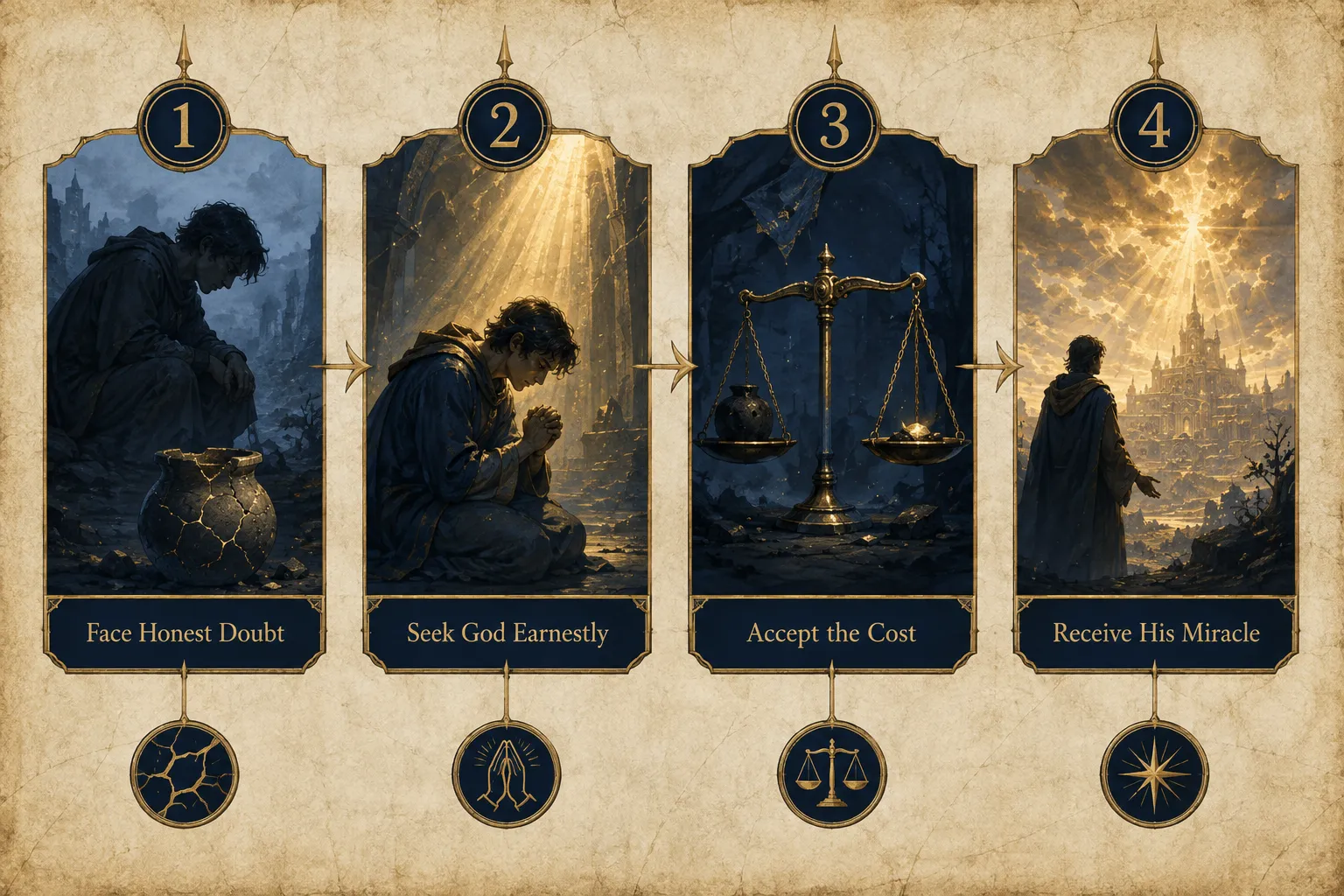
A miracle feels cheap when it arrives without cost and solves the problem completely. It feels earned when the character has already paid something, when the miracle does not remove all consequences, and when it arrives in a form the character did not expect.
Four marks of an earned miracle in Christian epic fantasy:
- Preceded by genuine need, not manufactured crisis, but a moment where human effort has genuinely run out.
- Answered differently than asked, God’s response addresses the real need, which is sometimes not the stated need. This reflects theological honesty about how prayer works.
- Leaves a mark, the character is changed by the miracle, not just rescued by it. Something costs something.
- Does not resolve everything, the miracle addresses one thing; other things remain hard. Cheap grace resolves everything at once.
The principle behind this is the same one that governs good fiction generally: redemption that costs something is the only kind that feels real. A miracle that arrives as a deus ex machina, right on time, perfectly solving the plot, tells the reader that the story was never actually in danger. Earned grace shows up after cost, not instead of it.
How Do Christian Fantasy Authors Balance Theology With Storytelling
The balance breaks down when theology becomes instruction rather than architecture. The moment a character stops making choices and starts delivering doctrine, the story stops.
Christian fantasy authors who handle this well share a common instinct: faith shows up in what characters choose and what those choices cost, not in what they say about God. A character who forgives an enemy at real personal expense is doing more theological work than a character who quotes scripture in a crisis.
Practical craft principles:
- Let the world’s rules carry the theology, if the magic system requires dependence, the theology is embedded in every scene that uses it.
- Trust the reader, readers who share the faith will recognize it; readers who don’t will still feel the moral weight if the story earns it.
- Doubt is not the opposite of faith in these stories, it’s the terrain faith has to cross. Characters who never doubt never demonstrate anything worth watching.
- Avoid the clean conversion moment, real faith is worked through over time, tested, and proven. A dramatic conversion that resolves the story’s spiritual tension is almost always a shortcut.
The Christian fiction market is growing, and readers are increasingly sophisticated about the difference between fiction that walks with them and fiction that talks at them. [2] [9]
Common Mistakes Authors Make When Writing Faith-Integrated Fantasy Worlds
The most common mistake is treating prayer as a spell, a formula that works when spoken correctly. This collapses the theological distinction between miracle and magic and produces a system that feels Christian in vocabulary but not in structure.
Other frequent errors:
- Over-explaining the theology, having a mentor character explain the magic system’s theological basis in dialogue is the fantasy equivalent of a sermon. Show it through story events.
- Miracles as plot convenience, if a miracle arrives exactly when the plot needs it, with no prior cost, it reads as authorial cheating rather than divine provision.
- Prophecy that removes agency, if the character cannot meaningfully choose otherwise, prophecy becomes determinism, which is not a Christian view of how God works.
- Clean moral categories, real faith-integrated worlds have characters who misuse covenant power, institutions that corrupt miracle-working, and prophets who get things wrong. Sanitizing the world removes the tension that makes faith meaningful.
- Avoiding the hard questions, Christian epic fantasy earns its readers’ trust by not flinching. Hope in the dark is only hope if the dark is real.
Best Christian Fantasy Books With Faith-Based Magic
Several titles stand out for how they handle faith-integrated magic systems with genuine craft.
Silas Bellhaven’s Sarel Chronicles, The Map of Unanswered Prayers builds its entire magic system around a living record of answered prayers. The system’s corruption (prayers being excluded from the official map) becomes the story’s central moral conflict. The Sarel Chronicles series page
The Kethara Chronicles, A covenant-based fantasy where an empire attempts to audit and contain every act of mercy. The power in this world flows from covenant relationship, not from personal mastery, and the antagonists are not monsters but bureaucrats who have made mercy into a managed resource. The Kethara Chronicles series page
C.S. Lewis’s Space Trilogy, Perelandra in particular handles the question of temptation, obedience, and cosmic spiritual warfare in ways that inform modern Christian fantasy worldbuilding.
Stephen Lawhead’s Pendragon Cycle, An early example of faith-integrated Arthurian fantasy that treats Christianity not as a backdrop but as the story’s moral spine.
The evangelical speculative fiction space has grown significantly, with more authors treating faith as structural rather than decorative. [2] [7]
Is Christian Epic Fantasy Only for Religious Readers
No. The best Christian epic fantasy works as literature first. Readers who don’t share the faith still respond to stories about characters who face genuine moral cost, who must choose between obedience and self-preservation, and who find that mercy is harder and more expensive than they expected.
What distinguishes Christian epic fantasy is not that it preaches, it’s that its world has a moral architecture that holds. Readers who are tired of nihilistic fantasy, where power is the only real value and survival is the only real goal, often find Christian fantasy satisfying for reasons they can’t immediately name. The world feels like it means something.
The growing Christian fiction market reflects this broader appeal. [3] [9] Readers across a wide range of belief backgrounds are drawn to stories with earned redemption, real stakes, and a sense that the universe is not indifferent.
Where Should New Authors Start When Learning to Write Christian Fantasy
Start with the theology before the magic system. Understand what you actually believe about how God acts in the world, whether prayer changes things, how miracles work, what prophecy means, before you try to translate those convictions into worldbuilding mechanics.
A starting framework for new authors:
- Define your cosmology, Is God (or the God-analog) personal or impersonal? Does he intervene directly or through people? This shapes everything.
- Design the power system around dependence, What does a character have to give up or surrender to access covenant power? What happens when they try to use it selfishly?
- Build the corruption into the world, Every faith-integrated system should have a way it can be abused. That’s where your conflict lives.
- Write the doubt before the faith, Let characters earn their belief through the story. Readers trust faith that has been tested.
- Read widely in the tradition, Lewis, Tolkien, Lawhead, and newer voices like those in the Lorehaven community offer models for how faith and story can hold together without either one flattening the other. [7] [10]
The best resource for thinking through the theological mechanics is the emerging framework distinguishing miracles from magic by source and submission, a tool that is actively shaping how Christian fantasy authors design their worlds in 2026. [8]
FAQ
What is a faith-integrated magic system? A faith-integrated magic system is one where supernatural power flows from a character’s relationship with God (or a God-analog), operates through prayer or covenant rather than formula, and produces outcomes dependent on divine will rather than personal mastery.
Is it wrong for Christians to write fantasy with magic? Most Christian writing communities now distinguish between magic that subverts God’s authority and miracle-based power that reflects dependence on God. The word “magic” is not the issue, the source, purpose, and effect of the power are what matter. [8]
How does prayer work as a magic mechanic in fantasy? Prayer-based power is non-deterministic, the character asks, but the outcome is not guaranteed. This creates narrative tension and reflects biblical faith. The moment prayer becomes a formula that compels a result, it stops functioning as prayer.
What makes prophecy interesting in Christian fantasy rather than just a plot device? Prophecy becomes interesting when it creates a tension between foreknowledge and free will, when the character must choose to walk toward something hard before they know how it ends. It functions as a test of faith, not a spoiler.
Can Christian fantasy have morally complex characters who misuse covenant power? Yes, and the best Christian fantasy requires it. Characters who misuse prayer-based power, institutions that corrupt miracle-working, and prophets who misread their calling all create the moral complexity that makes faith meaningful rather than decorative.
How do I avoid making miracles feel like deus ex machina? Miracles earn their weight when they arrive after genuine cost, answer the real need rather than the stated need, leave a mark on the character, and do not resolve every remaining problem. Earned grace shows up after cost, not instead of it.
Is Christian epic fantasy growing as a genre? Yes. Religion book sales rose 7.8% in 2023, and evangelical speculative fiction has seen consistent growth as readers seek faith-based stories with real stakes. [4] [2]
What’s the difference between a Christian fantasy and a fantasy with Christian themes? A Christian fantasy has faith as load-bearing structure, the cosmology, the power system, and the moral architecture all reflect a theological conviction. A fantasy with Christian themes may reference faith without it shaping how the world actually works.
Do I need to include scripture in Christian fantasy? No. In fact, scripture-dropping often reads as the author stepping out of the story to make a point. Faith shows up more powerfully through what characters choose and what those choices cost.
Where can I find more Christian epic fantasy with faith-integrated magic? Silas Bellhaven’s Sarel Chronicles and Kethara Chronicles are strong starting points. The Lorehaven community and The Gospel Coalition’s fiction coverage also track the genre actively. [7] [8]
Conclusion
Christian epic fantasy with faith-integrated magic systems is not a niche accommodation for religious readers who want sanitized fiction. At its best, it’s a full literary tradition, one that takes seriously the conviction that God is real, that stories matter, and that the two have always belonged together.
The craft questions are real: how to build prayer into a magic system without making it a spell, how to use prophecy without removing agency, how to write miracles that arrive with weight rather than convenience. These are not problems to solve and move past. They’re the ongoing work of writing fiction that walks with readers rather than talking at them.
Actionable next steps for readers and writers:
- If you’re a reader new to the genre, start with The Map of Unanswered Prayers or The Stone That Remembered, both build faith-integrated systems that show rather than explain.
- If you’re an author beginning to design a faith-integrated world, work through the miracle/magic distinction framework before you name a single power. [8]
- If you’re looking for a broader catalog of clean Christian fiction across genres, mystery, western, thriller, fantasy, Silas Bellhaven’s full catalog is rooted in the same conviction: faith tested and proven through the plot, never delivered as a sermon.
Hope in the dark is only hope if the dark is real. The best Christian epic fantasy knows that, and builds worlds where grace, when it finally arrives, has earned every word.
References
[1] Marketersmedia 2026 2 18 Christshare Highlights Rise Of Short Form Christian Fiction – https://markets.chroniclejournal.com/chroniclejournal/article/marketersmedia-2026-2-18-christshare-highlights-rise-of-short-form-christian-fiction
[2] Evangelical Fantasy Christian Speculative Fiction Growth – https://www.christianitytoday.com/2025/01/evangelical-fantasy-christian-speculative-fiction-growth/
[3] The Rise Of Christian Fiction Market Trends Regional Dynamics And Future Predictions For 2026 – https://www.alibaba.com/product-insights/the-rise-of-christian-fiction-market-trends-regional-dynamics-and-future-predictions-for-2026.html
[4] 94679 Aap Preliminary Report Puts Religion Book Sales Up 7 8 In 2023 – https://www.publishersweekly.com/pw/by-topic/industry-news/religion/article/94679-aap-preliminary-report-puts-religion-book-sales-up-7-8-in-2023.html
[6] Fantasy Novels And The Christian Faith 1752245247 – https://wng.org/articles/fantasy-novels-and-the-christian-faith-1752245247
[7] The Lost Realm Of Christian Sci Fi And Fantasy 1725932830 – https://wng.org/articles/the-lost-realm-of-christian-sci-fi-and-fantasy-1725932830
[8] Magic Miracles Discerning – https://www.thegospelcoalition.org/reviews/magic-miracles-discerning/
[9] Christian Fiction 14 7 Yearly Surge Dramatic Market Expansion Data – https://www.firmenpresse.de/pressrelease734029/christian-fiction-14-7-yearly-surge-dramatic-market-expansion-data.html
[10] Why The World Needs More Christian Fantasy – https://www.talenawinters.com/wintersdayin/2025/5/19/why-the-world-needs-more-christian-fantasy