
Last updated: August 22, 2026
Quick Answer: Christian fantasy romance and secular fantasy romance share the same surface genre, magic, world-building, romantic tension, but faith reshapes every load-bearing element beneath that surface. In Christian fantasy romance, magic carries moral weight, love moves toward covenant rather than consummation, and the stakes are spiritual as much as physical. The difference isn’t tone or heat level alone; it’s a fundamentally different answer to the question of what love is for.
Key Takeaways
- Romantasy is one of publishing’s fastest-growing categories, with U.S. secular romantasy revenue estimated at US$610M in 2024 and projected to exceed US$920M in 2026, but Christian fantasy romance occupies a distinct lane with different reader expectations and different story architecture.
- Magic in Christian fantasy is morally sourced, it flows from or answers to a Creator, carries cost, and cannot be used without consequence. Secular fantasy magic is often morally neutral or identity-based.
- Romantic tension in Christian fantasy romance builds toward covenant, not consummation. Physical restraint isn’t prudishness; it’s a story choice that raises different emotional stakes.
- Spiritual warfare is a genuine plot engine in Christian fantasy, not decorative atmosphere. Good and evil are not just opposing factions, they reflect a real moral order.
- Christian fantasy romance is not the same as inspirational romance. The fantasy world-building is substantive, not a backdrop for a conversion story.
- Secular fantasy romance readers can and do enjoy Christian fantasy romance, especially readers who want emotional depth, earned romance, and clean content.
- The most common author mistake in Christian fantasy romance is letting theology become dialogue, characters explaining doctrine rather than living faith under pressure.
- Redemption that costs something is the defining throughline: grace shows up after sacrifice, not instead of it.
What’s the Difference Between Christian Fantasy Romance and Secular Fantasy Romance?
Christian fantasy romance and secular fantasy romance differ most fundamentally in their moral architecture, not their heat level. Both genres combine world-building, magic, and romantic plot. But in Christian fantasy romance, faith is load-bearing, it shapes what magic is, what love means, and what counts as a genuine moral stake.
In secular fantasy romance, the moral framework is usually self-determined. Characters define their own codes, magic is often a neutral force or an expression of personal power, and romantic tension frequently resolves through physical intimacy. The story’s emotional logic is desire-driven.
In Christian fantasy romance, the moral framework is given, not invented. A Creator or covenant structure exists above the characters’ choices, and the story’s emotional logic is redemption-driven. Romantic tension resolves through trust, sacrifice, and commitment, not just attraction.
Choose Christian fantasy romance if: you want romantic stakes that feel spiritually real, magic that carries moral weight, and love stories that build toward something lasting rather than something immediate.
How Does Faith Affect Magic Systems in Christian Fantasy?
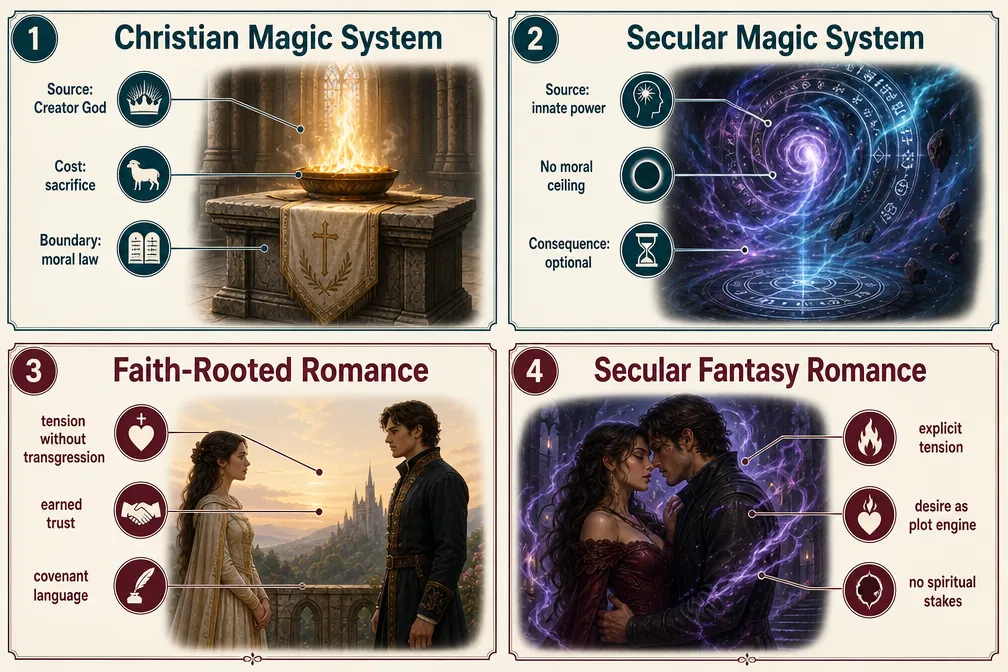
Faith changes magic from a neutral tool into a moral question. In Christian fantasy, magic typically has a source, a Creator, a covenant, a divine order, and using it outside that order carries genuine cost. This isn’t just a plot mechanic; it reflects a theological conviction that power without accountability corrupts.
Common patterns in faith-rooted magic systems:
- Sourced power: Magic flows from or is granted by a divine being, not from the character’s own will alone.
- Moral ceiling: Certain uses of power are forbidden, not just dangerous. The boundary is ethical, not merely practical.
- Cost and sacrifice: Significant power requires something given up, time, safety, pride, or something the character values.
- Spiritual warfare as a real force: Dark magic isn’t just “evil faction magic.” It represents a genuine opposing spiritual order.
In Silas Bellhaven’s Sarel Chronicles, for example, the silver roads on the Great Map mark prayers the Maker-Who-Hears has answered, magic is literally the record of divine response to human need. That’s a fundamentally different premise than a secular system where a character’s arcane power is an expression of personal identity.
Secular fantasy magic tends to be morally neutral: it can be used for good or ill, and the ethics depend entirely on the user’s choices. That’s a valid story framework, but it produces different emotional stakes [9].
Do Christian Fantasy Romances Have Different Moral Codes Than Secular Ones?
Yes, and the difference runs deeper than content restrictions. Christian fantasy romance operates inside a moral order that exists independent of the characters’ preferences. Right and wrong aren’t negotiated between lovers; they’re given by the story’s theological framework.
Key moral differences:
| Element | Christian Fantasy Romance | Secular Fantasy Romance |
|---|---|---|
| Source of morality | Revealed/covenantal | Self-determined or situational |
| Sexual boundaries | Drawn before the story begins | Determined by character desire |
| Villain’s evil | Reflects genuine spiritual opposition | Often political or personal |
| Redemption arc | Requires real cost and repentance | Often resolved by love alone |
| Magic’s ethics | Tied to divine order | Tied to intent or consequence |
This doesn’t mean Christian fantasy romance is rigid or preachy. The best examples, including the covenant fantasy of the Kethara Chronicles, put characters in genuine moral pressure and let them fail, repent, and find grace at real cost. The moral code creates stakes, not a safety net [2].
How Do Love Scenes Differ in Christian vs. Secular Fantasy Romance?
Christian fantasy romance keeps physical intimacy off the page or firmly pre-marital in its emotional logic. This isn’t absence of romantic tension, it’s a different kind of tension, one that builds through trust, sacrifice, and spiritual alignment rather than physical escalation.
What Christian fantasy romance does instead of explicit scenes:
- Emotional vulnerability as the primary intimacy marker
- Sacrifice as a love language (a character choosing cost on behalf of the other)
- Covenant language, promises, oaths, binding words that carry spiritual weight
- Restraint as character revelation (what a person doesn’t do under pressure tells you who they are)
Secular fantasy romance, particularly the mainstream romantasy category that generated US$610M in U.S. sales in 2024, frequently uses physical intimacy as a plot milestone. The “slow burn” in secular romantasy often resolves explicitly. In Christian fantasy romance, the slow burn resolves in commitment, and the emotional payoff is in the covenant, not the consummation.
Common mistake: Christian authors sometimes strip out all physical tension so completely that the romance feels bloodless. Earned romance still needs heat, it just channels that heat differently. Restraint is only meaningful when there’s something real being restrained.
What Makes Christian Fantasy Romance Different From Inspirational Romance?
Christian fantasy romance and inspirational romance both handle faith with care, but they’re structurally different genres. Inspirational romance is typically contemporary or historical, with faith woven into a realistic setting. Christian fantasy romance builds a secondary world where the theological framework is embedded in the world’s physics, history, and power systems.
The key distinction: In inspirational romance, characters bring their faith into a world that doesn’t share it. In Christian fantasy romance, the world itself is built on faith’s premises, a Creator exists, spiritual forces are real, and the magic system reflects that order.
This matters for readers because Christian fantasy romance can explore theological questions, the nature of grace, the cost of covenant, the reality of spiritual warfare, through world-building rather than through a character’s personal testimony. The story carries the theology; no character needs to explain it [5].
Can Secular Fantasy Romance Readers Enjoy Christian Fantasy Romance?
Many can, especially readers who are drawn to secular fantasy romance for its emotional depth, world-building, and slow-burn tension rather than its explicit content. Christian fantasy romance delivers all three of those elements, often with higher stakes, because the moral framework adds weight to every choice.
Secular readers who tend to connect with Christian fantasy romance:
- Readers who find mainstream romantasy emotionally shallow or formulaic
- Readers who prefer slow-burn tension that resolves in commitment
- Readers who enjoy magic systems with internal logic and moral consequence
- Readers who want villains whose evil feels genuinely threatening, not just politically opposed
The honest caveat: secular readers who specifically want explicit content or morally ambiguous protagonists who rewrite their own ethical codes will find Christian fantasy romance frustrating. The genre’s constraints are features for its target readers, not compromises.
Is Christian Fantasy Romance Only for Religious Readers?
No, though faith is genuinely central, not decorative. Christian fantasy romance is built for readers who want faith handled honestly, but the stories work as stories for anyone who values moral clarity, earned redemption, and romantic tension that builds toward something lasting.
The distinction that matters: these stories don’t require the reader to share the faith to follow the emotional logic. A reader who doesn’t believe in God can still feel the weight of a character choosing sacrifice over self-interest. The covenant framework creates stakes that translate even when the theology doesn’t transfer personally [5].
What Christian fantasy romance does require is tolerance for a moral order the characters can’t override. If that feels restrictive, secular fantasy romance is a better fit. If it feels like the kind of story that takes love seriously, Christian fantasy romance is worth the read.
Christian Fantasy Romance vs. Paranormal Romance: What’s the Difference?
These two genres are frequently confused but operate on opposite premises. Paranormal romance features supernatural beings, vampires, werewolves, fae, often as romantic leads, with the supernatural treated as exotic or dangerous rather than morally ordered. The “other” is appealing precisely because it exists outside normal moral constraints.
Christian fantasy romance treats the supernatural as morally ordered. Spiritual forces are real, but they answer to a Creator. Dark powers are genuinely evil, not just misunderstood. The romantic lead isn’t appealing because they’re dangerous and uncontrollable, they’re compelling because of what they choose to do with the power they carry.
Quick rule: If the supernatural element is meant to feel transgressive and thrilling, it’s probably paranormal romance. If it’s meant to feel weighty and morally real, it’s probably Christian fantasy romance.
Common Mistakes Christian Fantasy Romance Authors Make
The genre has specific failure modes that undercut what makes it distinct.
The most common errors:
- Theology as dialogue. Characters explain doctrine to each other instead of living faith under pressure. The story stops moving while a character delivers a sermon. Faith should show up in choices, not speeches [2].
- Cheap grace. A villain repents in the final chapter with no real cost. Or a protagonist’s faith crisis resolves too cleanly. Redemption that doesn’t cost something isn’t redemption, it’s a plot device.
- Magic as decoration. The fantasy world-building is thin, and the faith elements feel pasted on. Readers who came for fantasy feel cheated; readers who came for faith feel condescended to.
- Bloodless romance. Stripping all tension from the romantic plot to avoid any appearance of physical awareness. Real restraint requires real temptation.
- Spiritual warfare as action sequence. Treating demonic opposition as just another fight scene rather than as a genuine moral and spiritual crisis.
The strongest Christian fantasy romance, from C.S. Lewis’s Till We Have Faces to contemporary covenant fantasy, earns its grace by making the cost visible before the mercy arrives [9].
What Are Readers Looking For in Faith-Based Fantasy Romance?
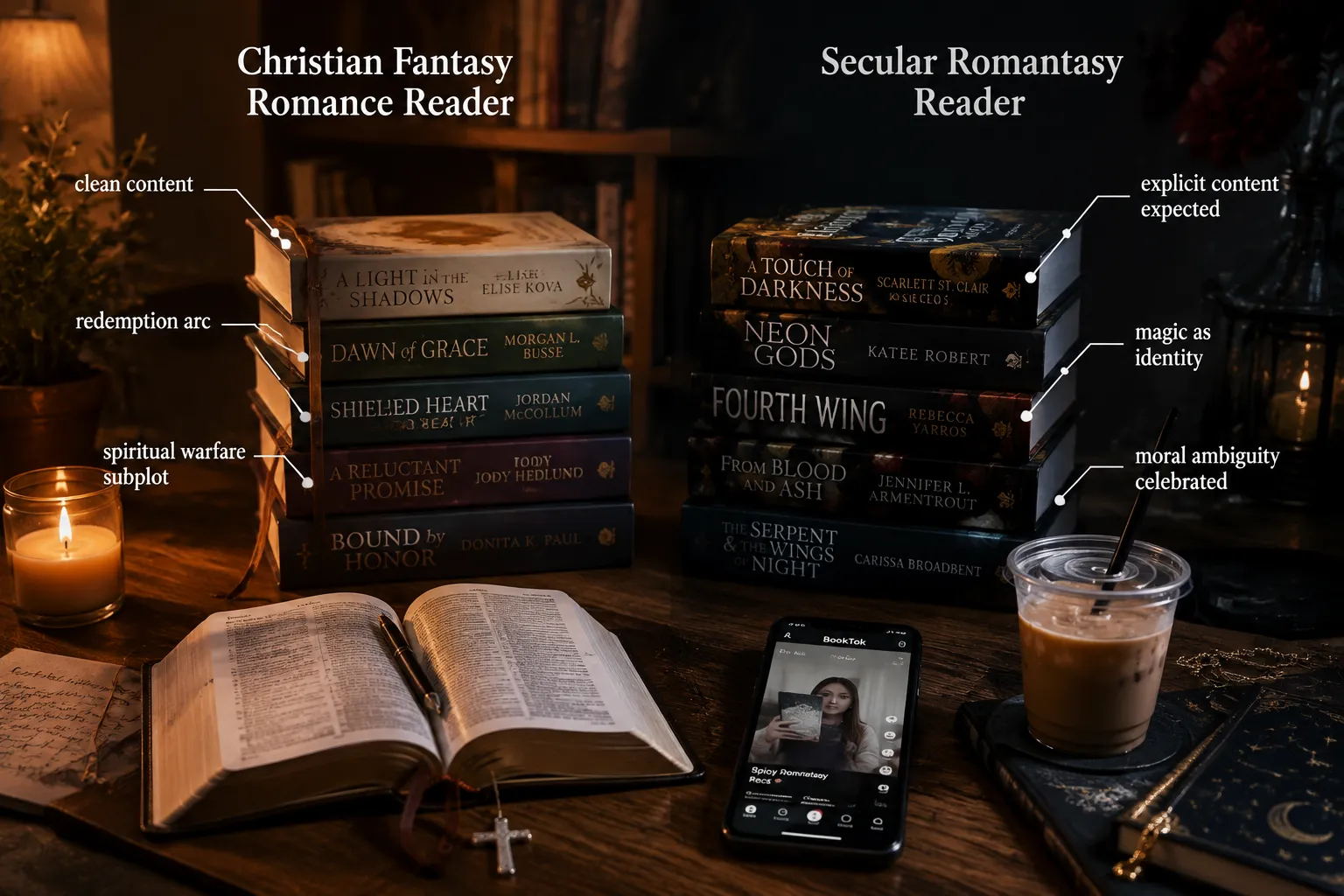
Readers of Christian fantasy romance are primarily women 35-65, many of them Kindle Unlimited subscribers, who want stories that walk with them rather than talk at them. They’ve often been burned by Christian fiction that felt preachy or by secular fantasy romance that went further than they wanted.
What they’re actually asking for:
- Real stakes. Not sanitized conflict, but genuine moral and spiritual pressure.
- Earned romance. Slow burn that means something because the restraint was real.
- Faith under fire. Characters who doubt, fail, and find grace, not characters who have it all figured out.
- Clean content. No graphic violence, no explicit scenes, no profanity, but this should be obvious from the prose, not announced as a disclaimer.
- Hope in the dark. Stories that don’t flinch from hard things but don’t leave the reader there.
NielsenIQ BookData commentary through December 2024 shows romantasy sales more than quadrupled over five years, with dominant female readership, a market signal that readers want fantasy and romance together. Christian fantasy romance serves the same emotional hunger with different moral architecture.
Christian Fantasy Romance Recommendations for Beginners
For readers new to the genre, these entry points balance strong world-building with accessible faith themes:
Faith-rooted fantasy with romantic elements:
- The Stone That Remembered (Kethara Chronicles, Book 1), covenant fantasy set in the highlands of Marat-Sol, where an empire tries to own mercy and two women carry a word it cannot contain. View on Amazon
- The Map of Unanswered Prayers (Sarel Chronicles, Book 1), a disgraced map-scribe discovers a black road on her skin belonging to a boy the official record refused to acknowledge. View on Amazon
For readers coming from secular romantasy: Start with The Stone That Remembered. The world-building is substantive, the romantic tension is real, and the faith elements are woven into the world’s structure rather than delivered as message.
For readers coming from inspirational romance: Start with The Map of Unanswered Prayers. The secondary world is fully realized, but the theological questions, what it means to carry an unanswered prayer, what the Maker-Who-Hears owes the forgotten, will feel familiar in emotional register.
How Do Christian Fantasy Authors Balance Theology With Storytelling?
The best Christian fantasy authors treat theology the way a good architect treats load-bearing walls: the structure depends on them, but you don’t see them unless something goes wrong. Faith shapes the world’s logic, the magic’s rules, and the characters’ choices, but it doesn’t interrupt the story to explain itself [9].
Practical principles that work:
- Let the world carry the theology. If the magic system reflects a Creator’s order, readers absorb the theological premise through story logic, not exposition.
- Put faith under genuine pressure. A character whose belief is never tested isn’t demonstrating faith, they’re demonstrating certainty. The difference matters emotionally.
- Show grace arriving after cost, not instead of it. Mercy that comes before sacrifice doesn’t feel like mercy; it feels like the story avoiding the hard thing.
- Trust the reader. Christian fiction readers are theologically literate. They don’t need the allegory explained. They need the story to be true to its own premises.
The C.S. Lewis comparison is apt not because Lewis wrote allegory, he consistently denied that Narnia was allegorical, but because he trusted the story to carry the weight. The faith was real, the world was real, and the two belonged together without either explaining the other [9].
Conclusion: What Faith Actually Changes
The question at the center of Christian Fantasy Romance vs. Secular Fantasy Romance isn’t really about content restrictions or heat levels. It’s about what a story believes love is for.
Secular fantasy romance, for all its genuine pleasures, tends to answer that love is for desire, connection, and self-completion. Those are real human needs, and the genre serves them well. But Christian fantasy romance answers differently: love is for covenant, for sacrifice, for becoming someone who can be trusted with another person’s soul.
That difference reshapes everything, the magic, the moral stakes, the romantic tension, and the resolution. It’s not a lesser version of the genre. It’s a different premise about what the story is actually about.
For readers who want their faith represented honestly in fantasy, not preached at, not sanitized, but genuinely present in the world’s bones, Christian fantasy romance is one of the most honest places to find it.
Next steps for readers:
- Browse the Kethara Chronicles for covenant fantasy with strong female leads
- Start with The Stone That Remembered for an accessible entry into faith-rooted secondary-world fantasy
- Explore the full Silas Bellhaven catalog for clean Christian fiction across fantasy, mystery, thriller, and western
FAQ
What is Christian fantasy romance? Christian fantasy romance is a subgenre that combines secondary-world fantasy, magic systems, and romantic plot lines within a framework where faith in a Creator God is load-bearing to the story’s moral and magical architecture. It differs from secular fantasy romance in its moral order, its treatment of magic, and its romantic resolution.
Is Christian fantasy romance the same as clean fantasy romance? Not exactly. Clean fantasy romance avoids explicit content but may have no faith element at all. Christian fantasy romance is specifically faith-rooted, the theology shapes the world-building and the story’s moral stakes, not just the content level.
Can you have real romantic tension in Christian fantasy romance? Yes. Restraint only creates tension when there’s something real being restrained. The best Christian fantasy romance builds genuine emotional heat through vulnerability, sacrifice, and covenant language, the slow burn is real, it just resolves differently than in secular romantasy.
What’s the difference between spiritual warfare in Christian fantasy and dark magic in secular fantasy? In secular fantasy, dark magic is usually a neutral force used for evil ends. In Christian fantasy, spiritual warfare reflects a genuine moral and spiritual opposition, dark powers aren’t just dangerous, they’re genuinely evil in a way that answers to a real moral order.
Do Christian fantasy romance books have happy endings? Most do, but the happiness is earned rather than given. Grace arrives after cost, not instead of it. The resolution is hopeful, but the hope is grounded in what the characters actually went through.
Is Christian fantasy romance growing as a genre? Yes. While mainstream romantasy dominates the broader market, with U.S. secular romantasy revenue at US$610M in 2024, Christian fantasy romance is growing within the Christian fiction market, particularly through Kindle Unlimited, where faith-based readers actively seek clean, substantive fantasy.
What makes a magic system “Christian” in fantasy? A Christian magic system is typically sourced in a divine order rather than personal power, carries moral constraints that reflect that order, and involves real cost for significant use. The magic answers to something above the characters’ own will.
How do I find good Christian fantasy romance if I’m new to the genre? Start with authors who build substantive secondary worlds rather than using fantasy as a thin backdrop for a faith message. The Kethara Chronicles and the Sarel Chronicles are solid entry points for readers who want real world-building alongside faith-rooted themes.
Why do some Christian fantasy romance books feel preachy? Usually because the author lets characters explain the theology rather than live it. When a character stops the story to deliver a faith lesson, the narrative trust breaks. The best Christian fantasy romance shows faith through choice and consequence, not through dialogue.
Is Christian fantasy romance suitable for teens? Most Christian fantasy romance is written for adult readers, but the clean content standard means it’s generally appropriate for older teens. Individual titles vary, check series descriptions for content specifics.
References
[2] 0048721x.2016 – https://www.tandfonline.com/doi/full/10.1080/0048721X.2016.1212526
[5] 2016 Fiction And Religion How Narratives About The Supernatural Inspire Religious Belief Introducing The Thematic Issue – https://www.academia.edu/29700787/2016_Fiction_and_Religion_How_Narratives_about_the_Supernatural_Inspire_Religious_Belief_introducing_the_thematic_issue
[9] Finding God S In Fantasylands Religious Ideas In Fantasy Literature – https://www.academia.edu/40971942/Finding_God_s_in_Fantasylands_Religious_Ideas_in_Fantasy_Literature