Last updated: September 18, 2026
Quick Answer: Christian historical romance with suspense elements blends faith-rooted love stories with genuine danger, land disputes, Pinkerton investigations, missing heirs, and frontier courtroom drama, while keeping content clean and appropriate for faith-based readers. This subgenre is one of the fastest-growing categories in Christian fiction and is well-represented on Kindle Unlimited, making it an ideal reading lane for KU subscribers who want real stakes without graphic content.
Key Takeaways
- Christian historical romance with suspense combines period-accurate danger (frontier courts, detective plots, wilderness peril) with faith themes and clean content standards
- The subgenre is identified as a “blue ocean” growth area in 2026 Christian fiction industry analysis [1]
- Kindle Unlimited hosts a strong and active catalog of faith-based historical romance with suspense, especially frontier and Gilded Age settings
- Pinkerton agents, territorial courts, land claims, and missing-heir plots are among the most popular suspense frameworks in the genre
- Faith in these stories functions as a moral weight on the characters, not a sermon delivered to the reader
- Clean danger means real jeopardy (physical, legal, relational) without graphic violence, explicit content, or profanity
- Series-driven reading is the dominant pattern for KU subscribers in this category
- The difference between Christian and secular historical romance is not the absence of tension, it’s what the tension costs the characters spiritually
What Is Christian Historical Romance with Suspense?
Christian historical romance with suspense is a fiction subgenre where a faith-rooted love story unfolds against a backdrop of genuine danger set in a historical period, most commonly the American frontier (1860s, 1900s), the Gilded Age, or the post-Civil War West. The suspense element is structural, not decorative: a Pinkerton investigation, a forged land claim, a missing heir, or a territorial court case drives the plot forward and puts the central relationship at real risk.
What separates it from secular romantic suspense is not the absence of danger but the presence of a moral framework that takes God seriously. Characters face hard choices, obey a corrupt authority or protect an innocent person, tell the truth or protect someone they love, and their faith is tested by those choices rather than confirmed by them.
Faith under fire means the character’s belief is load-bearing. It holds weight when the plot presses down on it.
This is not a subgenre where the hero prays once and the problem resolves. Grace shows up after cost, not instead of it.
Why Frontier and Gilded Age Settings Dominate the Subgenre
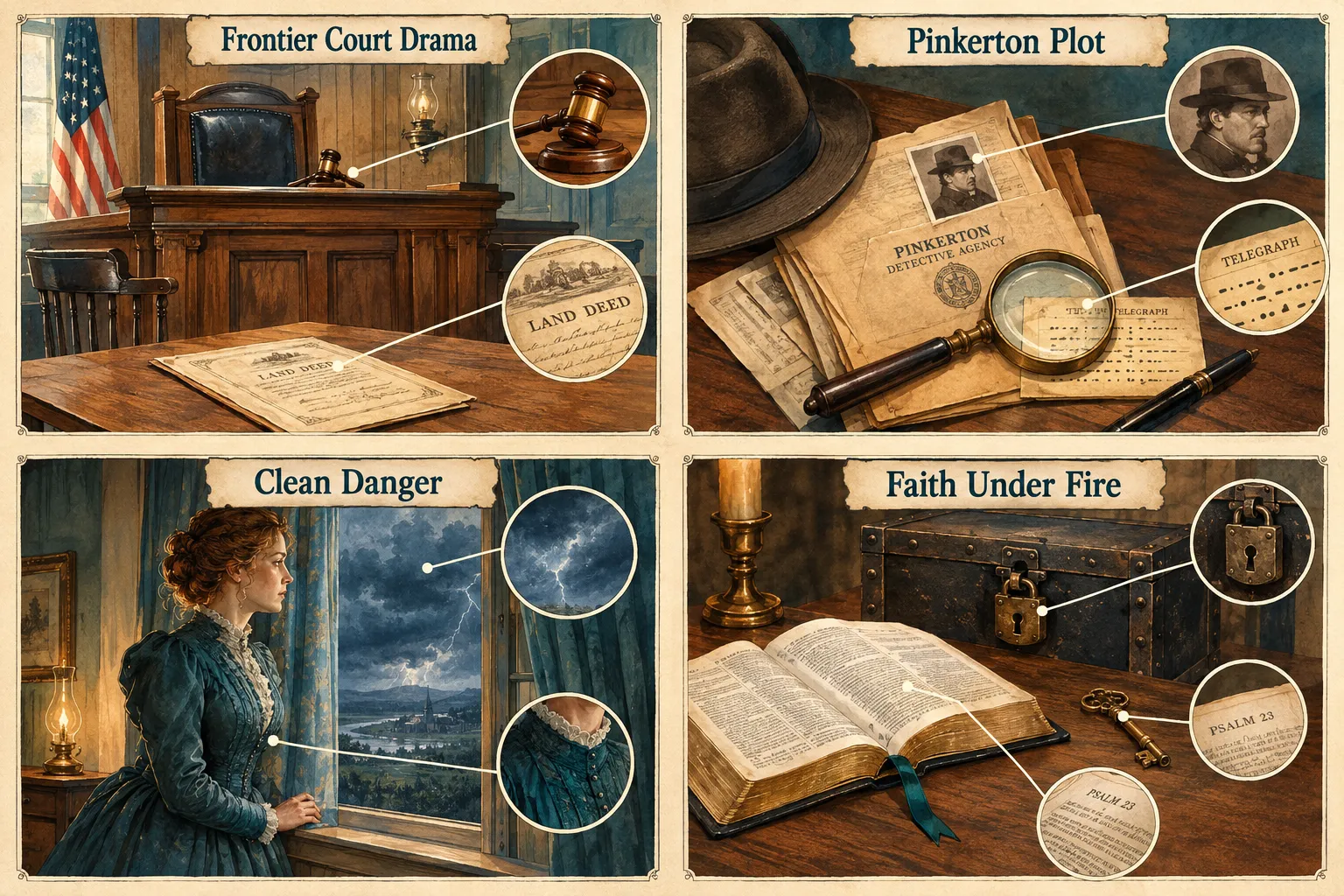
Frontier and Gilded Age settings dominate Christian historical romance with suspense because they provide natural, historically grounded sources of danger that don’t require graphic content to feel real. Land is contested. Courts are corrupt or absent. Records can be forged. A woman traveling alone faces genuine peril. A man holding a false warrant has real power over someone’s life.
Why these settings work so well:
- Legal ambiguity, territorial courts operated with limited oversight, making false warrants, disputed claims, and corrupt officials plausible plot engines
- Physical isolation, frontier geography creates jeopardy without requiring violence to feel threatening
- Record-keeping as power, ledgers, deeds, survey lines, and mail pouches carry life-or-death stakes in ways modern readers can still feel
- Gender and agency, women navigating frontier law had limited legal recourse, which raises the stakes of every choice a heroine makes
- Faith communities under pressure, frontier churches and mission outposts were real institutions facing real threats, giving faith a structural role in the story
Recent releases confirm this pattern. Freed by the Frontier (Wild Heart Books, June 2026) features three women facing captivity, tribal conflict, and dangerous frontier crossings, the blurb centers “caught between two worlds” as its core tension. Thawing the Frontiersman’s Heart (Andrea Byrd, August 2026) markets around “a missing father,” “a deadly storm,” and “a stranger who may be more dangerous than the wilderness.” Both titles signal that the August, September 2026 surge in Christian frontier historical romance is leaning hard into danger hooks precisely because readers are responding to them.
For more on how frontier fiction handles faith without turning it into a sermon, the approach carries across the genre.
Pinkerton Plots and Frontier Courts: The Best Suspense Frameworks
The most durable suspense frameworks in Christian historical romance with suspense elements are Pinkerton investigations, territorial court cases, and land/record disputes. Each one generates clean danger, jeopardy that is real and escalating without requiring graphic content.
Pinkerton plots work because the National Detective Agency operated across the frontier and Gilded Age West, giving authors a historically accurate reason to place a detective figure (hero or antagonist) into a romance. The tension is moral as much as physical: Pinkertons were hired guns for railroad and industrial interests, which means a Christian hero working as or against a Pinkerton agent faces genuine ethical weight. Who does the law actually serve here?
Frontier court drama generates suspense through procedural stakes. A forged deed, a false warrant, a disputed inheritance, these are legal problems with physical consequences. A heroine who holds the only copy of a legitimate land claim is in danger not because someone is chasing her with a weapon but because the wrong person controls the record. That’s a different kind of fear, and it’s one that translates cleanly to faith themes: what does it cost to tell the truth when the court is already bought?
Missing heir and inheritance plots carry Gilded Age suspense naturally into romance. A woman who discovers she’s the legitimate heir to a contested estate, or who is protecting someone who is, faces danger from people with financial and social power, not just physical threat.
Choose your framework based on what the faith question needs to be:
- Pinkerton plot → best for “who does justice actually serve?” questions
- Frontier court → best for “what does obedience cost when the law is wrong?” questions
- Missing heir → best for “what is a name worth, and who gets to keep it?” questions
Clean Romance Books with Suspense: What “Clean Danger” Actually Means

Clean danger in Christian historical romance means the threat is real and the stakes are high, but the content stays within the clean fiction standard: no graphic violence, no explicit sexual content, no profanity. The danger is structural and emotional, not sensational.
This is not the same as safe danger. A heroine trapped in a territorial dispute with no legal recourse is genuinely at risk. A hero who must decide whether to honor a false warrant or protect an innocent person is facing a real moral crisis. The reader feels the jeopardy because the consequences are real, not because the scene is graphic.
What clean danger includes:
- Physical peril (storms, pursuit, captivity, wilderness survival) described with tension but not gore
- Legal and financial threat (forged documents, corrupt courts, stolen inheritance)
- Relational danger (betrayal, false accusation, social ruin)
- Moral jeopardy (the character must choose between two costly options)
What clean danger excludes:
- Graphic depictions of violence or injury
- Explicit or near-explicit romantic content
- Profanity used for shock value
- Trauma rendered in clinical or exploitative detail
The non-violent suspense approach used in Christian psychological thrillers applies directly here: stakes are raised through consequence and moral weight, not through graphic content.
Christian Romance vs. Secular Historical Romance: The Real Differences
Christian historical romance and secular historical romance share period settings, romantic tension, and often similar plot structures. The difference is not the presence or absence of danger, both can have genuine suspense. The difference is what the danger costs the characters spiritually.
| Element | Christian Historical Romance | Secular Historical Romance |
|---|---|---|
| Faith role | Load-bearing, affects character choices | Optional or absent |
| Moral framework | Characters answer to God, not just society | Characters answer to social norms |
| Physical content | Clean standard maintained | Varies widely, often explicit |
| Resolution | Grace earned through cost | Typically emotional/relational resolution |
| Danger type | Often moral/legal as well as physical | Often physical or social |
| Suspense source | Records, courts, false authority | Similar, plus often more graphic threat |
The key distinction: in Christian historical romance, the faith question is not resolved by the romance. The romance may be the context in which the faith question gets answered, but the two are not the same thing. A hero who finds love has not necessarily found God. A heroine who survives danger has not automatically found grace. Those are separate costs.
Readers who want clean reads that still deliver real emotional stakes consistently report that the clean standard doesn’t reduce tension, it redirects it toward moral and relational stakes, which often land harder.
Best Christian Historical Romance with Suspense for KU Readers
Christian historical romance with suspense elements is well-represented on Kindle Unlimited, and the category is growing. Industry analysis from 2026 identifies Christian romantic suspense as a “growth leader” and frames Christian suspense and mystery as a “blue ocean”, meaning the demand is outpacing the supply of high-quality titles [1][7].
What to look for in a strong KU title in this category:
- A suspense framework that is specific (not just “danger” but a particular legal, investigative, or survival threat)
- A heroine with genuine agency, she makes choices that carry consequences, not just reactions
- Faith that shows up in the hard moment, not just in the church scene
- A romance arc that earns its resolution rather than arriving at it by default
Series-driven reading is the dominant pattern. KU readers in this category tend to read in series because the world-building and character trust carry over. A reader who finishes one book in a frontier suspense series wants to know what happens next in that community, not just in that relationship.
For readers building a faith-based KU reading list, the complete guide to Kindle Unlimited Christian reads across mystery, western, fantasy, thriller, and LitRPG covers the broader landscape.
The Silas Bellhaven Mercy Line series, nine books set in the railroad town of Mercy Crossing, operates in adjacent territory: frontier western fiction with legal and record-based suspense, faith under fire, and moral stakes built around courts, land claims, and false warrants. While the Mercy Line carries a romance-absent content contract, readers drawn to frontier court drama and Pinkerton-adjacent plots will find the same structural suspense DNA. The False Warrant (Book 1) opens on exactly the question this subgenre keeps asking: a territorial seal doesn’t make a custody lawful, and a man must decide what obedience is actually worth.
How to Write Christian Historical Romance with Mystery and Suspense
Writing Christian historical romance with suspense elements well requires the suspense to be structural, it has to threaten the relationship and the faith simultaneously, not just provide action between romantic scenes.
Core craft principles:
- Give the suspense a document or record at its center. A forged deed, a false warrant, a missing letter, a disputed ledger, these are historically accurate and generate clean danger that carries moral weight
- Make the faith question specific. Not “does she trust God?” but “does she hand over the ledger that will save her but destroy someone she loves?”
- Let the romance complicate the suspense, not resolve it. The hero arriving doesn’t end the danger, it raises the stakes because now there’s someone to lose
- Earn the grace. Mercy and justice both have to show up, and neither one comes free
- Use the period setting as a source of jeopardy, not just atmosphere. Frontier law, Pinkerton authority, territorial courts, these are real historical mechanisms that created real danger for real people
Common mistakes to avoid:
- Using the faith element as a moral safety net that prevents real consequences
- Resolving the suspense plot through prayer rather than through character action informed by faith
- Making the Pinkerton or court antagonist cartoonishly evil rather than systemically corrupt
- Treating the clean content standard as a limitation rather than a craft challenge
The moral gray areas in Christian western fiction piece covers the antagonist problem in depth, the most compelling villains in this genre are people doing wrong things for comprehensible reasons, not pure evil.
How Much Suspense Should Be in Christian Romance?
The suspense should be proportional to the faith question the story is asking. If the central spiritual question is about trust, can she trust God when the evidence says otherwise?, the suspense needs to make that distrust feel reasonable. If the question is about obedience, does he follow a corrupt law or a higher one?, the suspense needs to make disobedience genuinely costly.
A rough working guide:
- Light suspense (mystery-adjacent): A secret, a missing document, a past that threatens the present. Suitable for readers who want romance-primary with a tension layer
- Moderate suspense (thriller-adjacent): An active investigation, a pursuit, a court case with real stakes. Suitable for readers who want equal weight between romance and danger
- Heavy suspense (survival/legal thriller-adjacent): Physical peril, corrupt authority with real power, a race against time. Suitable for readers who want the suspense to drive the romance rather than the reverse
The clean Christian psychological thriller approach demonstrates that heavy suspense is fully achievable within clean content standards, the ceiling is not low.
Is Historical Romance Appropriate for Christian Readers?
Historical romance is appropriate for Christian readers when it maintains clean content standards and handles faith honestly. The genre itself is not the issue, period, setting, and plot structure are neutral. What matters is the content contract: no graphic violence, no explicit sexual content, no profanity, and faith treated as lived experience rather than decoration.
Christian readers who have avoided secular historical romance because of explicit content will find the Christian historical romance subgenre specifically built for them. The suspense elements, Pinkerton plots, frontier courts, missing heirs, add genuine tension without requiring graphic content to deliver it.
The broader Christian fiction market is large and growing globally, with suspense identified as a leading subgenre [1][6]. That growth reflects reader demand for stories that take both faith and danger seriously at the same time.
Conclusion: Where Mercy and Justice Meet on the Frontier
The best Christian historical romance with suspense elements, frontier courts, Pinkerton plots, and clean danger, doesn’t ask readers to choose between a good story and a faithful one. It insists those are the same thing.
A heroine holding a forged deed in a territorial court, a hero deciding whether to honor a false warrant, a Pinkerton agent who has to choose between his employer and his conscience, these are not just plot problems. They’re the old questions dressed in period clothes: what does obedience cost when the law is wrong? What does mercy require when justice is absent? What does it mean to tell the truth when the record has already been written against you?
That’s earned grace. Not cheap, not clean, not easy, but real.
Actionable next steps for KU readers:
- Browse the Kindle Unlimited Christian reads hidden gems list for frontier and suspense titles beyond the bestseller lists
- Start a frontier western suspense series at Book 1, the world-building pays off across the series
- If you’re new to the subgenre, begin with moderate suspense (a court case or investigation plot) before moving to survival-level danger
- Check the best Christian fiction authors across cozy mystery, western, fantasy, thriller, and LitRPG for a complete faith-focused reading map
- For frontier-specific reading, the Mercy Line series begins with The False Warrant, a territorial seal, a man who must decide what obedience is worth, and a conscience line that holds even when the law doesn’t
Rooted in Faith. Hope in the dark. Redemption that costs something.
FAQ
What makes a historical romance “Christian”? A Christian historical romance handles faith as a load-bearing element of the story, characters’ beliefs affect their choices and carry consequences, and maintains clean content standards (no graphic violence, explicit content, or profanity).
Do Christian historical romances always have a happy ending? Most follow the romance genre convention of a hopeful or happy ending, but in Christian historical romance the resolution is earned through genuine cost. Grace arrives after the hard choice, not before it.
What is a Pinkerton plot in historical romance? A Pinkerton plot uses the National Detective Agency, active from the 1850s through the early 20th century, as a suspense engine. A Pinkerton agent may be hero, antagonist, or complicating factor, and their presence raises questions about who law actually serves.
Are frontier court stories historically accurate? Territorial courts in the American West operated with limited oversight and significant corruption from roughly the 1860s through statehood for most territories. False warrants, disputed land claims, and corrupt officials are historically grounded plot elements, not invented drama.
Can Christian romance have real danger without graphic content? Yes. Clean danger, legal jeopardy, moral crisis, physical peril described without gore, can be as tense as any graphic scene. The stakes are raised through consequence and moral weight rather than graphic detail.
What is the difference between Christian suspense and Christian thriller? Suspense builds dread through uncertainty and moral weight; thriller builds urgency through active, escalating threat. Christian historical romance typically sits closer to suspense, the danger is real but the pacing allows for emotional and spiritual depth.
Is Kindle Unlimited a good place to find Christian historical romance with suspense? Yes. KU has a strong and growing catalog in this category, and the series-driven reading pattern suits the subscription model well. Industry analysis from 2026 identifies Christian romantic suspense as a growth leader within the platform [7].
How is faith handled in Christian historical romance differently from inspirational romance? Inspirational romance often treats faith as a backdrop or a character trait. Christian historical romance, at its best, makes faith a structural element: the character’s belief is tested by the plot and proven (or questioned) through specific choices, not through a conversion moment or a prayer scene.
What age group reads Christian historical romance with suspense? The primary audience is women aged 35-65, though the genre has readers across a wider range. KU subscribers in this demographic are among the most active series readers in Christian fiction.
Can men enjoy Christian historical romance with suspense? The frontier court and Pinkerton plot frameworks appeal to readers who enjoy legal and investigative tension regardless of gender. Readers who enjoy frontier western fiction with moral stakes, like the Mercy Line series, often cross over into historical romance suspense naturally.
References
[1] The Rise Of Christian Fiction Market Trends Regional Dynamics And Future Predictions For 2026 – https://www.alibaba.com/product-insights/the-rise-of-christian-fiction-market-trends-regional-dynamics-and-future-predictions-for-2026.html
[6] Christian Book Statistics – https://powelld.com/christian-book-statistics
[7] 2026 S Ultimate Guide To Christian Fiction Trends Top Authors And How To Profit – https://www.alibaba.com/product-insights/2026-s-ultimate-guide-to-christian-fiction-trends-top-authors-and-how-to-profit.html