
Last updated: August 17, 2026
Quick Answer: Christian LitRPG and progression fantasy is a growing subgenre that uses game-inspired mechanics, leveling systems, stat tracking, quest structures, as a framework for spiritual growth and faith-tested character development. It differs from secular LitRPG by grounding character progression in earned grace, moral consequence, and lived belief rather than pure power accumulation. These books are generally clean, appropriate for teens and adults, and readable even by non-religious readers who enjoy character-driven fantasy.
Key Takeaways
- Christian LitRPG blends game mechanics (levels, stats, quests) with faith-rooted storytelling where spiritual growth drives character progression.
- Leveling up in these stories often mirrors sanctification, the slow, costly process of becoming who you’re meant to be, not a quick power grab.
- The subgenre is clean by design: no graphic violence, no explicit content, and faith handled as lived experience rather than sermon.
- Major 2026 releases like Canthany Rising (Kenneth Bliss) and the Heavenly Places series (John Kowalski) show the subgenre actively expanding.
- Christian LitRPG is appropriate for teens, young adults, and older readers, and accessible to non-religious readers who appreciate moral complexity.
- The best titles in the genre treat grace as something earned through cost, not handed out as a reward for good behavior.
- Game mechanics work best spiritually when they create stakes, when a character’s choices inside the system carry real moral weight.
- Silas Bellhaven’s The Measured Debt series is a notable example of Christian LitRPG built around accountability, record-keeping, and earned redemption.
What Is Christian LitRPG and How Does It Differ from Regular Fantasy
Christian LitRPG is a subgenre of progression fantasy where game-inspired systems, experience points, skill trees, stat panels, leveling, are woven into a story that takes faith seriously as a load-bearing element of the plot. Unlike regular fantasy, which may include vague spiritual themes as backdrop, Christian LitRPG makes a character’s relationship with God, conscience, or covenant the engine that drives progression.
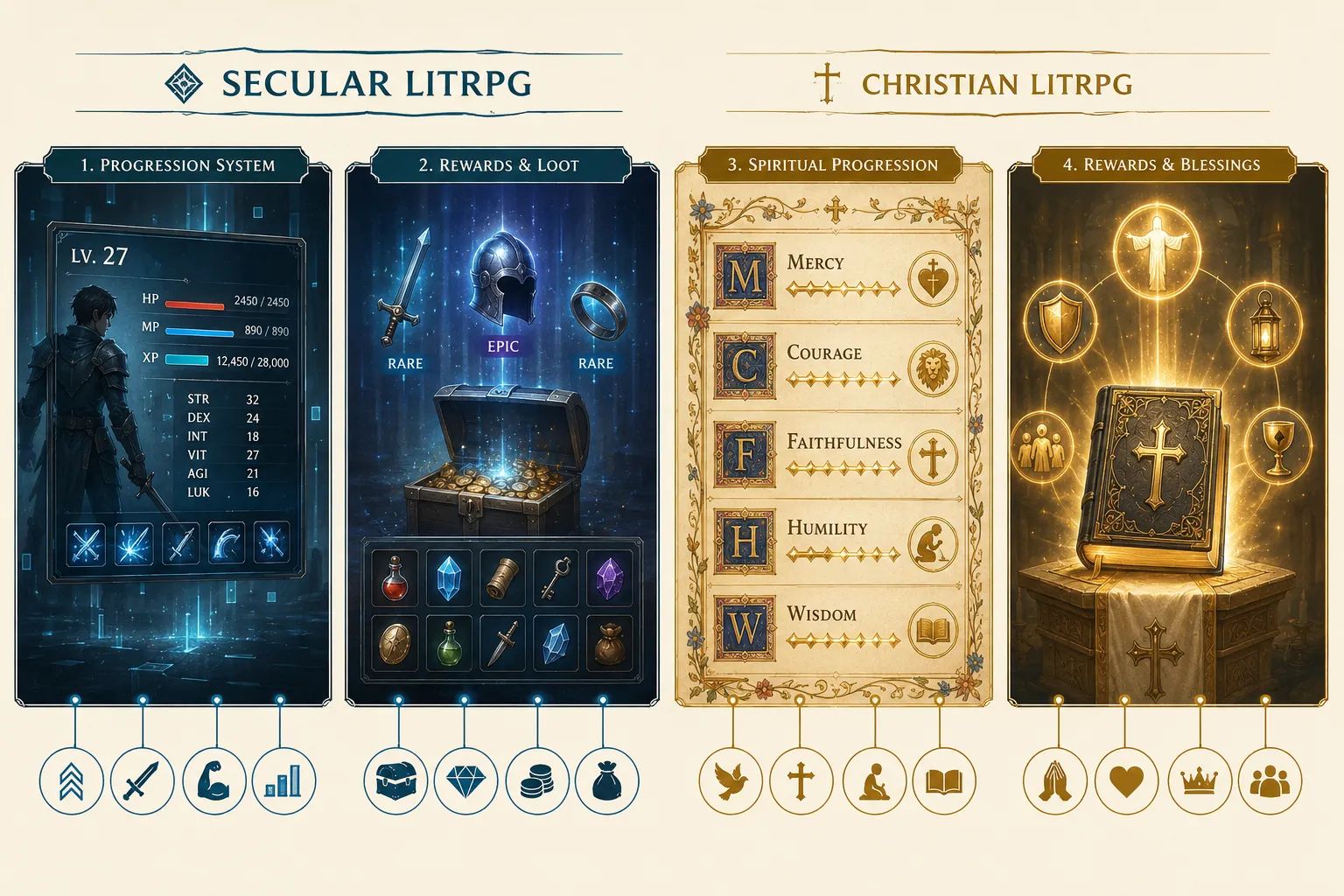
In secular LitRPG, the goal is usually power: the protagonist gains levels, defeats enemies, and climbs a hierarchy [3]. Christian LitRPG redirects that framework. The levels still exist, but what they measure, and what it costs to earn them, is different. A character might gain a virtue attribute by choosing mercy when violence would have been easier, or lose standing in the system by acting from pride rather than faith.
The distinction matters because it changes what the reader is rooting for. In secular progression fantasy, you cheer for the number going up. In Christian progression fantasy, you cheer for the person becoming someone worth cheering for.
Key structural differences:
| Feature | Secular LitRPG | Christian LitRPG |
|---|---|---|
| Progression driver | Power, survival, dominance | Character, virtue, covenant |
| Stat system reflects | Combat ability, magic capacity | Moral choices, spiritual faithfulness |
| Grace/mercy mechanic | Rare or absent | Central, but always costs something |
| Stakes | Physical danger | Physical and moral/spiritual danger |
| Resolution | Defeating the enemy | Becoming who you were meant to be |
How Do Faith and Game Mechanics Work Together in Christian LitRPG
Faith and game mechanics work together when the system itself reflects moral reality, when the rules of the world enforce consequences that align with how Scripture describes the shape of a human life. The mechanics aren’t decoration; they’re the plot’s skeleton.
The best Christian LitRPG authors treat the stat system the way a good parable treats its setting: it’s concrete and specific, but it points at something larger. When Silas Bellhaven’s The Measured Debt series tracks Eamon Kersey’s position record at Federated Record, those numbers aren’t just game data, they’re a ledger of what he’s spent and what he owes, and the story’s tension comes from the moment the math stops adding up [see The Cost of Being Chosen, Amazon ASIN B0HBLPPPDQ].
Kenneth Bliss’s Canthany Rising (released June 2026) uses leveling and quest structures explicitly as a framework for spiritual challenges and faith decisions, with biblical allegory woven into the game mechanics themselves. John Kowalski’s Heavenly Places series, which originated as a faith-based D&D 5e tabletop campaign, carries that same ecosystem logic into novel form, the mechanics and the theology were built together from the start [1].
How mechanics can carry spiritual weight:
- Virtue stats that rise through sacrifice, not just combat wins
- Quest failures that result in moral consequence, not just lost XP
- Debt and ledger systems that make grace visible as a transaction with real cost
- Covenant mechanics where promises made to God or community have binding in-world effects
- Progression ceilings that can only be broken by acts of faith, not grinding
The risk to avoid: making the system a sermon delivery mechanism. If a character gains +10 Faith every time they quote Scripture, the mechanic becomes preachy. The better design is when the system rewards choices that happen to align with virtue, and punishes the opposite, without ever explaining why.
Character Progression Systems in Faith-Based Fantasy Explained
Character progression in Christian progression fantasy mirrors the theological concept of sanctification, the slow, often painful process of becoming more fully yourself in God’s design. It’s not linear, it’s not clean, and it doesn’t happen because the character tried hard enough.
The most honest Christian LitRPG systems build in failure as a feature. A character who gains a Compassion stat through one arc can lose ground through pride in the next. This reflects how faith actually works: not as a permanent upgrade, but as a practice that has to be chosen again and again.
Common progression mechanics in faith-based fantasy:
- Virtue attributes (Mercy, Courage, Faithfulness, Humility) that function like stats but are earned through moral choices
- Covenant levels that unlock abilities tied to promises kept, not just enemies defeated
- Debt and ledger systems where spiritual obligations are tracked as in-world mechanics
- Spiritual warfare tiers where progression into higher levels requires confronting internal sin, not just external enemies
- Quest structures built around service, sacrifice, or truth-telling rather than conquest
The Heavenly Places series by John Kowalski runs characters through levels 10-20 in its TTRPG framework, with the novel series translating those mechanical stakes into narrative ones, prophecy, exile, and spiritual warfare all carry the weight of a character’s accumulated choices [1]. Lightraiders, a Christian RPG platform adopted by families and youth groups in 2026, uses similar leveling-of-spiritual-skills logic, applying Scripture to allegorical scenarios in ways that parallel progression fantasy’s core appeal.
Christian LitRPG vs Secular LitRPG: What’s the Difference
The core difference is what progression means. Secular LitRPG measures a character’s growth in power, efficiency, and dominance within a system [3][4]. Christian LitRPG measures a character’s growth in faithfulness, moral integrity, and relationship with something larger than themselves.
This isn’t just a content filter difference (though Christian LitRPG is generally cleaner). It’s a philosophical difference about what a human life is for.
In secular progression fantasy, the system is usually neutral or amoral, it rewards what works [2]. In Christian progression fantasy, the system reflects a moral universe. Choices have weight. Mercy costs something. Redemption doesn’t come from a clean exit; it comes from facing what you did and paying what you owe.
Where the genres overlap:
- Both use stat panels, leveling, and quest structures
- Both reward character investment and long-term planning
- Both appeal to readers who enjoy systematic world-building
- Both can feature intense stakes and genuine danger
Where they diverge:
- Christian LitRPG treats grace as the most powerful mechanic in the system, and the hardest to earn
- Secular LitRPG rarely asks whether the protagonist deserves their power
- The antagonist in Christian LitRPG is often internal (pride, fear, unforgiveness) as much as external
Is Christian LitRPG Appropriate for Young Adults and Teens
Yes, Christian LitRPG is generally well-suited for teens and young adults, and many titles in the subgenre are written with that audience in mind. The content contract across most Christian LitRPG is clean: no graphic violence, no explicit content, and faith handled as lived experience rather than formula.
The game mechanics framework actually makes these books more accessible to younger readers, not less. Teens already understand leveling systems, stat tracking, and quest structures from gaming culture. Christian LitRPG meets them in that language and uses it to ask harder questions about identity, cost, and what kind of person they want to become.
Age-appropriateness considerations:
- Teens (13+): Most Christian LitRPG is appropriate. Stakes can be high, but content stays clean.
- Young adults (18-25): The subgenre’s moral complexity and spiritual depth tend to land well with this group.
- Mature readers: The best titles don’t simplify faith for a young audience, they take it seriously, which makes them readable across age groups.
Lightraiders, the Christian RPG platform expanding in 2026, is being adopted specifically by families, youth groups, and Christian schools as a discipleship tool, evidence that the game mechanics + faith framework resonates with younger audiences in structured settings.
Can You Read Christian LitRPG If You’re Not Religious
Non-religious readers can absolutely enjoy Christian LitRPG, especially if they’re drawn to moral complexity, earned character growth, and worlds where choices have real consequences. The faith element doesn’t require the reader to share the belief, it requires the reader to respect that the character does.
The best Christian LitRPG never preaches at the reader. Faith shows up through character choice and consequence, not through narration that stops to explain what it means. A non-religious reader watching a character choose mercy when vengeance was available doesn’t need to be Christian to feel the weight of that choice.
Think of it the way a reader approaches Dostoevsky or Tolkien: you don’t have to share the author’s theology to be moved by a story built on it. What matters is whether the faith is earned, whether it costs the character something real, whether it shows up in the hard moments rather than the easy ones.
Choose Christian LitRPG if you’re not religious and you enjoy:
- Stories where moral choices drive plot more than combat ability
- Characters who doubt, fail, and have to reckon with what they’ve done
- World-building where the rules of the universe reflect a coherent moral order
- Clean fiction with genuine stakes
Common Tropes in Christian Progression Fantasy
Christian progression fantasy has developed its own set of recurring story patterns, some borrowed from secular LitRPG, some unique to the faith-rooted version of the genre.
Tropes that work well:
- The chosen-but-not-ready protagonist, called to something before they’ve earned it, and the story is about closing that gap honestly
- The ledger or record, a system that tracks not just power but debt, obligation, and what’s been spent
- The cost of being chosen, a direct echo of the theological reality that calling comes with burden, not just privilege
- Mercy as the hardest stat to max, characters who can fight their way to the top but can’t forgive their way there without real change
- The false record, someone has manipulated the system, and the protagonist has to decide what truth is worth
Tropes to handle carefully:
- The instant conversion moment that resolves everything, faith under fire is more honest than faith as a dramatic rescue
- The system that rewards prayer like a vending machine, if Scripture-quoting grants automatic bonuses, the mechanic becomes a formula
- The villain who is simply evil with no moral complexity, Christian fiction handles justice best when it also handles mercy
Silas Bellhaven’s The Measured Debt series leans into the ledger trope deliberately: Eamon Kersey’s position record at Federated Record is the story’s central mechanic, and the tension builds when the numbers he built his reputation on turn out to have been borrowed, and the debt has finally come due [see The Borrowed Yield, Amazon ASIN B0HBLSQBH5].
Best Christian Progression Fantasy Books to Read in 2026

The subgenre is actively growing, with new releases and series expansions arriving through 2026. Here are the most notable titles and series for readers new to Christian LitRPG and progression fantasy.
Established series:
- The Measured Debt by Silas Bellhaven, Three-book Christian LitRPG series set at Federated Record, following Eamon Kersey through a progression system built on accountability, debt, and earned redemption. Start with The Cost of Being Chosen (Amazon).
- Heavenly Places by John Kowalski, Epic fantasy series rooted in the “Coram Deo” theme, originating from a faith-based D&D 5e campaign. Book 4, Diaspora, launches September 2026 [1].
New 2026 releases:
- Canthany Rising by Kenneth Bliss, A novelette blending biblical allegory, fantasy adventure, and game-inspired mechanics. Released June 2026, described as “a bold new entry into the growing Christian fantasy and LitRPG genres.”
For readers who want faith-rooted fantasy adjacent to LitRPG:
- The Kethara Chronicles and The Sarel Chronicles by Silas Bellhaven, Covenant fantasy and epic fantasy that share the same earned-grace DNA as Christian LitRPG, without explicit game mechanics. Good entry points for readers unsure about the LitRPG format.
How Does Character Growth Reflect Spiritual Development in These Books
In Christian LitRPG, character growth and spiritual development are the same arc told twice, once in the game mechanics, once in the character’s interior life. The stat panel shows what changed; the story shows what it cost.
This parallel structure is what separates Christian progression fantasy from secular LitRPG at the level of meaning. When a character gains a level in secular LitRPG, the reader asks: what can they do now? When a character gains a level in Christian LitRPG, the reader asks: who are they becoming?
Sanctification, the theological term for the ongoing process of becoming more fully who God made you to be, is inherently a progression fantasy structure. It’s slow. It involves failure. It requires outside help (grace) that you can’t earn on your own but still have to choose to receive. The best Christian LitRPG authors understand that this is not a limitation of the genre; it’s the genre’s greatest strength.
How spiritual development maps to game mechanics:
- Repentance = stat reset after moral failure, with the possibility of rebuilding differently
- Sanctification = the long progression arc across multiple books, not a single-session level-up
- Grace = a mechanic that can’t be gamed, only received, and always arrives after cost, not instead of it
- Community/covenant = party mechanics where individual growth is tied to faithfulness to others
- Spiritual warfare = the highest-tier content, where the real enemy is internal as much as external
Where to Find Christian LitRPG Recommendations and Communities
Christian LitRPG is a small but growing corner of a larger genre, and finding it requires knowing where to look. The broader LitRPG and progression fantasy community is active on Reddit’s r/ProgressionFantasy [2] and in dedicated Facebook groups [7], though explicitly Christian titles represent a minority of recommendations in those spaces.
Where to find Christian LitRPG specifically:
- Amazon’s Christian Fantasy category, search “Christian LitRPG” or browse the Kindle Unlimited Christian Fantasy section
- Silas Bellhaven’s author page, Amazon author page for The Measured Debt and related faith-rooted fiction
- Goodreads lists, search “Christian LitRPG” or “faith-based progression fantasy” for curated reader lists
- Christian fiction reader communities, Facebook groups focused on Christian fantasy and clean fiction often surface LitRPG titles alongside epic fantasy
- Lightraiders community, for readers interested in the game mechanics + faith discipleship overlap, the Lightraiders platform has an active community around its RPG and book ecosystem
The LitRPG market overall is large and growing [4], but the Christian subgenre is still establishing its shelf presence. Word-of-mouth among Kindle Unlimited subscribers who want clean, faith-based fantasy remains the most reliable discovery channel for now.
Do Christian LitRPGs Have Romance and Mature Content
Most Christian LitRPG titles are clean by design, no graphic violence, no explicit content, and romance handled with restraint or absent entirely. This is a defining feature of the subgenre, not an afterthought.
Some series maintain a romance-absent content contract entirely. Silas Bellhaven’s The Measured Debt follows this pattern: the story’s emotional stakes come from moral and spiritual tension, not romantic relationship dynamics. Other Christian LitRPG titles may include wholesome romance as a subplot, but explicit content is not part of the genre’s identity.
Content expectations by category:
- Violence: Present as plot stakes, but not graphic. Combat and danger are real; gore is not the point.
- Romance: Ranges from absent to clean/wholesome. No explicit content.
- Language: Clean. No profanity.
- Faith content: Handled as lived experience, not sermon. Characters doubt, fail, and reckon, faith isn’t a tidy answer.
- Spiritual warfare: May include dark themes (spiritual danger, moral failure, oppression) but handled with care, not horror-genre shock value.
This content profile is what makes Christian LitRPG particularly well-suited to the Kindle Unlimited audience of Christian fiction readers who want real stakes without content they’d have to skip past.
Conclusion: Where to Start with Christian LitRPG and Progression Fantasy
Christian LitRPG and progression fantasy is a subgenre built on a simple but demanding premise: that the most interesting progression system in any story is the one that asks what a person is becoming, not just how powerful they’re getting. The game mechanics are real, levels, stats, quests, ledgers, but they serve a story where earned grace matters more than accumulated power, and where redemption costs something before it means something.
Actionable next steps:
- Start with The Cost of Being Chosen by Silas Bellhaven (Amazon), the clearest entry point into Christian LitRPG built on accountability and earned progression.
- Check the Heavenly Places series by John Kowalski for Christian LitRPG-adjacent epic fantasy rooted in the Coram Deo theme, with Book 4 arriving September 2026.
- Look up Canthany Rising by Kenneth Bliss for a 2026 novelette that uses biblical allegory and game mechanics together in a compact, accessible format.
- Browse Silas Bellhaven’s full catalog at Amazon for faith-rooted fiction across LitRPG, covenant fantasy, and epic fantasy, all built on the same promise: rooted in faith, walking with readers rather than talking at them.
- If you’re new to LitRPG entirely, start with the Kethara Chronicles or Sarel Chronicles for faith-rooted fantasy that shares the same earned-grace DNA without explicit game mechanics, a gentler on-ramp to the progression fantasy structure.
The ordinary Tuesday can turn out to matter more than anyone expected. That’s true in Juniper Gap, in Marat-Sol, and in every corridor Eamon Kersey walks at Federated Record. Christian LitRPG just gives you a stat panel to prove it.
FAQ
What is Christian LitRPG? Christian LitRPG is a subgenre of progression fantasy that uses game mechanics, leveling, stat systems, quest structures, as a framework for faith-rooted storytelling, where spiritual growth and moral choices drive character progression.
Is Christian LitRPG the same as Christian fantasy? No. Christian fantasy uses fantastical settings with faith themes. Christian LitRPG specifically incorporates game-inspired mechanics (levels, stats, skill trees) as structural elements of the story, not just as setting flavor.
What makes a LitRPG “Christian”? The faith element is load-bearing, not decorative. God, covenant, grace, and moral consequence are woven into the mechanics and the plot, not added as a content filter or a character’s background detail.
Are Christian LitRPG books clean? Yes. The subgenre’s content contract is generally clean: no graphic violence, no explicit content, no profanity, and faith handled as lived experience rather than sermon.
Can non-Christians enjoy Christian LitRPG? Yes. Readers who enjoy moral complexity, earned character growth, and worlds where choices have real consequences will find the subgenre accessible, even without sharing the author’s faith.
What is the best Christian LitRPG series to start with? The Measured Debt by Silas Bellhaven (starting with The Cost of Being Chosen) is a strong entry point, built around accountability, debt, and earned redemption with clear game-mechanic structure.
How does leveling work in Christian LitRPG? Leveling in Christian LitRPG typically reflects virtue, faithfulness, or moral growth rather than pure combat power. Characters gain progression through costly choices, mercy, sacrifice, truth-telling, not just defeating enemies.
Is Christian LitRPG appropriate for teens? Yes. Most Christian LitRPG is appropriate for teens 13 and up. The game mechanics framework is familiar to younger readers from gaming culture, and the content stays clean throughout.
What is The Measured Debt series about? The Measured Debt by Silas Bellhaven follows Eamon Kersey at Federated Record, where a position-series ledger tracks his progression, until the numbers he built his reputation on stop adding up and the debt comes due.
Where can I find more Christian LitRPG recommendations? Amazon’s Christian Fantasy Kindle Unlimited section, Goodreads lists for “Christian LitRPG,” and Silas Bellhaven’s author page are the most reliable starting points in 2026.
Do Christian LitRPGs include romance? Some include clean/wholesome romance as a subplot; others maintain a romance-absent contract. Explicit content is not part of the genre.
What new Christian LitRPG books came out in 2026? Canthany Rising by Kenneth Bliss (June 2026) and Heavenly Places 4: Diaspora by John Kowalski (September 2026) are the major 2026 releases in the Christian LitRPG and LitRPG-adjacent faith fantasy space.
References
[1] Legends And Tea Author Spotlight John Kowalski – https://legendsofandolin.com/2024/04/08/legends-and-tea-author-spotlight-john-kowalski/
[2] One Year Of Litrpg Book Lists 4 Stats Facts And – https://www.reddit.com/r/ProgressionFantasy/comments/1dwlmdv/one_year_of_litrpg_book_lists_4_stats_facts_and/
[3] Litrpg Evolution – https://wildflintbooks.com/blog/litrpg-evolution
[4] 2026 08 10 State Of Litrpg 2026 Discovery Crisis Market Analysis – https://litrpgcritic.com/blog/2026-08-10-state-of-litrpg-2026-discovery-crisis-market-analysis/
[7] facebook – https://www.facebook.com/groups/LitRPG.books/posts/25107643748832291/