Last updated: August 7, 2026
Quick Answer: The best Christian western fiction authors writing in 2026 include Heather Blanton, Silas Bellhaven, and a growing field of indie and small-press writers who treat faith as load-bearing structure inside the story, not decoration. These authors write clean frontier fiction where redemption costs something real, and where the landscape itself feels morally weighted. For readers searching for Christian Western fiction authors to read next, the key is finding writers where faith shapes character choices, not just chapter headings.
Key Takeaways
- A Christian western is defined by faith that drives plot and character consequence, not by a character who attends church
- Heather Blanton’s Burning Dress Ranch series (complete as of 2026) is one of the most accessible entry points for new readers of clean Christian frontier fiction [1]
- Silas Bellhaven’s The Mercy Line series offers a romance-absent, conscience-driven take on frontier justice set in the railroad town of Mercy Crossing
- Clean content in Christian westerns means no graphic violence, no explicit content, and no profanity, but the best titles still carry real moral weight and genuine stakes
- Christian western fiction differs from secular westerns primarily in its treatment of mercy, guilt, and what justice actually owes a person
- Series fiction tends to reward Christian western readers more than standalones because faith development takes time to feel earned
- The most common flaw in the genre is sanitizing frontier history to the point of dishonesty, the best authors hold both the hardship and the hope
- Kindle Unlimited carries a strong selection of indie Christian western titles, making it a practical discovery tool for this genre
What Makes a Western Novel Christian vs. Just Having Religious Characters
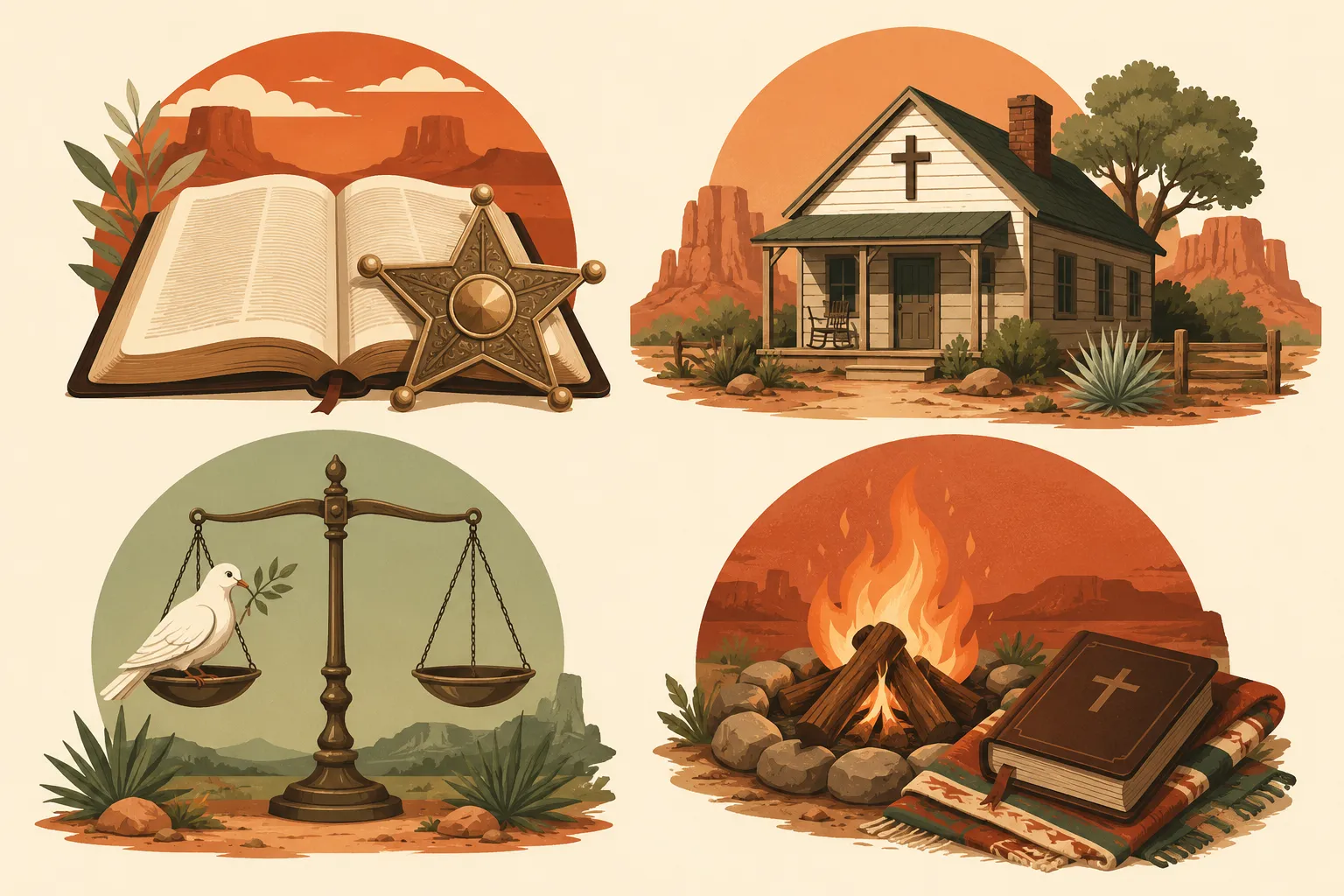
A western novel is genuinely Christian when faith changes what a character does at the moment of decision, not when a character quotes scripture or attends a Sunday service. The difference is structural. Religious characters can exist in any secular western; a Christian western is one where the moral architecture of the story only holds together because of what the characters believe about God, guilt, and grace.
Think of it this way: in a secular western, a man might spare his enemy because he’s tired of killing. In a Christian western, that same moment carries the weight of what mercy actually costs, and what it might mean before God. The story doesn’t have to say that out loud. The best ones never do.
Signs a western is genuinely faith-rooted:
- Characters wrestle with forgiveness as a moral obligation, not just an emotional release
- Redemption arrives after real cost, not as a tidy resolution
- The community of faith (a church, a circuit preacher, a shared prayer) functions as part of the story’s moral landscape
- Doubt and failure are present, grace shows up in response to them, not instead of them
“Walking with them, not talking at them”, that’s the line that separates Christian fiction that works from Christian fiction that preaches.
How Christian Western Fiction Differs From Regular Westerns
Christian western fiction and secular frontier fiction share the same geography, open land, contested claims, hard weather, harder men. What separates them is the question each genre is actually asking.
Secular westerns tend to ask: Who is strong enough to survive? Christian westerns ask: What does a person owe, and to whom? That shift changes everything about how justice, violence, and community get handled on the page.
In Silas Bellhaven’s The Mercy Line, the conscience line built into the series, “Where law runs out, a man finds what he answers to”, captures this exactly. The law in Mercy Crossing is real and often corrupt. What a man does when the law fails him is where the Christian story begins.
Key differences at a glance:
| Element | Secular Western | Christian Western |
|---|---|---|
| Justice | Earned by force or cunning | Accountable to something higher than law |
| Violence | Often cathartic or heroic | Present but weighted with consequence |
| Community | Survival-based | Covenant-based |
| Redemption | Optional story beat | Load-bearing structure |
| Female characters | Often secondary | Often moral centers of the story |
Best Christian Western Fiction Authors for Beginners
For readers new to Christian western fiction, start with authors who balance accessibility with genuine faith stakes. Three names stand out in 2026.
Heather Blanton is the clearest entry point. Her Burning Dress Ranch series completed in 2026 and is now available as a full set, a rare gift for readers who hate waiting. [1] The series is categorized as sweet/clean historical western romance, meaning no steam and a faith-positive arc throughout. Her standalone The Vaquero’s Heart (March 2026) offers a single-volume taste of her voice before committing to a series. [1]
Silas Bellhaven’s The Mercy Line is the right choice for readers who want frontier justice over frontier romance. The series opens with The False Warrant, where a territorial seal doesn’t make a custody lawful, and Caleb must decide what obedience is worth. That’s a question with no clean answer, which is exactly why it works.
For Oregon Trail and settler-era stories, titles like Yonder (A Sweeping Oregon Trail Saga Book 1) and Rustlers and Widows: A Christian Western (The Settlers Book 1) appear on curated Christian western lists as of August 2026. [8]
Christian Western Books Without Romance or Minimal Romance
Romance-free Christian western fiction is harder to find than it should be, but it exists. Silas Bellhaven’s The Mercy Line maintains a romance-absent content contract across its entire catalog, confirmed in the series description. The stories are built on conscience, land claims, labor bonds, and buried records. What a man answers to when the law runs out. No romantic subplot competes with that question.
For readers who don’t mind light romance but want faith and frontier justice as the primary engine, Heather Blanton’s titles are categorized as “sweet”, meaning romance is present but clean, and the faith arc carries equal weight. [1]
Choose based on your preference:
- No romance at all: The Mercy Line by Silas Bellhaven
- Light, clean romance with strong faith arc: Burning Dress Ranch series by Heather Blanton [1]
- Family and community focus over romance: Look for titles tagged “Christian Historical Fiction” rather than “Christian Western Romance”
Christian Western Authors Similar to Louis L’Amour but Faith-Focused
Louis L’Amour built his reputation on moral clarity, landscape as character, and men who chose honor over convenience. Christian western authors working in that same register, but with faith as the explicit moral foundation, include Silas Bellhaven and a handful of indie authors writing for the Kindle Unlimited market.
The L’Amour comparison is useful but imprecise. L’Amour’s heroes answer to a personal code. Christian western heroes answer to something they didn’t invent and can’t revise. That’s a meaningful difference in how guilt, forgiveness, and obligation get handled.
What to look for in a L’Amour-adjacent Christian western:
- Lean prose, not ornate description
- Moral weight carried by action and consequence, not narration
- A sense that the land itself has something to say about how people live on it
- Justice that costs the protagonist something real
The False Warrant and The Survey Line (Books 1 and 2 of The Mercy Line) both fit this description.
Where to Find Clean Western Fiction That Doesn’t Feel Preachy
Clean Christian western fiction that avoids moralizing is available on Amazon, Kindle Unlimited, and through small Christian publishers like CKN Christian Publishing. [1] The challenge isn’t finding clean content, it’s finding clean content where the faith feels lived rather than performed.
Practical discovery methods:
- Start with series pages on Amazon, a series with nine or more books signals an author who has found a consistent voice
- Read the “Look Inside” sample, preachy fiction usually reveals itself in the first chapter; if a character delivers a sermon in chapter one, the rest of the book will too
- Check Kindle Unlimited, the KU catalog carries a disproportionate share of indie Christian western authors who write for readers, not for awards committees
- Use curated lists, Cherry Picks Reviews maintains a verified Christian Westerns list updated through August 2026 [8]
- Look for “sweet” or “clean” tags, these signal no explicit content, though they don’t guarantee the faith will feel earned
The tone of a book’s cover copy tells you almost everything. If it reads like a disclaimer, the book probably preaches. If it reads like a question worth answering, it probably doesn’t.
Christian Western Fiction for Women Readers
Christian western fiction written with women readers in mind tends to center on community, moral courage, and the cost of truth-telling, not just action and gunplay. This is where the genre is most actively growing in 2026.
Heather Blanton’s Burning Dress Ranch series is explicitly marketed to women readers who want clean historical western romance with a genuine faith arc. [1] The Mercy House Mysteries by Silas Bellhaven, while set in modern Tennessee rather than the frontier, carry the same emotional DNA: a woman navigating a community where secrets have weight and grace is never cheap.
For frontier-era stories centered on women’s experience, look for:
- Homesteader and settler narratives (the Yonder Oregon Trail series) [8]
- Stories where the female protagonist holds the moral center of the community
- Titles tagged under both “Christian Women’s Fiction” and “Historical Western”
Christian Western Series vs. Standalone Books
For Christian western fiction specifically, series almost always reward the reader more than standalones. Faith development, doubt, failure, repentance, earned grace, takes time to feel real. A standalone can gesture at redemption; a series can make you believe it.
The Mercy Line by Silas Bellhaven uses a linked-protagonist structure, meaning each book follows a different man through Mercy Crossing, but the town and its moral landscape accumulate meaning across the series. By Book 6 (The Ash Ledger), the reader understands what it costs to tell the truth in that place.
When standalones work better:
- You’re testing a new author before committing to a series
- The story is a contained moral question (one claim, one verdict, one choice)
- You’re reading for comfort rather than depth
When series work better:
- You want faith that develops under pressure over time
- You want a community that feels lived-in
- You want earned grace, not delivered grace
How to Know If a Western Book Is Actually Clean Before Buying
The most reliable pre-purchase signals for clean Christian western content:
- Publisher imprint: CKN Christian Publishing titles are explicitly categorized by content level [1]
- “Sweet” label in the title or subtitle: Signals no explicit romantic content
- Amazon categories: Books listed under “Christian Westerns” rather than just “Western Romance” tend to hold a cleaner content standard
- Read the first chapter sample: Graphic content almost always appears early
- Check the series description: Authors like Silas Bellhaven state the content contract in the series copy (no profanity, no graphic violence, no explicit content)
- Curated review sites: Cherry Picks Reviews verifies content before listing [8]
Common mistake: Assuming “inspirational” automatically means clean. Inspirational fiction has a broad definition. “Sweet” and “clean” are more specific signals.
What Christian Western Fiction Gets Wrong About Frontier History
The most honest criticism of the genre is this: some Christian western fiction sanitizes the frontier to the point of dishonesty. Real frontier life involved land theft, broken treaties, brutal labor conditions, and communities where faith was often used to justify harm rather than prevent it.
The best authors in this genre hold both truths, the genuine faith of frontier believers and the genuine cost of how that era was built. Silas Bellhaven’s The Mercy Line engages directly with labor bond corruption, false legal records, and the gap between what the law says and what justice requires. That’s harder to write than a clean conversion scene, and it’s more honest.
What the best Christian westerns do with history:
- Acknowledge that the frontier was contested and costly, not just adventurous
- Let faith be tested by historical reality, not protected from it
- Avoid casting every antagonist as a cartoonish villain, real moral complexity is harder and truer
- Treat the land and its prior inhabitants with the same specificity given to the white settler characters
Earned redemption requires a real problem. Fiction that softens the problem to protect the reader isn’t serving the reader, it’s flattering them.
Christian Western Books That Focus on Family and Community
Some of the strongest Christian western fiction is built around community rather than individual heroism. The frontier church, the shared meal, the neighbor who shows up when the claim is contested, these are the moral centers of the best books in this genre.
The Mercy House Mysteries by Silas Bellhaven, while set in modern Tennessee, carries this community-centered DNA most clearly: Juniper Gap is a place where the church social and the murder investigation occupy the same moral space. For historical frontier community stories, the Burning Dress Ranch series by Heather Blanton and settler-era titles like Rustlers and Widows [8] both foreground the cost and comfort of building a life together.
Themes that signal community-centered Christian western fiction:
- Land disputes that affect multiple families, not just one hero
- The church as a gathering place where secrets and grace coexist
- Women characters who hold the community’s moral memory
- Consequences that ripple outward rather than resolving neatly for one protagonist
Indie vs. Traditionally Published Christian Western Authors
Both publish strong work in 2026, but they serve different reader needs. Traditionally published Christian western authors (through imprints like CKN Christian Publishing) tend to have stronger editorial polish and clearer content labeling. [1] Indie authors on Kindle Unlimited often publish faster, build longer series, and write more directly to reader preferences.
Silas Bellhaven is an indie author with nine books in The Mercy Line series, a catalog depth that traditional publishing rarely achieves this quickly. Heather Blanton publishes through CKN, which provides the content categorization and discoverability that helps new readers find her work. [1]
Choose traditionally published if: You want editorial polish, clear content labeling, and discoverability through Christian bookstores.
Choose indie/KU if: You want longer series, faster release schedules, and authors who are writing directly for the reader rather than for a market committee.
FAQ
What is the best first book to read in the Christian western genre? The False Warrant by Silas Bellhaven or A Donation to Die For by the same author (cozy mystery, not western) are both strong entry points. For historical western romance, start with The Vaquero’s Heart by Heather Blanton. [1]
Are Christian westerns only for women readers? No. The Mercy Line by Silas Bellhaven uses masculine-only leads and a conscience-driven structure that reads well across gender lines. The genre skews toward women readers overall, but the frontier justice subgenre has broad appeal.
Do Christian westerns have to be set in the 1800s? No, but most are. The frontier setting (1860s, 1900s) carries the moral weight the genre relies on, contested land, absent law, communities building something from nothing. Modern settings can carry similar themes but require more work to establish the same stakes.
What’s the difference between “sweet” and “clean” in Christian western labels? “Sweet” typically refers specifically to romantic content (no explicit scenes). “Clean” is broader, no profanity, no graphic violence, no explicit content of any kind. The best Christian westerns are both.
Is Kindle Unlimited worth it for Christian western readers? Yes. The KU catalog carries a disproportionate share of indie Christian western series, including The Mercy Line. For readers who consume multiple books per month, the subscription pays for itself quickly in this genre.
How long does a typical Christian western series run? Anywhere from three books (a trilogy) to ten or more. The Mercy Line currently runs nine books. The Mercy House Mysteries runs ten. Longer series allow faith development to feel genuinely earned rather than rushed.
Are there Christian westerns that address Native American characters respectfully? This is an area where the genre has historically underperformed. The most honest authors acknowledge the contested nature of frontier land without either romanticizing or erasing Indigenous presence. Look for authors who treat the land’s prior inhabitants with the same narrative specificity given to settler characters.
Can I read Christian western series out of order? Some series use linked-protagonist structures (like The Mercy Line) where each book follows a different character, these can be read more flexibly. Series with a single protagonist throughout should be read in order.
Where is Christian western fiction heading in 2026? Toward longer indie series, stronger female-led frontier stories, and more honest engagement with frontier history. The completion of Heather Blanton’s Burning Dress Ranch as a full set [1] and the continued growth of The Mercy Line both signal a maturing genre with real staying power.
Conclusion
The Christian western fiction authors worth reading in 2026 are writing stories where the frontier is morally real, where land claims matter, where labor bonds trap people, where the law and justice are not the same thing, and where faith shows up not as a comfort but as a demand. That’s what separates the best books in this genre from the ones that merely have a preacher in the background.
Where to start:
- For romance-absent frontier justice: Begin with The False Warrant (Book 1 of The Mercy Line by Silas Bellhaven), Amazon link
- For clean historical western romance: Start with The Vaquero’s Heart by Heather Blanton or the complete Burning Dress Ranch set [1]
- For community-centered frontier stories: Look for settler-era titles on the Cherry Picks verified Christian Westerns list [8]
- For Kindle Unlimited readers: Search the KU catalog by “Christian Western” and sort by series length, longer series signal authors who have found a consistent, trustworthy voice
The readers who find this genre and stay tend to say the same thing: they didn’t know they wanted faith handled this honestly until they found an author who did it. That’s not a small thing. That’s the whole point.
References
[1] New Releases Books – https://cknchristianpublishing.com/category/new-releases-books/ [8] Christian Westerns – https://www.cherrypicksreviews.com/christian-westerns