Last updated: September 1, 2026
Quick Answer: Dexter is not a show built for Christian audiences, and it doesn’t pretend to be. But the questions it raises, about guilt, justice, the nature of evil, and whether a broken person can ever be made whole, are deeply biblical questions. Christian readers and viewers can engage thoughtfully with Dexter’s moral framework, provided they go in with clear eyes and a clear sense of what the show offers versus what it cannot deliver: earned grace.
Key Takeaways
- Dexter explores moral ambiguity, vigilante justice, and the tension between law and conscience, themes that intersect meaningfully with Christian ethics, even when the show’s conclusions differ sharply from a biblical worldview.
- The show contains significant graphic violence, adult content, and dark themes that make it inappropriate for many Christian viewers, particularly those seeking clean Christian fiction.
- Theologically, Dexter has been compared to the Lutheran concept of simul iustus et peccator, simultaneously righteous and sinful, making him useful for Christian reflection even as an unbelieving character [2].
- Season 6 directly engages questions of faith, belief, and whether science can substitute for God, making it the most explicitly theological stretch of the series [8].
- Dexter’s “code” is a secular substitute for moral law, not a Christian ethic, the distinction matters when evaluating the show from a faith perspective.
- Dexter: Resurrection drew 4.4 million cross-platform viewers in its first seven days (Paramount, 2025), confirming the franchise’s ongoing cultural weight.
- Christian readers fascinated by Dexter’s moral tension have better options in faith-rooted psychological thrillers that ask the same hard questions without the graphic content.
- Redemption in Dexter is incomplete and costly, which, ironically, makes it more theologically honest than stories where grace arrives without consequence.
Is Dexter Appropriate for Christian Audiences?
Dexter is not appropriate for most Christian audiences in the way a clean Christian fiction title would be. The show contains graphic depictions of violence, sexual content, and morally complex scenarios presented without clear resolution or condemnation.
That said, “appropriate” is not a single threshold. Mature Christian readers and viewers who engage critically with difficult cultural texts, the way one might read Crime and Punishment or engage with a morally complex film, may find Dexter worth examining on its own terms [3]. The key is going in with discernment rather than passive consumption.
What to weigh before watching:
- Graphic violence is frequent and detailed, not implied
- Sexual content is present across multiple seasons
- The protagonist’s worldview is explicitly secular and at times nihilistic
- The show does not resolve moral questions from a Christian framework
- Season 6 engages faith themes directly but does not affirm them [8]
Choose to engage if: You’re a mature reader or viewer who processes dark fiction critically and wants to understand the cultural conversation around moral antihero narratives.
Choose to skip if: You’re sensitive to graphic violence, you’re looking for content that affirms faith, or you prefer stories where hope in the dark is built into the structure rather than incidental.
For readers who want that same psychological tension without the content concerns, the Psychological Thriller With Purpose framework is worth understanding, faith as the engine of suspense, not an afterthought.
What Are the Main Moral Themes in Dexter?
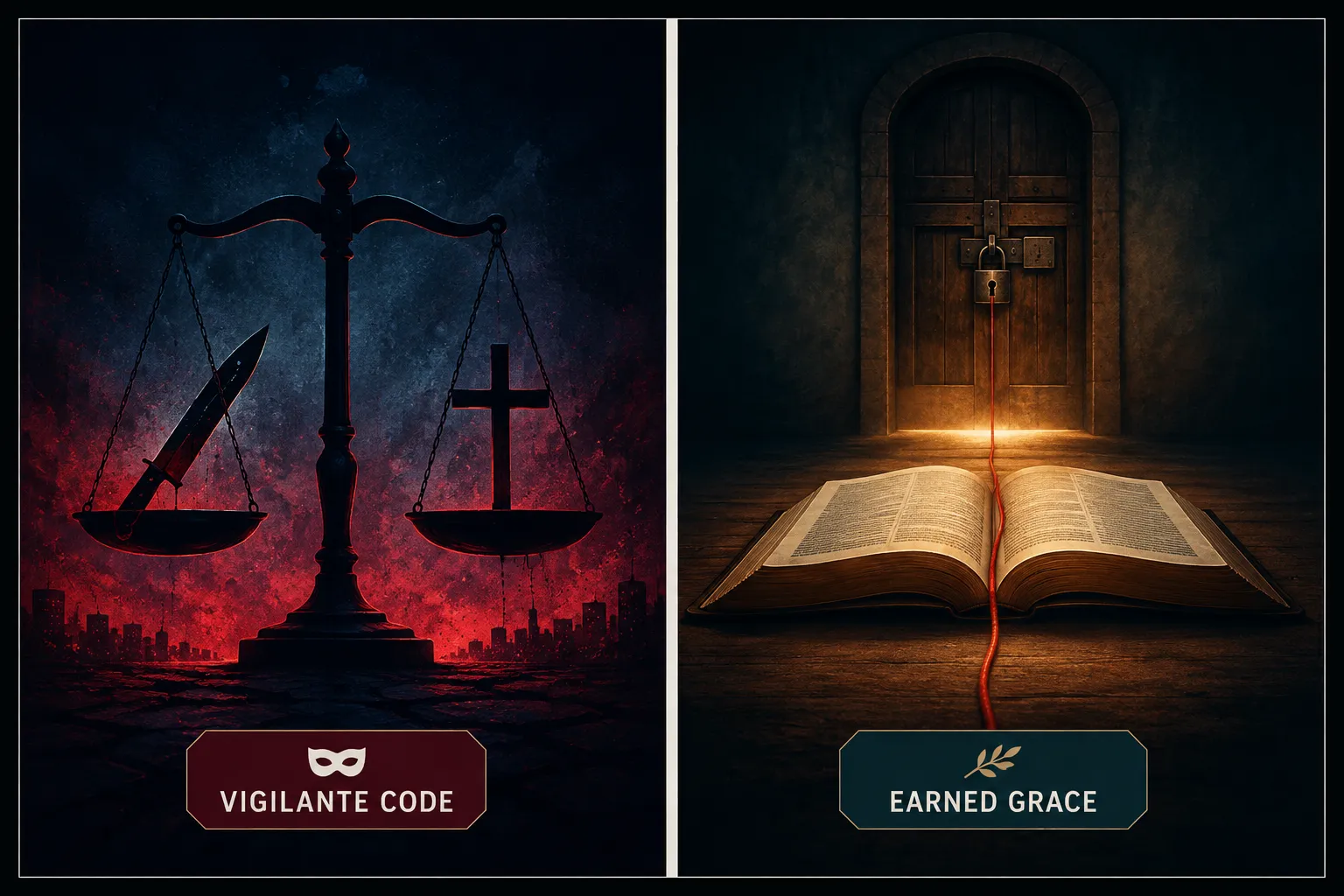
Dexter’s central moral themes are vigilante justice, the nature of evil, self-deception, and the question of whether a person defined by darkness can ever be redeemed. These themes overlap significantly with Christian theology, even when the show’s answers diverge from it.
Core moral questions the show raises:
| Theme | What Dexter Asks | What Christian Ethics Answers |
|---|---|---|
| Vigilante justice | Is killing evil people justified? | Justice belongs to God; human vengeance corrupts (Romans 12:19) |
| The “code” as moral law | Can a self-made rule substitute for conscience? | Moral law is written on the heart, not invented by it (Romans 2:15) |
| Guilt and self-knowledge | Can Dexter truly know himself? | Self-deception is a core human problem; only grace cuts through it |
| Redemption | Can Dexter be made whole? | Wholeness requires repentance and a power outside the self |
| Mercy vs. justice | Does the victim’s guilt change the moral weight of killing? | Mercy and justice are held together in God’s character, not traded off |
The show’s most honest moment may be that Dexter’s code, his father’s rules for channeling his violent impulses, never actually saves him. It manages him. That distinction is theologically significant: management is not transformation. Mercy and justice, in the Christian framework, require both [2].
How Does Dexter Explore Redemption and Faith?
Dexter explores redemption as an open wound rather than a destination. The show gestures toward transformation repeatedly, through relationships, through his son Harrison, through moments of genuine remorse, but it cannot deliver actual redemption because it has no theological foundation to build one on [4].
This is the central frustration for Christian readers engaging with Dexter’s arc: the show understands the shape of redemption (cost, loss, the desire to be different) without understanding its source.
“Redemption that costs something is closer to the biblical model than cheap grace, but cost alone isn’t enough. Someone has to pay what the sinner cannot.”
Where Dexter gets redemption right:
- Consequences are real and accumulate, no clean exits
- Dexter’s darkness is never fully glamorized; it hollows him out
- His relationship with Harrison in New Blood and Resurrection shows genuine love straining against genuine damage
Where Dexter’s redemption falls short:
- There is no repentance in the theological sense, no turning toward something outside himself
- The “code” is self-referential; it cannot offer forgiveness, only rules
- The show’s ending choices (across both New Blood and Resurrection) prioritize narrative consequence over moral resolution
For readers who want to understand how redemption arcs work in Christian thrillers and dark fantasy, the contrast with Dexter is instructive: earned grace still requires grace, not just earning.
How Do Christians Interpret Dexter’s Vigilante Justice?
Christians have interpreted Dexter’s vigilante justice in two broad ways: as a cautionary picture of what happens when human beings appoint themselves executors of divine judgment, and as a useful mirror for examining the church’s own complicated history with retributive thinking [2].
The Mockingbird theological reading is the most developed: it frames Dexter as simul iustus et peccator, simultaneously righteous and sinful, and argues that his internal division, his “law,” and his inability to escape his own nature make him a useful figure for Christian reflection, not because he models faith but because he models its absence [2].
The key distinction Christian readers should hold:
- Dexter believes his code makes him better than ordinary killers. Scripture suggests that self-justification is itself the problem, not a partial solution (Proverbs 21:2).
- The show occasionally punishes this belief, characters who trust Dexter’s judgment are often destroyed by it.
- Retributive justice without mercy is not the Christian model; it’s the Old Testament misread [2].
Think Christian’s analysis of the show noted the tension between forcing a faith reading onto Dexter and recognizing what the show actually offers: a portrait of someone who needs grace and cannot find it within himself [1].
Does Dexter Have a Christian Message or Ending?
Dexter does not have a Christian message, and neither the original series finale nor New Blood delivers a Christian ending. What the show does deliver, particularly in New Blood, is an ending that takes moral consequence seriously, which is closer to a biblical instinct than most secular drama manages.
New Blood ended with Harrison shooting Dexter. That’s a son killing a father to stop a cycle of violence. It is not redemption. It is consequence, which is not the same thing, but it is honest [5].
Dexter: Resurrection, which drew 3.1 million cross-platform viewers in its first three days (Paramount, 2025), appears to continue the franchise with Dexter surviving and caught “between two killers.” Whether this deepens or undermines the moral weight of New Blood‘s ending remains an open question for viewers following the revival.
From a faith perspective, the ending questions to hold:
- Does the story treat evil as real and costly? (Yes, mostly.)
- Does the story offer a path to genuine transformation? (No, not yet.)
- Does the story affirm that mercy and justice can coexist? (It asks the question; it doesn’t answer it.)
Dexter’s Code vs. Christian Ethics: What’s the Difference?
Dexter’s code and Christian ethics share surface similarities, both involve rules, both are concerned with protecting the innocent, both acknowledge that some actions are wrong. The difference is foundational.
Dexter’s code:
- Self-authored by Harry Morgan, Dexter’s adoptive father
- Pragmatic: it manages Dexter’s impulses rather than transforming them
- Consequentialist: the rightness of an action depends on the target’s guilt
- Offers no forgiveness, no repentance, no path to being made new
Christian ethics:
- Grounded in the character of God, not human judgment
- Concerned with transformation of the person, not management of behavior
- Holds that all human beings bear the image of God, including those who do evil
- Offers mercy alongside justice, not instead of it
The code is, in theological terms, law without gospel. It can condemn. It cannot save [2][10].
This is exactly the tension that makes Dexter compelling to Christian readers: the show builds a character who understands law deeply and has no access to grace at all. That is a recognizable human condition. The question faith-rooted fiction asks is what happens when grace enters that same story.
Are There Christian Characters or Values in Dexter?
Dexter does not feature prominent Christian characters in the theological sense, though Season 6 introduces Brother Sam, a reformed killer turned pastor, who represents the show’s most earnest attempt to portray genuine faith [8].
Brother Sam is significant precisely because the show takes his faith seriously rather than mocking it. He is not naive. He has done real violence and found real transformation, which makes him the closest thing to a biblically coherent redemption arc in the entire series. His death in Season 6 is the show’s way of asking whether faith can survive a world like Dexter’s. The answer the show gives is ambiguous. The answer Christian readers might bring to it is not.
Christian-adjacent values present in Dexter:
- Protection of the innocent as a moral obligation
- The weight of guilt and the desire to be free of it
- Love as a complicating force that disrupts self-sufficiency
- The recognition that a person’s past does not have to be their permanent identity
Where Christian values are notably absent:
- Forgiveness as a transformative act (not just a sentiment)
- Repentance directed toward anyone outside the self
- The possibility of being made genuinely new, not just better-managed
Dexter: New Blood and Resurrection, A Faith Perspective on the Endings
New Blood‘s ending, a son killing his father to stop generational violence, carries real theological weight even outside a Christian framework. It is a story about inheritance: what we pass down, what we refuse to pass down, and what it costs to break a cycle [5].
From a faith perspective, the problem with New Blood is that breaking the cycle requires Harrison to become, in some sense, what Dexter was. The show presents this as tragic necessity. Christian theology would call it a picture of why human beings cannot save themselves, even the act of stopping evil requires someone to carry its weight.
Resurrection, now in production for Season 2 (confirmed filming in New York City alongside James Remar, April 2026), appears to sidestep New Blood‘s moral finality. Whether that choice strengthens or weakens the franchise’s moral coherence is a fair question for any thoughtful viewer.
Faith-lens questions for New Blood:
- Who pays the cost of generational sin, and is that fair?
- Can a person choose not to inherit what was given to them?
- Is stopping evil the same as being freed from it?
Best Psychological Thrillers With Redemption Arcs for Faith-Based Readers
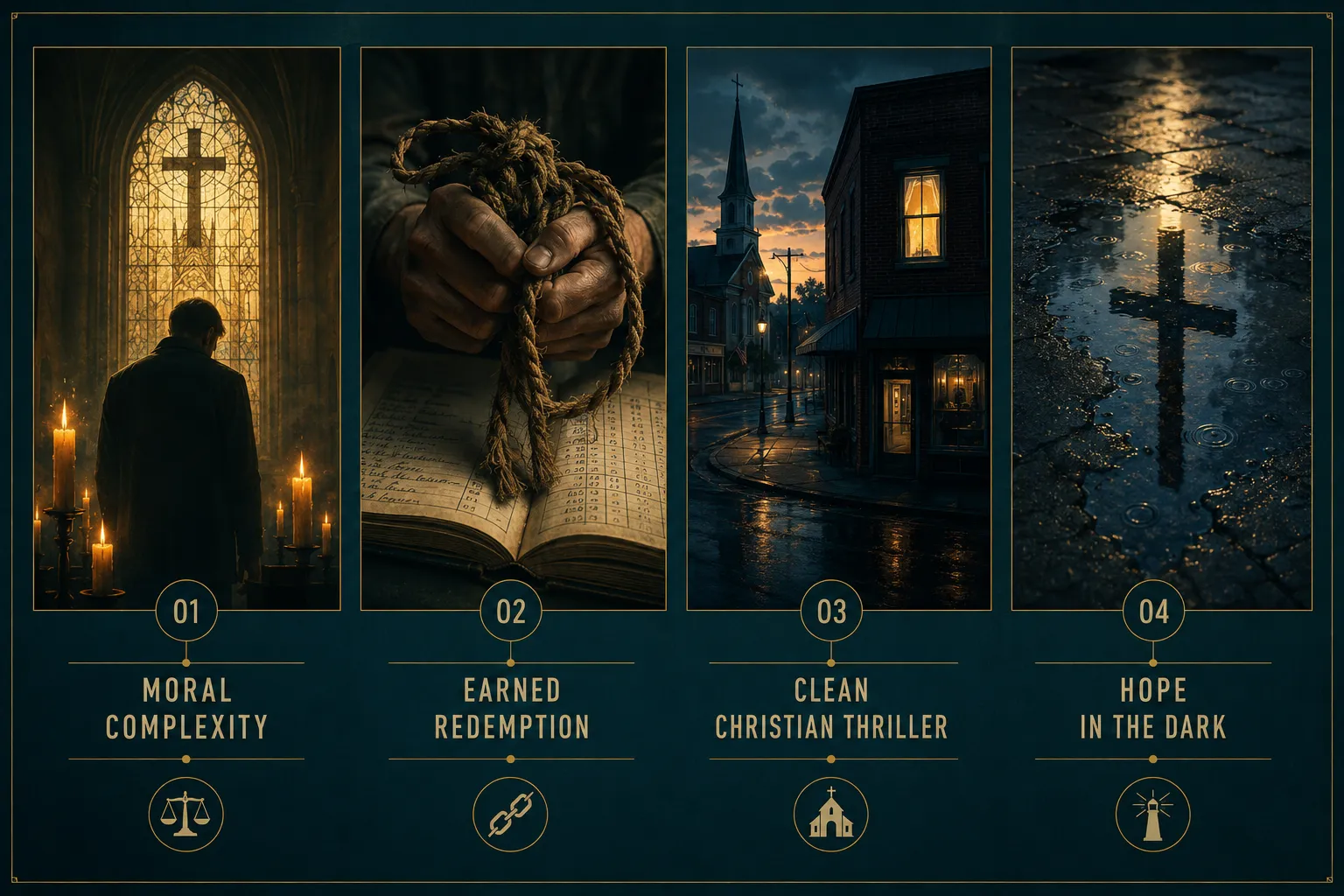
Christian readers drawn to Dexter’s moral complexity have better options, stories that ask the same hard questions about guilt, justice, and transformation without the graphic content, and that can actually deliver on the redemption arc the show only gestures toward.
What to look for in a faith-rooted psychological thriller:
- Moral stakes that are real, not decorative
- A protagonist who doubts, fails, and faces genuine cost
- Redemption that arrives after consequence, not instead of it
- Faith handled as lived experience, not sermon
Recommended starting points:
The Gathering Light series (Silas Bellhaven), When Hannah Sleeps, When the Voice Breaks, and When the Prayer List Opens are clean Christian psychological thrillers built around the question of who controls the record of someone’s truth. Each book features a new protagonist in genuine jeopardy, with faith under fire rather than faith as comfort. Browse the series on Amazon.
For readers who want to understand how Christian psychological thrillers use unreliable perception without undermining hope, that tension is exactly what separates faith-rooted suspense from secular dark drama.
The Mercy House Mysteries offer a gentler entry point, cozy mystery with real moral weight, set in Juniper Gap, Tennessee, where faith is woven into the community rather than announced.
The core difference: In clean Christian fiction, hope in the dark is structural, not accidental. The story is built so that grace can arrive, because the author believes it can.
Can You Recommend Shows Like Dexter That Align With Christian Beliefs?
No mainstream television show replicates Dexter’s tone while fully aligning with Christian beliefs, that combination doesn’t exist at the prestige drama level. But the underlying appetite (moral complexity, a protagonist with darkness in their past, justice questions that don’t resolve cleanly) is exactly what faith-rooted fiction can serve.
Shows with more Christian-compatible elements:
- Rectify (SundanceTV), a man released from death row rebuilding his life; quiet, morally serious, no graphic violence
- When Calls the Heart, lighter, but faith-present and clean
- The Chosen, directly faith-based, high production quality
For readers rather than viewers: The Earned Redemption Fiction category covers stories where grace shows up after cost, which is the thing Dexter fans are actually looking for, even if they don’t name it that way.
Conclusion: What Dexter Offers Christian Readers, and What It Cannot
Dexter for Christian readers is most useful as a mirror, not a model. The show is honest about the weight of guilt, the inadequacy of self-made moral codes, and the way darkness compounds across generations. Those are real things, and the show renders them with enough seriousness to be worth engaging.
What Dexter cannot offer is what only faith-rooted fiction can: a story where the cost of sin is real and the possibility of genuine transformation is also real. Mercy and justice held together. Redemption that costs something, and then actually arrives.
If Dexter’s questions resonate, the next step is finding stories built to answer them honestly. The Gathering Light series is a strong starting point for readers who want psychological suspense with real stakes and faith handled as lived experience rather than formula.
Actionable next steps:
- Engage Dexter critically, if you choose to watch, bring the theological questions with you rather than setting them aside.
- Read the Mockingbird analysis [2] for the most developed Christian-lens treatment of the show’s themes.
- Try When Hannah Sleeps for a clean Christian psychological thriller that handles moral complexity without the content concerns.
- Explore the Psychological Tension Techniques tag for more on how faith-rooted suspense builds genuine stakes.
- Find your community, the Faith and Storytelling conversation is worth joining if you’re processing how dark fiction and faith intersect.
Stories that walk with readers through hard questions, rather than talking at them, are worth finding. They exist. They’re rooted in faith. And they don’t require you to set your convictions at the door to enjoy them.
FAQ
Q: Is Dexter appropriate for Christian teenagers? A: No. The graphic violence, sexual content, and morally unresolved protagonist make it unsuitable for teenage audiences, regardless of faith background. Mature adult viewers engaging critically is a different question.
Q: What season of Dexter is most relevant for Christian reflection? A: Season 6 is the most theologically engaged, introducing Brother Sam as a genuine faith character and directly asking questions about belief, science, and God [8]. It also contains some of the series’ most disturbing content, so the tradeoff is real.
Q: Does Dexter ever become a Christian? A: No. Dexter remains explicitly secular throughout the series. Season 6 shows him considering faith, but he does not convert or adopt a Christian worldview [8].
Q: What is the “code” in Dexter, and how does it compare to biblical law? A: The code is a set of rules Harry Morgan created to channel Dexter’s violent impulses toward criminals. It functions like law without gospel, it can regulate behavior but cannot transform the person or offer forgiveness [2][10].
Q: Is Dexter: New Blood better or worse than the original series from a moral standpoint? A: New Blood takes moral consequence more seriously than the original series finale, which was widely criticized for its lack of resolution. The ending is tragic rather than triumphant, which is more honest [5].
Q: What does the Lutheran concept simul iustus et peccator have to do with Dexter? A: Mockingbird’s theological reading applies this concept, simultaneously righteous and sinful, to Dexter’s divided nature, arguing that his internal conflict makes him useful for Christian reflection even as an unbeliever [2].
Q: Are there clean Christian psychological thrillers with similar moral complexity? A: Yes. The Gathering Light series by Silas Bellhaven (When Hannah Sleeps, When the Voice Breaks, When the Prayer List Opens) offers clean Christian psychological suspense with real moral stakes and faith handled honestly.
Q: How many viewers watched Dexter: Resurrection? A: Paramount reported 3.1 million cross-platform viewers in the first three days and 4.4 million in the first seven days, describing it as a franchise record (Paramount Press Express, 2025).
Q: Can faith-based readers enjoy dark fiction without compromising their values? A: Yes, with discernment. The question is whether the darkness serves truth or merely entertains with it. Faith-rooted fiction can hold moral complexity honestly without glorifying sin, that’s the distinction worth looking for.
Q: Where can I find more faith-rooted fiction that handles moral gray areas? A: The From Small-Town Sheriff to Reluctant Outlaw: Moral Gray Areas in Christian Western Fiction article is a good starting point, as is the full Silas Bellhaven catalog at Amazon.
References
[1] Forcing Faith On Dexter – https://thinkchristian.net/forcing-faith-on-dexter [2] Dexter Retributive Justice And Knights Of Faith – https://mbird.com/religion/dexter-retributive-justice-and-knights-of-faith/ [3] Dexter Christian Review – https://christian-review.com/dexter-christian-review/ [4] Sin And Redemption – https://religion-in-dexter.webnode.page/sin-and-redemption/ [5] Rw10648883 – https://www.imdb.com/title/tt33043892/review/rw10648883/ [8] Dexter Season 6 Selected Episode Guide – https://fullerstudio.fuller.edu/dexter-season-6-selected-episode-guide/ [10] Dexter – https://stablecross.com/files/Dexter.html