

Last updated: August 16, 2026
Quick Answer: Faith in fiction works best when it functions as a natural engine of the plot, driving character choices, creating conflict, and shaping consequences, rather than arriving as commentary inserted between scenes. The difference between a spiritual journey that resonates and one that feels like a sermon is almost always structural: faith that costs something reads as real; faith that arrives as explanation reads as intrusion.
Key Takeaways
- Show faith through choice and consequence, not through narration or scripture-dropping mid-scene
- Doubt is not the enemy of a faith arc, it’s what makes the arc honest and the resolution earned
- A misbelief-to-truth transformation is the structural backbone of any believable spiritual journey
- Prayer and spiritual practices belong in plot when they change what a character does next, not when they pause the story to describe what a character feels
- The litmus test for every faith-forward line: Is this what the character would say, or what I want to tell the reader? [1]
- Conversion moments are not the same as character development, one is an event, the other is a through-line
- Faith elements can serve readers across genres and across belief backgrounds when they’re handled as lived experience, not doctrine
- Subtext carries more weight than direct statement, readers are spiritually intelligent and will meet the story halfway [2]
- Religious conflict in fiction works when it’s rooted in competing loyalties, not competing theology lectures
- Earned grace, mercy that arrives after real cost, is the difference between cheap resolution and a story that stays with a reader
What Does It Mean to Write Authentic Faith in Fiction
Authentic faith in fiction means that a character’s belief is load-bearing, it shapes what they risk, what they refuse, and what they can’t walk away from. It is not a label attached to a character (“she was a woman of deep faith”) but a set of convictions that produce visible behavior under pressure.
Faith in fiction becomes authentic when:
- The character’s beliefs create genuine conflict, not just comfort
- Spiritual conviction costs the character something real, a relationship, a reputation, a choice they cannot undo
- The resolution, when it comes, has been paid for by the plot itself
The Christian fiction market has expanded significantly in 2026, with reader demand centering on stories that feel honest rather than formulaic [4][10]. That demand is a signal: readers already know what performed piety looks like, and they’re tired of it. What they want is faith that walks with them through the story, not faith that talks at them from above it.
How Do You Show Spiritual Growth in a Character Without Being Preachy
Spiritual growth shows through changed behavior, not stated belief. A character who begins the story unable to forgive and ends it choosing mercy, without ever announcing “I have learned to forgive”, has demonstrated a faith arc. A character who announces it has delivered a speech.
Practical steps for showing growth without preaching:
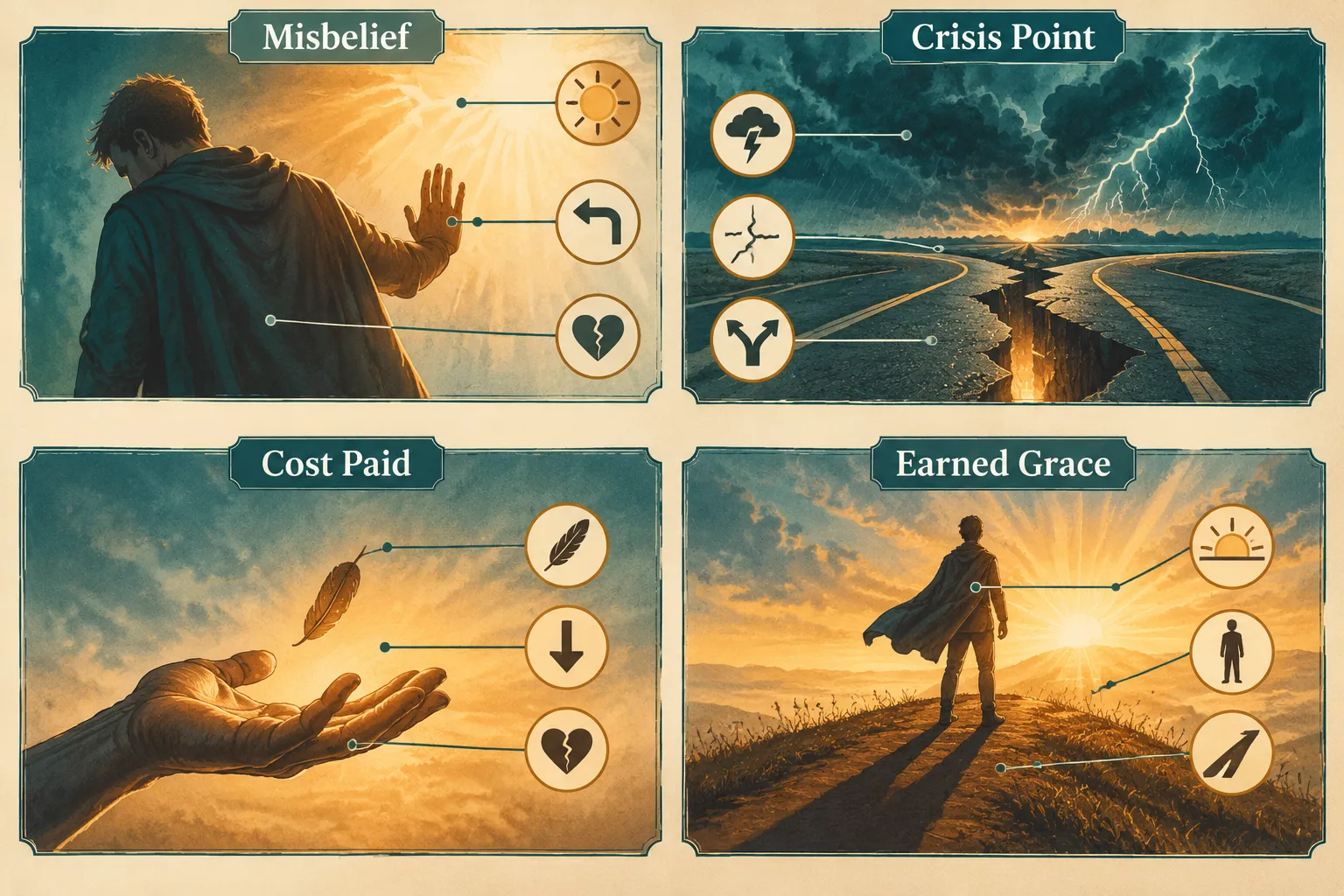
- Map the misbelief first. What does the character wrongly believe about God, themselves, or others at the start? That misbelief is the engine.
- Let plot events pressure the misbelief, not a mentor character who explains it.
- Mark growth through decision points, not reflection paragraphs. The character chooses differently at the end than they would have at the beginning.
- Resist the summary. Don’t write the sentence that names what the character learned. Trust the scene to carry it. [2]
“Is this what the character would say, or what I want to tell the reader?” That single question, applied to every faith-forward line, eliminates most of the preaching before it reaches the page. [1]
What’s the Difference Between Faith-Based Fiction and Fiction With Faith Elements
Faith-based fiction is built on a worldview framework where spiritual reality is load-bearing to the plot, remove the faith and the story collapses. Fiction with faith elements includes characters who practice religion, but the story could function without it.
Neither is wrong. But they require different craft decisions:
| Faith-Based Fiction | Fiction With Faith Elements | |
|---|---|---|
| Faith’s role | Structural, drives plot and character arc | Atmospheric, adds texture and identity |
| Spiritual conflict | Central to the story’s stakes | Present but not primary |
| Reader expectation | Wants the worldview honored | May or may not share the belief |
| Risk | Can tip into preaching | Can feel like faith is decoration |
The Silas Bellhaven catalog operates as faith-based fiction: in The False Warrant, Caleb’s question about what obedience is worth isn’t a subplot, it is the plot. In When Hannah Sleeps, the retreat’s manipulation of testimony language is inseparable from the spiritual stakes of the story. Faith is structural, not decorative.
How Do Authors Balance Religious Themes With Mainstream Audiences
The answer is subtext over sermon. Readers who don’t share a character’s faith can still follow the emotional and moral logic of that faith under pressure. What they can’t follow, and won’t, is a character stopping to explain theology to them. [3]
Strategies that work across belief backgrounds:
- Ground spiritual stakes in universal human questions: guilt, forgiveness, belonging, what we owe each other
- Let the character’s doubt do the work of making the faith accessible, a character wrestling with God is more relatable than one who has it settled
- Use concrete, sensory details of spiritual practice (a worn hymnal, a prayer said under breath at a kitchen table) rather than abstract declarations
- Trust what craft teachers call reader spiritual intelligence, the capacity of readers to feel the weight of faith even when they don’t share the specific doctrine [2]
What Are Common Mistakes Writers Make When Writing About Faith
The most common mistake is treating faith as the answer rather than the question. When faith arrives in a story as a solution, the character prays, feels peace, problem resolved, it reads as wish fulfillment, not truth. [1]
Other frequent errors:
- Scripture-dropping without integration: quoting a verse in narration that the character would never actually think in that moment
- The mentor who explains: a wise pastor or elder character who exists to deliver the story’s theme in dialogue
- Cheap conversion: a dramatic salvation moment that isn’t earned by the character’s prior arc
- Avoiding the dark: writing around doubt, anger at God, or spiritual failure because it feels unsafe, which produces stories that feel sanitized rather than honest [3]
- Confusing the author’s conviction with the character’s voice: the character should speak from their own limited, developing understanding, not from the author’s fully-formed theology
How Do You Write Doubt and Spiritual Crisis in a Believable Way
Doubt is not the opposite of faith in fiction, it’s the proof that the faith is real. A character who never questions, never struggles, and never sits in the silence of an unanswered prayer is not a person of deep faith. They’re a placeholder. [6]
Writing doubt well means:
- Letting the doubt be specific, not generic. “Why didn’t God stop this?” is stronger than “She began to question her faith.”
- Giving doubt real stakes. What does the character lose if the doubt wins? What does she lose if she suppresses it?
- Not resolving it too quickly. Spiritual crisis that clears up in two scenes is as unconvincing as physical illness that heals overnight with no explanation.
- Allowing the resolution to be partial. Not every question gets answered. Sometimes the character chooses to trust without understanding, and that choice, made honestly, is the arc. [7]
The Sarel Chronicles handle this directly: Elya Renn carries the weight of prayers the House of Witness refused to record. Her doubt isn’t a detour from the story’s faith, it’s the story’s faith, tested and worked through.
Can You Have a Spiritual Journey in a Non-Religious Character
Yes. A spiritual journey doesn’t require a character who uses religious language. It requires a character whose deepest convictions are tested, broken, and rebuilt through the events of the plot. [7]
A non-religious character can carry a spiritual arc when:
- The story asks questions about meaning, justice, mercy, or what we owe each other, and the character’s answers shift
- The character encounters something that exceeds their existing framework and has to decide what to do with it
- The arc moves from self-sufficiency toward something larger than the self, whether that’s named as God or not
For writers working in clean Christian fiction, this matters because secondary characters, antagonists, and even protagonists in earlier stages of their arc may not be believers. Their spiritual movement, toward or away from faith, is still a spiritual arc, and it still needs to be earned by the plot.
What Techniques Do Successful Authors Use to Weave Faith Into Plot Naturally
The most reliable technique is making faith the source of the character’s central conflict, not the resolution of it. When a character’s belief in mercy puts her at odds with a system built on judgment, every plot beat becomes a test of that belief. Faith drives the story forward rather than pausing it. [5]
Craft techniques that work:
- The misbelief framework: identify the false belief the character holds at the start, then build plot events that pressure it specifically
- Consequence as theology: let the natural consequences of choices carry the moral weight, rather than having a character or narrator explain it
- Subtextual Scripture: a verse or prayer that lives in the background of a scene without being quoted directly, the reader feels it without being told to feel it [2]
- Spiritual practices as plot beats: prayer, confession, or a moment of worship that changes what the character does next, not just how they feel
- The cost before the grace: structure the story so that mercy arrives after something has genuinely been lost or surrendered, earned grace, not cheap grace [1][3]
How Do You Avoid Making Faith Feel Like a Plot Device
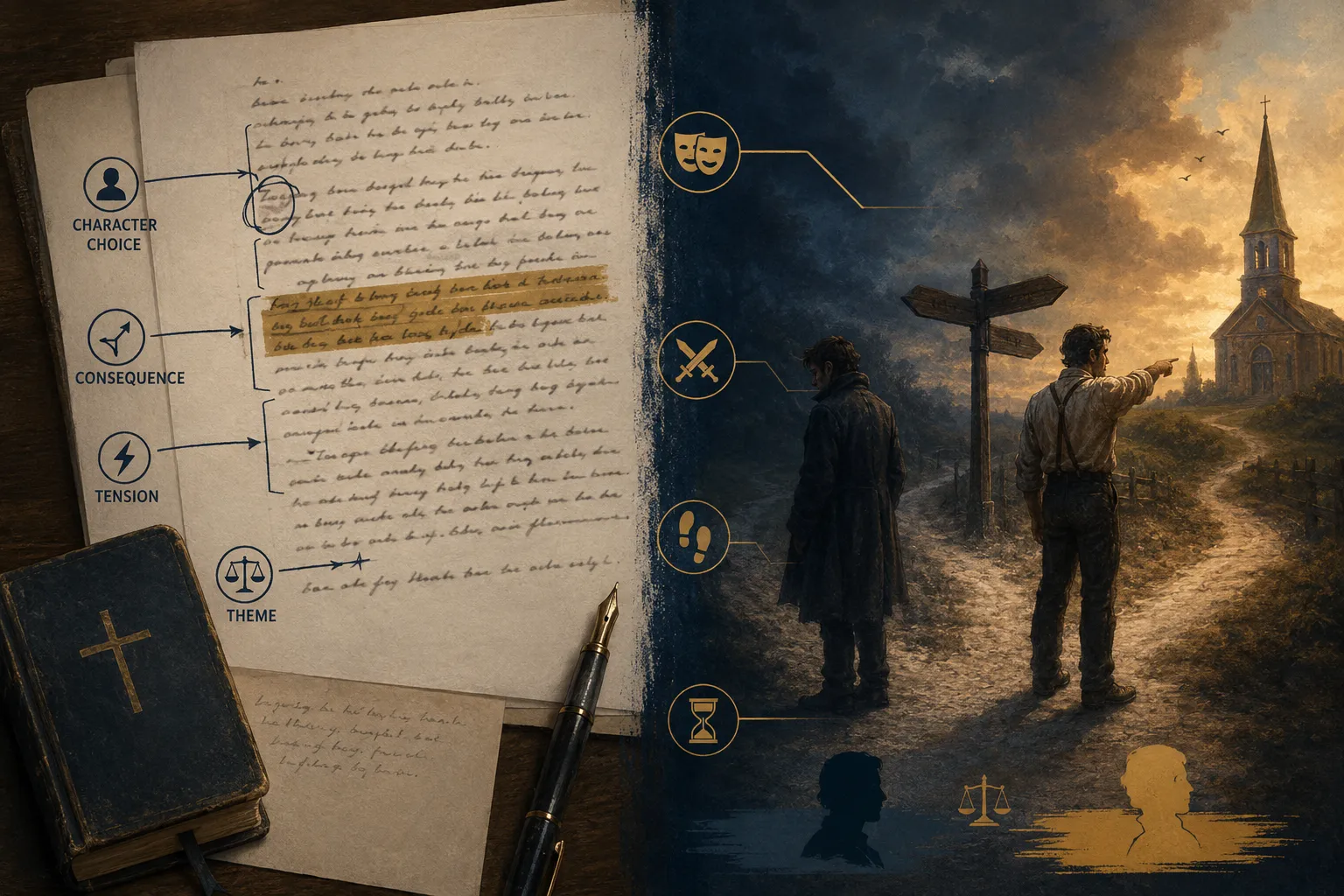
Faith becomes a plot device when it exists to solve problems the plot can’t solve on its own, the character prays and the answer arrives, the conversion happens and the villain softens, the miracle resolves the conflict. That’s not faith as lived experience. That’s faith as a narrative shortcut. [6]
To keep faith from functioning as a device:
- Faith should create problems as often as it solves them. A character’s conviction that she must tell the truth even when silence would protect her is a faith element that generates conflict, not resolves it.
- Don’t use spiritual peace as a scene-ender. If the character prays and then feels calm, the scene has to continue, the problem is still there, and now she has to act.
- Let God be silent sometimes. The character prays and hears nothing. That silence is more honest than a story where every prayer produces a clear answer.
- Consequences should follow from character choices, not from divine intervention that bypasses the character’s agency.
Is Faith in Fiction Better for Certain Genres or All of Them
Faith works in every genre, but the craft demands shift by genre, and the failure modes are different. [7]
- Cozy mystery: Faith shows up in community, in the character’s moral compass during an investigation, in the question of what justice actually requires. The risk is sentimentality.
- Psychological thriller: Faith under manipulation, when a system weaponizes spiritual language, creates some of the sharpest possible stakes. The risk is that the faith looks naive.
- Epic fantasy: Secondary-world faith can carry the full weight of covenant theology without the baggage of denominational association. The risk is allegory that becomes too obvious.
- Western: Frontier settings strip away institutional religion and force faith to be personal and costly. The risk is that the lone-gunman-with-a-conscience becomes a cliché.
- LitRPG: Earned progression mechanics mirror the theology of sanctification, growth through cost, not through shortcuts. The risk is that the system metaphor crowds out the actual spiritual stakes.
The Silas Bellhaven catalog covers all five, with the same conviction at the center: faith is load-bearing, not decorative, regardless of the setting.
How Do You Write Faith for Readers Who Don’t Share Your Beliefs
Write the human experience of belief, not the doctrinal content of it. A reader who has never prayed can still feel the weight of a character who kneels in a dark room and speaks into silence. A reader who doesn’t share a character’s theology can still understand what it costs that character to act against their own interests because of what they believe. [5][6]
Practical guidance:
- Lead with emotion and consequence, not vocabulary. “She believed God was watching” lands differently than a paragraph of theological explanation.
- Avoid insider language that creates distance, or, when you use it, make sure context carries the meaning
- Let doubt and struggle be the bridge. Readers who don’t share a faith often find it most accessible at its most honest, when the character is arguing with God, not praising Him
- Don’t write toward conversion. A story that exists to convert the reader is a tract, not a novel. A story that shows faith honestly may do more for a skeptical reader than any direct argument could. [3]
What’s the Difference Between Character Conversion and Character Development Through Faith
Conversion is an event. Development is a through-line. A character can convert in chapter three and still have no faith arc, if the conversion doesn’t cost anything and doesn’t change how they act in every subsequent scene, it’s a label, not a transformation. [1]
Character development through faith means:
- The character’s belief deepens, fractures, or shifts in response to what happens in the plot
- Each story beat tests the belief and forces a choice
- The character at the end of the book acts differently than the character at the beginning, not because they said a prayer, but because the story put them through something that changed what they’re willing to do
Conversion can be part of a faith arc, but it’s only meaningful if it’s the beginning of the development, not the resolution of it. Cheap grace, salvation without cost, transformation without struggle, is the thing that makes Christian fiction feel hollow to the readers who want it most.
How Do You Handle Religious Conflict in Fiction Without It Feeling Forced
Religious conflict works when it’s rooted in competing loyalties and costs, not in competing arguments. Two characters who disagree about theology and debate it across three scenes is a theology seminar. Two characters whose beliefs put them on opposite sides of a real, concrete decision, that’s a story. [7]
Steps for grounding religious conflict:
- Make the conflict specific and local. Not “faith versus doubt” in the abstract, but “she believes she must return the money, and he believes the family needs it more than the truth does.”
- Give both sides something real to lose. Conflict that only costs one character is drama. Conflict that costs both is tragedy, and it’s honest.
- Let the conflict remain unresolved longer than feels comfortable. The pressure of unresolved spiritual tension is what makes the eventual movement meaningful.
- Avoid the straw man. The character whose faith is wrong in the story should still be wrong for understandable reasons, not because they’re a villain who never believed anyway.
What Role Should Prayer or Spiritual Practices Play in Plot Structure
Prayer and spiritual practices belong in plot structure when they produce action, not when they produce feeling. A character who prays and then decides to act differently, to go back, to speak up, to stay when leaving would be easier, has used prayer as a story beat. A character who prays and then feels better has used prayer as a scene-pause. [2][5]
How to integrate spiritual practices into structure:
- Before a decision: prayer or Scripture as the moment that clarifies or complicates what the character does next
- After a failure: confession or lament as the beat that reopens the character’s capacity to act, rather than closing the scene
- As a habit that reveals character: the way a character prays, rushed, desperate, rote, honest, tells the reader something about where they are spiritually without any narration required
- As contrast: a character who used to pray and no longer does, or who begins praying for the first time, marks a turning point in the arc
The goal is always the same: spiritual practice as engine, not as decoration.
Conclusion: Faith in Fiction That Walks With the Reader
Faith in fiction, how to weave believable spiritual journeys into plot without preaching, comes down to one conviction held consistently across every scene: the story is the sermon. Not a vehicle for the sermon. Not a pause between sermons. The story itself, with its costs and consequences and hard-won mercies, does the work that no amount of inserted explanation ever could.
Actionable next steps for writers:
- Audit your faith-forward scenes with the litmus test: Is this what the character would say, or what I want to tell the reader? Cut or rewrite anything that answers “what I want to tell.”
- Map your character’s misbelief before you write chapter one. Know what’s wrong in their spiritual understanding, and build plot events that pressure it.
- Delay the grace. Find the place in your manuscript where mercy arrives, and ask whether the character has paid enough for it yet. If not, the plot needs more cost before the resolution.
- Read the dark honestly. Let doubt, silence, and spiritual failure stay on the page long enough to be real.
- Trust the reader. Spiritual intelligence is not rare. Readers will meet the story halfway, if the story is honest enough to deserve it.
For readers looking for examples of these principles in practice, the Mercy House Mysteries, the Mercy Line, and the Gathering Light series each handle faith under fire differently, but all of them hold the same line: hope in the dark, earned grace, and redemption that costs something.
FAQ
What is the “show, don’t preach” rule in Christian fiction? It means faith should be visible through what characters do and choose, not through narration, scripture quotation, or dialogue that exists to deliver a spiritual message to the reader. If a line sounds like a sermon, it probably is one. [1]
How long should a faith arc be in a novel? A faith arc should span the full length of the story. The misbelief is present in chapter one, pressured throughout the middle, and resolved, or honestly left open, at the end. A faith arc that only appears in the final act isn’t an arc; it’s a conclusion dropped onto a story that didn’t earn it.
Can a villain have a faith arc? Yes, and it’s often more interesting than the protagonist’s. A villain whose faith has curdled into self-justification, or who is in the process of losing it, carries enormous dramatic weight, and forces the protagonist’s faith to be tested against something real.
Should Christian fiction avoid dark themes? No. Avoiding darkness produces stories that feel dishonest. Clean Christian fiction means no graphic content, not no hard content. Grief, betrayal, spiritual crisis, moral failure, and the silence of God are all fair territory. The difference is in how they’re handled, not whether they appear. [3]
How do you write a prayer scene that doesn’t slow the story down? Keep it short, specific, and consequential. The character says something honest and particular, not a formal prayer, but the actual thing they need to say. Then the scene continues. The prayer should change what happens next, even if only in the character’s resolve. [2]
What’s the difference between faith-rooted fiction and inspirational fiction? Inspirational fiction uses faith as an uplifting element, the story is designed to encourage. Faith-rooted fiction treats belief as load-bearing to the plot and doesn’t guarantee an uplifting outcome. Both are valid; they serve different reader needs and require different craft commitments.
How do you handle a character whose faith is different from your own? Write from inside the character’s logic, not from outside it. Understand why they believe what they believe, what it costs them, and what they’d risk for it. Readers can tell when an author respects a character’s faith even when the story questions it, and they can tell when the author doesn’t.
Is it possible to write too much faith into a story? Yes, when faith becomes the answer to every plot problem, or when every scene carries a spiritual lesson, the story stops being a story and becomes a devotional. Faith should be present the way gravity is present: constant, structural, and not requiring announcement.
What makes earned grace different from cheap grace? Earned grace is mercy that arrives after something real has been lost, surrendered, or paid. Cheap grace is forgiveness or transformation that costs the character nothing and changes nothing in the plot. The first feels true. The second feels like a shortcut. [1][3]
How do you know if your faith arc is working? Ask whether a reader who doesn’t share your faith could still follow the emotional and moral logic of the arc. If the answer is yes, if the stakes are human enough, the doubt honest enough, the cost real enough, the arc is working. If it only makes sense to someone who already agrees with you, it’s a tract.
References
[1] 319 How To Write A Christian Novel That Actually Helps People Without Being Preachy – https://christianindiewriters.net/319-how-to-write-a-christian-novel-that-actually-helps-people-without-being-preachy/
[2] How To Write A Faith Arc Without It Sounding Preachy – https://penandpolish.studio/2026/05/10/how-to-write-a-faith-arc-without-it-sounding-preachy/
[3] Dont Preach Write The Gospel – https://storytellersquad.com/2025/12/23/dont-preach-write-the-gospel/
[4] Christian Fiction 14 7 Yearly Surge Dramatic Market Expansion Data – https://www.firmenpresse.de/pressrelease734029/christian-fiction-14-7-yearly-surge-dramatic-market-expansion-data.html
[5] Episode 12 Faith In Fiction, How To Weave Christianity Into Your Story Without Preaching – https://kathleenguire4.podbean.com/e/episode-12-faith-in-fiction-%E2%80%93-how-to-weave-christianity-into-your-story-without-preaching-%F0%9F%8E%99%EF%B8%8F/
[6] Faith In Fiction – https://medium.com/@diepiriyerita/faith-in-fiction-731c9103b87a
[7] Writing Faith In Fiction – https://careerauthors.com/writing-faith-in-fiction/
[10] The Rise Of Christian Fiction Market Trends Regional Dynamics And Future Predictions For 2026 – https://www.alibaba.com/product-insights/the-rise-of-christian-fiction-market-trends-regional-dynamics-and-future-predictions-for-2026.html