
Last updated: August 26, 2026
Quick Answer: Faith in LitRPG and Progression Fantasy, how Christian game-world narratives turn leveling up into spiritual growth, works by mapping the genre’s built-in mechanics (XP, skill trees, stat growth, quests) onto the actual shape of sanctification: slow, costly, and earned through failure as much as victory. The best Christian entries in this space don’t preach. They let the system itself ask the question every believer already knows, what are you spending yourself on, and is it enough?
Key Takeaways
- LitRPG uses game mechanics (levels, stats, skill trees) as the story’s structural spine; progression fantasy focuses on the arc of growing power over time, both map naturally onto spiritual growth narratives.
- The genre has exploded: 2,642 tracked LitRPG/progression releases were recorded in 2025, up 188% from 917 in 2023, creating both opportunity and a discovery problem for niche Christian entries [4][5].
- Christian LitRPG works best when faith shows up through character choice and consequence, not through scripture-dropping or narrator commentary.
- Earned grace, mercy that arrives after real cost, is the theological concept that fits most naturally inside a leveling system.
- Common writer mistakes include using the System as a sermon delivery device, granting spiritual power without spiritual cost, and confusing religious vocabulary with genuine faith integration.
- The Measured Debt series by Silas Bellhaven and Canthany Rising by Kenneth Bliss (June 2026) are current examples of explicitly Christian LitRPG.
- Mainstream LitRPG’s visibility, He Who Fights With Monsters hitting #7 on hardcover fiction lists in July 2026, legitimizes the structural template for Christian authors who want to shift the genre’s goal from power fantasy to sanctification [34].
- The audience for Christian LitRPG overlaps significantly with Christian epic fantasy readers: readers who want real stakes, clean content, and faith handled honestly.
What Is LitRPG and Progression Fantasy?
LitRPG (Literary Role-Playing Game) is a fiction subgenre where the story’s world operates by explicit game mechanics, characters gain experience points, level up, acquire skills, and read their own stat sheets. The mechanics aren’t background flavor; they’re load-bearing plot structure. Progression fantasy is the broader category: stories where a character’s measurable growth in power, skill, or status drives the narrative, whether or not the world uses formal game-system language.
The practical difference matters for writers:
- LitRPG shows the numbers. A character sees “[Level 7, Faith: 42/100]” and acts on it.
- Progression fantasy shows the arc. The reader feels the character becoming something they weren’t before, without necessarily seeing a dashboard.
Both are exploding. The LitRPG/progression space logged 2,642 releases in 2025 alone, a 188% increase from 917 in 2023, with a recent three-month pace of 532 releases per month [4][5]. Dungeon Crawler Carl put the genre on mainstream publishing maps, and He Who Fights With Monsters reached #7 on hardcover fiction lists in July 2026 [34]. The structural template is now widely understood by readers, which means Christian authors can borrow it without explaining it.
LitRPG vs. Progression Fantasy: What’s the Difference for Faith Narratives?
For Christian storytelling, the distinction shapes how faith gets expressed on the page.
LitRPG’s explicit mechanics let a writer build faith directly into the System. A character’s Wisdom stat might govern prayer-based abilities. A quest log might read like a covenant obligation. The numbers make the spiritual cost visible in a way that feels native to the genre rather than imposed.
Progression fantasy’s softer arc allows faith to operate more like it does in literary Christian fiction, through character choice, consequence, and the slow accumulation of what a person is becoming. There’s no dashboard, but the reader still tracks the growth.
Choose LitRPG if you want the mechanics to carry theological weight explicitly. Choose progression fantasy if you want faith woven into the arc without the genre’s harder edges.
Both work. The mistake is treating the System as a pulpit rather than a plot engine.
How Do Christian Themes Work in LitRPG Novels?

Christian themes work in LitRPG when the game mechanics mirror the actual shape of spiritual formation, not the idealized version, but the real one. That means cost before reward, failure that teaches rather than punishes arbitrarily, and grace that shows up after something has been spent.
Specific ways Christian themes integrate naturally:
- Skill trees as sanctification maps. A character who starts with raw strength but must invest points in Mercy, Patience, or Discernment to unlock the next tier is living out a discipleship arc the reader recognizes.
- Quests as covenant obligations. When a quest isn’t just “kill ten wolves” but “return what was taken from the widow in the eastern quarter,” the System becomes a moral ledger.
- Stat penalties for sin. If a character’s Integrity stat drops when they lie, not as punishment from an angry god but as a natural consequence of who they’re becoming, the mechanics teach without moralizing.
- Death and respawn as resurrection metaphor. Handled carefully, the LitRPG convention of dying and returning carries genuine theological weight about what it costs to come back changed.
Silas Bellhaven’s The Measured Debt series builds this out through Eamon Kersey, whose position in a post-collapse record system keeps proving his strength, right up until the debt behind his numbers comes due. The System doesn’t preach at Eamon. It simply keeps the record.
What doesn’t work: A divine NPC who quotes scripture at the protagonist. A faith stat that rises automatically when the character attends in-world church services. Any mechanic that makes grace feel like a reward for correct behavior rather than an unearned gift that still costs the recipient something.
What Does Spiritual Growth Mean in Game-World Narratives?
Spiritual growth in game-world narratives means the character’s inner life, their capacity for mercy, honesty, sacrifice, and trust, changes in ways the plot makes visible. The game mechanics are the measuring tool, not the source of the growth.
The theological concept that fits most naturally here is sanctification: the slow, often painful process of becoming more fully what a person was made to be. It’s not a single conversion moment. It’s a hundred small choices, most of them made when no one is watching, that compound over time.
What this looks like in practice:
| Spiritual Reality | LitRPG Mechanic Equivalent |
|---|---|
| Conviction of sin | Stat penalty for moral compromise |
| Repentance | Quest to restore what was broken |
| Forgiveness received | Unexpected buff from an NPC the character wronged |
| Spiritual discipline | Daily skill practice with slow, invisible gains |
| Earned grace | A locked tier that opens only after real cost |
| Doubt | A skill that stops working mid-dungeon for no visible reason |
The last row matters most. Faith under fire, belief that holds when the System gives no feedback, is where Christian LitRPG does something secular progression fantasy almost never does. It lets the character keep going when the numbers don’t confirm the choice.
How Do Leveling Systems Represent Faith Development?
Leveling systems represent faith development most honestly when they’re slow, nonlinear, and sometimes punishing. A character who levels up in Wisdom after a single good choice isn’t experiencing sanctification, they’re experiencing a video game tutorial.
The most theologically resonant leveling arcs share these traits:
- Early levels are cheap; later ones cost everything. Getting from Faith 10 to Faith 20 is straightforward. Getting from Faith 80 to Faith 90 requires the character to give up something they built their identity around.
- Regression is possible. A character who loses ground, whose Integrity drops, whose Mercy skill atrophies from disuse, is living in the same moral reality believers actually inhabit.
- The System doesn’t explain itself. The most honest LitRPG faith narratives let the mechanics be opaque sometimes. The character acts in faith, and the XP either comes or it doesn’t. That uncertainty is the point.
Kenneth Bliss’s Canthany Rising (announced May 2026, released June 2026) positions itself explicitly as a Christian LitRPG that embeds biblical allegory inside game-inspired mechanics, a direct attempt to use the genre’s structure for spiritual growth narratives [43].
What Are the Best Christian LitRPG Books and Series?
The Christian LitRPG subgenre is small but growing. Here are the most notable current entries:
Silas Bellhaven, The Measured Debt series
- The Cost of Being Chosen (Book 1)
- The Remembered Route (Book 2)
- The Borrowed Yield (Book 3)
- Series page on Amazon
Built around Eamon Kersey at Federated Record, a post-collapse system where position series determine blame and survival. The faith integration is structural, the record itself functions as a moral ledger, and Eamon’s earned reputation turns out to rest on borrowed ground. Earned progression, no cheap grace.
Kenneth Bliss, Canthany Rising (2026) Announced as a “bold new entry” combining biblical allegory, fantasy adventure, and game-inspired mechanics. Positioned explicitly as both Christian fantasy and LitRPG [43].
What to look for in any Christian LitRPG:
- Faith shows up in choices, not in narrator commentary
- The System has moral weight, not just mechanical weight
- Grace arrives after cost, not instead of it
- Clean content that doesn’t require a disclaimer to signal it
Can LitRPG Teach Religious Lessons Without Being Preachy?
Yes, and the genre’s mechanics are actually one of the best tools available for doing exactly that. The key is letting the System carry the theology rather than having characters explain it.
The difference between preachy and honest:
- Preachy: A mentor NPC explains the parable of the talents to the protagonist after they waste skill points.
- Honest: The protagonist wastes skill points, loses a critical fight because of it, and has to live with the gap in their build for the next three chapters.
The second version teaches the same lesson. The reader arrives at it themselves. That’s the whole principle behind walking with them, not talking at them, the brand conviction behind Silas Bellhaven’s fiction across every genre.
Practical rules for writers:
- If a character is explaining faith to another character, ask whether the plot could demonstrate the same truth instead.
- Spiritual insight should cost the character something to arrive at, it shouldn’t arrive as a reward for being in the right place.
- Let doubt stay unresolved for longer than feels comfortable. Real faith doesn’t resolve in a chapter.
Examples of Character Progression Tied to Moral Choices
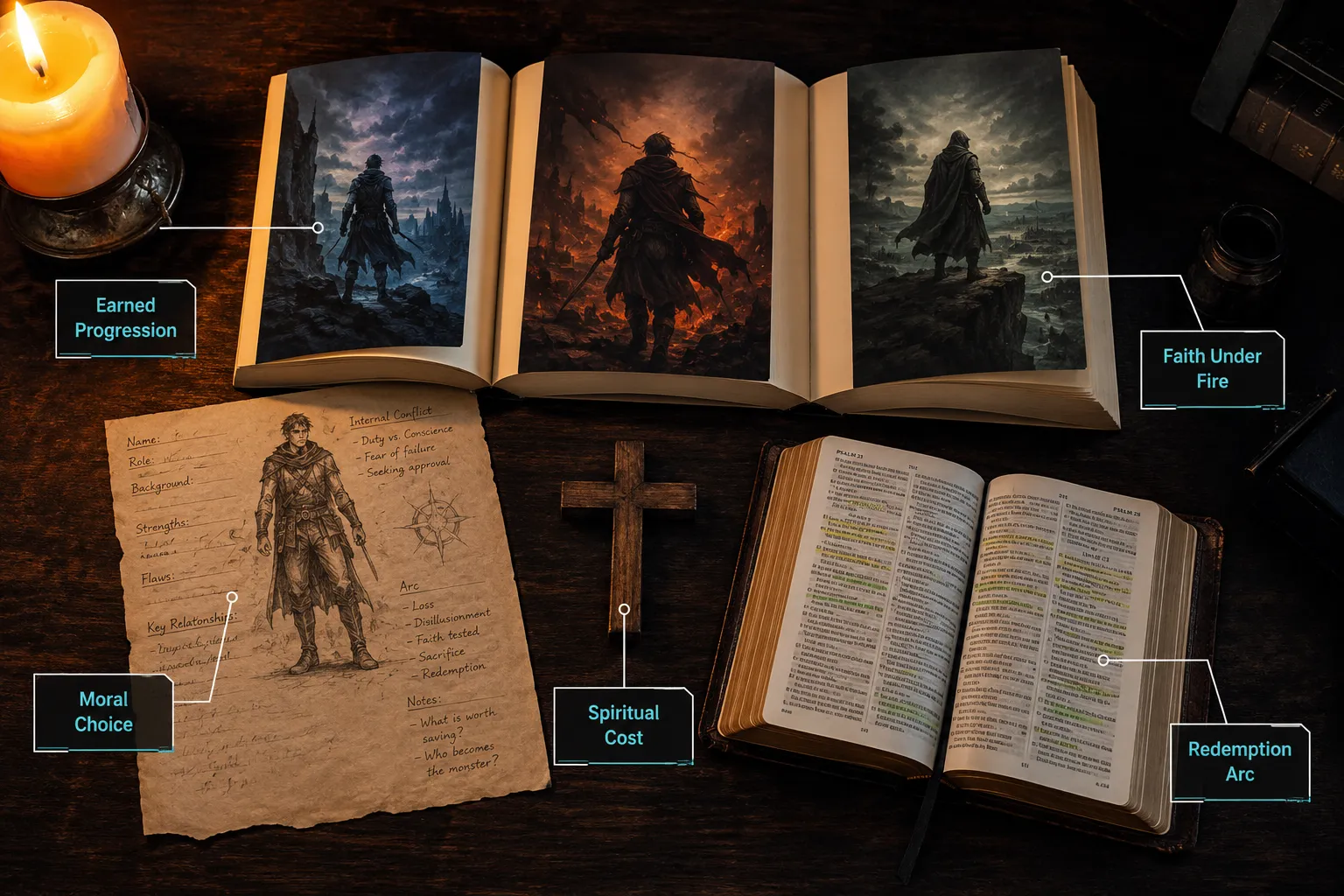
The most effective examples in Christian LitRPG and progression fantasy use moral choices as the actual trigger for progression, not combat victories or puzzle solutions.
Concrete examples of this structure:
- A character who could loot a fallen enemy’s gear but chooses to leave it for the enemy’s surviving family, and gains a Mercy skill point they didn’t know existed.
- A character whose Deception skill is maxed out but who finds it stops working entirely in the presence of a specific NPC, not because the NPC is magical, but because the character can’t lie to someone they’ve come to genuinely respect.
- A character who is offered a shortcut to the next level tier and takes it, and finds the borrowed power comes with a debt that shows up three books later. (The Borrowed Yield in The Measured Debt is built around exactly this premise.)
The pattern in all three: the moral choice is the mechanic. The System isn’t rewarding good behavior with points. The System is recording who the character is becoming, and the record eventually speaks.
Are There Non-Christian LitRPG Books With Spiritual Themes?
Several secular LitRPG and progression fantasy titles carry spiritual resonance without explicit Christian framing. These are worth knowing because they demonstrate that the genre’s structure is naturally hospitable to questions of meaning, cost, and transformation.
- He Who Fights With Monsters (Travis Deverell), reached #7 on hardcover fiction lists in July 2026 [34]. The protagonist’s growth arc involves genuine questions about what power is for and what it costs to remain human while accumulating it.
- Dungeon Crawler Carl (Matt Dinniman), credited with bringing LitRPG to mainstream publishing audiences [34]. The series uses a brutal game-show structure to ask what a person holds onto when everything else is stripped away.
- Buddhist and Daoist progression fantasy, a significant portion of translated Chinese cultivation fiction (xianxia/wuxia) is built around explicitly spiritual progression systems, with cultivation stages that map onto stages of spiritual refinement.
The distinction that matters: These works ask spiritual questions without providing Christian answers. For readers who want the question and the answer, or at least a story rooted in faith that holds, Christian LitRPG fills a gap the secular market doesn’t address.
What Happens When LitRPG Mixes Faith With Magic Systems?
When faith and magic systems share the same world, the writer faces a specific theological question: is faith a power source, or is it something else entirely?
The common mistake is treating faith as a mana pool, a resource the character draws on to cast divine spells. This collapses faith into a utility, which is the opposite of what Christian theology actually claims about it.
The more honest approach treats the magic system and faith as operating on different registers:
- Magic is what the world allows. Faith is what the character chooses.
- A character can have high Faith and low magical power, or vice versa. The two don’t automatically correlate.
- Divine intervention, when it comes, is not triggered by the character’s faith stat. It comes when it comes, and sometimes it doesn’t come at all, and the character has to hold that.
Mercy and justice as competing forces in a magic system create natural theological tension. A world where justice magic is abundant and mercy magic is rare, or where mercy magic costs the caster something justice magic doesn’t, reflects a genuinely Christian understanding of what mercy actually is.
The Kethara Chronicles and the Sarel Chronicles from Silas Bellhaven handle this in epic fantasy rather than LitRPG, but the principle transfers. Covenant and power are not the same thing, and the best Christian game-world narratives keep that distinction visible.
Who Reads Christian LitRPG and Progression Fantasy?
The core audience for Christian LitRPG overlaps with two existing reader groups: Christian epic fantasy readers and secular LitRPG readers who are open to faith themes.
Christian epic fantasy readers, primarily women 35-65 on Kindle Unlimited, are already comfortable with secondary-world settings and willing to follow faith through darkness and doubt. They want hope in the dark, not a sanitized world where nothing costs anything. They’re the same readers who trust Silas Bellhaven across cozy mystery, western, and psychological thriller because the brand promise transfers: faith handled honestly, not preached.
Secular LitRPG readers who engage with spiritual themes in xianxia or cultivation fantasy are often open to Christian LitRPG if it doesn’t feel like a tract. The genre’s mechanics give Christian authors a way to demonstrate faith rather than declare it, which is exactly the entry point secular readers need.
LitRPG for young adults with faith elements is an underserved pocket. Teen readers who grew up on video games understand the genre’s language instinctively, and the moral-choice structure maps naturally onto the questions adolescents are already asking about identity, cost, and what they’re building toward.
Common Mistakes Writers Make With Faith in LitRPG
These are the patterns that turn a promising Christian LitRPG into something that reads like a pamphlet:
- The System speaks in scripture. If the game’s notification messages quote Bible verses, the author has outsourced their theology to a UI element. Let the story carry the scripture’s meaning without citing it.
- Faith is a stat that only goes up. Real faith has dark nights. A Faith stat that never drops isn’t depicting faith, it’s depicting a character who has never been tested.
- Grace is a reward for correct behavior. If the character earns divine favor by making good choices, that’s karma, not grace. Grace shows up after cost, not because of merit.
- The mentor explains everything. A wise NPC who walks the protagonist through Christian doctrine chapter by chapter is a Sunday school lesson wearing a fantasy costume.
- Clean content is announced, not demonstrated. A story that tells the reader it’s clean has already broken the contract. The prose itself should make that obvious before the reader finishes the first chapter.
- Redemption comes too fast. Redemption that costs something is the whole point. A character who repents in chapter three and is fully restored by chapter five hasn’t experienced earned grace, they’ve experienced a plot shortcut.
Conclusion: What the Level Cap Actually Is
The genre’s deepest question, the one faith in LitRPG and progression fantasy: how Christian game-world narratives turn leveling up into spiritual growth keeps circling back to, is whether there’s a level cap, and what happens when you reach it.
Secular progression fantasy tends to answer: there isn’t one. Power compounds indefinitely. The character becomes a god, or something close.
Christian LitRPG answers differently. The level cap is not power. It’s something more like wholeness, and it’s not achievable by accumulating enough XP. It’s given. That’s the theological claim the genre can make that no secular entry can, and it’s the reason Christian LitRPG is worth writing and worth reading.
For readers who want to start: The Cost of Being Chosen (Book 1 of The Measured Debt by Silas Bellhaven) is available on Amazon. For writers building their own Christian LitRPG, the rule is simple: let the System keep the record, let the character pay the cost, and let grace show up in its own time, not as a reward, but as a gift that was never earned and still changes everything.
Frequently Asked Questions
What is the difference between LitRPG and progression fantasy? LitRPG shows explicit game mechanics on the page, stat sheets, XP notifications, level-up alerts. Progression fantasy is the broader category where a character’s measurable growth drives the story, without necessarily showing a game interface. Both work for Christian narratives; LitRPG makes the spiritual cost more visible, while progression fantasy integrates faith more like traditional literary fiction.
Can Christian faith be integrated into LitRPG without it feeling preachy? Yes. The key is letting the game mechanics carry the theology rather than having characters explain it. When a moral choice triggers a stat change, or when a quest functions as a covenant obligation, the reader arrives at the spiritual truth through the story rather than being told it.
What is earned grace in a LitRPG context? Earned grace means the character receives something they didn’t merit, forgiveness, restoration, an unexpected second chance, but only after paying a real cost. It’s not grace instead of cost; it’s grace after cost. This is the theological concept that fits most naturally inside a leveling system.
Are there Christian LitRPG books available now? Yes. Silas Bellhaven’s The Measured Debt series (starting with The Cost of Being Chosen) is available on Amazon Kindle Unlimited. Kenneth Bliss’s Canthany Rising, announced in May 2026 and released June 2026, is another explicitly Christian LitRPG entry.
Is Christian LitRPG appropriate for young adult readers? Generally yes, particularly titles that maintain clean content contracts, no graphic violence, no explicit content, no profanity. The genre’s game mechanics are familiar to younger readers, and the moral-choice structure addresses questions about identity and cost that resonate with adolescent experience.
What makes a faith stat feel theologically honest? A faith stat that only rises, never falls, and triggers divine power on demand is not depicting faith, it’s depicting a utility. A theologically honest faith stat can drop, can go silent, and sometimes doesn’t produce the outcome the character expected. The uncertainty is the point.
How does the LitRPG genre handle the concept of sin? In secular LitRPG, moral compromise is rarely tracked by the System. In Christian LitRPG, the most effective approach builds moral consequence into the mechanics, not as arbitrary punishment, but as a natural record of who the character is becoming. A character whose Integrity stat drops when they lie is living in a world where choices have weight.
What is The Measured Debt series about? The Measured Debt by Silas Bellhaven follows Eamon Kersey at Federated Record, a post-collapse system where position series determine blame and survival. Eamon’s name keeps clearing every collapse, until the record starts asking why he’s always the one left standing, and the debt behind his reputation finally comes due.
How does faith in LitRPG differ from faith in Christian epic fantasy? Christian epic fantasy typically integrates faith through worldbuilding, covenant systems, divine beings, sacred histories. Christian LitRPG integrates faith through mechanics, stats, quests, skill trees, and XP. The former shows faith as part of the world’s structure; the latter shows faith as part of the character’s measurable growth. Both are valid; LitRPG simply makes the cost more quantifiable.
What should writers avoid when mixing faith and magic systems? Avoid treating faith as a mana pool, a resource that powers divine spells. This reduces faith to a utility. Instead, keep faith and magic on different registers: magic is what the world allows, faith is what the character chooses. Divine intervention, when it comes, should not be mechanically triggered by a faith stat.
References
[4] State Of Litrpg August 2026 – https://www.litrpgtools.com/insights/state-of-litrpg-august-2026
[5] 2026 08 10 State Of Litrpg 2026 Discovery Crisis Market Analysis – https://litrpgcritic.com/blog/2026-08-10-state-of-litrpg-2026-discovery-crisis-market-analysis/