
Last updated: September 15, 2026
Quick Answer: Christian readers who love the tension, moral complexity, and high stakes of crime classics like Pulp Fiction and Scarface don’t have to choose between a good story and their faith. A growing shelf of Christian psychological thrillers, suspense novels, and clean crime fiction delivers the same grip, without the graphic violence, profanity, or explicit content. The key is knowing where to look and what to expect when you get there.
Key Takeaways
- Secular crime classics work because of moral weight and consequence, not because of gore or profanity. Christian thrillers can carry that same weight.
- Clean doesn’t mean safe. The best faith-based thrillers put characters in genuine jeopardy, including spiritual jeopardy.
- Christian psychological thrillers are the closest genre match for fans of Pulp Fiction-style moral complexity.
- Frank Peretti (This Present Darkness) is the most cited starting point, but the genre has grown far beyond him in 2026.
- Faith shows up as lived experience in the best Christian suspense, doubt, failure, and hard choices, not tidy answers.
- Kindle Unlimited has become the primary discovery platform for indie Christian thriller and suspense titles in 2026.
- Streaming platforms like Pure Flix [2] and Angel Studios now offer faith-forward crime dramas as film alternatives to secular blockbusters.
- “Inspirational fiction” and “Christian thriller” are not the same category, understanding the difference saves readers from disappointment.
- Morally gray characters exist in Christian fiction. Redemption that costs something is the genre’s defining feature.
- Non-religious readers often find Christian thrillers accessible when faith functions as character motivation rather than sermon.
What Makes Pulp Fiction and Scarface So Compelling, and What Christian Readers Actually Miss
Pulp Fiction and Scarface grip audiences because they take moral consequence seriously, even while their characters ignore it. Tony Montana’s rise and catastrophic fall is a story about pride and destruction that reads almost like a dark parable. Pulp Fiction‘s Jules Winnfield walks away from a near-death experience convinced he witnessed a miracle, and that conviction changes him. The violence and profanity are loud, but the questions underneath are ancient ones: What does a man owe for what he’s done? Can a moment of grace arrive in the middle of a life built on wrong choices?
Christian readers who love these films aren’t drawn to the shock content. They’re drawn to the weight. The problem is that the shock content is inseparable from the package, and for readers who want stories that honor their faith, that’s a real cost.
What readers are actually looking for:
- Characters who carry genuine guilt and face real consequences
- Moral ambiguity that doesn’t resolve cheaply
- Tension that comes from choices, not just action sequences
- The possibility of grace, even when it arrives late and at a price
That’s not a description of a watered-down story. That’s a description of clean Christian fiction that still grips readers through pacing, tension, and emotional stakes.
Christian Alternatives to Pulp Fiction and Scarface, What the Genre Actually Offers
Christian thrillers are the most direct alternative for fans moving from secular blockbusters to Christian clean reads. The best titles in this space don’t swap out the darkness, they change what the darkness is for.
Where to start:
- Frank Peretti’s This Present Darkness remains the benchmark for supernatural thriller with real stakes. The spiritual warfare is literal, the danger is genuine, and faith is tested rather than assumed.
- Ted Dekker’s Thr3e and the Circle Series bring psychological complexity and moral jeopardy that rival secular crime fiction.
- Silas Bellhaven’s The Gathering Light series, particularly When Hannah Sleeps, operates in the psychological thriller space with a spine question about who controls the record of someone’s truth. Hannah Garrick has transcribed a hundred women’s worst nights, until her own testimony starts appearing in someone else’s file. That’s not a soft premise.
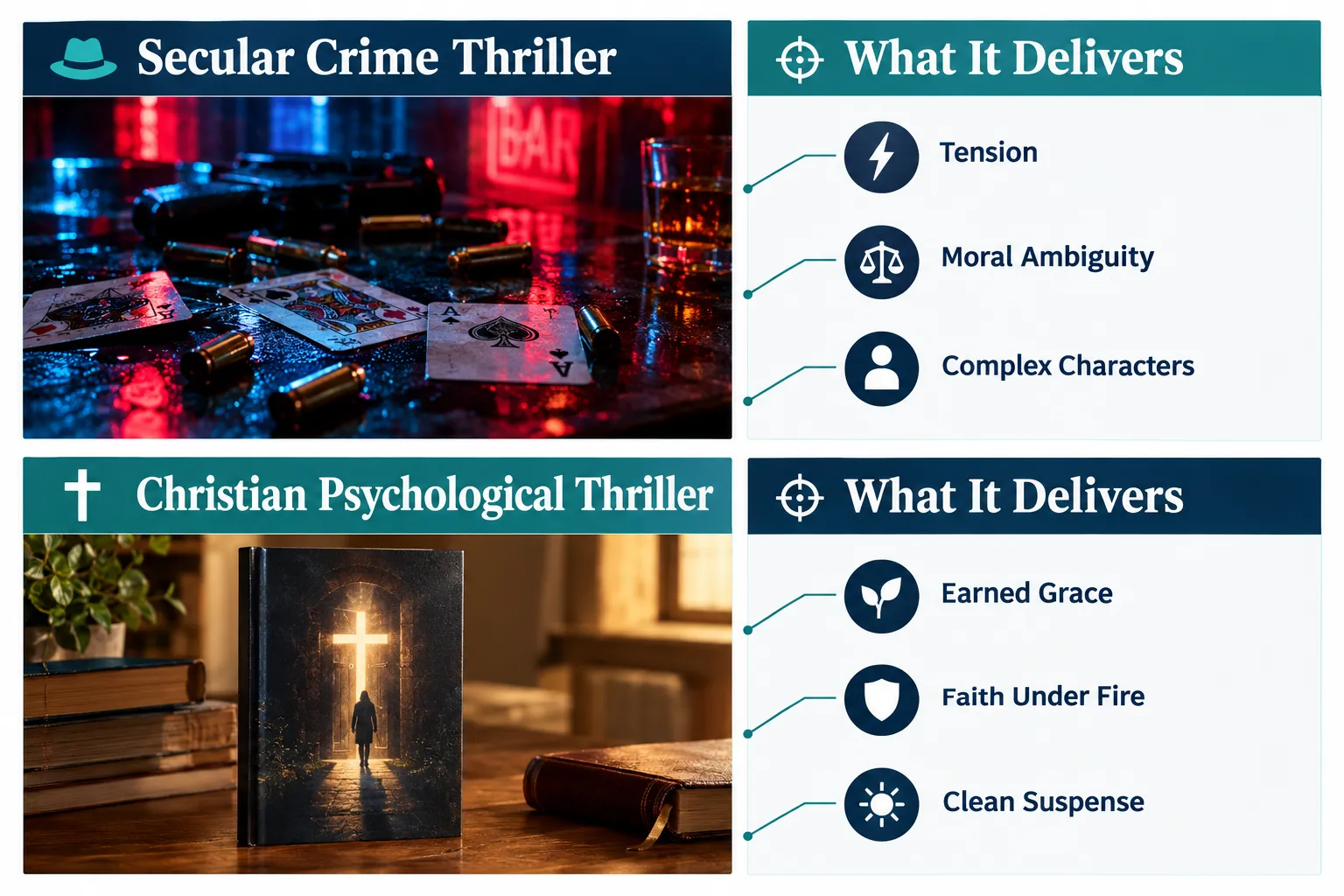
The key distinction: In Christian thrillers, the darkness serves the light, not by being minimized, but by being answered. Earned grace. Redemption that costs something. Faith under fire, not faith as a safety net.
Are There Christian Noir or Crime Thrillers Worth Reading?
Yes, and the category is larger in 2026 than most readers realize. Christian noir exists at the intersection of moral failure, hard justice, and the possibility of mercy. It doesn’t sanitize crime; it frames it within a worldview where consequences are real and grace is not guaranteed.
What qualifies as Christian noir:
- Crime plots where the protagonist is morally compromised, not just threatened
- Settings where institutional justice fails and something harder is required
- Faith that shows up as doubt, wrestling, and costly choice, not comfort
Silas Bellhaven’s The Mercy Line western series operates close to this territory. The False Warrant opens with a territorial seal that doesn’t make a custody lawful, and a man who has to decide what obedience is worth when the law itself is the problem. That’s noir logic in a frontier frame. The Ash Ledger asks whether truth can be spoken before it hardens into a false record. These aren’t cozy premises.
Common mistake: Readers sometimes assume “Christian crime fiction” means the detective prays before solving the mystery. The better titles use faith as a moral pressure point, not a plot device.
What’s the Difference Between Inspirational Fiction and Christian Thrillers?
Inspirational fiction and Christian thriller are neighboring shelves, not the same book. Knowing the difference saves readers from picking up the wrong title and concluding the whole category is too soft.
| Category | Tone | Faith Role | Conflict Level |
|---|---|---|---|
| Inspirational fiction | Warm, uplifting | Central, comforting | Low-to-moderate |
| Christian cozy mystery | Gentle suspense | Community-rooted | Moderate |
| Christian thriller/suspense | Tense, sometimes dark | Tested, not assumed | High |
| Christian psychological thriller | Unsettling, layered | Under pressure | High |
Choose Christian thriller if you want genuine jeopardy, morally complex characters, and faith that earns its conclusions through the plot. Choose inspirational fiction if you want warmth, community, and a story where faith is the stable center rather than the thing being tested.
For a deeper look at how these categories sit on Kindle Unlimited, this guide to building a clean, faith-filled TBR breaks down the genre landscape clearly.
What Makes a Thriller Clean Without Losing the Tension?
A clean thriller isn’t a thriller with the danger removed. It’s a thriller where the danger comes from character, consequence, and moral pressure rather than from graphic content.
Tension sources that don’t require explicit content:
- Information asymmetry, the reader knows something the protagonist doesn’t, or vice versa
- Psychological pressure, gaslighting, manipulation, identity threat
- Institutional power, a system that can bury the truth
- Spiritual jeopardy, a character whose faith is the thing at risk
- Relational stakes, the threat of losing someone, not just being killed
The When Hannah Sleeps series uses all five. Hannah’s testimony appearing in someone else’s file is terrifying precisely because it’s quiet. No blood required. When the Voice Breaks follows Caris Weller, who built her career on careful language, until the retreat’s own system starts speaking for her instead. The horror is institutional and intimate at once.
The practical rule: Graphic content creates shock. Psychological pressure creates dread. Dread lasts longer and costs the reader more, which is exactly what makes a thriller worth finishing.
For more on how Christian authors build suspense without graphic content, that resource covers the craft side in detail.
Do Christian Thrillers Have the Same Intensity as Secular Ones?
The honest answer is: the best ones do, and the worst ones don’t. The gap isn’t about faith, it’s about craft and willingness to let characters actually suffer.
What the best Christian thrillers share with secular crime fiction:
- Protagonists who make genuinely bad choices and pay for them
- Antagonists with coherent, even sympathetic, motivations
- Endings that don’t resolve every thread cleanly
- Faith that is tested, not just stated
Where some Christian thrillers fall short:
- Villains who exist only to be converted or defeated
- Protagonists whose faith insulates them from real cost
- Resolutions that arrive before the character has earned them
Silas Bellhaven’s brand vocabulary names this directly: earned grace, not cheap grace. Mercy is never a clean exit. That’s the standard the best faith-based thrillers hold themselves to, and it’s the same standard that makes Scarface worth watching despite everything else in it.
Best Christian Suspense Authors, Beyond Frank Peretti
Frank Peretti opened the door in the 1980s. The category has expanded significantly since, particularly through Kindle Unlimited indie publishing in 2026.
Authors worth knowing:
- Ted Dekker, psychological thriller, often with supernatural elements; Thr3e, Blink, the Circle Series
- Brandilyn Collins, forensic-detail crime suspense; Violet Dawn, the Kanner Lake series
- Dee Henderson, military and law enforcement thriller; clean, procedural, faith-woven
- Ronie Kendig, military thriller with spiritual warfare; high action, genuine stakes
- Silas Bellhaven, psychological thriller (The Gathering Light), frontier crime (The Mercy Line), cozy mystery (The Mercy House Mysteries); faith handled as lived experience, not lesson
For readers who want to explore the broader landscape, finding clean Christian fiction across every genre is a practical starting point.
Can Christian Thrillers Appeal to Non-Religious Readers?
Yes, when faith functions as character motivation rather than authorial message. A character who prays because they’re desperate, who doubts because the evidence is against them, who acts on conviction when every practical signal says otherwise, that’s compelling to any reader who cares about why people do what they do.
The test is simple: does the faith feel like it belongs to the character, or does it feel like it belongs to the author? When it belongs to the character, non-religious readers engage with it the same way they’d engage with any deeply held belief that shapes behavior under pressure.
The Gathering Light series passes that test. The retreat setting in When Hannah Sleeps uses the language of faith as a tool of institutional control, which is a premise that works for any reader who has ever watched a system weaponize the vocabulary of care. The faith in these books is not a comfort blanket. It’s a pressure point.
Edge case: Readers who find any religious content alienating may still struggle. But readers who are simply secular, curious, open, drawn to moral complexity, often find Christian thrillers more accessible than they expect. The difference between clean Christian fiction and general clean reads explains this distinction well.
How to Find Faith-Friendly Alternatives to Violent Movies, Books and Streaming
For readers and viewers moving from secular blockbusters to Christian clean reads, the options in 2026 are broader than ever.
Streaming alternatives:
- Great American Pure Flix [2] markets itself as a faith-first streaming service with values-driven thrillers, dramas, and crime stories, a direct alternative for viewers who want the genre without explicit content.
- Angel Studios has built an audience with morally serious faith-forward films.
- UP Faith & Family, Redeem TV, and CBN Family round out a growing ecosystem of platforms [13] that offer content filters or curated libraries for viewers who still want crime and suspense without the graphic content of Pulp Fiction or Scarface.
- Netflix maintains a Faith & Spirituality genre category [5] with a growing slate of options.
For books specifically:
- Search Kindle Unlimited using terms like “Christian psychological thriller,” “clean suspense,” or “faith-based crime fiction”
- The Kindle Unlimited Christian fiction discovery guide walks through filtering strategies that actually work
Christian Mystery and Thriller Series Recommendations, A Practical List
For readers ready to move from secular blockbusters to Christian clean reads, here are series worth starting in 2026:
Psychological Thriller:
- The Gathering Light by Silas Bellhaven, institutional gaslighting, identity threat, faith under pressure. Start with When Hannah Sleeps.
Cozy Mystery (real stakes, gentle suspense):
- The Mercy House Mysteries by Silas Bellhaven, Juniper Gap, Tennessee. Nora Bell Hartley keeps finding bodies where she meant to find donations. Start with A Donation to Die For.
Frontier Crime / Western Noir:
- The Mercy Line by Silas Bellhaven, railroad justice, buried records, conscience under pressure. Start with The False Warrant.
Supernatural Thriller:
- This Present Darkness by Frank Peretti, the genre’s foundation stone
- Thr3e by Ted Dekker, psychological thriller with a twist that earns its ending
Procedural / Law Enforcement:
- Dee Henderson’s O’Malley series, clean, detailed, faith woven through character rather than plot
FAQ
Q: Are Christian thrillers actually scary or tense, or are they too safe? The best ones are genuinely tense. The tension comes from psychological pressure, moral jeopardy, and spiritual stakes rather than graphic content, which often produces more lasting dread than shock value.
Q: What’s the closest Christian equivalent to Pulp Fiction? Ted Dekker’s Thr3e comes closest in terms of psychological complexity and moral disorientation. Silas Bellhaven’s The Gathering Light series matches the institutional menace and identity-threat elements.
Q: Do Christian thrillers have morally gray characters? Yes. The best ones do. Characters who have done real wrong, who carry genuine guilt, and whose redemption, if it comes, costs them something real. Cheap grace is the enemy of good Christian fiction.
Q: Is This Present Darkness still worth reading in 2026? Yes, though it shows its age in places. It established the template for spiritual warfare thriller and remains the most-cited entry point for new readers in the genre.
Q: Can I find Christian thrillers on Kindle Unlimited? Yes, Kindle Unlimited has become the primary platform for indie Christian thriller and suspense in 2026. The catalog has grown substantially, particularly in psychological thriller and frontier crime.
Q: What’s the difference between a Christian thriller and a Christian cozy mystery? Cozy mysteries prioritize community, gentle suspense, and resolution. Thrillers prioritize jeopardy, psychological pressure, and moral cost. Both can be faith-rooted, they just sit at different points on the tension scale.
Q: Are there Christian crime thrillers without a romance subplot? Yes. Silas Bellhaven’s The Mercy Line western series maintains a romance-absent content contract across its entire catalog. The focus is conscience, justice, and the cost of truth.
Q: Where do faith-forward streaming options fit for movie fans? Pure Flix [2], Angel Studios, and UP Faith & Family offer the closest film equivalents, crime dramas and thrillers with moral weight and without explicit content. Netflix’s Faith & Spirituality category [5] is also expanding.
Q: Do non-Christian readers enjoy Christian thrillers? Often, yes, when faith functions as character motivation rather than authorial message. Readers drawn to moral complexity and genuine consequence tend to find the faith elements add depth rather than distract.
Q: What makes Christian fiction “clean” without being boring? Clean content means no graphic violence, profanity, or explicit material, not the absence of danger or moral complexity. The stakes are real; only the delivery method changes.
Q: How do I find Christian thriller series on Goodreads? The Goodreads guide for Christian fiction fans covers how to find curated lists that filter by genre and content level.
Q: Is faith in Christian thrillers preachy? In the best titles, no. Faith shows up through character choice and consequence, not narration or scripture-dropping. The goal is stories that walk with the reader, not talk at them.
Conclusion
The move from secular blockbusters to Christian clean reads isn’t a retreat from good storytelling. It’s a search for the same things that made Pulp Fiction and Scarface matter, moral weight, real consequence, the possibility that a moment of grace can arrive in the middle of a ruined life, without the content that makes those films difficult to watch with a clear conscience.
That search has a real answer in 2026. The Christian thriller and suspense shelf is deeper than it’s ever been, the streaming alternatives are multiplying, and the best indie authors on Kindle Unlimited are writing faith-rooted fiction that holds nothing back except the gratuitous.
Where to start:
- Pick up When Hannah Sleeps if psychological suspense is your primary interest.
- Start The False Warrant if you want frontier crime with a conscience.
- Try A Donation to Die For if you want mystery with warmth and real stakes.
- Browse the full Silas Bellhaven catalog for a range of genres built on the same promise: faith tested and proven through the plot, never delivered as a sermon.
Hope in the dark doesn’t require looking away from the dark. It requires a story honest enough to sit in it, and faithful enough to mean something when the light comes.
References
[1] 10 Best Christian Movies Streaming Or In Theaters Summer 2026 – https://www.christianactivities.com/10-best-christian-movies-streaming-or-in-theaters-summer-2026/ [2] pureflix – https://www.pureflix.com/ [5] netflix – https://www.netflix.com/browse/genre/26835 [7] 5 Christian Films Of 2026 – https://rhemalogy.com/2026/04/10/5-christian-films-of-2026/ [9] Best Christian Movies To Watch In 2026 – https://amberginter.com/2026/07/21/best-christian-movies-to-watch-in-2026/ [10] 6 Christian Movies On Netflix Worth Watching – https://www.crosswalk.com/culture/features/6-christian-movies-on-netflix-worth-watching.html