
Last updated: August 4, 2026
Quick Answer: Frontier justice novels where conscience is the law are works of western fiction, literary, genre, and faith-rooted, that place a character’s moral code at the center of the story when formal legal systems are absent, corrupt, or simply too far away. The best of them don’t celebrate vigilantism. They ask what a person owes the truth when no court is watching.
Key Takeaways
- Frontier justice novels where conscience is the law explore what happens when legal authority fails, retreats, or becomes complicit in wrong, and a character must decide what they answer to instead.
- The genre spans literary fiction (True Grit, Blood Meridian, Lonesome Dove) and faith-rooted series like Silas Bellhaven’s The Mercy Line, which frames its conscience question explicitly: “Where law runs out, a man finds what he answers to.”
- Moral ambiguity is the engine of the best frontier justice stories, not clean heroes, but characters whose codes are tested, bent, and sometimes broken.
- Faith-based frontier fiction handles conscience differently than secular literary westerns: grace is earned through cost, not delivered as a verdict.
- These novels appeal to readers who want real moral stakes, not shock value, not easy resolution, but the kind of earned reckoning that stays with you.
- Common themes include the gap between legal authority and genuine justice, the violence hidden inside lawful systems, and the cost of telling the truth when the record lies.
- Readers who enjoy moral dilemmas, historical settings, and character-driven plots are the core audience, not action-first western fans.
- The subgenre has strong academic and critical attention, with scholars reading frontier justice as an allegory for contemporary questions about sovereignty, extralegal violence, and moral legitimacy. [1][3]
What Are Frontier Justice Novels Where Conscience Is the Law?
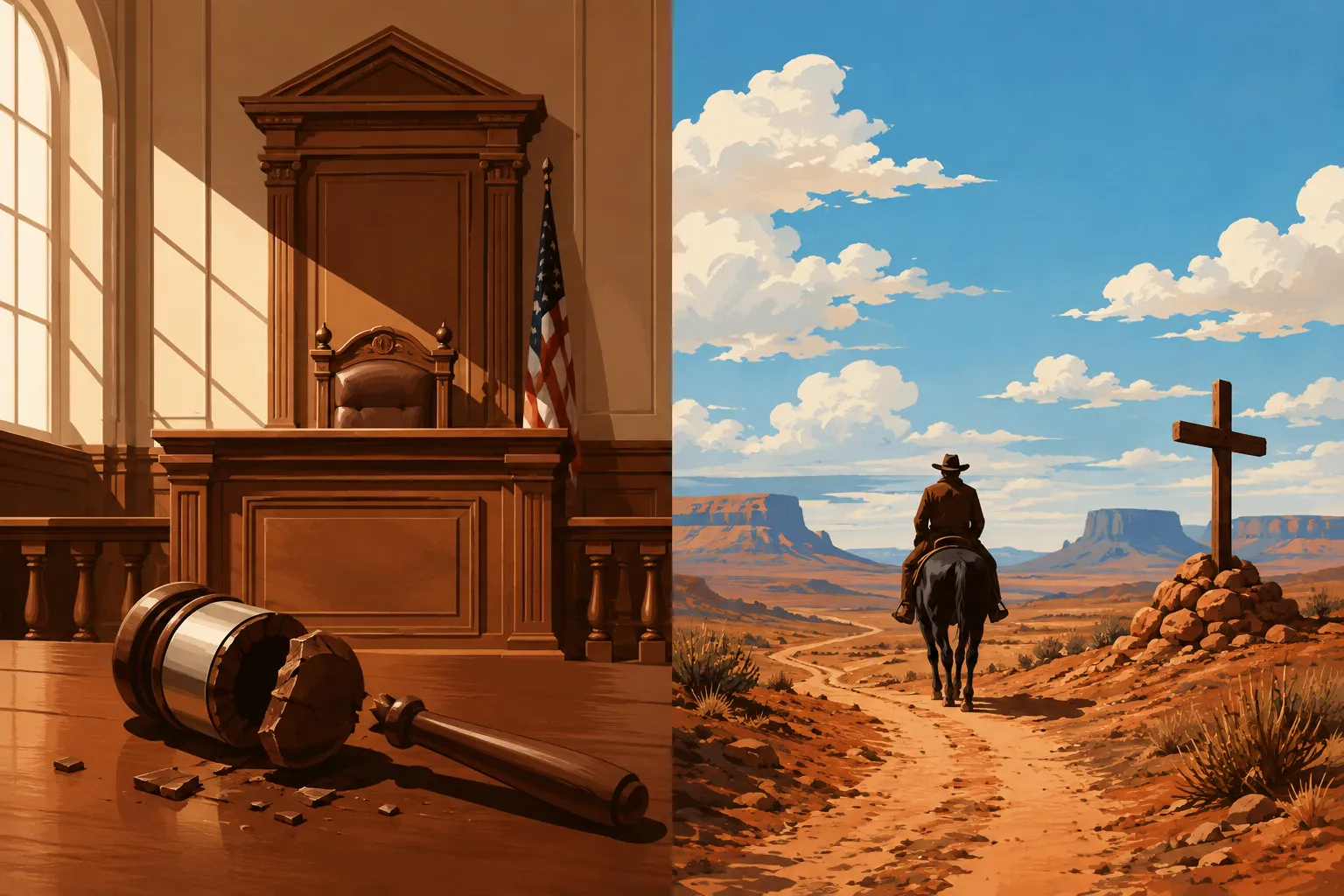
Frontier justice novels where conscience is the law are stories set in spaces, geographic, legal, or moral, where formal authority cannot or will not reach. The protagonist must act, and the story’s weight comes entirely from what they choose and what that choice costs them.
This isn’t the same as vigilante fiction, though there’s overlap. The key distinction: vigilante stories tend to celebrate personal force as a substitute for law. Frontier justice novels rooted in conscience treat that substitution as the problem, the thing that must be examined, not cheered. The protagonist isn’t a hero because they act outside the law. They’re tested because they have to.
The setting is usually the American West of the 19th century, but the moral geography matters more than the geography itself. What defines the subgenre is the constitutive exception, the legal scholar’s term for the moment when the law creates a zone where it suspends its own rules. [1] In those zones, conscience becomes the only operating system a person has left.
Best Books About Frontier Justice and Moral Conscience
The most cited and studied titles in this space share one quality: they refuse to let the law off the hook, and they refuse to let the protagonist off the hook either.
Literary and secular:
- True Grit (Charles Portis), Mattie Ross pursues justice in Indian Territory, a space the law has deliberately constructed as a “zone of indeterminacy.” [1] The extralegal hanging she witnesses isn’t triumphant; it’s a question the novel leaves open.
- Blood Meridian (Cormac McCarthy), Judge Holden embodies law’s founding violence. His “law is law” pronouncements hide what scholars describe as an “absolute, universalized crime as its hidden reverse.” [1] This is frontier justice at its darkest: the law as predator.
- No Country for Old Men (McCarthy), Sheriff Bell confronts the insufficiency of legal order and the danger of personal codes. Anton Chigurh’s coin-flip “justice” is a grotesque mirror of conscience-based decision-making. [1]
- Lonesome Dove (Larry McMurtry), Rangers and cattlemen enforce a frontier justice that is structurally extralegal and, as scholars note, structurally racist. The novel attempts to demythologize the cowboy while producing “a Western par excellence.” [1]
Faith-rooted:
- The Mercy Line (Silas Bellhaven), A nine-book Christian frontier western series set in the railroad town of Mercy Crossing. Each book turns on a ledger, a warrant, a bond, or a record, and the question of whether a man will honor what’s written or what’s right. The series conscience line says it plainly: “Where law runs out, a man finds what he answers to.” Series page
How Is Conscience Portrayed in Western Frontier Justice Novels?
Conscience in frontier justice fiction isn’t a voice in the character’s head delivering moral lectures. It shows up as choice under pressure, and the pressure is almost always a document, a record, or a claim that is technically lawful but morally wrong.
James Fenimore Cooper’s Leatherstocking hero is an early model: a figure who stands between colonial law and natural justice, enforcing an improvised ethic in spaces the law cannot reach. [2] That template, the man between two systems, runs through the entire tradition.
The best frontier justice novels don’t tell you what conscience is. They show you what it costs.
In faith-rooted fiction, conscience carries an additional weight: it answers not just to community or code, but to God. That’s what separates a series like The Mercy Line from secular literary westerns. Caleb in The False Warrant doesn’t refuse a false custody order because he’s a hero. He refuses because a territorial seal doesn’t make a thing lawful, and he knows who he answers to when the paperwork runs out.
Frontier Justice Novels vs. Traditional Legal System Books
These are genuinely different reading experiences, and the difference matters for readers choosing between them.
| What you want | Better fit |
|---|---|
| Courtroom drama, procedural tension, institutional conflict | Legal thriller / courtroom fiction |
| Moral weight, personal code, conscience under fire | Frontier justice novel |
| Faith as a lived, tested element of the story | Faith-rooted frontier western |
| Ambiguity without resolution | Literary western (McCarthy, Portis) |
Traditional legal fiction trusts the system, even when characters fight it. Frontier justice novels start from the premise that the system cannot be trusted here, and the story lives entirely in what the character does with that fact.
The academic literature frames this as the difference between law as regulative norm and law as founding violence. [1] Legal thrillers work inside the norm. Frontier justice novels work at the founding, the moment before the norm exists, or after it has collapsed.
Are Frontier Justice Novels Based on Real Historical Events?
Many draw on genuine history, though the best ones aren’t historical reconstructions, they use history as moral pressure.
The American frontier’s legal reality was genuinely fragmented. Federal law, territorial law, railroad company contracts, and local custom operated simultaneously and often contradictorily. Land claims, labor bonds, and custody warrants were routinely falsified or weaponized. The “zone of indeterminacy” scholars describe in True Grit, Indian Territory as a space where killing was juridically invisible, was a real legal construction, not a metaphor. [1]
The Mercy Line series draws on this specific history: railroad-era land records, labor-credit ledgers, and the gap between a document’s legal form and its moral content. The Bond Book centers on a labor-credit ledger that hides an old cage. The Ash Ledger turns on a fire-loss claim that doesn’t add up. These aren’t invented scenarios, they’re the texture of frontier economic life, where paperwork was often the weapon of choice.
Frontier Justice Novels for Readers Who Like Moral Dilemmas
If moral dilemmas are what you’re after, frontier justice is one of the richest subgenres available. The dilemmas tend to be structural, not melodramatic, meaning the character isn’t choosing between good and evil, but between two things that both have legitimate claims.
Common dilemma structures in frontier justice fiction:
- Obedience vs. conscience, A lawful order that requires a wrong act (The False Warrant)
- Record vs. reality, A legal document that accurately records a lie (The Survey Line, The Ash Ledger)
- Mercy vs. accountability, Forgiving someone who hasn’t paid the cost (The Mercy Road)
- Personal code vs. community survival, When one man’s moral line endangers everyone around him
These aren’t puzzles with solutions. They’re the kind of questions that stay open after the last page, which is exactly what readers who love moral dilemmas are looking for.
Frontier Justice Novels with Antiheroes and Vigilante Justice
Not all frontier justice protagonists are moral exemplars. Some are antiheroes, men whose codes are real but whose methods are brutal, or whose conscience is genuine but self-serving.
Judge Holden in Blood Meridian is the extreme case: a figure who has constructed a complete moral philosophy that justifies total violence. He isn’t unconscious. He’s a conscience-based actor whose conscience has gone entirely wrong. [1]
Anton Chigurh in No Country for Old Men operates similarly, his coin-flip “justice” is a parody of conscience-based decision-making, a personal code stripped of any mercy. [1]
The vigilante justice tradition, characters who step outside law to enforce their own standard, runs through the genre, but the best frontier justice novels treat it with suspicion. Lonesome Dove‘s Rangers hang a man on the trail with the same extralegal authority they use to protect settlers. The novel doesn’t celebrate this. It records it. [1]
Faith-rooted frontier westerns tend to be harder on their protagonists’ self-justifications. Earned grace, in The Mercy Line’s framework, means the character’s conscience must be tested against something larger than themselves, not just against the law, but against what they actually owe.
What Makes a Good Frontier Justice Novel About Conscience
The best frontier justice novels where conscience is the law share a specific set of qualities. Not every book that calls itself a western has them.
What separates good from generic:
- The law is present and specific, not just absent. The story works because legal authority exists but is corrupt, insufficient, or weaponized.
- The protagonist’s code is tested, not confirmed, their conscience is wrong about something, or costs them something real.
- The moral question stays open, resolution doesn’t mean the dilemma was easy.
- The setting does moral work, the frontier geography isn’t backdrop; it’s the reason the question exists.
- Grace, if it appears, is earned, not a clean exit, not a dramatic conversion, but something that comes after cost. [6]
Choose this subgenre if: you want character-driven fiction where the plot exists to test what a person believes, not to deliver action for its own sake.
Common Themes in Frontier Justice and Conscience Literature
Across literary westerns, academic analysis, and faith-rooted fiction, several themes recur consistently. [1][3][6]
- The record as weapon, Ledgers, warrants, deeds, and bonds that are technically lawful but morally false
- The zone of exception, A space where normal legal protection doesn’t apply, and someone has to decide what applies instead
- The cost of truth-telling, Characters who hold a dangerous record and must decide whether to speak
- Mercy and justice in tension, Not as opposites, but as two things that both make legitimate demands
- The violence inside legality, The recognition that lawful systems can be built on founding violence, and that “legal” doesn’t mean “right” [1]
- Faith under fire, In faith-rooted fiction specifically, the question of what a person’s belief actually requires when the stakes are real
Who Should Read Frontier Justice Conscience Novels
These books are for readers who want moral weight without moral simplicity. The audience is broader than the “western” label suggests.
Good fit if you:
- Enjoy character-driven fiction where internal conflict drives the plot
- Want historical settings that feel morally alive, not just atmospheric
- Are drawn to questions of justice, mercy, and accountability
- Read faith-based fiction that handles belief honestly, doubt included
- Appreciate clean content with real stakes (no graphic violence, no shock for shock’s sake)
Probably not your fit if you:
- Want fast-paced action-first westerns with clear heroes and villains
- Prefer legal procedural tension over moral philosophical weight
- Are looking for romance as a central plot element (The Mercy Line, specifically, maintains a romance-absent contract)
The Mercy Line series is particularly suited to readers who came to the subgenre through cozy mystery or psychological thriller, the moral architecture is similar, the pacing is deliberate, and the faith element is lived rather than preached.
Frontier Justice Novels Similar to True Grit or Blood Meridian
Readers who loved True Grit or Blood Meridian and want more are often looking for different things, so it helps to separate them.
If True Grit is your model (moral determination, a protagonist with a clear code, dark humor, extralegal pursuit of justice):
- The False Warrant (Silas Bellhaven), Caleb’s refusal of a false custody order has the same structural logic as Mattie’s pursuit into Indian Territory: conscience operating in a space the law has abandoned.
- The Living Record (Silas Bellhaven), Jonah holding a line between lawful paper and a deadly road.
If Blood Meridian is your model (law’s founding violence, moral philosophy as horror, the sovereign who embodies both):
- The academic work of Daniel Davis Wood, which reads Cooper and McCarthy as being in “legal and ethical dialogue,” is the best entry point for understanding what McCarthy is doing. [2][3]
- No Country for Old Men functions as a more accessible companion, Sheriff Bell’s confrontation with the insufficiency of legal order is the same question, with more room for the reader to breathe.
The faith-rooted frontier western and the literary western are asking the same question from different starting positions. McCarthy asks whether conscience can survive in a world where law is founding violence. The Mercy Line asks what conscience requires when you believe the law answers to something higher than itself.
How Do Frontier Justice Novels Handle Moral Ambiguity
Moral ambiguity in frontier justice fiction isn’t a stylistic choice, it’s the point. The genre exists because the frontier, historically and morally, was a space where ambiguity was structural. [4][5]
The best books in this space don’t resolve ambiguity with a verdict. They let it stand. Lonesome Dove ends with loss and exhaustion, not triumph. True Grit ends with Mattie’s arm gone and her certainty intact but diminished. Sheriff Bell retires, unable to face what the world has become.
Faith-rooted frontier westerns handle ambiguity differently, not by resolving it cheaply, but by placing it inside a framework where mercy and justice are both real demands, not just competing preferences. The ambiguity doesn’t disappear. But it has somewhere to go.
In The Orchard Claim, a debt that was never Aaron Wren’s gets quietly copied into the family ledger, and a widow pays for it. The moral question isn’t whether that’s wrong, it clearly is. The question is what it costs to correct it, and whether the man holding the ledger will pay that cost. That’s frontier justice where conscience is the law: not a verdict, but a reckoning.
Conclusion: Where to Start
Frontier justice novels where conscience is the law are among the most morally serious fiction available, and the most underread, partly because the “western” label undersells what they actually do.
Actionable next steps:
- Start with The False Warrant if you want faith-rooted frontier justice with clean content and real moral stakes. It’s the first book in The Mercy Line and sets the series’ conscience question clearly. Amazon link
- Browse The Mercy Line series page for the full nine-book sequence. Series page
- Read True Grit or No Country for Old Men if you want the literary western tradition that scholars have studied most carefully. [1]
- Look for the moral architecture, not the genre label. The best frontier justice novels are about what a person answers to, and that question shows up in westerns, mysteries, thrillers, and fantasy alike.
The frontier, as a moral space, never really closed. It just moved indoors.
FAQ
What is a frontier justice novel? A frontier justice novel is a work of fiction, usually set in the American West, where formal legal authority is absent, corrupt, or insufficient, and a character must act according to their own moral code. The story’s weight comes from what that code requires and what it costs.
Are frontier justice novels the same as vigilante fiction? Not exactly. Vigilante fiction tends to celebrate personal force as a substitute for law. Frontier justice novels rooted in conscience treat that substitution as the problem to be examined, the protagonist’s moral code is tested, not simply vindicated.
What makes The Mercy Line different from other western series? The Mercy Line is a faith-rooted Christian frontier western where conscience is explicitly framed as answering to God, not just to personal code or community. Grace is earned through cost, not delivered as a verdict. The series also maintains a romance-absent content contract and a linked-protagonist structure across nine books.
Is Blood Meridian a frontier justice novel? Yes, though it’s the genre’s darkest expression. Judge Holden embodies law’s founding violence, a conscience-based actor whose conscience has gone entirely wrong. Scholars read him as embodying the paradox of law as both regulative norm and absolute crime. [1]
Who is the target reader for faith-based frontier justice fiction? Readers who want moral weight with clean content, no graphic violence, no explicit material, faith handled as lived experience rather than lesson. The audience skews toward women 35-65 who read across cozy mystery, psychological thriller, and western, and who want their faith represented honestly, not preached at.
How long is The Mercy Line series? Nine books as of 2026, from The False Warrant through The Oath Ledger. Each book features a linked protagonist and a central record, ledger, warrant, bond, or letter, that drives the moral question.
Do I need to read The Mercy Line in order? The linked-protagonist structure means each book has a self-contained story, but reading in order deepens the world of Mercy Crossing and the recurring moral architecture. Starting with The False Warrant is recommended.
What’s the difference between frontier justice and natural law in fiction? Natural law fiction tends to appeal to a universal moral order above human law. Frontier justice fiction is more immediate, it’s about what a specific person does in a specific gap where law has failed, not a philosophical argument about what law should be. Faith-rooted frontier fiction bridges both: the character acts from conscience, and that conscience answers to something the story treats as real.
Are there academic resources on frontier justice in literature? Yes. Daniel Davis Wood’s Frontier Justice is the key monograph, reading Cooper and McCarthy in legal and ethical dialogue. [2][3] Duncan Clegg’s dissertation work on the “constitutive exception” in westerns is also foundational. [1][4]
Can frontier justice novels be cozy or low-violence? Yes. The moral weight of the genre doesn’t require graphic content. The Mercy Line handles frontier violence at a distance, the moral cost of the record is the real tension, not physical confrontation. Clean frontier justice fiction is a real and growing category.
References
[1] Frontier Justice – https://jamesehartley.com/frontier-justice/ [2] Frontierjustice Sampler – https://danieldaviswood.com/wp-content/uploads/2017/06/frontierjustice-sampler.pdf [3] Frontier Justice – https://danieldaviswood.com/non-fiction/frontier-justice/ [4] Content – https://yorkspace.library.yorku.ca/server/api/core/bitstreams/6dcf4368-e34a-494b-a975-b488a003b612/content [5] 9781137564771 6 – https://link.springer.com/chapter/10.1057/9781137564771_6 [6] The Old West The Law Vs Whats Right 2beb960ba9b2 – https://medium.com/a-writers-raggedy-thoughts/the-old-west-the-law-vs-whats-right-2beb960ba9b2