Last updated: September 12, 2026
Quick Answer: Building a faith-focused Christian LitRPG reading list on Goodreads requires combining the platform’s list and shelf tools with manual content filtering, because Goodreads has no dedicated “Christian LitRPG” category and mainstream LitRPG lists skew heavily secular and often explicit. The key is learning which tags signal clean content, which phrases in book descriptions flag harem subplots, and which curated lists are actually maintained by faith-conscious readers. Done right, you end up with a TBR that delivers earned progression, real moral stakes, and faith under fire, without the content surprises.
Key Takeaways
- Goodreads LitRPG lists are overwhelmingly secular; faith-focused readers must actively filter rather than passively browse [8][9]
- “Harem” is a distinct LitRPG subgenre tag, it will appear in descriptions, shelves, and list titles when present
- Christian LitRPG differs from secular LitRPG in how faith functions: as a load-bearing story element, not a backdrop
- The most reliable filtering method combines Goodreads list tags + book description keywords + reader shelf names
- Custom Goodreads shelves (e.g., “christian-litrpg,” “clean-progression-fantasy”) let you build a personal TBR that survives algorithm drift
- Several active Goodreads lists track anticipated clean and Christian fiction for 2025-2026 [2][3]
- Harem content is rarely hidden, specific phrases in blurbs give it away before you click “Want to Read”
- Silas Bellhaven’s The Measured Debt series is one of the few explicitly Christian LitRPG series in active publication
- Progression fantasy and Christian LitRPG overlap significantly, both reward earned growth over cheap shortcuts
- Building a TBR list is a one-time investment that saves hours of post-purchase regret
What Is LitRPG and How Is It Different from Fantasy
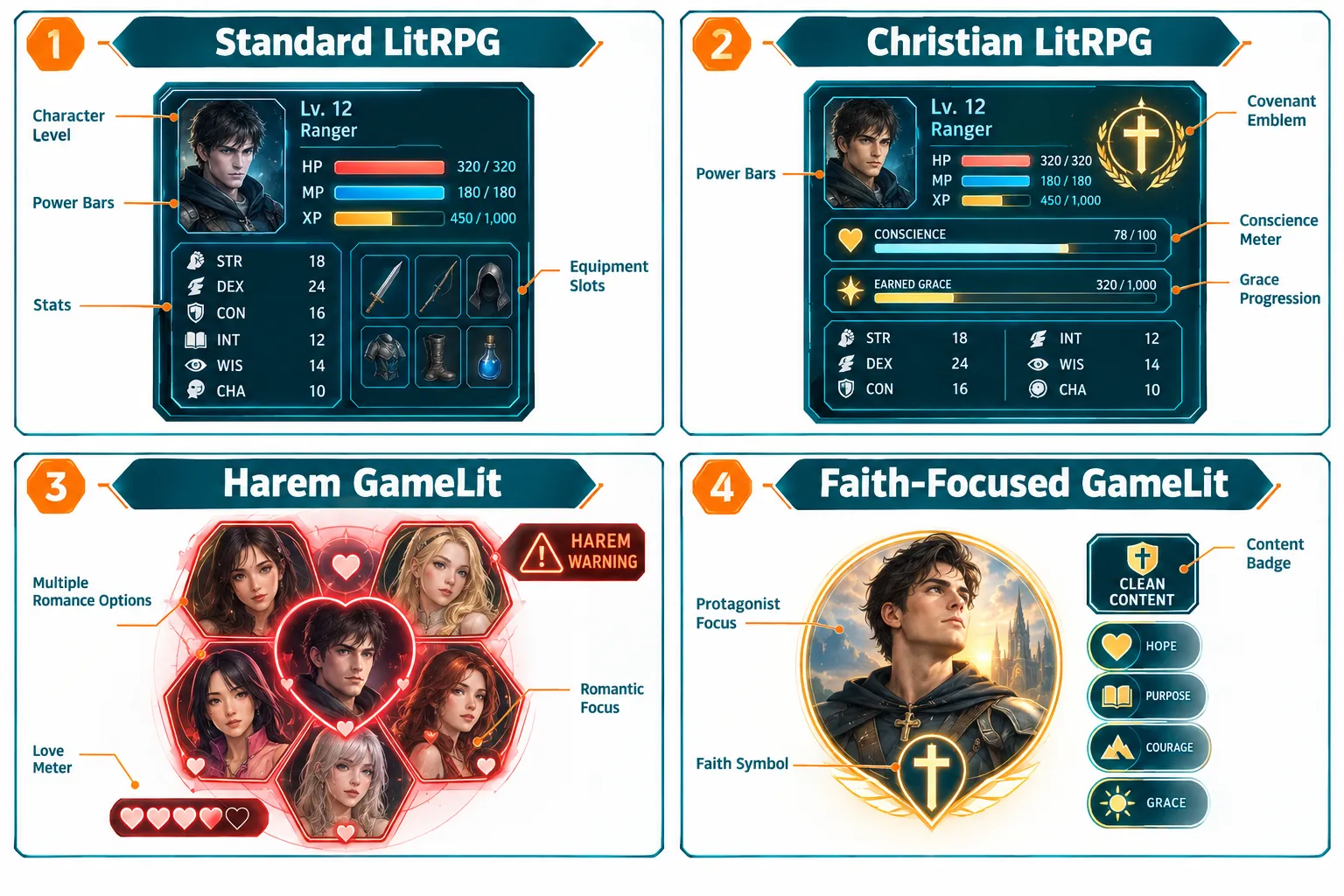
LitRPG (Literary Role-Playing Game) is a fiction subgenre where the story world operates by visible game mechanics, characters gain experience points, level up, read stat screens, and progress through a system the narrative treats as real. Unlike traditional fantasy, the game layer isn’t metaphorical. It’s structural.
Where epic fantasy might show a warrior growing stronger through training and trial, LitRPG shows the actual numbers: Strength +3, new skill unlocked, dungeon tier cleared. The story’s tension often hinges on whether the protagonist can grind, strategize, or earn their way to the next level before something worse arrives.
This mechanical structure is actually hospitable to Christian themes. Earned progression, grace that costs something, growth that comes through cost rather than convenience, maps naturally onto the LitRPG format. For more on how faith-rooted storytelling integrates with game-world mechanics, see Christian LitRPG on Kindle Unlimited: Hidden Faith-Forward Game Worlds Readers Are Missing.
What Makes a LitRPG Book Christian or Faith-Focused
A Christian LitRPG isn’t just a LitRPG with a cross on the cover. Faith functions as load-bearing structure, it shapes how the protagonist makes choices under pressure, what the progression system costs morally, and whether mercy and justice are treated as real forces in the world.
Three markers that distinguish Christian LitRPG from secular:
- Moral stakes tied to the system, The game mechanics aren’t morally neutral. Choices about how to use power carry weight.
- Faith tested, not performed, Characters doubt, fail, and find grace through cost, not through a tidy conversion moment.
- Clean content contract, No graphic sexual content, no explicit violence as spectacle, no harem dynamics.
What it doesn’t mean: scripture-dropping, characters who pray their way out of plot problems, or a sermon tucked inside a dungeon crawl. The best Christian LitRPG reads like faith under fire, present, honest, and worked through rather than announced.
Silas Bellhaven’s The Measured Debt series (beginning with The Cost of Being Chosen) builds this out through Eamon Kersey, a character whose position in the system keeps proving itself right up until the debt behind it comes due. For a broader look at how progression fantasy handles earned grace for Christian readers, that companion piece is worth reading alongside this one.
What Is a Harem Series and Why Do Some LitRPG Books Have Them
A harem series is a subgenre where the male protagonist accumulates multiple romantic or sexual partners, often as a direct reward for leveling up or completing quests. In LitRPG and GameLit, this is common enough to have its own dedicated communities, lists, and publishing pipelines.
It exists in LitRPG for a structural reason: the game-world format rewards accumulation. Power, items, companions, the genre logic of “more is more” extends naturally into relationships when authors aren’t working from a moral framework that pushes back on it.
Why this matters for Christian readers:
- Harem content is rarely subtle. It’s usually central to the plot and escalates across a series.
- It often appears in books otherwise marketed as “adventure” or “dungeon fantasy” with no explicit content warning on the product page.
- Goodreads’ mainstream LitRPG lists [8][9] include harem titles alongside clean titles with no consistent separation.
The good news: harem content is almost always flagged somewhere, in reader shelves, in blurb language, or in series descriptions. The skill is knowing where to look.
How to Avoid Harem Romance in LitRPG Recommendations
The most reliable way to avoid harem content in LitRPG is to read the book description carefully for specific phrases, check reader-applied Goodreads shelves, and cross-reference against curated clean lists before adding anything to your TBR.
Phrases in blurbs that signal harem content:
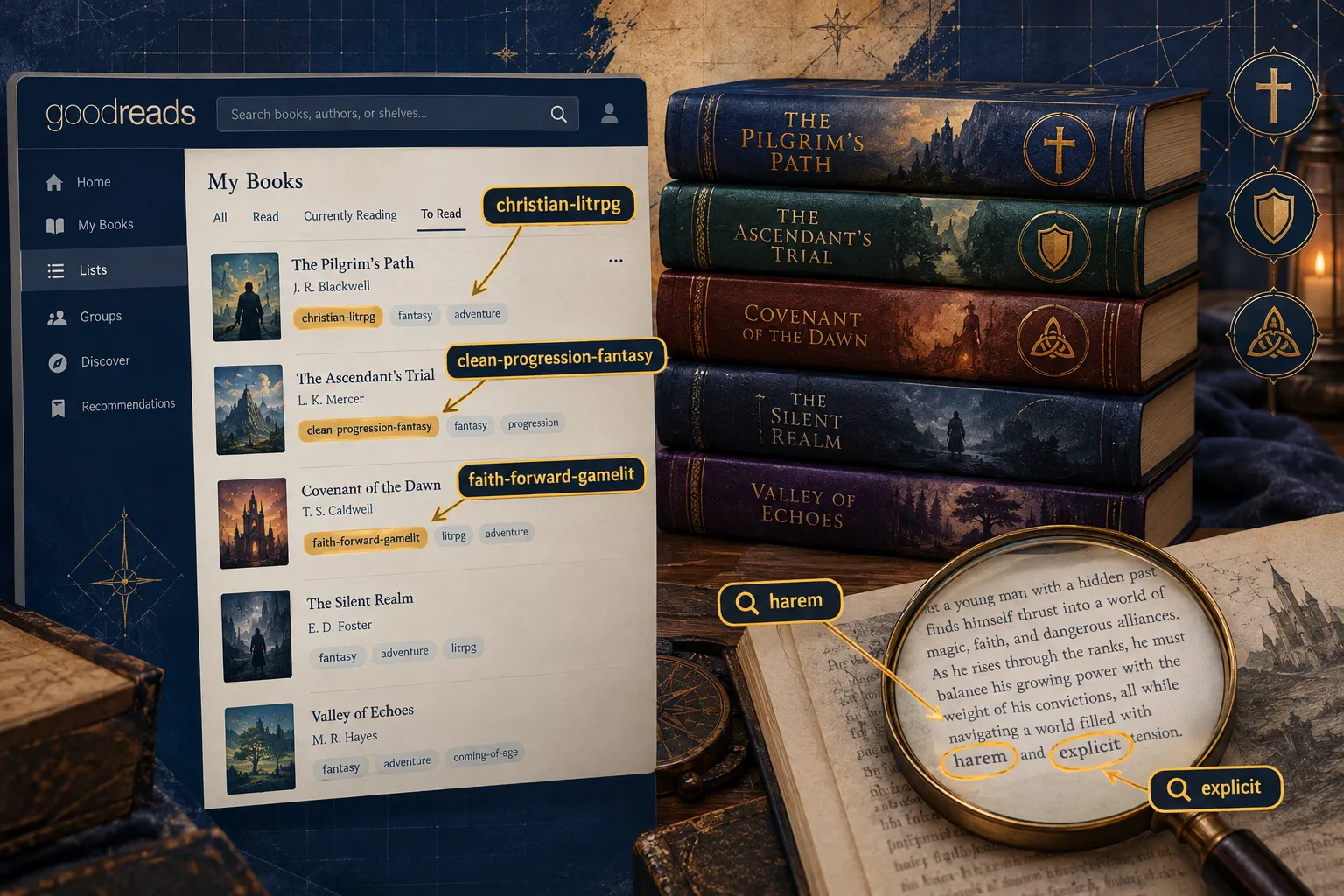
- “harem,” “reverse harem,” “multiple love interests”
- “companions” used in a romantic context
- “claim,” “bond,” or “mate” language in a game-world setting
- Cover art featuring multiple women posed around a single male figure
Goodreads shelf names that flag harem content (search these to see what’s been tagged):
haremlitrpg-haremgamelit-haremreverse-harem
Goodreads shelf names that signal clean/faith content:
christian-litrpgclean-litrpgfaith-based-fantasyclean-progression-fantasychristian-gamelit
One practical rule: if a LitRPG book’s Goodreads page has been shelved under any harem tag by even a handful of readers, treat that as a confirmed signal. Reader-applied tags are more reliable than publisher categories for this specific content type.
Are There Goodreads Lists Specifically for Christian LitRPG
As of 2026, there is no single dedicated “Christian LitRPG” Goodreads list with broad community maintenance. However, several adjacent lists are actively curated and useful for building a faith-focused game-world TBR.
Most useful active lists:
- Most Anticipated Clean and Christian Fiction 2025-2026 [3], Broad but actively maintained; includes speculative fiction and fantasy titles alongside mystery and thriller.
- Most Anticipated Christian Fiction 2026 [2], Skews toward traditional Christian fiction but includes fantasy and speculative entries worth checking.
- Best LitRPG Books (All) [9], Secular and comprehensive; useful for discovery, but requires heavy manual filtering for content.
- LitRPG This Year shelf [10], Community-driven, updated regularly; mix of clean and explicit titles.
- Goodreads lists tagged “christian-books” [7], Broad tag, but filtering by genre within results surfaces faith-based speculative fiction.
- Goodreads lists tagged “litrpg” [8], The starting point for any LitRPG TBR, with the understanding that curation for faith content is entirely manual.
The practical approach: use the Christian fiction lists [2][3] to find faith-forward speculative titles, then cross-check those titles against the LitRPG lists [8][9] to confirm genre fit. Titles appearing on both are strong candidates for a clean Christian LitRPG shelf.
How to Filter Goodreads Lists by Content Tags and Build a Custom TBR
Goodreads doesn’t offer a native content filter, but its shelf and list systems can be used strategically to approximate one. The process takes about 20 minutes to set up and saves hours of post-purchase regret.
Step-by-step process for building a faith-focused Christian LitRPG TBR:
- Create a custom shelf named
christian-litrpgorclean-progression-fantasyin your Goodreads account. - Search Goodreads lists using the tag
litrpg[8] and browse results for titles also taggedchristianorcleanby other readers. - Check each candidate title’s shelves, click “See top shelves” on any book page to see how the community has tagged it. If harem tags appear, skip it.
- Read the full book description before adding, look for the phrase markers listed in the previous section.
- Cross-reference with Christian fiction lists [2][3], if a speculative title appears there, it’s been vetted by at least some faith-conscious readers.
- Add confirmed titles to your custom shelf, not just the default “Want to Read” list, so you can find them later without re-filtering.
- Follow readers whose shelves include
christian-litrpgorclean-litrpg, their future additions populate your feed automatically.
Christian LitRPG vs. Secular LitRPG: What’s the Difference in Practice
The mechanical structure of LitRPG is the same across both. The difference is what the system is for and what it costs the protagonist to use it.
In secular LitRPG, the game system is typically morally neutral, a tool for power accumulation. The protagonist’s growth is measured in stats and cleared dungeons. Moral questions, when they appear, are usually resolved by whatever makes the protagonist stronger.
In Christian LitRPG, the system carries moral weight. Progression isn’t just earned, it’s accountable. The question isn’t only “can I level up?” but “what am I becoming as I do?” Grace shows up after cost, not instead of it. Mercy and justice operate as real forces, not just flavor text.
This distinction matters practically for TBR building: a book can have all the LitRPG mechanics (stat screens, leveling, dungeon tiers) and still be entirely secular in its moral logic. The Christian difference isn’t in the format, it’s in what the format is made to carry.
For a deeper look at how faith integrates into game-world worldbuilding without becoming preachy, Christian epic fantasy worldbuilding: integrating faith without preaching covers the craft side of this question directly.
Best Christian LitRPG Series for Beginners
The best entry point for Christian LitRPG is a series that makes the faith element structural rather than decorative, keeps the game mechanics accessible, and doesn’t require prior LitRPG reading to follow.
Starting recommendations:
- The Measured Debt by Silas Bellhaven, Begin with The Cost of Being Chosen. Eamon Kersey’s story is built on the LitRPG premise of earned progression, but the position-series structure at Federated Record means every cleared corridor has a moral cost attached. Clean content, no harem dynamics, faith as a load-bearing story element. The full series page is here.
- Progression fantasy with faith themes, Some progression fantasy titles (a close cousin of LitRPG) handle Christian themes implicitly rather than explicitly. These can be found through the Canthany Rising and Beyond: 7 Christian LitRPG Releases Signaling a New Faith-Forward Game Fantasy Microgenre roundup.
Beginner’s content checklist before starting any LitRPG series:
- Does the series description mention faith, covenant, or moral stakes?
- Are there reader reviews that specifically mention clean content?
- Does the Goodreads page show any harem-related shelf tags?
- Is the series available on Kindle Unlimited? (KU titles from faith-focused publishers tend to maintain clean content contracts)
For a broader KU-focused reading strategy, Kindle Unlimited Christian Reads: How to Build a Clean, Faith-Filled TBR covers the full process across multiple genres.
What to Look for in Book Descriptions to Spot Harem Content
Harem content in LitRPG almost always surfaces in the book description before purchase, the challenge is knowing which phrases to read carefully.
High-confidence harem signals in blurb language:
| Phrase or Pattern | What It Usually Means |
|---|---|
| “harem,” “his harem,” “build a harem” | Explicit harem subgenre, confirmed |
| “multiple companions” in a romantic context | Strong indicator |
| “claim her/them” in a fantasy/game setting | Possessive romance, often harem-adjacent |
| “reverse harem” | Female protagonist with multiple male love interests |
| Cover shows one man surrounded by multiple women in combat/fantasy gear | Visual harem signal |
| Series tagged “GameLit Romance” | Check carefully, often explicit |
Neutral phrases that don’t signal harem content:
- “party members,” “guild,” “companions” in a combat context
- “love interest” (singular)
- “faith,” “covenant,” “redemption,” “grace”
One practical rule: if the blurb spends more time on the protagonist’s romantic options than on the actual stakes of the story, that’s a content signal regardless of whether the word “harem” appears.
Common Mistakes When Building a Goodreads Christian LitRPG TBR
The most common mistake is trusting genre categories over reader-applied tags. Goodreads categories like “Fantasy” or “Science Fiction” tell you almost nothing about content. Reader shelves tell you much more.
Other mistakes worth avoiding:
- Adding from mainstream LitRPG lists without checking individual books, The Best LitRPG Books list [9] is comprehensive but includes explicit titles alongside clean ones with no distinction.
- Assuming “Christian fiction” tags cover LitRPG, Most Christian fiction lists [7] focus on contemporary, historical, and cozy mystery. LitRPG rarely appears without manual addition.
- Skipping the “top shelves” check, This is the fastest content filter available. It takes ten seconds per book and surfaces harem tags immediately if they’ve been applied.
- Treating “clean” and “Christian” as identical, A book can be clean (no explicit content) without being faith-focused. For readers who want faith as a structural element, not just an absence of content, these are different standards. Clean Christian Fiction vs. General Clean Reads explains the distinction clearly.
- Building a TBR from a single list, Cross-referencing two or three lists [2][3][8] catches titles the other lists miss and filters out titles that only appear on secular lists.
- Not following faith-conscious readers, Once you find a Goodreads user whose
christian-litrpgorclean-progression-fantasyshelf matches your taste, following them is the most efficient ongoing curation strategy available.
Conclusion: A TBR That Walks With You, Not Past You
The gap between “LitRPG reader” and “Christian LitRPG reader” is real, and Goodreads doesn’t close it automatically. The platform’s tools are genuinely useful, lists, shelves, reader tags, but they require intentional use rather than passive browsing.
The process is straightforward once you know it: start with the active Christian fiction lists [2][3], cross-reference against LitRPG tags [8][10], check every candidate title’s top shelves for harem flags, read blurbs for the specific phrase markers that signal explicit content, and build a custom shelf that holds your vetted list permanently.
What you’re building isn’t just a reading queue. It’s a curated space where faith under fire, earned grace, and hope in the dark can show up in a format that feels genuinely new, game mechanics and moral weight together, progression that costs something, a story that walks with you rather than past you.
Actionable next steps:
- Create a
christian-litrpgshelf in your Goodreads account today. - Browse the Most Anticipated Clean and Christian Fiction list [3] and add any speculative/fantasy titles to a review queue.
- Check each candidate’s top shelves before committing.
- Start The Cost of Being Chosen as a baseline for what Christian LitRPG can do when the faith element is structural.
- Bookmark Best Christian Fiction Authors Across Cozy Mystery, Western, Fantasy, Thriller, and LitRPG for when the LitRPG TBR is built and you’re ready to branch into adjacent genres.
FAQ
What is LitRPG in simple terms? LitRPG is fiction where characters exist inside a world with visible game rules, they gain experience points, level up, and see their stats. The game layer is treated as real within the story, not as a metaphor.
Does Christian LitRPG actually exist as a published genre? Yes. It’s a small but growing category. Silas Bellhaven’s The Measured Debt series is one of the most explicitly Christian LitRPG series in active publication as of 2026. Several other faith-forward progression fantasy titles are also emerging in the space.
How do I find Christian LitRPG on Goodreads specifically? Search the Goodreads list tags for both “litrpg” [8] and “christian-books” [7], then cross-reference. Also browse the Most Anticipated Clean and Christian Fiction 2025-2026 list [3] for speculative titles.
What does “harem” mean in LitRPG? In LitRPG, a harem series is one where the male protagonist accumulates multiple romantic or sexual partners, often as a direct result of leveling up or completing quests. It’s a distinct subgenre with its own readership and publishing pipeline.
Can I filter Goodreads by “no harem” content? Not natively. The workaround is checking reader-applied shelf tags on individual book pages, if any harem-related shelf appears, treat it as a confirmed content flag.
Is progression fantasy the same as LitRPG? Close but not identical. Progression fantasy shows characters growing in power and skill over time, but doesn’t always include visible game mechanics like stat screens. Christian LitRPG typically includes both the mechanical layer and the faith element.
What phrases in a book description signal harem content? Watch for: “harem,” “reverse harem,” “claim her/them,” “multiple companions” in a romantic context, and cover art showing one man surrounded by multiple women.
Are Kindle Unlimited LitRPG titles safer for clean content? Not automatically. KU includes both clean and explicit LitRPG titles. However, faith-focused publishers who use KU tend to maintain clean content contracts consistently. Checking the publisher alongside the content tags is a useful double-check.
What makes faith “load-bearing” in a story rather than decorative? Faith is load-bearing when it shapes the protagonist’s choices under pressure and when those choices have real consequences. It’s decorative when it appears as background detail or occasional dialogue without affecting what the character actually does when the cost is high.
How often are Goodreads Christian fiction lists updated? The Most Anticipated Christian Fiction 2026 [2] and Most Anticipated Clean and Christian Fiction 2025-26 [3] lists are community-maintained and updated regularly through the year as new titles are announced and released.
Is there a Goodreads group specifically for Christian LitRPG readers? As of 2026, no dedicated group exists with significant membership. The closest active communities are broader Christian speculative fiction groups and general LitRPG groups where faith-focused readers self-identify through shelf tags.
What’s the best first Christian LitRPG book for someone new to the genre? The Cost of Being Chosen by Silas Bellhaven is the most accessible entry point, it uses LitRPG mechanics in a way that’s legible to readers new to the format, and the faith element is structural rather than bolted on.
References
[1] September Pick For Me – https://www.goodreads.com/topic/show/24741269-september-pick-for-me
[2] Most Anticipated Christian Fiction 2026 – https://www.goodreads.com/list/show/225610.Most_Anticipated_Christian_Fiction_2026
[3] Most Anticipated Clean and Christian Fiction 25-26 – https://www.goodreads.com/list/show/219059.Most_Anticipated_Clean_and_Christian_Fiction_25_26
[7] Christian Books (Goodreads list tag) – https://www.goodreads.com/list/tag/christian-books
[8] LitRPG (Goodreads list tag) – https://www.goodreads.com/list/tag/litrpg
[9] Best LitRPG Books All – https://www.goodreads.com/list/show/127417.Best_LitRPG_books_ALL_
[10] LitRPG This Year (Goodreads shelf) – https://www.goodreads.com/shelf/show/litrpg-this-year