
Last updated: August 30, 2026
Quick Answer: Faith themes raise the stakes in Christian psychological thrillers by adding a layer of consequence that goes beyond physical danger, when a character’s soul, calling, or relationship with God hangs in the balance, every choice carries eternal weight. Spiritual questions like guilt, forgiveness, and doubt become active plot forces, not background decoration, making the tension feel personal in a way that secular thrillers rarely reach.
Key Takeaways
- Spiritual stakes are higher than physical ones. A character who might lose their life faces one kind of fear; a character who might lose their faith, their integrity before God, or their ability to forgive faces something deeper.
- Doubt is a thriller mechanic, not a weakness. When a believer questions what they know to be true, that internal fracture creates the same narrative tension as an unreliable narrator.
- Guilt and redemption drive the plot engine. In faith-based thrillers, guilt isn’t just backstory, it’s the pressure that forces characters into bad decisions and costly confessions.
- Faith-based thrillers differ from secular ones in that moral resolution matters as much as the plot resolution.
- Avoiding preachy dialogue requires showing faith through character choice and consequence, never through narration or scripture-dropping.
- Non-religious readers can engage fully when faith is treated as lived experience rather than a theological position to be argued.
- Spiritual warfare elements, prayer, conviction, spiritual oppression, can function as genuine plot mechanics when handled with craft.
- Earned grace is the defining structural difference between Christian psychological thrillers and inspirational fiction: grace shows up after cost, not instead of it.
- The Gathering Light series (When Hannah Sleeps, When the Voice Breaks, When the Prayer List Opens) demonstrates how faith under fire shapes both character arc and plot structure in clean Christian fiction.
What Makes Faith Themes Work in Psychological Thrillers
Faith themes work in psychological thrillers when they function as load-bearing story structure, not as moral commentary layered on top of the plot. The moment a character’s belief system becomes the thing the antagonist is targeting, or the thing the character herself is fighting against, faith stops being backdrop and starts being the engine.
The reason this works structurally is simple: psychological thrillers run on internal conflict. The most effective ones make the reader question what the protagonist knows, trusts, and believes about reality. Faith is already built around questions of trust, unseen truth, and the reliability of things that can’t be physically verified. That overlap is not incidental, it’s why the genre and the theme are such a natural fit.

Three conditions make faith themes genuinely effective rather than decorative:
- Faith must be tested by the plot, not stated in the narration. A character who says she trusts God but never has that trust challenged isn’t in a thriller, she’s in a devotional.
- The spiritual question must have a concrete story consequence. If a character chooses to forgive, that choice should cost her something visible in the plot.
- Doubt must be treated as honest, not as a problem to be quickly solved. Readers who have lived through real faith struggles recognize when doubt is handled with respect, and they stay.
The Christian fiction market has grown steadily, Publishers Weekly reported religion book sales up 7.8% in 2023 [4], and the psychological thriller sub-category has been among the most active areas of that growth, with 2026 release slates showing strong emphasis on danger-plus-redemption arcs [1].
How Christian Authors Use Doubt and Belief to Create Tension
Doubt and belief create tension in Christian psychological thrillers by placing the protagonist in a state of epistemic instability, she cannot fully trust her own perception of events because she cannot fully trust her own spiritual footing. That double uncertainty is more unsettling than a locked-room mystery.
Consider a character like Hannah Garrick in When Hannah Sleeps (The Gathering Light, Book 1). Hannah has spent years transcribing other women’s testimonies at a restoration retreat. She believes she is doing good work. When her own testimony starts appearing in someone else’s file, the violation isn’t just professional, it’s theological. Someone has taken the record of her truth and made it serve a different story. The question she faces isn’t only “who did this?” but “what does it mean that the language I used to help others is now being used against me?”
That second question is what faith themes add. It’s the difference between a puzzle and a reckoning.
How doubt functions as a narrative tool:
- It destabilizes the protagonist’s judgment, creating an unreliable narrator effect without requiring deception
- It forces characters to act on partial knowledge, which is where moral complexity lives
- It makes the resolution feel earned, when faith is restored or deepened, readers feel it because they watched it break
The Difference Between Faith-Based Thrillers and Regular Psychological Thrillers
The core difference is the nature of the stakes. In a standard psychological thriller, the protagonist is trying to survive, expose a truth, or escape a manipulator. In a faith-based thriller, all of that is still true, but there is also a question about who the character is before God, and whether that relationship can survive what the plot demands of her.
This changes the structure in a few specific ways:
| Element | Secular Psychological Thriller | Christian Psychological Thriller |
|---|---|---|
| Central threat | Physical danger, gaslighting, exposure | All of the above + spiritual/moral compromise |
| Character’s worst fear | Death, loss of sanity, public ruin | All of the above + separation from God, loss of integrity |
| Resolution | Truth revealed, antagonist stopped | Truth revealed + spiritual reckoning, grace that cost something |
| Moral framework | Relative, situational | Absolute, but tested honestly |
| Emotional register | Dread, paranoia | Dread, paranoia + grief, conviction, hope |
This doesn’t make faith-based thrillers heavier, it makes them richer. The reader gets every layer the secular genre offers, plus a moral architecture that gives the suffering meaning without explaining it away.
How Spiritual Conflict Raises the Stakes in Thrillers
Spiritual conflict raises the stakes by making the threat multidimensional. When a villain isn’t just dangerous but is actively exploiting a character’s faith, using the language of grace to manipulate, or weaponizing a community’s trust, the harm goes deeper than physical danger.
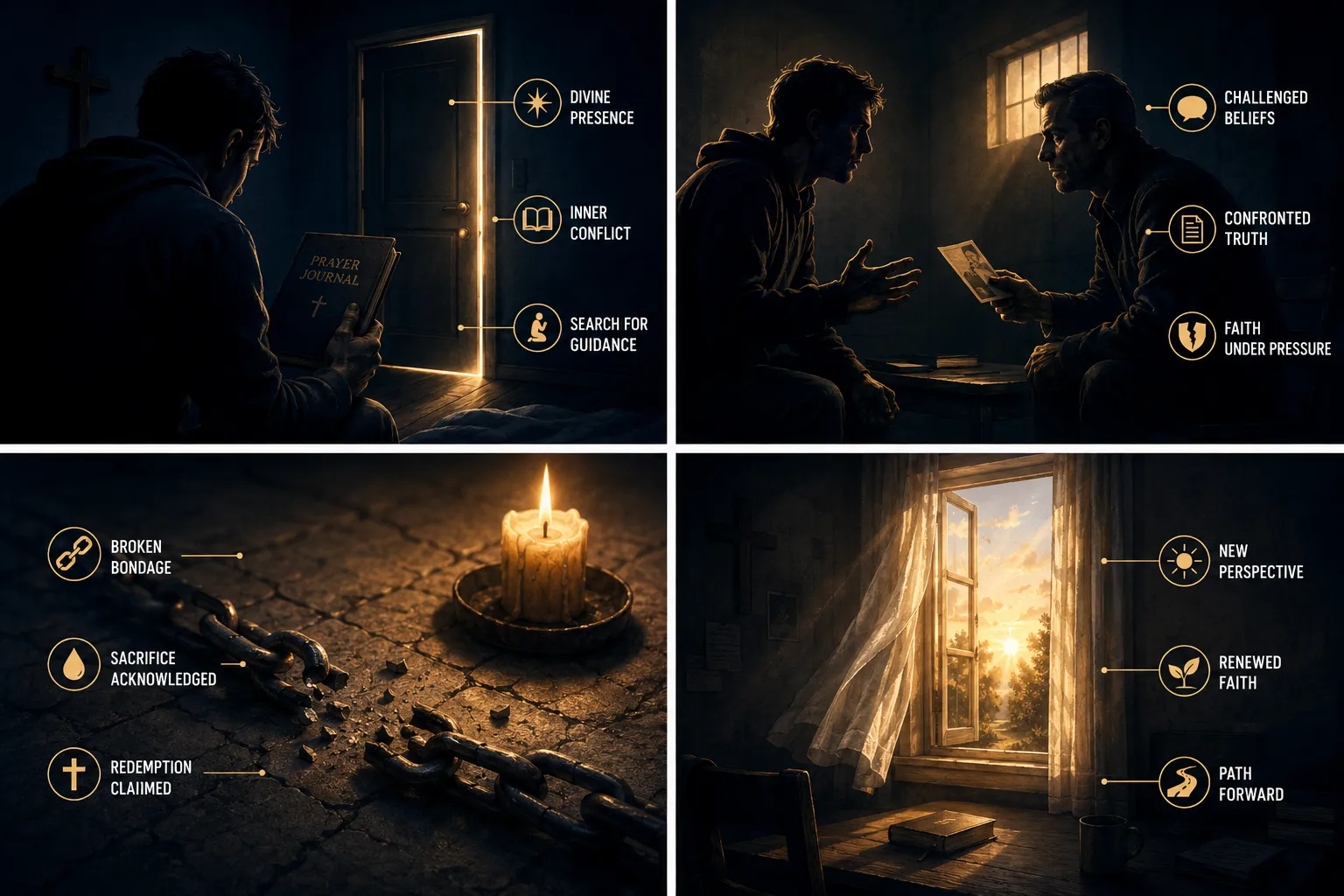
The Gathering Light series builds its entire premise on this principle. The Gathering Light Restoration Retreat uses the careful language of Christian testimony to preserve women’s stories, and that same language becomes the instrument of control. The spiritual community that should be the safest place becomes the most dangerous one. That inversion is what spiritual conflict does at its best in a thriller: it takes the thing the character most trusts and shows her how it can be corrupted.
Spiritual conflict raises stakes in three specific ways:
- Institutional betrayal. When a church, retreat, or faith community is the source of harm, the betrayal is compounded by the loss of sanctuary.
- Moral complicity. Characters who have participated in a harmful system, even with good intentions, face a reckoning that goes beyond “I made a mistake.”
- The cost of speaking truth. In communities built on shared testimony, telling a different story than the one the institution endorses is an act of spiritual courage, not just personal bravery.
What Are the Common Faith Themes in Christian Psychological Thrillers
The most common faith themes in this genre are guilt, forgiveness, calling, spiritual warfare, and the question of who gets to define someone’s truth. These aren’t decorative, each one maps directly onto a thriller mechanic.
Guilt functions like a ticking clock. A character carrying unconfessed guilt will make increasingly desperate decisions to keep it buried, which is exactly what a thriller plot needs.
Forgiveness is the hardest choice in the story, not the easiest. When forgiveness is earned rather than given cheaply, it becomes the climax, not the epilogue.
Calling creates a specific kind of stakes: a character who believes God has called her to a particular work will endure more, risk more, and resist quitting longer than a character motivated by self-interest alone.
Spiritual warfare, when handled with craft rather than as a genre gimmick, treats prayer, conviction, and spiritual oppression as active forces in the plot. This doesn’t require supernatural events; it requires that the character’s interior spiritual life has visible consequences on her choices.
Who controls the record of someone’s truth is the recurring question across The Gathering Light series, and it’s a deeply theological one: testimony, witness, and the integrity of a person’s story before God and community are all at stake when someone else starts editing the record.
What Role Does Guilt Play, and How Does Redemption Cost Something
Guilt and redemption are the structural spine of Christian psychological thrillers. Guilt drives the plot forward by creating pressure; redemption resolves it, but only when it arrives at real cost.
Cheap grace, the kind that arrives without consequence, without confession, without loss, doesn’t satisfy readers who have lived through real faith struggles. It reads as false. The promise of clean Christian fiction isn’t that nothing bad happens; it’s that when grace shows up, it means something because the story made it earn its place.
Redemption that costs something looks like:
- Confession that ends a relationship the character valued
- Forgiveness extended to someone who doesn’t deserve it and may not even accept it
- Truth told at professional or social cost within a faith community
- A calling pursued in the face of institutional opposition
This is what separates a Christian psychological thriller from inspirational fiction: inspirational fiction tends toward comfort earned by endurance. A Christian psychological thriller earns comfort through honest reckoning, mercy and justice held together, not traded off against each other.
Can Non-Religious Readers Enjoy Christian Psychological Thrillers
Yes, when faith is treated as lived experience rather than a position to be argued, non-religious readers engage fully. The emotional truth of guilt, the longing for forgiveness, the fear of being defined by someone else’s version of your story, these are human experiences, not exclusively Christian ones.
What drives non-religious readers away is not faith itself but preachiness: characters who exist to deliver theological conclusions, plots that pause for sermons, and resolutions that feel like lessons rather than earned story moments. When those elements are absent, when faith shows up through character choice and consequence rather than narration, readers who don’t share the belief can still feel the weight of it.
The best Christian psychological thrillers are, at their core, stories about people trying to do right in situations where the right thing is genuinely costly. That premise has no religious prerequisite.
How Do Authors Avoid Preachy Dialogue in Faith-Based Thrillers
Preachy dialogue happens when a character says what the author believes instead of what that character, in that moment, under that pressure, would actually say. The fix is not to remove faith from the dialogue, it’s to make sure every line of faith-talk is earned by the scene.
Practical techniques for keeping faith grounded:
- Let doubt speak. A character who only voices certainty isn’t believable. Let her say the hard thing: “I don’t know if God is listening right now.”
- Show the cost before the comfort. If a character finds peace in prayer, the reader should have already watched her fail to find it three times first.
- Use action over statement. A character who quietly chooses not to destroy someone who hurt her shows more about grace than a paragraph of internal reflection about forgiveness.
- Trust the reader. The reader knows what a Bible verse means. She doesn’t need the character to explain it.
The guiding principle is walking with the reader, not talking at her. Fiction that feels like it’s walking alongside a reader earns the right to go to hard places. Fiction that talks at her loses that right in the first chapter.
How Does Questioning Faith Create Unreliable Narrators
A character who is actively questioning her faith makes an unreliable narrator not because she is deceptive but because her interpretive framework is unstable. She genuinely cannot be certain whether what she is perceiving is spiritual discernment, paranoia, or manipulation.
This is one of the most structurally elegant things faith themes bring to the psychological thriller: the unreliable narrator effect without requiring the character to lie to the reader. The reader and the protagonist are in the same position, they both want to trust what she believes, and they both aren’t sure they can.
In When the Prayer List Opens (The Gathering Light, Book 3), Taryn Vickers finds her own name on the retreat’s prayer list, written in the hand of a woman who was supposed to be safe. The horror of that moment isn’t just “someone is watching me”, it’s “someone who prays for me is also the threat.” Faith and danger have collapsed into the same person, and Taryn’s ability to trust her own spiritual instincts is exactly what the antagonist is counting on undermining.
Do Faith-Based Thrillers Need Religious Characters, and Best Titles to Read
Faith-based thrillers don’t require every character to be religious, they require faith to be a genuine force in the story’s moral architecture. Secondary characters who don’t share the protagonist’s beliefs can serve as foils, antagonists, or unexpected sources of grace. What matters is that the story takes faith seriously as a real thing with real consequences, not as a personality trait or a cultural backdrop.
Recommended starting points in clean Christian psychological thrillers:
- When Hannah Sleeps (The Gathering Light, Book 1), A transcriptionist at a faith-based retreat discovers her own testimony has been placed in someone else’s file. View on Amazon
- When the Voice Breaks (The Gathering Light, Book 2), A woman who built her career on careful language finds the retreat’s system speaking for her instead. View on Amazon
- When the Prayer List Opens (The Gathering Light, Book 3), A name appears on the prayer list in the hand of someone who should have been safe. View on Amazon
The Gathering Light series (series page) introduces a new protagonist and household in each book, so each title works as a standalone entry point. All three are available on Kindle Unlimited.
How to Write a Psychological Thriller with Christian Themes
The single most important principle: faith must be dramatized, not stated. Everything else follows from that.
A working framework for structuring faith into a thriller:
- Identify the spiritual question at the center of the story. Not “will she survive?” but “what will she have to give up, or give over, to survive with her integrity intact?”
- Make the antagonist’s method exploit something the protagonist believes. The most effective villains in faith-based thrillers don’t attack belief directly, they corrupt it from the inside.
- Build the cost before the grace. Map out what the character will lose before she finds her way through. Grace that arrives without cost is not grace, it’s a shortcut.
- Let the faith community be complicated. Not evil, not perfect, complicated. Real faith communities contain both the safest people a character will ever know and the ones most capable of institutional harm.
- End on hope in the dark, not on resolution in the light. The reader doesn’t need every question answered. She needs to believe the character is still standing and still facing the right direction.
The cross-market classification of “psychological thriller / Christian / suspense” is increasingly used by both publishers and readers [1], which reflects a genuine audience looking for stories that hold faith and danger together without flinching from either.
FAQ
What makes a psychological thriller “Christian” rather than just faith-adjacent? A Christian psychological thriller places faith as a load-bearing element of the plot and character arc, not just a character trait. The spiritual stakes must be real, the faith must be tested, and the resolution must reckon with grace honestly.
Is Christian psychological thriller a growing genre? Yes. Religion book sales rose 7.8% in 2023 [4], and the psychological thriller sub-category within Christian fiction has seen strong momentum through 2025-2026 [1], with new discovery platforms explicitly foregrounding “faith + suspense + high stakes.”
What’s the difference between a Christian psychological thriller and a Christian suspense novel? Suspense is primarily about external threat and plot tension. Psychological thrillers add internal destabilization, the protagonist’s perception, memory, or judgment is under attack. Christian psychological thrillers add a third layer: the character’s spiritual footing is also being tested or undermined.
Can a Christian psychological thriller include a villain who uses faith as a weapon? Yes, and some of the most effective ones do. When a villain exploits the language of grace, testimony, or community trust, the spiritual betrayal compounds the physical danger and creates stakes that go deeper than a standard antagonist.
How do you keep spiritual warfare elements from feeling like a genre gimmick? Ground them in the character’s interior life and make them have visible plot consequences. Prayer that changes a character’s decision is spiritual warfare handled with craft. A glowing angel who appears to solve the plot is a gimmick.
Do these books need to have a happy ending? They need to have a hopeful ending, which is different. Hope in the dark means the character has come through something real and is still oriented toward light, even if the wounds haven’t fully healed. Cheap happy endings undermine the earned grace the genre is built on.
What’s the best entry point for new readers of Christian psychological thrillers? When Hannah Sleeps (The Gathering Light, Book 1) is a strong starting point, it establishes the genre’s core mechanics clearly and works as a standalone.
Are these books appropriate for readers who are going through a faith crisis? They’re written for exactly that reader. The characters doubt, fail, and find grace through honest reckoning, not through tidy resolution. Readers in hard seasons tend to recognize that and find it more comforting than fiction that avoids the difficulty.
Conclusion
How faith themes raise the stakes in Christian psychological thrillers comes down to one thing: they make the cost of every choice bigger. When a character’s soul, calling, and integrity before God are on the line alongside her physical safety, the reader has more to lose alongside her, and more to gain when grace finally shows up.
The key is that faith must be earned into the story, not announced. It shows up through the choices characters make when no one is watching, through the guilt that won’t stay buried, through the forgiveness that costs more than the character expected to pay. That’s not a formula, it’s a conviction about how stories work and what they’re for.
Next steps for readers:
- Start with When Hannah Sleeps for a grounded introduction to faith-rooted psychological suspense
- Browse the full Gathering Light series page for all three titles
- Explore the complete Silas Bellhaven catalog for clean Christian fiction across mystery, western, fantasy, and thriller
Hope in the dark is still hope. These stories are built to prove it.
References
[1] The Rise Of Christian Fiction Market Trends Regional Dynamics And Future Predictions For 2026 – https://www.alibaba.com/product-insights/the-rise-of-christian-fiction-market-trends-regional-dynamics-and-future-predictions-for-2026.html
[4] 94679 Aap Preliminary Report Puts Religion Book Sales Up 7 8 In 2023 – https://www.publishersweekly.com/pw/by-topic/industry-news/religion/article/94679-aap-preliminary-report-puts-religion-book-sales-up-7-8-in-2023.html