

Last updated: August 16, 2026
Quick Answer: To write a Christian cozy mystery, build a five-act whodunit structure around a likable amateur sleuth in a tight-knit community, then let faith surface through character choice and consequence rather than narration or scripture-dropping. Keep content clean, no graphic violence, no explicit material, no profanity, and let mercy and justice shape the resolution rather than a tidy moral lesson. The result is a story that satisfies genre expectations while remaining genuinely rooted in faith.
Key Takeaways
- Christian cozy mystery follows the same five-act whodunit structure as secular cozy mystery, with a spiritual arc layered into the character’s internal journey.
- Faith integration works best when it shows up as lived doubt, prayer under pressure, and costly choice, not as sermon or scripture-drop.
- Clean content means no graphic violence, no explicit romance, and no profanity; the tone itself should make this obvious before a reader finishes the first chapter.
- The amateur detective protagonist should have a community role that gives her natural access to suspects and secrets, a thrift store manager, a church secretary, a quilting circle leader.
- Earned grace is the theological engine: mercy shows up after cost, not instead of it.
- Word count typically runs 55,000-80,000 words for a standalone cozy; series installments often land closer to 60,000-70,000.
- The biggest craft mistake is resolving the spiritual question before the mystery resolves, faith and plot should arrive at their answers together.
- Romance is permitted but kept at a slow-burn, emotionally grounded level; physical content stays off the page.
- Christian cozy mystery and inspirational mystery overlap but differ in degree of explicit faith content.
- In 2026, major Christian publishers including Love Inspired Trade are actively expanding their mystery lists, signaling strong commercial viability for the genre. [1]
What Is a Christian Cozy Mystery and How Is It Different from Regular Cozy Mysteries?
A Christian cozy mystery is a clean, low-violence whodunit in which faith functions as a load-bearing element of the story, not a decorative one. It shares the genre’s defining features with secular cozy mystery: an amateur sleuth, a contained community, a puzzle-driven plot, and a warm, often humorous tone. What sets it apart is that the protagonist’s belief system shapes how she reads people, weighs evidence, and ultimately decides what justice looks like.
In a secular cozy, the detective might rely on intuition or professional skill. In a Christian cozy, she also carries a moral framework rooted in mercy and justice, and that framework gets tested. The mystery isn’t just “who did it” but “what does it cost to tell the truth when you love the person who did it?”
Key distinctions at a glance:
| Feature | Secular Cozy | Christian Cozy |
|---|---|---|
| Violence | Minimal, off-page | Minimal, off-page |
| Language | Mild allowed | None |
| Romance | Light to moderate | Slow-burn, no explicit content |
| Faith content | Absent or incidental | Central, lived, tested |
| Moral resolution | Justice served | Justice + mercy, earned grace |
| Spiritual arc | None required | Required, woven into plot |
What’s the Basic Plot Structure for a Christian Cozy Mystery Novel?
A Christian cozy mystery follows a five-act structure, with a spiritual turning point built into the third act. [2] The mystery plot and the faith arc should arrive at their crisis together, not one before the other.
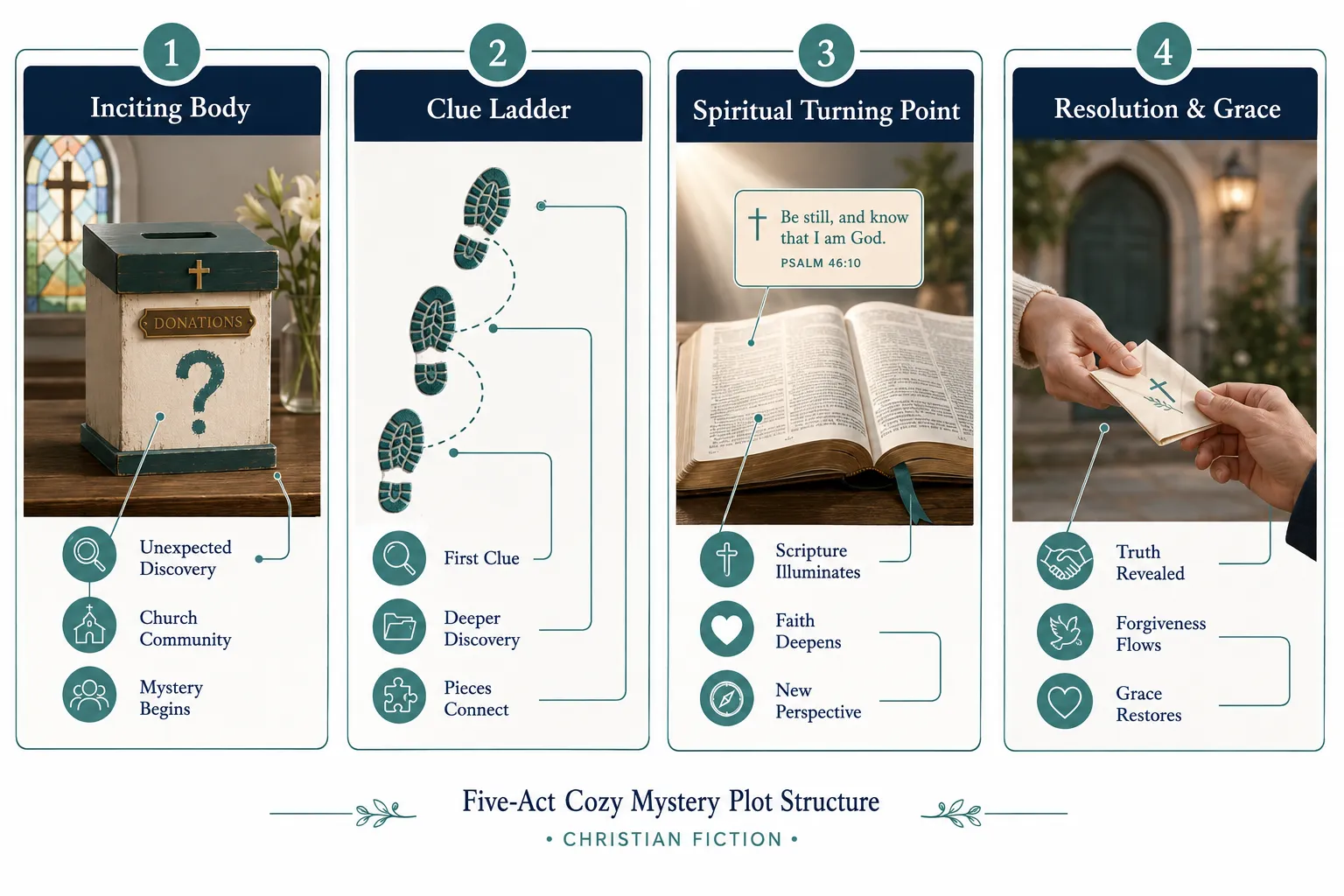
The five-act blueprint:
Setup and inciting body, Introduce the sleuth, her community, and her faith life before the crime. The body (or the discovery of wrongdoing) arrives by the end of Act One, ideally connected to something the protagonist already cares about.
Investigation begins / clue ladder, Suspects multiply. Each clue reveals a layer of the community’s hidden life. The protagonist’s faith assumptions start to crack, she trusted someone she shouldn’t have, or she’s being asked to protect someone she loves.
Spiritual turning point (midpoint crisis), This is the hinge. The protagonist faces a choice that her faith makes harder, not easier: stay silent to protect the church’s reputation, or speak and risk everything. This is where earned grace begins to cost something. [3]
Dark night / false resolution, A wrong suspect is accused, or the protagonist’s own judgment fails her. She has to sit with the possibility that she got it wrong, about the killer and about herself.
True resolution and mercy, The real culprit is revealed through the protagonist’s persistence and moral clarity. The resolution honors both justice and mercy: the truth comes out, consequences follow, and grace shows up, but only after the cost has been paid.
Craft rule: Never let the spiritual arc resolve before the mystery does. If the protagonist finds peace in Chapter 14 and the killer isn’t caught until Chapter 22, the story loses its tension. Faith under fire means both fires go out at the same time.
How Do You Naturally Integrate Faith and Christian Themes Without Being Preachy?
Faith integrates naturally when it shows up as character choice and consequence, not as narration or dialogue that explains what the story means. [6] The moment a character stops to reflect on a Bible verse in a way that conveniently answers the plot’s question, the story has crossed into sermon. The moment a character prays because she genuinely doesn’t know what else to do, it reads as lived belief.
Practical techniques for clean faith integration:
- Let prayer be imperfect. A protagonist who prays and gets no immediate answer is more honest than one whose prayer resolves the scene.
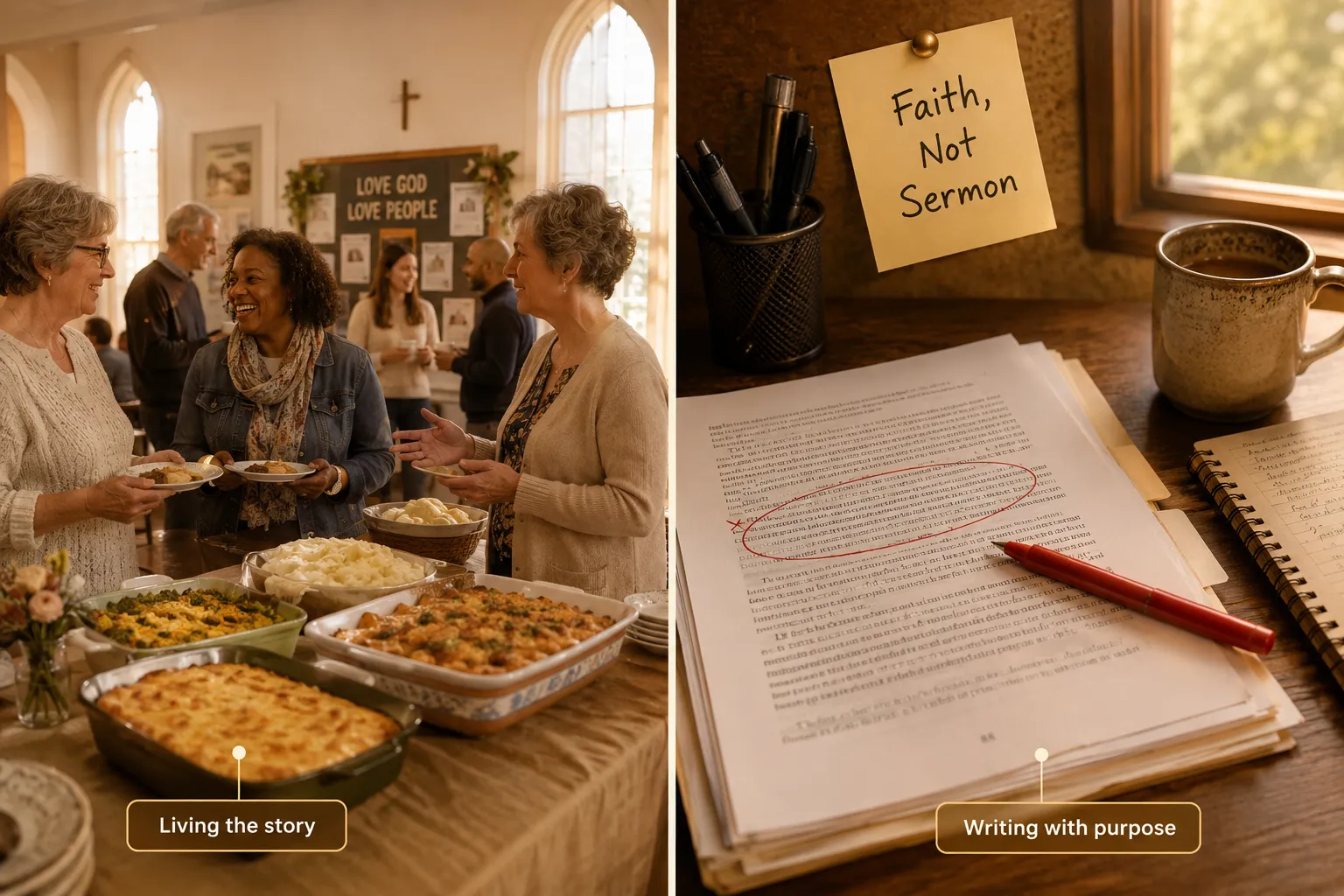
- Use community as the vehicle. Church socials, prayer chains, and potluck dinners carry faith into the story through setting and relationship, not exposition.
- Show faith under fire, not faith on display. The protagonist’s belief should be most visible when it costs her something, when she chooses to tell the truth even though it will hurt someone she loves.
- Earn the scripture. If a verse appears, it should arrive at the end of a scene that has already done the emotional work, not at the beginning as a thesis statement.
- Let other characters doubt. A community where everyone believes identically reads as fantasy. Real faith communities include skeptics, the wounded, and the quietly lapsed, and those characters make the protagonist’s faith more credible by contrast.
Common mistake: Giving the protagonist a spiritual insight that solves the mystery. Faith can inform how she pursues truth, but the solution should come from evidence, not revelation.
What Content Should You Avoid in Christian Cozy Mysteries?
Clean Christian fiction means the content contract is built into the prose itself, not announced as a disclaimer. [8] Readers should feel the boundaries through tone before they consciously register them.
Content to keep off the page:
- Graphic violence, The death can be real and the stakes can be high, but the physical details of the crime stay minimal. The body is found; the horror is in the implication, not the description.
- Profanity, None. This includes mild substitutes that exist to signal the same emotional register.
- Explicit sexual content, Romance, if present, stays at the level of emotional tension and a closed door. No explicit scenes.
- Gratuitous cruelty, Villains can be genuinely threatening without being sadistic in ways that require graphic depiction.
- Theological shortcuts, A villain who is evil because he’s an atheist, or a hero whose faith makes her immune to real doubt, both flatten the story and misrepresent how belief actually works.
What’s not off the table: Moral complexity, genuine grief, characters who fail, marriages under strain, addiction in backstory, and communities that have done real harm in the name of religion. Honesty about hard things is not the same as graphic content. Comfort earned through honesty is different from comfort earned by avoiding difficulty.
How Long Should a Christian Cozy Mystery Be?
A standalone Christian cozy mystery typically runs 55,000-80,000 words, with most series installments landing in the 60,000-70,000 range. [10] Shorter than a thriller, longer than a novella, the length matches the genre’s pacing: enough room for a full cast of suspects and a satisfying community portrait, not so long that the warmth turns into sprawl.
Length guidelines by format:
- Standalone novel: 65,000-80,000 words
- Series installment (established cast): 55,000-70,000 words
- Novella (holiday or bridge story): 25,000-40,000 words
Kindle Unlimited readers, who make up a significant portion of the Christian cozy audience, tend to reward consistent series output over long individual books. A 65,000-word book published every six to eight weeks outperforms an 85,000-word book published annually in KU read-through metrics.
What Are Common Mistakes Writers Make in Faith-Based Mysteries?
The most damaging mistakes in Christian cozy mystery fall into two categories: craft failures and faith failures, and they often happen at the same time.
Craft mistakes:
- Introducing too many suspects without giving each a believable motive rooted in the community’s specific history
- Withholding clues from the reader that the protagonist has already seen (this breaks the fair-play contract cozy readers expect) [5]
- Resolving the mystery through coincidence rather than the protagonist’s active pursuit
Faith mistakes:
- Using the mystery’s resolution as a conversion moment, the killer repents dramatically and the story ends on his prayer. This is cheap grace: redemption that costs nothing and arrives on cue.
- Making the protagonist’s faith the reason she’s right and everyone else is wrong, rather than the reason she keeps going when she’s not sure she’s right.
- Dropping scripture into dialogue as a way to signal Christian content rather than earning it through the scene’s emotional logic.
The test: If you removed every explicit faith reference from your manuscript, would the story still feel like it was written by someone who believes? If yes, you’ve integrated faith correctly. If no, you’ve been decorating rather than building.
How Do You Write a Satisfying Mystery Ending That Doesn’t Feel Contrived?
A satisfying cozy mystery ending reveals the killer through clues the reader has already seen, resolved through the protagonist’s active choice rather than luck or coincidence. [2] In a Christian cozy, the ending carries an additional weight: the resolution should honor both justice and mercy without collapsing one into the other.
What makes an ending land:
- Fair-play cluing, Every major clue is visible to the reader before the reveal. The satisfaction comes from the reader thinking “I should have seen that.”
- The protagonist earns it, She takes a risk, makes a sacrifice, or tells a hard truth to get to the answer. The ending is a consequence of her choices, not a gift from the plot.
- Mercy and justice both show up, The killer faces real consequences. But the protagonist’s response to that moment, the way she holds grief and relief at the same time, is where the faith arc closes.
- Leave one thread unresolved, Not the mystery, but something human. A relationship that’s still healing, a question that didn’t get answered cleanly. This is what makes readers come back for the next book.
Can You Include Romance in a Christian Cozy Mystery, and How Much Is Appropriate?
Romance is permitted in Christian cozy mystery and is common in the genre, but it stays at a slow-burn, emotionally grounded level with no explicit physical content. [8] The Mercy House Mysteries, for example, maintain a warm community setting where relationship tension can exist without requiring a romantic subplot to carry the series.
The appropriate range:
- Emotional tension and longing: Fully appropriate. This is where the best slow-burn lives.
- Courtship, conversation, a first kiss: Appropriate, handled with restraint.
- Physical intimacy beyond a kiss: Off the page. The door closes; the scene ends.
- Romantic subplot driving the main plot: Use carefully. The mystery should remain the primary engine; romance is a secondary thread.
Some Christian cozy series are romance-absent by design, particularly those aimed at readers who want the community warmth without the will-they-won’t-they tension. Knowing your reader’s expectation before you commit to a romantic arc saves significant revision later.
What Makes a Good Amateur Detective Protagonist for Cozy Mysteries?
A strong cozy mystery protagonist has a community role that gives her natural, believable access to suspects, secrets, and the kind of conversation people have when they think they’re just making small talk. [6] In a Christian cozy, that role often connects to the church or to a service institution, a thrift store, a food pantry, a quilting circle.
What the best cozy protagonists share:
- A reason to investigate, Not just curiosity, but stakes. She knew the victim, she’s been accused, or the wrong person is about to take the fall.
- A community anchor, She belongs somewhere specific. Readers should be able to picture her regular Tuesday before the body shows up.
- A faith life that’s active but imperfect, She prays, she doubts, she sometimes goes to church out of habit and sometimes out of genuine need.
- A flaw that creates plot, Stubbornness, loyalty to the wrong person, a tendency to see the best in people past the point of wisdom. Her flaw should cost her something before the end.
Nora Bell Hartley of the Mercy House Mysteries is a useful model: her role managing a church thrift store in Juniper Gap, Tennessee, puts her in contact with the community’s discarded objects and discarded secrets in equal measure.
How Do Successful Christian Cozy Mystery Authors Handle Violence and Dark Themes?
The most effective approach keeps violence minimal and off-page while refusing to sanitize the emotional reality of what a death means to a community. [3] The darkness in a Christian cozy isn’t graphic, it’s moral. The horror is in the betrayal, the hidden sin, the person everyone trusted.
The practical framework:
- The crime happens before or between scenes. The reader learns about it through discovery, not through witnessing it.
- The emotional aftermath is not minimized. Grief, fear, and the disruption of community trust are all fair game and make the story honest without making it graphic.
- The villain’s motivation is human, not monstrous. Greed, shame, self-protection, a secret that got out of hand, these are more unsettling than pure evil because they’re recognizable.
- Hope in the dark is earned, not assumed. The protagonist doesn’t arrive at comfort by skipping past the hard part. She moves through it.
What’s the Difference Between Christian Cozy Mystery and Inspirational Mystery?
Christian cozy mystery and inspirational mystery overlap significantly but differ in the degree and explicitness of faith content. Inspirational mystery is the broader category, it includes any mystery with positive, uplifting themes, which may include faith but doesn’t require it to be central or tested. Christian cozy mystery specifically places the protagonist’s Christian faith as a load-bearing story element that shapes plot, character, and resolution.
In practice: an inspirational mystery might have a protagonist who mentions attending church. A Christian cozy mystery has a protagonist whose faith is tested by the investigation and whose understanding of mercy and justice is part of how she solves the crime.
Publishers Weekly noted in 2026 that editor Shana Asaro at Love Inspired Trade sees rising demand specifically for “clean, faith-centered mysteries” in the tradition of Agatha Christie, a signal that the market is moving toward the more explicitly faith-integrated end of the spectrum. [1]
What Publishing Options Exist for Christian Cozy Mystery Authors?
Christian cozy mystery authors in 2026 have three viable paths: traditional Christian publishing, indie/self-publishing via Kindle Direct Publishing (KDP), and hybrid publishing.
Traditional publishing: Love Inspired Trade, Bethany House, and Revell are the primary Christian imprints actively acquiring mystery. Love Inspired Trade announced new mystery titles for 2026-2027, including works by Heather Day Gilbert and Dana Mentink, confirming that mystery is becoming a more viable niche in Christian publishing after years of being secondary to romance. [1] The trade-off is a longer timeline (12-24 months from acquisition to publication) and lower royalty rates.
Indie/KDP: Kindle Unlimited is the primary distribution channel for indie Christian cozy mystery. KU readers in this genre are voracious series readers, a 10-book series with consistent covers and a recognizable protagonist can build significant read-through revenue. The Mercy House Mysteries demonstrates this model: 10 books set in Juniper Gap, Tennessee, with a consistent protagonist and community.
Hybrid publishing: Some authors begin indie to build an audience, then approach traditional publishers with proven sales data. Literary agent Rachelle Gardner noted that Christian fiction historically developed around romance, leaving mystery “behind”, which means the traditional market is still catching up to reader demand, and indie authors who build audience now may have leverage as that market matures. [1]
Choose based on your goals:
- Choose traditional if you want bookstore distribution and editorial support and can wait 18-24 months.
- Choose indie/KDP if you want to publish quickly, control your covers, and build series read-through on Kindle Unlimited.
- Choose hybrid if you have an established indie audience and want to expand distribution.
How Do You Balance Mystery Plot with Character Development in Cozy Fiction?
The mystery plot and the character arc should be the same story told from two directions. [5] Every clue the protagonist uncovers should also reveal something about her, about her assumptions, her loyalties, or her faith. When plot and character are running on separate tracks, the cozy loses its warmth.
The integration test: For each major plot beat, ask: what does this reveal about who the protagonist is, and what does it cost her? If the answer is “nothing,” the beat is doing only one job when it should be doing two.
Practical balance points:
- Give the protagonist a personal stake in the victim or the accused, not just professional curiosity.
- Let the investigation disrupt her ordinary life in ways that matter: a friendship strained, a routine broken, a belief challenged.
- Reserve the deepest character revelation for the moment of accusation, when she has to name the killer, she has to decide what she believes about grace, guilt, and who deserves mercy.
Are There Specific Settings That Work Better for Christian Cozy Mysteries?
Small towns and faith-community institutions are the most natural settings for Christian cozy mystery because they provide both the contained suspect pool the genre requires and the organic integration of faith into daily life. [8] The setting isn’t just backdrop, it’s the reason everyone knows everyone, and the reason secrets stay buried until they don’t.
Settings that work well:
- Small-town church communities (the model for Juniper Gap, Tennessee in the Mercy House Mysteries)
- Church-adjacent institutions, thrift stores, food pantries, quilting circles, vacation Bible school
- Small-town businesses with community overlap, a bakery that caters church events, a bookshop attached to a ministry
- Seasonal or event-based settings, a church Christmas bazaar, a summer camp, a missions trip
What makes a setting earn its place: Emotional specificity. The reader should be able to smell the fellowship hall coffee and feel the particular social pressure of a small congregation where everyone watches everyone else. Generic “small town” doesn’t do the work, Juniper Gap, Tennessee does.
FAQ
Q: Do I have to include a church setting in a Christian cozy mystery? A: No. The faith needs to be central to the protagonist, not necessarily to the setting. A Christian protagonist investigating a murder at a county fair or a historical society is still writing Christian cozy mystery if her faith shapes how she pursues truth and justice.
Q: Can my protagonist be a pastor or clergy member? A: Yes, but use caution. Clergy protagonists can feel constrained by their role in ways that limit the investigation. Amateur sleuths with community roles, thrift store manager, quilting circle leader, church secretary, tend to have more natural access to suspects without the professional complications.
Q: How explicit can the villain’s sin be? A: The sin can be serious, fraud, long-buried abuse, a decades-old murder covered up by community silence, but the depiction stays off-page. The weight of the sin is conveyed through its consequences and the community’s response, not through graphic detail.
Q: Should every book in a series have a standalone spiritual arc? A: Yes. Each book should resolve its own faith question even as the protagonist’s overall spiritual life develops across the series. A reader who starts with Book 4 should be able to follow both the mystery and the spiritual stakes without having read the first three.
Q: How do I handle a Christian character who does something morally wrong? A: Honestly. Characters who fail, repent, and bear the consequences of their choices are more theologically credible than characters whose faith makes them immune to serious error. Earned grace requires a real fall.
Q: Is it acceptable to have the killer be a churchgoer or even a church leader? A: Yes, and it’s often more powerful. The mystery of how a person can hold faith and do harm is one of the most honest questions Christian fiction can ask. Handle it with care and without making the church itself the villain.
Q: What’s the minimum faith content required for a book to qualify as Christian cozy mystery? A: The protagonist’s faith should visibly shape at least one major plot decision and the story’s resolution. If faith could be removed without changing the plot, the book is cozy mystery with a Christian protagonist, not Christian cozy mystery.
Q: How do I avoid the “preachy” label? A: Show faith through what characters do under pressure, not through what they say about what they believe. Action is theology in fiction.
Q: Can I write a Christian cozy mystery series with multiple protagonists? A: Yes. A linked-protagonist structure, where each book follows a different character in the same community, works well in cozy mystery and allows the faith arc to vary by character while the setting provides continuity.
Q: How do I handle death and grief in a genre that’s supposed to feel warm? A: Honestly and briefly. The grief is real; the warmth comes from how the community responds to it, not from pretending it doesn’t hurt. Hope in the dark is more powerful than hope that never got dark.
Conclusion
Writing a Christian cozy mystery that genuinely works, that satisfies the whodunit and leaves the reader feeling something true about faith, requires holding two things at once: the genre’s structural discipline and the theological honesty to let grace cost something before it arrives.
The plot structure is learnable. Five acts, a fair-play clue ladder, a midpoint spiritual crisis, a resolution that honors mercy and justice together. The clean content guidelines are clear. What takes longer to develop is the instinct for when faith is being earned versus when it’s being announced, when a character’s prayer is a real moment versus a signal to the reader that this is a Christian book.
Actionable next steps:
- Map your protagonist’s faith arc separately from your mystery plot, then find the three places they intersect, those intersections are your most powerful scenes.
- Read the Mercy House Mysteries starting with A Donation to Die For to see how a church-community setting carries faith without preaching it.
- Write your inciting scene twice, once with explicit faith language, once without. The version that reads more honestly is usually the right one.
- Study the market: Love Inspired Trade’s 2026 expansion into mystery titles signals that traditional publishing is catching up to reader demand. If you’re building a series now, you’re building into a growing market. [1]
Stories rooted in faith don’t need to announce themselves. The best ones walk with the reader, and the reader knows, by the last page, exactly what kind of ground they’ve been standing on.
References
[1] Best Christian Mystery Authors Faith Based Suspense Book Picks For 2026 – https://www.firmenpresse.de/pressrelease736031/best-christian-mystery-authors-faith-based-suspense-book-picks-for-2026.html [2] Complete Guide Plotting Cozy Mystery – https://booksandbiz.com/complete-guide-plotting-cozy-mystery/ [3] How To Write A Cozy Mystery Extract 1 – https://ninaharrington.com/wp-content/uploads/2021/03/HOW-TO-WRITE-A-COZY-MYSTERY-EXTRACT-1.pdf [5] Combined Story Plan For A Cozy Mystery – https://ninaharrington.com/wp-content/uploads/2017/11/Combined-Story-Plan-for-a-Cozy-Mystery.pdf [6] How To Write A Cozy Mystery – https://thewordling.com/how-to-write-a-cozy-mystery/ [8] Writing Cozy Mystery Guide – https://www.iwrity.com/writing-cozy-mystery-guide [10] How To Write Cozy Mystery Series 2026 – https://rivereditor.com/guides/how-to-write-cozy-mystery-series-2026