
Last updated: August 24, 2026
Quick Answer: Quiet miracles in Christian westerns are understated acts of providence, answered prayer, and divine timing woven into frontier plots, not dramatic spectacle, but small turns that cost something and mean everything. They work best when foreshadowed through character, grounded in historical detail, and allowed to arrive after real loss rather than instead of it. The craft question isn’t whether to include them. It’s how to earn them.
Key Takeaways
- Quiet miracles differ from overt supernatural events: they read as possible coincidence to skeptical characters but carry weight for readers rooted in faith
- Effective subtle miracles require narrative groundwork, foreshadowing, cost, and character readiness, before they land
- The frontier setting is historically and thematically compatible with Christian themes of providence, mercy, and justice [4]
- Preachy miracles break story tension; miracles that arrive through character choice and consequence deepen it
- Christian fiction is in a strong growth phase in 2026, with westerns identified as a compatible subgenre by religious publishers [4][8]
- The primary audience for Christian westerns with supernatural themes skews toward readers who want faith handled honestly, not performed
- Common mistakes include miracle-as-escape-hatch, over-explaining divine meaning, and placing the supernatural before the cost is paid
- Historical frontier details, land claims, drought, isolation, mortality, create natural conditions where quiet miracles feel earned, not inserted
- Secular western readers can receive subtle miracles if the story never demands they interpret them as miraculous
What Are Quiet Miracles in Christian Fiction?
Quiet miracles are moments of divine intervention so understated that they could, on the surface, be explained away. A letter arrives the morning a man loses his last reason to stay. Rain breaks a drought the same week a congregation finally stops arguing long enough to pray together. A stranger appears at a crossroads and says exactly the right thing, then is never seen again.
In Christian fiction, these moments function differently from the dramatic healing scenes or angelic visitations common in overtly supernatural stories. They don’t announce themselves. They sit inside the plot like a splinter of light under a door, only visible if the reader is already looking.
The concept of quiet miracles on the frontier: integrating subtle supernatural elements in Christian westerns matters because the frontier setting amplifies both the need and the plausibility. When law runs thin, when medicine is a day’s ride away, when a single hard winter can erase a family’s entire claim, the conditions for desperate faith are already built into the landscape. A miracle doesn’t need to be large to feel enormous in that context.
What Is the Difference Between Overt and Subtle Miracles in Storytelling?
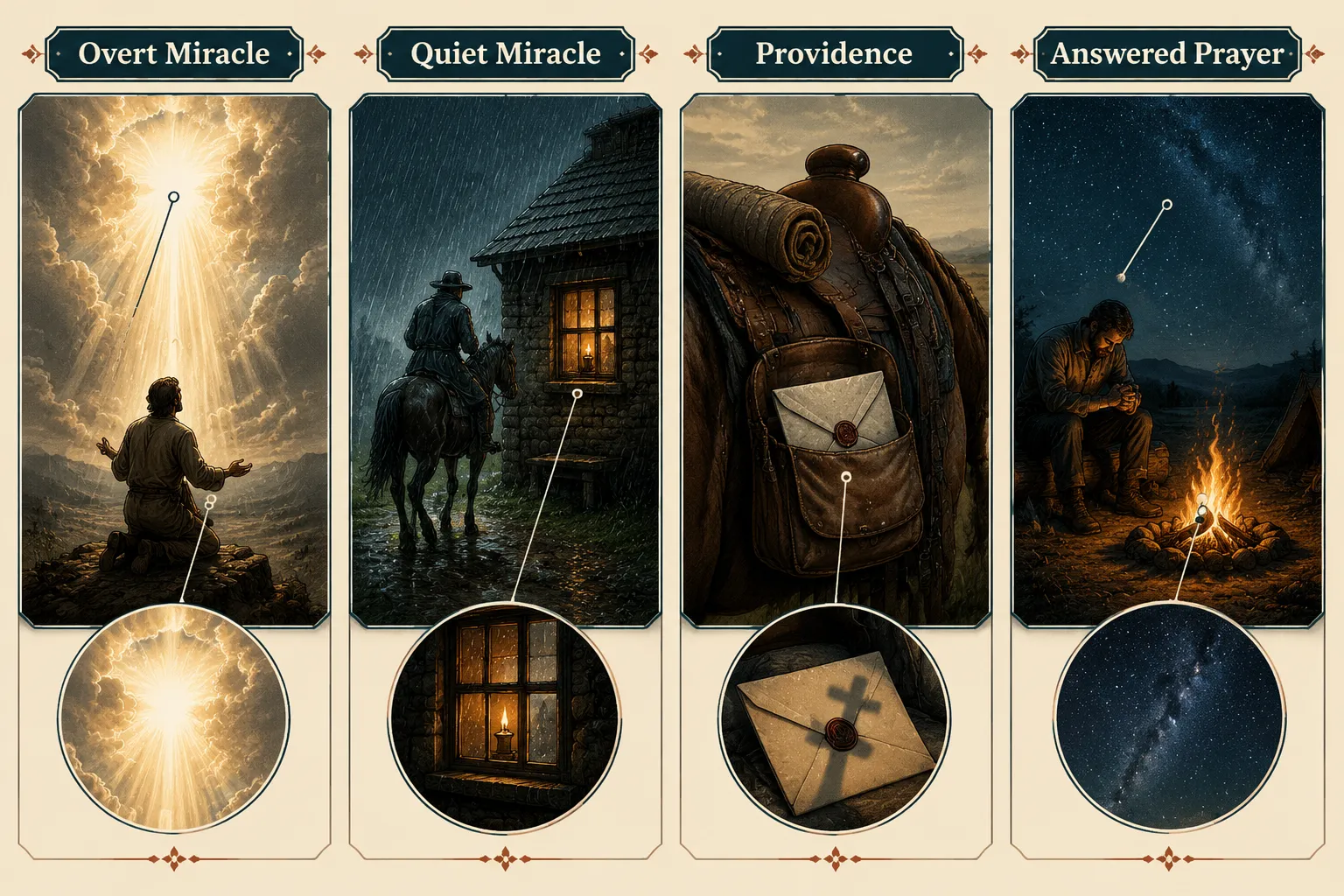
Overt miracles make the supernatural undeniable within the story’s world: a character is raised from the dead, a fire stops at a property line, an angel speaks aloud. Subtle miracles leave interpretive space, they are consistent with providence but not provable by it.
That gap is where quiet miracles live, and it’s also where they do their best work for readers of faith. The story doesn’t need to argue for God’s existence. It only needs to arrange events in a pattern that a believing reader recognizes.
A practical distinction:
| Type | Story Signal | Reader Experience |
|---|---|---|
| Overt miracle | Other characters witness and confirm | Awe, certainty, sometimes disbelief |
| Quiet miracle | Only the protagonist (or reader) notices | Recognition, gratitude, private conviction |
| Providence | Retrospective, seen only in hindsight | Reflection, meaning-making, earned peace |
The frontier is particularly suited to the third category. A man who survives a blizzard might credit luck. His wife, who prayed through the night, knows what she believes. The story doesn’t have to resolve that tension, it only has to hold it honestly.
How to Write Subtle Supernatural Elements in Westerns
Subtle supernatural elements work in westerns when they are structurally prepared, not dropped in for comfort. The three-part framework below applies whether the miracle is a healed wound, a providential arrival, or an answered prayer that changes the direction of a plot.
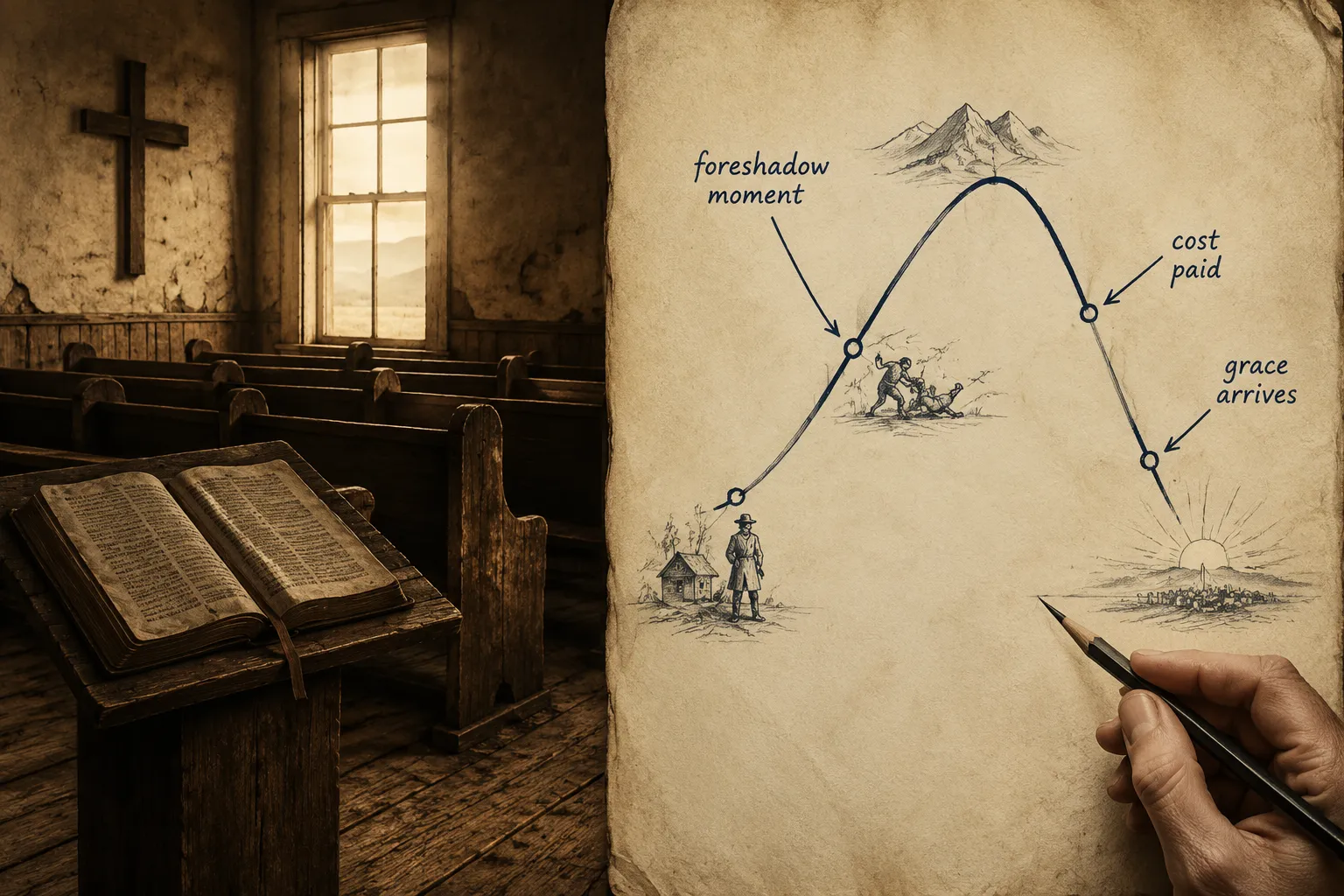
1. Establish the need before the answer arrives. A character must want something specific, fail to get it by their own effort, and reach a genuine point of exhaustion or surrender. Grace that arrives before the cost is paid reads as cheap. Grace that arrives after it reads as mercy.
2. Foreshadow through small true details. Plant the conditions of the miracle early, a character who mentions praying, a recurring image (a particular bird, a verse someone quotes once), a pattern the reader can recognize when it completes. This is not heavy-handed symbolism. It’s the difference between a miracle that feels planted and one that feels discovered.
3. Let the character’s response carry the weight. Don’t narrate the miracle’s meaning. Show what the character does next. A man who survives a gunfight he had no right to survive and then quietly returns to a life of honesty, that’s the miracle completing itself through action, not explanation.
4. Resist the rescue. The most common mistake is using a quiet miracle to cancel consequences rather than transform a character’s response to them. The miracle of quiet miracles on the frontier is not that the bad thing doesn’t happen. It’s that something true shows up inside the bad thing.
What Makes a Miracle Feel Authentic in a Western Setting?
Authenticity in a frontier miracle comes from historical and emotional specificity. The western setting carries real conditions, drought, displacement, violence, isolation, the collapse of institutions, that make divine intervention feel necessary rather than decorative.
Editors working in Christian publishing have noted that miracles are allowed in fiction, but they demand narrative groundwork, particularly for healing or resurrection scenarios [4]. That groundwork is easier to build in a frontier context because the stakes are already physical and immediate.
Historical elements that support quiet miracles:
- Land claims and legal disputes, a document that arrives in time, a witness who appears unexpectedly
- Weather and survival, rain, shelter, a thaw that comes one day earlier than expected
- Illness and injury, recovery that outpaces what the frontier doctor predicted
- Isolation and community, a stranger who arrives with exactly the skill a settlement needs
- Death and grief, a letter written before someone died that answers a question asked after
Each of these is historically plausible. Each of them, in the right story, can carry the weight of answered prayer without requiring the narrative to say so.
How Do Christian Authors Handle Supernatural Elements Believably?
The most consistent craft advice from Christian fiction editors and writing guides is: show faith through character choice and consequence, not through narration or scripture-dropping [5]. That principle applies directly to miracles.
A character who prays and then acts differently, who makes a harder, costlier choice because of what they believe they heard, is more persuasive than a character who prays and then watches a problem dissolve. The supernatural element becomes believable because it changes behavior, not because it changes circumstances.
What works:
- Miracles that arrive after a character has already chosen the harder right thing
- Answered prayer that comes in an unexpected form (not the thing asked for, but the thing needed)
- Providence visible only in retrospect, acknowledged quietly rather than celebrated loudly
What breaks the contract:
- A miracle that arrives to prevent a character from facing real consequences
- Narration that explains what the miracle means (“God had heard her prayer and now…”)
- A conversion moment that resolves all tension in a single scene
The Mercy Line series, Silas Bellhaven’s Christian frontier western, operates on exactly this principle. Its conscience line is “Where law runs out, a man finds what he answers to.” That’s a quiet miracle framing built into the series architecture: the supernatural isn’t a special event. It’s the pressure that reveals what was already true.
Common Mistakes When Writing Religious Themes in Westerns
The most damaging mistake is using faith as a shortcut rather than a load-bearing element. When a miracle arrives to rescue a character from a problem the plot created, it signals to readers that the story isn’t willing to pay what it’s asking them to pay emotionally.
Mistakes that undermine quiet miracles:
- The sermon disguised as dialogue, a character explains the theological meaning of what just happened
- Miracle-as-escape-hatch, divine intervention cancels a consequence instead of transforming a response to it
- Premature grace, the miracle arrives before the character has genuinely failed or surrendered
- Over-symbolism, every hawk, every candle, every rainstorm is loaded with obvious spiritual meaning
- Ignoring historical texture, a miracle set in 1880s frontier territory that reads like a contemporary prayer meeting
The fix for most of these is the same: slow down. Let the character earn the moment. Let the reader feel the weight of what’s at stake before anything shifts. Earned grace, redemption that costs something, is the only kind that resonates past the last page.
How to Balance Faith and Realism in Christian Frontier Fiction
Balancing faith and realism means treating both as equally serious. The frontier was brutal, legally ambiguous, and frequently unjust, and a Christian western that softens those conditions in order to make faith look easier is doing a disservice to both history and theology.
The best Christian frontier fiction holds mercy and justice in the same hand. Characters face real consequences. Communities fail each other. Law is sometimes corrupt and sometimes absent. Into that specific, historically grounded world, faith shows up not as a solution but as a posture, a way of standing inside hard things without being destroyed by them.
Practical balance points:
- Let characters doubt without resolving the doubt too quickly
- Allow prayers to go unanswered in ways the story takes seriously
- Show the cost of obedience, not just its reward
- Use the historical record honestly, land theft, labor exploitation, racial injustice were all frontier realities that Christian characters would have had to navigate, not ignore
Religious publishers have noted that westerns are uniquely compatible with Christian themes of providence and redemption precisely because the genre already carries moral weight [4]. The frontier is a place where law runs thin and character is tested. That’s not a setting that needs faith added to it. It’s a setting that was always asking for it.
What Audience Reads Christian Westerns with Supernatural Themes?
The core audience for Christian westerns with subtle supernatural elements is readers who want their faith represented honestly, not preached at, not simplified, but genuinely present inside a story with real stakes [3][9].
This audience skews toward women aged 35-65, many of them Kindle Unlimited subscribers who read across multiple Christian fiction subgenres. They are experienced readers who recognize formula quickly and respond to authenticity. They don’t need a miracle in every chapter. They need to feel that the author takes faith seriously enough to let it cost something.
What this audience responds to:
- Characters who doubt and work through it, rather than characters who believe without friction
- Miracles that arrive quietly, without fanfare, after real loss
- Historical settings treated with specificity and respect
- Clean content that doesn’t use “clean” as a selling point, the tone makes it obvious
Can quiet miracles work for secular western readers? Yes, if the story never demands a theological interpretation. A secular reader can experience a quiet miracle as a meaningful coincidence, a turn of fate, or simply good storytelling. The faith layer is present for those who see it. It doesn’t require a confession of belief to function as a satisfying narrative moment.
Techniques for Foreshadowing Miracles Without Being Heavy-Handed
Foreshadowing a quiet miracle means planting the conditions of its arrival so early and so naturally that when it comes, it feels like recognition rather than surprise.
Practical techniques:
- The recurring small detail, a character who pauses to pray before a specific action, every time. When that action matters most, the pause carries accumulated weight.
- The planted question, a character asks, early in the story, whether God answers prayers for people like them. The miracle doesn’t answer the question directly. It just happens, and the question hangs in the air differently afterward.
- The almost-moment, show a near-miss early that the character dismisses as luck. When the real moment arrives, the reader connects them.
- The secondary witness, a minor character who notices something the protagonist doesn’t. Their quiet observation plants a seed the reader carries.
- The object with history, a Bible, a letter, a deed that appears early and returns at the moment of the miracle. Objects carry emotional weight without narration.
The key is restraint. Foreshadowing works because it’s invisible until it completes. If the reader can see it coming from the first chapter, it’s not foreshadowing, it’s telegraphing. The difference is in how lightly the detail is placed and how long it waits before it matters.
How Do You Avoid Making Miracles Feel Preachy in Fiction?
A miracle becomes preachy the moment the narrative stops trusting the reader. Preachy miracles are explained. They come with a character who names what just happened, or a narrator who steps in to confirm the theological significance, or a conversion scene that wraps everything in a bow.
The rule is simple: show the miracle, then get out of the way.
Let the character sit with it. Let the reader sit with it. If the story has done its work, if the cost was real, the foreshadowing was honest, the character’s faith was shown through choice rather than declaration, the reader will find the meaning without being handed it.
This is the core of what it means to write faith that walks with readers rather than talks at them. The miracle is not a lesson. It’s an event. What it means is between the reader and God, not between the narrator and the reader.
Conclusion: Writing the Miracle That Earns Its Place
The craft of quiet miracles on the frontier: integrating subtle supernatural elements in Christian westerns comes down to one commitment: faith under fire, not faith on display. The frontier provides the fire. The author’s job is to let faith show up inside it without announcing itself.
Actionable next steps for writers:
- Audit your miracle scenes, ask whether each one arrives after genuine cost, or instead of it
- Strip the narration, remove any sentence that explains what a miracle means; trust the image
- Add historical texture, ground your supernatural moments in specific frontier conditions (land, weather, law, mortality)
- Foreshadow with restraint, plant one small detail per miracle, early, and let it wait
- Read the genre, the Mercy Line series (The False Warrant, The Mercy Road, The Living Record) demonstrates how quiet miracles function inside frontier plots built on conscience and consequence
Earned grace is the only grace that lasts past the last page. The miracle that costs something, arrives quietly, and changes what a character does next, that’s the one readers carry with them.
FAQ
What is a quiet miracle in a Christian western? A quiet miracle is a moment of divine providence or answered prayer that fits inside the story’s natural events, plausible as coincidence, but weighted with meaning for characters and readers who are paying attention. It doesn’t announce itself.
Do Christian westerns need to include miracles? No. Many strong Christian westerns operate entirely through conscience, consequence, and moral choice without any overtly supernatural moment. Miracles are one tool, not a requirement.
How is a quiet miracle different from a coincidence in fiction? Structurally, they look the same. The difference is in the narrative preparation: a quiet miracle is foreshadowed through prayer, character posture, and recurring detail so that when it arrives, it completes a pattern the reader has been holding.
Can a secular reader enjoy a Christian western with subtle miracles? Yes. A secular reader can experience the same moment as meaningful coincidence or narrative satisfaction. The faith layer doesn’t require a theological commitment to function as good storytelling.
What’s the biggest mistake writers make with miracles in westerns? Using the miracle as an escape hatch, letting divine intervention cancel consequences rather than transform a character’s response to them. Redemption that costs nothing convinces no one.
How much foreshadowing does a quiet miracle need? One well-placed detail, planted early and allowed to wait, is usually enough. More than that risks telegraphing the moment. The foreshadowing should be invisible on first read and obvious on second.
Should a character explicitly name what happened as a miracle? Rarely, and only if it’s in character and costs them something to say it. A character who names a miracle too easily makes it smaller. A character who almost names it, and then doesn’t, often makes it larger.
What historical frontier details support miracle scenes? Weather events, land claim timing, the arrival of letters or strangers, survival of illness or injury, and the collapse or restoration of legal documents all carry natural miracle potential in a frontier setting.
Is Christian fiction growing as a market in 2026? Yes. Christian fiction is in a strong growth phase, with religious publishing identified as one of the faster-growing trade segments [8]. Westerns are specifically noted as compatible with Christian themes by publishers [4].
How do I keep faith from feeling like a sermon in a western? Show faith through what characters choose and what those choices cost, not through dialogue that explains belief or narration that confirms it. The story should walk with the reader, not lecture them.
What makes the frontier setting uniquely suited to Christian themes? The frontier is a place where law runs thin and character is tested under genuine pressure. Providence, mercy, and justice are not abstract in that context, they are survival questions. That makes faith load-bearing rather than decorative.
Where can I read examples of quiet miracles in Christian frontier fiction? The Mercy Line series by Silas Bellhaven, beginning with The False Warrant, builds frontier plots around conscience, earned grace, and the question of what a man answers to when law runs out.
References
[1] Frontier Western – https://christianbooks.today/collections/frontier-western
[4] Christian Fiction Embraces A Classic Genre: The Western – https://www.publishersweekly.com/pw/by-topic/industry-news/religion/article/95660-christian-fiction-embraces-a-classic-genre-the-western.html
[5] Workshop 12 Fiction By The Numbers – https://member.acfw.com/ezine/article/workshop_12_fiction_by_the_numbers/
[8] Christian Fiction 14.7% Yearly Surge: Dramatic Market Expansion Data – https://www.firmenpresse.de/pressrelease734029/christian-fiction-14-7-yearly-surge-dramatic-market-expansion-data.html
[3] Best Selling Christian Fiction: Proven Sales Data & Strategic Insights – https://www.alibaba.com/product-insights/best-selling-christian-fiction-proven-sales-data-strategic-insights.html
[9] Top Christian Fiction Bestsellers: Verified Sales Data & Market Trends – https://www.alibaba.com/product-insights/top-christian-fiction-bestsellers-verified-sales-data-market-trends.html