Last updated: July 27, 2026
Quick Answer: A Christian fantasy book is different from regular fantasy in one foundational way, faith is load-bearing, not decorative. The spiritual dimension shapes what characters want, what they fear, what they’re willing to sacrifice, and what mercy costs them. It’s not that Christian fantasy avoids darkness or difficult themes; it’s that the story is built on the conviction that those things mean something, and that grace, when it arrives, has been earned.
Key Takeaways
- Christian fantasy treats faith as structural to the plot, not as a background detail or moral lesson tacked on at the end
- The divine in Christian fantasy is personal and morally weighted, not a neutral force or a magic system characters can master
- Grace, redemption, and moral consequence are the engine of Christian fantasy plots, not just themes that appear occasionally
- Christian fantasy doesn’t require explicit mentions of God, Jesus, or Scripture, allegory and secondary-world theology are both valid approaches
- Magic in Christian fantasy is evaluated by its source, purpose, and posture within the story, not simply by whether it exists [5]
- Christian fantasy can include darkness, conflict, and moral complexity, clean content doesn’t mean shallow stakes
- The genre serves readers who want their faith represented honestly, not preached at them
- Both children’s and adult Christian fantasy exist, but adult titles increasingly carry theological nuance and real moral weight [6]
- The Realm Makers Conference & Expo 2026 continues to be the primary professional gathering for Christian speculative fiction authors [3]
- Finding good Christian fantasy is easier than ever through Kindle Unlimited, Christian indie publishers, and dedicated speculative imprints
What Defines Christian Fantasy as a Genre
Christian fantasy is speculative fiction, dragons, secondary worlds, magic systems, epic quests, where the spiritual architecture of the story reflects a Christian worldview. That means the universe has moral order, human choices carry weight, and redemption is possible but not cheap.
This is what makes the question “What makes a Christian fantasy book different from regular fantasy?” more than a marketing distinction. It’s a question about what the story believes about the world.
Three things that make Christian fantasy structurally distinct:
- Moral order is built into the world. Evil isn’t just an opposing force to be defeated, it’s a corruption of something good. Good isn’t just winning, it’s costly faithfulness.
- Grace is earned through the plot, not delivered as a speech. A character doesn’t receive mercy because the author wants to make a point; they receive it because the story has shown what it cost.
- The divine is personal. Whether the story names God directly or works through analogy and symbol, the transcendent in Christian fantasy is not a neutral energy. It has character. It makes demands. It loves.
How Is Christian Fantasy Different From Secular Fantasy Books
The most direct answer: secular fantasy can be morally serious, beautifully written, and even spiritually resonant, but it isn’t accountable to a specific theological framework. Christian fantasy is.
In regular fantasy, a character might find redemption through personal growth, community, or sheer will. In Christian fantasy, redemption involves something outside the self, a grace that the character cannot manufacture, only receive. That distinction changes how stories are built from the ground up.
What changes in practice:
| Element | Regular Fantasy | Christian Fantasy |
|---|---|---|
| Source of moral authority | Often the character or culture | Rooted in transcendent, personal truth |
| Redemption arc | Self-determined or earned by deeds | Requires grace from outside the self |
| Evil | Opposing force or systemic problem | Corruption of created good |
| Magic | Neutral system or power | Evaluated by source and posture [5] |
| Hope | Earned through plot resolution | Grounded in something that outlasts the plot |
Regular fantasy can be excellent literature. The difference isn’t quality, it’s foundation.
Do Christian Fantasy Books Have to Mention God or Jesus
No. Christian fantasy doesn’t require explicit naming of God, Jesus, or Scripture to be genuinely Christian. C.S. Lewis built Narnia around Aslan, a Christ-figure, without ever using the word “Jesus” in the Chronicles. The theology is present in the structure of the story: sacrifice, resurrection, moral law, mercy.
What matters is whether the worldview underneath the story is Christian, whether the universe the author built operates on Christian assumptions about sin, grace, and the nature of the divine [8].
- Allegorical approach: God-figures, Christ-symbols, and covenant language translated into the secondary world (Tolkien, Lewis, and much of modern Christian epic fantasy)
- Direct approach: Characters who explicitly pray, reference Scripture, or live within a recognizable Christian faith community (more common in contemporary or historical Christian fiction)
- Thematic approach: Stories that don’t name God but are built on Christian convictions about human dignity, sacrifice, and the cost of mercy
All three can be authentically Christian fantasy. The test isn’t vocabulary, it’s worldview.
What Are Common Themes in Christian Fantasy Literature
Christian fantasy returns to a consistent set of questions, even when the worlds and characters change completely.
The most recurring themes:
- Earned redemption: Characters who fail, fall, and find grace, but only after the story has shown what failure actually costs [9]
- Faith under fire: Belief tested by circumstance, not confirmed by it, characters who trust when the evidence runs out
- Mercy and justice in tension: The hardest question Christian fantasy keeps asking is whether both can be true at once
- The cost of truth: Telling the truth, holding a record, bearing witness, these actions carry weight and consequence
- Hope in the dark: Not optimism, but something more stubborn, the conviction that darkness doesn’t get the last word
These themes show up whether the setting is a covenant highland, a frontier railroad town, or a secondary world with a magic map system. The genre changes; the questions don’t.
Is Christian Fantasy Only for Religious Readers
Christian fantasy is written from a Christian worldview, but it isn’t written exclusively for church members. Readers who appreciate moral seriousness, earned redemption arcs, and stories where choices carry real weight often find Christian fantasy satisfying regardless of their personal faith.
That said, the genre is honest about what it is. It doesn’t hide its convictions or water them down to reach a broader audience. Readers who prefer morally neutral fantasy or who find any spiritual framework intrusive will likely prefer secular fantasy, and that’s a fair preference.
Christian fantasy works well for readers who:
- Want clean content without shallow stakes
- Value redemption arcs where grace costs something
- Appreciate secondary worlds with coherent moral architecture
- Are tired of cynicism as a default narrative mode
Can Christian Fantasy Have Dark or Violent Content
Yes, but with purpose and proportion. Christian fantasy can portray evil, suffering, betrayal, and moral failure honestly. What it avoids is gratuitous darkness: graphic violence for shock value, explicit content, or despair without any counterweight.
The distinction matters. A story that shows the real cost of sin is not the same as a story that wallows in it. Christian fantasy handles hard things with honesty, not avoidance, but it doesn’t confuse darkness with depth [2].
Comfort earned through honesty about hard things, not by avoiding them.
This is the line Christian fantasy walks: serious about the weight of the world, but not resigned to it.
Do Christian Fantasy Authors Use Allegory or Is It More Direct
Both approaches are legitimate, and many authors blend them. The allegorical tradition, where secondary-world figures and events carry theological meaning without direct naming, runs from Lewis and Tolkien through much of modern Christian epic fantasy. The more direct tradition places characters in worlds where faith is explicit and God is named [8].
Allegory works well when:
- The secondary world has its own internal logic that would be disrupted by direct theological language
- The author wants the truth to arrive through story rather than statement
- The reader is meant to discover the meaning, not be told it
Direct theology works well when:
- The story is set in a world where Christianity is already present (historical, contemporary, or frontier settings)
- The character’s faith is itself the subject being tested
- The author wants to avoid the risk of allegory becoming too abstract
The best Christian fantasy, whatever approach it takes, makes faith feel lived rather than explained. Walking with the reader, not lecturing them.
What Makes a Fantasy Book Christian if There’s No Real-World Setting
A fantasy book is Christian when the world it builds operates on Christian convictions about reality, even if that world has no churches, no Bibles, and no recognizable religious language.
The question to ask isn’t “does this world look like ours?” but “does this world believe what Christianity believes about human nature, moral order, and the possibility of grace?” [9]
In practice, this means:
- Evil is a corruption of good, not just an opposing force
- Human choices carry moral weight that outlasts the moment
- Redemption is possible but requires real cost
- Something transcendent, personal, not merely powerful, stands behind the order of things
A secondary world built on those convictions is Christian fantasy, even if the characters never say a prayer that sounds familiar.
Christian Fantasy vs. Inspirational Fiction: What’s the Difference
Christian fantasy and inspirational fiction both carry faith content, but they serve different purposes and make different promises.
Inspirational fiction tends to be contemporary or historical, emotionally warm, and focused on personal spiritual growth, faith as comfort and encouragement. It often resolves toward hope and healing.
Christian fantasy uses speculative world-building to put faith under pressure in ways contemporary settings can’t. The stakes are larger, the moral questions are more structural, and the genre can carry theological weight that inspirational fiction rarely attempts.
- Inspirational fiction asks: How does faith sustain a person through ordinary hardship?
- Christian fantasy asks: What does faith demand when the entire order of the world is at stake?
Both are valid. They’re just asking different questions.
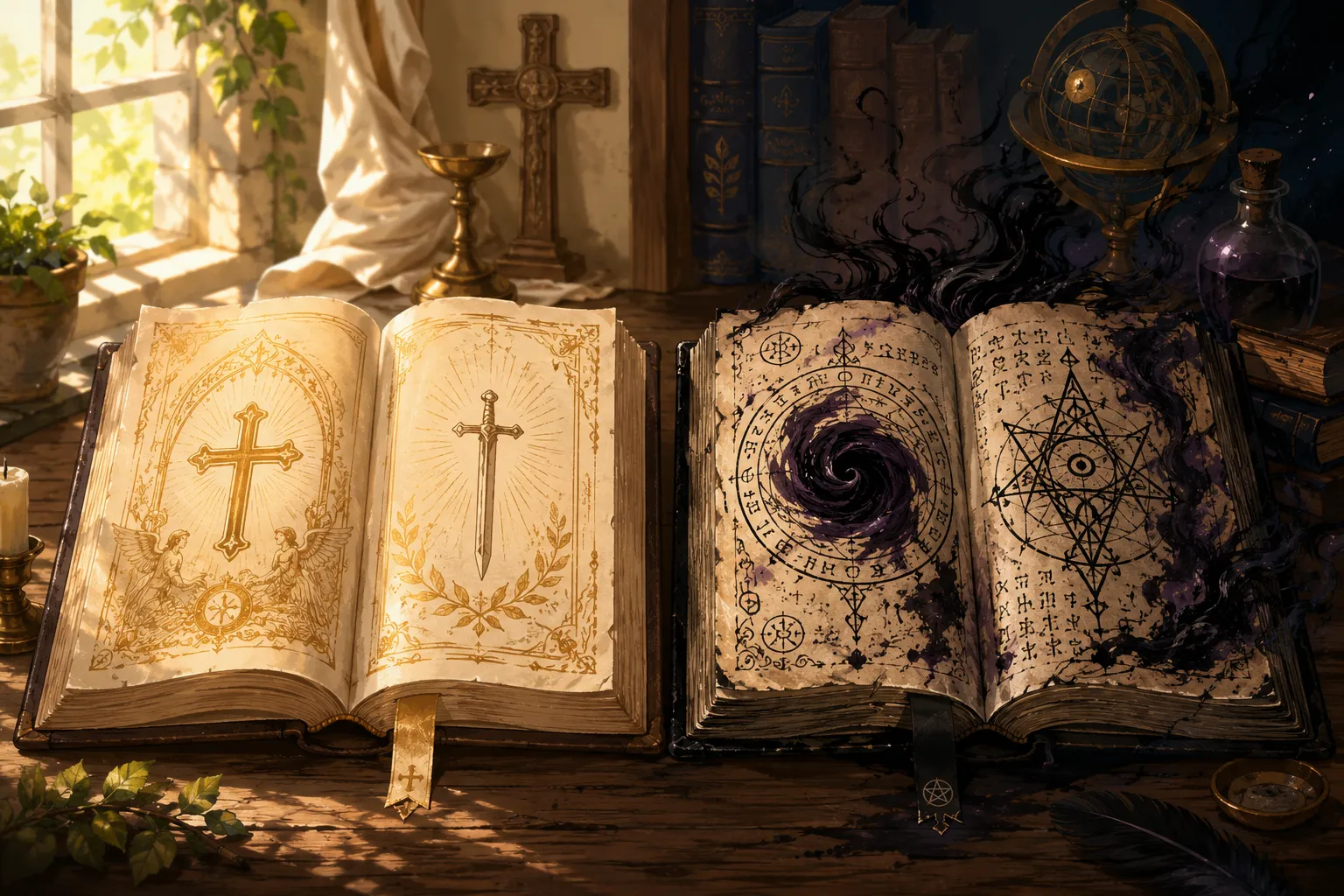
Can Christian Fantasy Include Magic Systems and Still Be Appropriate
Yes, but the magic system’s source, purpose, and posture within the story matter significantly [5]. The Gospel Coalition’s framework for evaluating fictional magic focuses not on whether magic exists in a story, but on how it functions narratively and what it asks of characters [5].
Magic that fits Christian fantasy:
- Operates as a gift, covenant, or stewardship, something given, not seized
- Carries moral consequence when misused
- Is not modeled on real-world occult practice [9]
- Serves the story’s larger moral architecture rather than undermining it
Magic that creates problems in Christian fantasy:
- Presents power as morally neutral and infinitely available to whoever wants it
- Mirrors real occult ritual closely enough to function as instruction [9]
- Removes the need for grace by making self-sufficiency the answer
A magic system can be elaborate, imaginative, and central to the plot, and still be entirely appropriate for Christian fantasy, as long as it’s honest about what power costs and where it comes from.
Common Mistakes People Make When Writing Christian Fantasy
Writing Christian fantasy well is harder than it looks. The most common failures aren’t about content, they’re about craft and conviction.
Mistakes that undermine the genre:
- Preaching instead of showing. Faith delivered as speech rather than demonstrated through character choice and consequence
- Cheap grace. Redemption that arrives without cost, as if the story just needed a happy ending
- Cardboard evil. Antagonists who exist only to be defeated, with no moral weight or comprehensible motivation
- Avoiding the hard questions. Sanitizing the story until faith has nothing real to stand against
- Allegory without craft. Forcing theological meaning onto plot mechanics rather than letting it emerge from character
- Confusing clean content with shallow stakes. A story can be entirely appropriate and still carry real weight, the two aren’t in conflict
The goal is fiction that walks with the reader, not talks at them. That requires trusting the story to carry the theology, rather than stopping to explain it.
Christian Fantasy for Kids vs. Adults: What Changes
Christian fantasy exists across age ranges, but the differences between children’s and adult titles go beyond reading level.
Children’s Christian fantasy tends toward clearer moral architecture, good and evil are more distinct, the Christ-figure is more recognizable, and the resolution is more complete. The Narnia Chronicles are the canonical example: theologically rich, but emotionally accessible to young readers.
Adult Christian fantasy increasingly carries theological nuance, moral ambiguity, faith that doubts before it holds, grace that arrives late and costs more than expected [6]. The questions are harder, the characters more compromised, and the resolution less tidy.
What stays the same across age ranges:
- Faith as load-bearing, not decorative
- Earned hope rather than easy comfort
- Clean content that doesn’t require graphic darkness to carry real stakes
The genre is growing in both directions, with specialized imprints and indie publishers expanding what’s available at every reading level [6].
Where to Find Good Christian Fantasy Recommendations
Finding quality Christian fantasy has become significantly easier as the genre has grown through indie publishing and Kindle Unlimited.
Reliable starting points:
- Realm Makers Conference & Expo 2026, the dedicated professional and reader community for Christian speculative fiction, with author spotlights and recommended reading lists [3]
- Kindle Unlimited, a large percentage of Christian fantasy, particularly indie titles, is available through KU, making it cost-effective to explore widely
- Lorehaven, a dedicated Christian speculative fiction review and community platform [10]
- Christian indie imprints, publishers like Enclave Publishing and others specifically focused on Christian speculative fiction
- Author series pages, once you find an author whose approach to faith resonates, their back catalog is usually the most reliable next read
For readers new to the genre, starting with a series rather than a standalone gives the best sense of how a Christian fantasy author handles faith across a sustained narrative arc. The Sarel Chronicles (The Map of Unanswered Prayers) and The Kethara Chronicles (The Stone That Remembered) are both strong entry points for readers looking for covenant fantasy with real theological weight.
Best Christian Fantasy Books to Start With
The best entry point depends on what kind of fantasy you already enjoy and how directly you want faith handled.
For readers who love epic fantasy with allegorical depth:
- The Map of Unanswered Prayers (The Sarel Chronicles, Book 1), a disgraced map-scribe carries a mark the religious institution refuses to record, in a world where answered prayers are certified and kept by official witnesses
- The Stone That Remembered (The Kethara Chronicles, Book 1), a covenant word an empire cannot own, carried by two women through the highlands of Marat-Sol
For readers who want faith tested through plot rather than allegory:
- The Mercy House Mysteries series (A Donation to Die For), cozy mystery set in Juniper Gap, Tennessee, where faith shows up in ordinary community life under real pressure
- The Mercy Line series (The False Warrant), Christian frontier western where conscience is the last line when law runs out
For readers exploring Christian LitRPG:
- The Cost of Being Chosen (The Measured Debt, Book 1), earned progression, no cheap grace, in a system that keeps proving a man’s record right up until the debt comes due
All titles are available on Amazon and through Kindle Unlimited.
Conclusion
What makes a Christian fantasy book different from regular fantasy isn’t a content checklist or a set of rules about what can and can’t appear on the page. It’s a conviction about what stories are for, and what the world is actually like.
Christian fantasy is built on the belief that moral choices carry weight, that evil is a corruption of something good, and that grace, when it finally arrives, costs something real. That foundation changes everything: how worlds are built, how characters fail, how redemption works, and what hope means at the end of a long, hard story.
Actionable next steps for readers:
- If you’re new to Christian fantasy, start with a series rather than a standalone, the faith architecture shows up more clearly across multiple books
- Browse the Realm Makers community [3] for curated recommendations across the full range of Christian speculative fiction
- Check Kindle Unlimited for cost-effective access to a wide range of Christian fantasy, particularly indie titles
- If a book’s faith content feels preachy rather than lived, that’s a craft problem, keep looking, because the genre has strong work that earns its theology
For readers who want fiction that walks with them rather than talks at them, Christian fantasy, at its best, is exactly that.
FAQ
Q: Is Christian fantasy the same as “clean fantasy”? A: Not exactly. Clean fantasy means no graphic violence, explicit content, or profanity. Christian fantasy carries those content standards but adds a specific theological worldview. A book can be clean without being Christian, and Christian fantasy is defined by its faith foundation, not just its content limits.
Q: Can non-Christians enjoy Christian fantasy? A: Yes. Readers who appreciate moral seriousness, earned redemption, and secondary worlds with coherent ethical architecture often find Christian fantasy satisfying regardless of personal faith. The genre doesn’t hide its convictions, but it doesn’t require the reader to share them.
Q: Does Christian fantasy have to have a happy ending? A: No. It has to have a hopeful one, which is different. Hope grounded in something that outlasts the plot isn’t the same as a tidy resolution. Christian fantasy can end with loss, grief, or unresolved tension, as long as the story hasn’t surrendered to despair.
Q: Is Tolkien’s Lord of the Rings Christian fantasy? A: Tolkien was a devout Catholic and considered his work a fundamentally Christian mythology, though he avoided direct allegory. Most scholars and Christian literary critics classify it as Christian fantasy in the allegorical tradition, the moral architecture reflects Christian convictions even without explicit religious content [8].
Q: What’s the difference between Christian fantasy and Christian fiction generally? A: Christian fiction is the broader category, it includes contemporary romance, historical fiction, mystery, and more. Christian fantasy is specifically the speculative subset: secondary worlds, magic systems, epic quests, or supernatural elements, all built on a Christian worldview.
Q: How do I know if a magic system is appropriate for a Christian fantasy? A: The Gospel Coalition’s framework focuses on source, purpose, and posture [5]. Magic that functions as a gift or stewardship with moral consequence fits Christian fantasy. Magic that mirrors real occult practice or presents power as morally neutral and self-sufficient creates problems [9].
Q: Are there Christian fantasy books for young adults? A: Yes, and the category is growing. Young adult Christian fantasy tends to carry clearer moral lines than adult titles but increasingly engages with real doubt, identity, and moral cost rather than simple good-vs-evil frameworks [6].
Q: What is the Realm Makers Conference? A: Realm Makers Conference & Expo 2026 is the primary professional and community gathering for Christian speculative fiction authors and readers, covering fantasy, science fiction, horror, and related genres from a Christian worldview [3].
Q: Can Christian fantasy include morally ambiguous characters? A: Yes. Moral ambiguity, characters who fail, compromise, or hold conflicting loyalties, is not incompatible with Christian fantasy. What Christian fantasy doesn’t do is treat moral ambiguity as the final word. The story still believes choices matter and that grace is possible.
Q: Does Christian fantasy always resolve toward faith? A: Not always in a dramatic conversion sense. Christian fantasy is more likely to show faith tested, doubted, and held at cost than to deliver a clean spiritual resolution. The conviction underneath the story is Christian; the character’s arc may be messier than that.
References
[2] Fantasy Novels And The Christian Faith – https://wng.org/articles/fantasy-novels-and-the-christian-faith-1752245247
[3] The Best Event For Christian Nerds And Speculative Authors Realm Makers Conference Expo 2026 – https://creativecornerstones.com/2026/05/06/the-best-event-for-christian-nerds-and-speculative-authors-realm-makers-conference-expo-2026/
[5] Christians Evaluate Fictional Magic – https://www.thegospelcoalition.org/article/christians-evaluate-fictional-magic/
[6] 92746 Christian Houses Add More Sci Fi Fantasy Titles – https://www.publishersweekly.com/pw/by-topic/industry-news/religion/article/92746-christian-houses-add-more-sci-fi-fantasy-titles.html
[8] Does The Genre Of Fantasy Belong With Christianity – https://vanguarduniversityvoice.com/2022/11/16/does-the-genre-of-fantasy-belong-with-christianity/
[9] The Christian And Fantastic Literature Part 10 Magic In Fantasy Continued – https://centralseminary.edu/the-christian-and-fantastic-literature-part-10-magic-in-fantasy-continued/
[10] 37 Should Christians Enjoy Fantasy With Fictional Magic Part 1 – https://lorehaven.com/podcast/37-should-christians-enjoy-fantasy-with-fictional-magic-part-1/