
Last updated: August 1, 2026
Quick Answer: A LitRPG series earns the label “Christian” not by inserting scripture into stat screens or having characters deliver sermons between boss fights, but by building its progression system around moral cost, earned grace, and faith that gets tested by the plot itself. The difference between Christian LitRPG and preachy Christian LitRPG is the same difference between a character who prays because they’re desperate and a character who prays to deliver a lesson to the reader. One is a story. The other is a tract wearing armor.
Key Takeaways
- Faith belongs in the consequences, not the narration. Christian LitRPG shows belief through what characters choose when the cost is real, not through what the narrator explains.
- Progression systems are a natural fit for earned grace, leveling up only after genuine sacrifice mirrors the theological reality that mercy isn’t cheap.
- Preachiness is a structural problem, not a content problem. A book becomes preachy when scenes are built to deliver a point rather than to advance a story.
- Clean content doesn’t mean safe content. The best Christian LitRPG puts faith under genuine pressure, doubt, failure, and moral ambiguity are not enemies of Christian fiction.
- The LitRPG audience includes many non-religious readers who respond to moral clarity and earned redemption arcs even without explicit faith framing.
- Subtlety is not compromise. Letting themes emerge through character action is more powerful than stating them directly.
- Common mistakes include: scripture-dropping mid-action, conversion moments that cost nothing, and using the game-system as a metaphor so heavy-handed it stops the story.
- The market for Christian LitRPG is growing but still sparse, readers are actively seeking titles that fill this gap [1][6].
What Defines a Christian LitRPG Series
A Christian LitRPG series is one where the core worldview, that moral choices carry weight, that grace exists but costs something, that there is a source of meaning beyond the character’s own power, is load-bearing to the plot. It isn’t defined by whether the word “God” appears in the text.
The LitRPG genre is built on progression: experience points, skill trees, stat sheets, and the satisfaction of watching a character grow through effort. Christian LitRPG takes that same structure and asks a harder question underneath it, what are you actually becoming, and at what cost? The game system becomes a ledger of moral consequence rather than just a reward mechanism.
Titles like The Cost of Being Chosen from Silas Bellhaven’s The Measured Debt series put this directly into the premise: Eamon Kersey’s name keeps clearing every collapse at Federated Record, and the position series starts asking why he’s always the one left standing. The progression isn’t just numerical, it’s a reckoning.
How Do You Write Christian Values Into LitRPG Without Being Preachy
The answer is structural, not stylistic. Christian values enter LitRPG without preachiness when they drive plot events rather than pause them.
Writing coaches and Christian fiction advisors consistently point to the same principle: show faith through lived character behavior rather than inserting explanations [16]. One 2026 craft resource put it plainly, if there’s a sermon, cut it out. Let the action carry the weight.
Practical techniques that work:
- Make the moral choice the plot choice. When a character must decide whether to exploit a downed enemy for loot or show mercy, that decision should have mechanical and narrative consequences, not a narrator stepping in to explain its significance.
- Use the progression system as moral accounting. If a character gains power through deception, let the system reflect that cost somewhere downstream. Earned grace means the numbers don’t lie.
- Let characters doubt without resolution. A character who prays and doesn’t hear an answer, then acts in faith anyway, is more compelling, and more honest, than one who prays and immediately receives a stat boost.
- Avoid the “convenient conversion” beat. Redemption that costs nothing reads as propaganda. Redemption that costs everything reads as story [25].
The brand phrase that captures this well: walking with them, not talking at them. The story accompanies the reader through the hard thing rather than explaining it from a distance.

The Difference Between Christian LitRPG and Regular LitRPG
The mechanical surface of both genres looks identical, stat screens, leveling, skill acquisition, dungeon progression. The difference is in what the system is for.
In standard LitRPG, the progression system measures competence and power. In Christian LitRPG, the system also measures, or at least reflects, moral and spiritual state. The numbers aren’t just a reward for clever play. They’re a record of who the character is becoming.
| Element | Standard LitRPG | Christian LitRPG |
|---|---|---|
| Progression goal | Power, competence, status | Character formation, moral accountability |
| Consequences | Mechanical (damage, death) | Mechanical and moral |
| Grace | Earned through skill | Earned through cost and humility |
| Conflict source | External enemies, puzzles | External and internal, conscience, doubt |
| Resolution | Victory condition met | Truth acknowledged, even if costly |
Regular LitRPG can have morally complex characters. Christian LitRPG has characters for whom moral complexity is the point of the game.
Can LitRPG Have Faith Themes Without Explicit Preaching
Yes, and the most effective examples do exactly this. Faith themes in LitRPG work best when they operate the way faith operates in real life: quietly, under pressure, through small choices that accumulate into character.
Community discussions among LitRPG readers note that religion in the genre tends to work when it functions as part of the world’s logic rather than as a message delivered to the reader [6]. When a character’s prayer ability has real mechanical weight, as in Canthany Rising, where prayer serves as a source of power within the game system [2], it integrates faith into the story’s rules rather than interrupting them.
The key test: does the faith element advance the scene, or does it pause the scene to make a point? If it advances, it belongs. If it pauses, it’s preaching.
What Makes Readers Feel a Book Is Preachy vs. Inspirational
Readers, including Christian readers, consistently describe the same triggers for feeling preached at [4]:
- A character delivers a speech that sounds like a devotional rather than dialogue
- The villain exists primarily to be wrong about God, not to be a real threat
- Moral questions are resolved too cleanly and too quickly
- Other characters exist to be converted rather than to be people
- The narrative voice steps in to explain what a scene means
Inspirational fiction, by contrast, earns its emotional weight by letting the reader arrive at the meaning themselves. The character suffers genuinely. The doubt is real. The resolution, when it comes, feels like it cost something, because it did.
A useful frame from Christian fiction craft guidance: scenes should not be “tailor-made for the point” [18]. When a scene exists to deliver a message, readers feel it, even if they can’t name why. When a scene exists because the story demands it, the message lands harder for being unannounced.
Best Christian LitRPG Books That Don’t Feel Like Sermons
The Christian LitRPG shelf is genuinely sparse, community readers in 2026 still describe it as an underserved niche [1][8]. But several titles have earned recommendations for handling faith without heavy-handedness:
- The Measured Debt series (Silas Bellhaven), The Cost of Being Chosen, The Remembered Route, and The Borrowed Yield build a LitRPG world where the progression system functions as moral accounting. Eamon Kersey’s record at Federated Record is both literal and spiritual, and the series never pauses to explain the parallel. The Measured Debt series page
- Canthany Rising (Kenneth Bliss, June 2026), uses prayer as a mechanical power source in an Eden-origin world, targeting Christian gamers with clean content and no profanity [2][5].
- The Ritualist, War Aeternus, and Ethria, recommended by LitRPG community members as adjacent titles with moral weight, though not explicitly Christian [1][8].
The common thread in titles that work: faith is structural, not decorative. It shapes what the protagonist can and cannot do, not just what they believe.
Examples of Subtle Christian Messaging in Fantasy Novels
The most cited example remains C.S. Lewis’s The Chronicles of Narnia, where Aslan’s sacrifice and resurrection carry the full weight of substitutionary atonement without the word “Christ” appearing once. The allegory works because it is story-first, the emotional truth lands before the theological parallel becomes visible.
In LitRPG terms, subtle Christian messaging looks like:
- A mercy mechanic that costs the player something, choosing not to execute a defeated enemy and losing a stat bonus for it, but gaining something harder to quantify
- A “debt” system where past moral failures accumulate and must be addressed, not simply leveled past
- An NPC whose forgiveness is unearned by the protagonist, given freely, at the NPC’s own cost, with no narrative explanation of why
The Kethara Chronicles (Silas Bellhaven) uses a covenant-based magic system in which power flows through relationship and promise rather than raw ability, a structural metaphor for grace that never announces itself as one. Series page
How Much Religion Is Too Much in a LitRPG Story
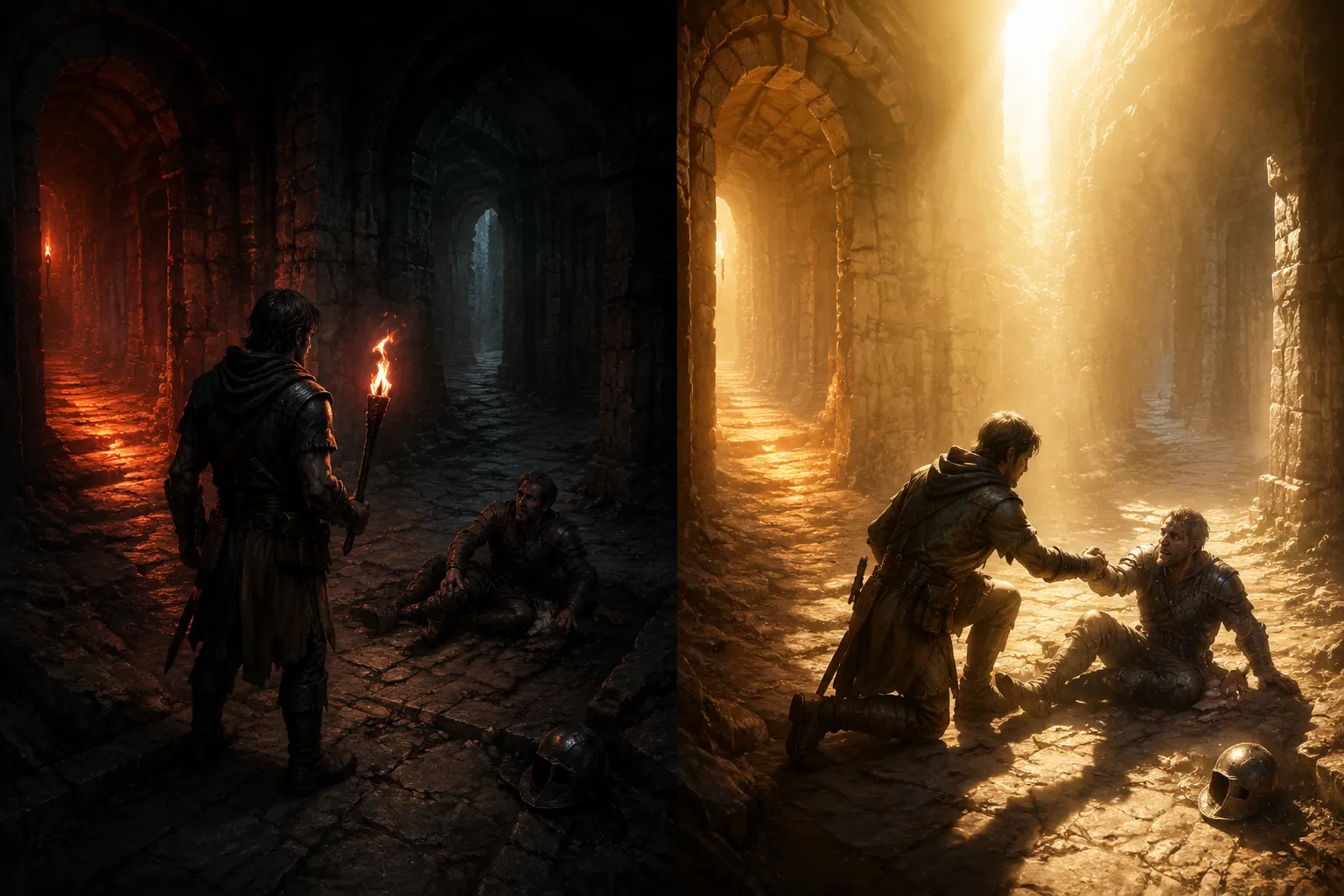
There’s no word-count answer to this. The threshold isn’t frequency, it’s function. A character can pray on every page and never feel preachy if each prayer is an act of desperation or gratitude that moves the scene forward. A single sermon can derail an otherwise strong book if it stops the story to deliver a message.
The practical test: Read the faith-content passage and ask whether removing it would hurt the plot. If the answer is no, if the story would proceed identically without it, the passage is probably preaching rather than storytelling.
Faith that is load-bearing to the plot cannot be removed without the story collapsing. That’s the standard worth aiming for.
Common Mistakes When Writing Faith-Based LitRPG
These are the structural errors that turn Christian LitRPG into something readers put down [23][25]:
- Scripture-dropping mid-action. A character pausing a boss fight to quote a verse breaks narrative tension and signals that the author has a message to deliver.
- Cheap grace. A character sins, feels bad for half a chapter, and is fully restored. Real grace costs something, in the story, not just in the character’s feelings.
- The conversion as climax. When the story’s emotional peak is a character accepting faith rather than a character acting on faith at great cost, the arc feels like a sales pitch.
- Villain-as-strawman. An antagonist who exists to be theologically wrong rather than genuinely threatening makes the story’s moral argument feel rigged.
- Over-explaining the allegory. If the game system is a metaphor for spiritual debt, trust the reader to feel it. Naming it kills it.
- Clean resolution of doubt. Characters who doubt and then receive a tidy answer are less honest, and less compelling, than characters who act in faith before the answer arrives.
Christian LitRPG for Non-Religious Readers
Non-religious readers respond to moral clarity, earned redemption, and consequences that mean something, all of which are structural features of good Christian LitRPG, regardless of their theological origin.
The LitRPG community’s own discussions show that readers who aren’t Christian will engage with faith themes when those themes are integrated into the story’s mechanics rather than delivered as content [6][7]. What they resist is the sense of being addressed, of a story that seems to want something from them beyond their attention.
A Christian LitRPG series written with craft rather than agenda is, functionally, a story about a person whose moral choices have weight and whose failures have consequences. That’s not a niche appeal. That’s the oldest kind of story there is.
Do Christian LitRPGs Sell as Well as Secular Ones
The honest answer: the Christian LitRPG niche is small but actively underserved, which creates real opportunity. LitRPG and GameLit remain among the strongest growth categories in fantasy publishing as of 2026 [40], and community readers consistently report difficulty finding titles that satisfy both the genre’s mechanical pleasures and a faith-rooted worldview [1][8].
The market gap is the opportunity. Readers who want clean LitRPG with genuine moral weight are searching for it and not finding enough of it. That scarcity is not a signal of low demand, it’s a signal of low supply.
Conclusion: Faith Under Fire Is the Whole Point
What makes a LitRPG series Christian without being preachy comes down to one commitment: faith must be tested by the plot, not delivered through it. The game system, the progression mechanics, the dungeon runs, all of it becomes meaningful when the choices inside it carry real moral weight and the grace that follows costs something real.
Readers who want clean Christian fiction with genuine stakes aren’t asking for a story that avoids hard things. They’re asking for a story that walks with them through hard things without flinching and without lecturing. That’s the contract. That’s what rooted in faith actually means in practice.
Actionable next steps:
- If you’re a reader looking for this kind of fiction, start with The Cost of Being Chosen, it’s the entry point to The Measured Debt series and establishes the moral-accounting premise immediately.
- If you’re a writer building a Christian LitRPG series, audit every faith-content passage with one question: does this advance the scene, or pause it to make a point? Cut every pause.
- Browse the full Silas Bellhaven catalog for examples of how faith operates as a structural element across multiple genres, the same principles that work in cozy mystery and frontier western apply directly to LitRPG.
FAQ
What is Christian LitRPG? Christian LitRPG is a subgenre that combines the game-system mechanics of LitRPG, stat screens, leveling, skill progression, with a worldview grounded in Christian faith. The defining feature is that moral choices carry real weight within the story’s progression system, and grace, when it appears, is earned rather than automatic.
Is Christian LitRPG only for Christian readers? No. Non-religious readers respond well to Christian LitRPG when the faith elements are structural rather than preachy, meaning they drive plot consequences rather than deliver messages. Moral clarity and earned redemption have broad appeal regardless of the reader’s personal beliefs.
What’s the difference between inspirational and preachy in LitRPG fiction? Inspirational fiction lets the reader arrive at meaning through the story’s events. Preachy fiction pauses the story to explain the meaning. In LitRPG terms: a character who prays and then acts at great cost is inspirational. A character who stops mid-dungeon to deliver a theological speech is preachy.
Can a LitRPG use prayer as a game mechanic without feeling heavy-handed? Yes, if the mechanic has real costs and consequences. Prayer as a power source works when it operates by the same rules as everything else in the system, it can fail, it can be costly, it can be misused. When it functions as a guaranteed win button, it stops being a mechanic and starts being a message.
What are the most common mistakes in faith-based LitRPG writing? The most common are: scripture-dropping mid-action, cheap grace with no real cost, conversion moments that function as the story’s climax, villain characters who exist only to be theologically wrong, and over-explaining the allegorical meaning of the game system.
Are there Christian LitRPG books available right now? The shelf is small but growing. The Measured Debt series by Silas Bellhaven and Canthany Rising by Kenneth Bliss (June 2026) are among the most explicitly Christian-framed options. Community readers also recommend adjacent titles like The Ritualist and War Aeternus for moral weight, though these are not explicitly Christian.
How do you write earned grace in a LitRPG progression system? Earned grace means the character receives something they don’t deserve, but only after the story has established what it cost someone to give it. In LitRPG terms, this might mean a character’s debt is cleared by another’s sacrifice, or a stat penalty is lifted only after genuine accountability rather than simply leveling past it.
Does clean content limit the stakes in Christian LitRPG? No. Clean content means no graphic violence, no explicit content, and no profanity, not the absence of real danger or moral complexity. The stakes in clean Christian fiction are often higher because the reader’s attention is on character and consequence rather than shock value.
References
[1] Facebook LitRPG Books Group – https://www.facebook.com/groups/LitRPG.books/posts/25107643748832291/
[2] Canthany Rising Brings Christian Faith And LitRPG Adventure Together – https://natlawreview.com/press-releases/canthany-rising-brings-christian-faith-and-litrpg-adventure-together-epic
[4] Goodreads, List of Super Good But Not At All Preachy Christian Fiction – https://www.goodreads.com/topic/show/21521298-list-of-super-good-but-not-at-all-preachy-christian-fiction
[5] Canthany Rising A Christian LitRPG Adventure By Kenneth Bliss – http://juliearduini.com/2026/07/07/canthany-rising-a-christian-litrpg-adventure-by-kenneth-bliss/
[6] Reddit, Religion In LitRPGs – https://www.reddit.com/r/litrpg/comments/16w4fa4/religion_in_litrpgs/
[7] Finding Christ In The LitRPG – https://www.dappledthings.org/deep-down-things/17469/finding-christ-in-the-litrpg
[8] Facebook LitRPG Books Group (second post) – https://www.facebook.com/groups/LitRPG.books/posts/2841769299179721/