Last updated: August 25, 2026
Quick Answer: Christian readers are drawn to frontier westerns because the genre’s core tensions, law versus conscience, mercy versus justice, survival versus integrity, map almost perfectly onto how faith actually works in real life. The frontier setting strips away modern noise and forces characters to answer for what they believe when it costs them something. For readers who want clean fiction with real stakes, frontier westerns deliver both without apology.
Key Takeaways
- Frontier westerns offer moral clarity with genuine cost, exactly the kind of faith test Christian readers find meaningful
- The genre is one of the most consistently clean in Christian fiction, with most titles carrying no profanity, graphic violence, or explicit content
- Faith shows up in frontier westerns through character choice and consequence, not sermon-style narration
- Christian westerns differ from secular westerns primarily in how they handle redemption, earned, not cheap
- The genre appeals to readers who want hope in the dark without having the hard things smoothed over
- Romance content varies widely, some series carry a romance-absent contract, others center it
- Christian publishers are actively investing in new frontier releases through 2026 [2][3]
- You don’t need to be religious to enjoy frontier westerns, the moral architecture resonates broadly
- Strong female characters with faith-grounded values appear across the genre, in both lead and supporting roles
- The best place to find faith-based frontier westerns in 2026 is Kindle Unlimited, where the subgenre is thriving
What Makes Frontier Westerns Appealing to Christian Readers
The frontier strips a character down to what they actually believe. That’s the short answer, and it’s the reason why Christian readers love frontier westerns in ways that other genres can’t quite replicate.
When a man stands between a false warrant and a frightened family, there’s no committee to consult, no policy to hide behind. What he does next is a direct expression of his conscience. That kind of moral pressure is exactly what faith-based fiction is built to explore. The frontier setting isn’t just atmosphere, it’s a pressure test.
Several specific elements drive this appeal:
- Moral clarity without simplicity. The frontier presents clear stakes (land, life, law) while keeping the ethical questions genuinely hard. Who owns the record? What does a man owe a stranger? When does obedience become complicity?
- Consequence that sticks. Frontier stories don’t let characters off the hook. Grace shows up after cost, not instead of it, which is how most Christian readers understand grace to work in real life.
- Rootedness. Small towns, specific landscapes, and communities that remember everything, these settings carry the same emotional weight as the small-town and church-community settings Christian readers already love in cozy mysteries and women’s fiction.
- Redemption as plot, not decoration. In the best frontier westerns, a character’s faith is tested and proven through what happens, not announced in a conversion scene.
Publishers Weekly noted the genre’s staying power in Christian fiction specifically because it gives authors room to explore mercy and justice as competing obligations, not easy partners [7].
How Do Faith Themes Show Up in Western Novels
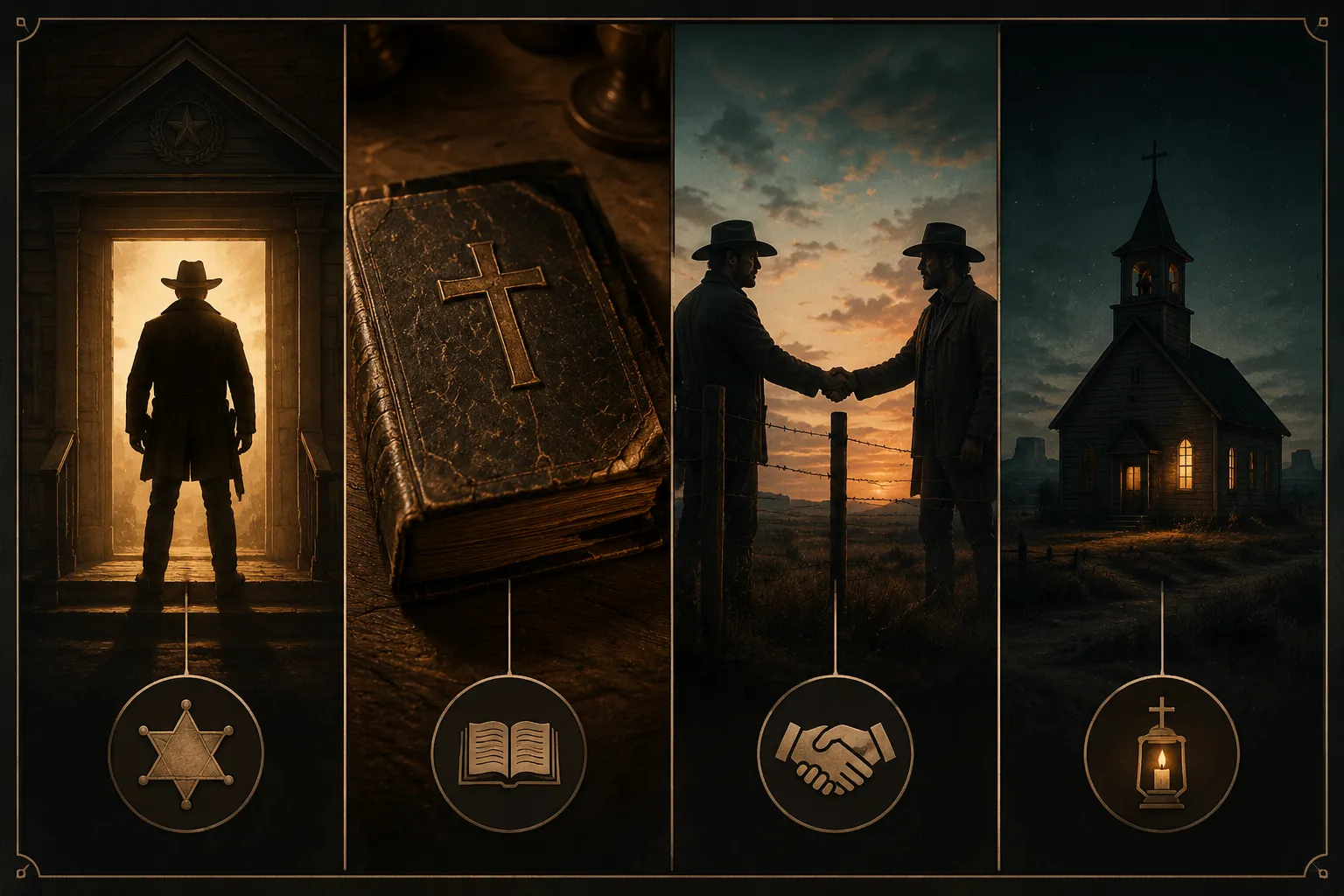
Faith in frontier westerns tends to arrive quietly, through a decision made in the dark, a debt acknowledged, a wrong that could have stayed buried but didn’t.
The best Christian frontier fiction doesn’t drop scripture into the narrative as punctuation. Instead, faith shows up in:
- What a character refuses to do when no one would know the difference
- How they treat the person with no legal standing, the widow, the laborer, the man whose claim has no deed
- Whether they tell the truth when lying would be easier and safer
- How they carry guilt, not as dramatic torment, but as the quiet weight of someone who knows what they owe
This is faith under fire, not faith as a comfort prop. The frontier setting makes these moments feel earned because the stakes are physical and immediate. A man who chooses conscience over self-preservation in a land dispute isn’t making a theological statement, he’s making a human one, and readers feel the difference.
Series like The Mercy Line (Silas Bellhaven) build this directly into their structural premise: the conscience line “Where law runs out, a man finds what he answers to” isn’t a tagline, it’s the question every book in the series is built around. Titles like The False Warrant, The Living Record, and The Ash Ledger each put a different character at a different version of that line, and let the plot decide what they’re made of.
What’s the Difference Between Christian Westerns and Regular Westerns
The difference is primarily in how redemption is handled and what the story considers a win.
In a secular western, the hero typically wins through superior force, cunning, or luck. Redemption, if it appears, is usually personal, the gunslinger who hangs up his weapons, the outlaw who goes straight. The moral universe is self-contained.
In a Christian western, the moral universe has an outside reference point. Characters answer to something beyond the law, beyond community opinion, and beyond their own survival instinct. That reference point doesn’t have to be stated explicitly, it shows up in what they can’t bring themselves to do, and what they can’t stop themselves from doing even when it costs them.
"Christian westerns ask what a man answers to when the law runs out. Secular westerns ask what a man can get away with."
Other practical differences:
| Element | Secular Western | Christian Western |
|---|---|---|
| Redemption arc | Self-earned, personal | Costs something; grace is external |
| Moral authority | Law, community, reputation | Conscience, covenant, God |
| Violence | Often graphic, cathartic | Present but purposeful, not gratuitous |
| Romance | Varies widely | Often clean; some series romance-absent |
| Resolution | Justice as victory | Justice and mercy in tension |
Are Frontier Westerns Considered Clean Reads
Most Christian frontier westerns qualify as clean reads, meaning no graphic violence, no explicit sexual content, and no profanity. But “clean” isn’t a uniform standard across the genre, and readers should know what they’re actually getting.
What “clean” typically means in this genre:
- No explicit or even suggestive sexual scenes
- Violence present but not described in graphic detail, consequences shown, gore avoided
- Language kept at the level of period-appropriate mild expressions
- Faith handled as lived experience, not as moral instruction
What it doesn’t always mean:
- No moral darkness. Clean Christian westerns can and do explore corruption, injustice, grief, and betrayal, they just don’t wallow in it
- No tension or danger. Stakes are real; characters can and do suffer
CKN Christian Publishing’s 2026 new releases section continues to feature frontier and historical westerns prominently, reflecting sustained publisher investment in the clean Christian western market [2]. Scrivenings Press released A Whole New Plan (Historical Frontier Romance, Christian) in May 2026, further confirming that publishers treat this as an active, growing category [5].
Are All Frontier Westerns Actually Clean or Family Friendly
Not all frontier westerns marketed as “Christian” carry the same content standards. This is one of the most common points of confusion for new readers in the genre.
The label “Christian western” can mean anything from a story where a character attends church occasionally, to a series built entirely around a faith-rooted moral framework. Readers looking for genuinely clean content should check:
- Publisher imprint, Christian imprints from houses like Revell, Barbour, or Scrivenings Press maintain stricter content standards than self-published titles using “Christian” as a marketing label
- Series descriptions, Look for explicit statements about content contracts, or read the first few pages as a sample
- Reader reviews, Other clean-read readers are usually specific about content concerns in their reviews
- Kindle Unlimited listings, Many faith-based western authors in KU include content notes in their product descriptions
Baker Publishing Group’s launch of a clean secular fiction imprint signals that the publishing industry now treats “clean” as a distinct market segment separate from explicitly Christian content [1], which means readers need to distinguish between “clean” (no explicit content) and “Christian” (faith-rooted worldview). The best frontier westerns for faith readers offer both.
How Much Romance Is Typically in Christian Frontier Westerns
Romance content in Christian frontier westerns ranges from central to entirely absent, depending on the series.
Romance-forward: Many Christian frontier titles, particularly those from Barbour Publishing and similar houses, are historical frontier romances, the faith element is present, but the love story is the primary plot engine. These are clean romances: no explicit content, but courtship and emotional connection are central.
Romance-adjacent: Some series include a romantic subplot without making it the spine of the story. The relationship develops alongside the main conflict but doesn’t drive it.
Romance-absent: A smaller category, but a real one. Series like The Mercy Line (Silas Bellhaven) carry an explicit romance-absent content contract, the stories are built around conscience, justice, and earned grace, with masculine-only leads and no romantic arc. This serves readers who want frontier fiction without the courtship structure entirely.
Readers who want to know upfront: check the series description for phrases like “frontier romance,” “historical romance,” or, on the other end, “no romance” or “action-adventure.”
Do I Need to Be Religious to Enjoy Frontier Westerns
No. The moral architecture of frontier westerns works whether or not a reader shares the faith of the characters.
What non-religious readers respond to in Christian frontier westerns is the same thing that makes any good fiction compelling: characters who face genuine dilemmas, make costly choices, and live with the consequences. The frontier setting amplifies all of that. A man who chooses to correct a false land record at personal risk is interesting regardless of whether his motivation is explicitly theological.
That said, Christian frontier westerns do ask readers to take the faith of the characters seriously, not to agree with it, but to accept it as real within the story’s world. Readers who find religious conviction implausible or irritating in fiction will likely find the genre frustrating. But readers who simply aren’t personally religious but respect characters who act from deep conviction often find the genre surprisingly absorbing.
The best Christian frontier fiction is, as one way of putting it, walking with the reader rather than talking at them, which means the faith earns its place through what it costs the character, not through what it says.
Why Do Christians Prefer Westerns Over Other Genres
The frontier western does something specific that most contemporary fiction can’t: it puts a character in a situation where the only thing left is what they actually believe.
Modern settings come with institutional buffers, lawyers, social media, HR departments, appeals processes. The frontier has none of that. When the law is three days’ ride away and the man with the deed is lying, a character’s response is a direct expression of their moral core. For Christian readers, that’s not just dramatic, it’s theologically interesting.
Other reasons the genre resonates with Christian audiences specifically:
- The land itself carries moral weight. Stewardship, inheritance, honest dealing, these are biblical categories, and frontier westerns are saturated with them
- Community accountability. Small frontier towns function like close-knit congregations, everyone knows, everyone remembers, and reputation is a form of testimony
- The redemption arc is structural, not decorative. A character who changes in a frontier western changes because the plot demanded it, not because the author needed a feel-good ending
- Clean-read expectations are met naturally. The genre’s conventions, focus on action, conscience, and community rather than sexuality, align with what faith readers want without requiring explicit content warnings
Publishers Weekly has tracked Christian fiction’s embrace of the western as a genre specifically because of this alignment between frontier conventions and faith-based storytelling values [7].
What Content Warnings Should I Know About in Frontier Westerns
Even clean Christian frontier westerns contain elements some readers want to know about in advance.
Common content present in most Christian frontier westerns:
- Violence: Gunfights, physical confrontations, and the consequences of frontier justice appear regularly. It’s rarely graphic, but it’s present
- Injustice and moral darkness: Corruption, land fraud, exploitation of laborers, and racial or social injustice in historical settings are common themes, handled with honesty, not gratuitously
- Death: Characters die, sometimes characters readers care about. Clean fiction doesn’t mean safe fiction
- Moral ambiguity: Not every antagonist is a cartoon villain; not every protagonist makes the right call
What’s typically absent in genuinely Christian frontier westerns:
- Graphic gore or torture
- Explicit sexual content or detailed romantic scenes
- Profanity beyond period-appropriate mild language
- Nihilistic or hopeless endings, hope in the dark is a genre expectation, not a guarantee, but it’s usually present
Readers with specific sensitivities (particularly around historical depictions of racial injustice or violence against women in frontier settings) should read samples before committing to a series.
Best Frontier Westerns for Christian Audiences in 2026
The Christian frontier western market is active and growing in 2026, with new releases from both established houses and independent authors [2][3][8].
For readers who want faith-rooted moral tension without romance:
- The Mercy Line by Silas Bellhaven, Nine-book series set in the railroad town of Mercy Crossing. Linked-protagonist structure, each book a standalone. Titles include The False Warrant, The Survey Line, The Mercy Road, The Ash Ledger, and The Oath Ledger. Romance-absent. Conscience-driven. Available on Kindle Unlimited. Series page
For readers who want Christian frontier romance:
- Heather Blanton’s Burning Dress Ranch series, Frontier historical romance with strong faith themes, featured in CKN Christian Publishing’s 2026 new releases [2]
- A Whole New Plan by Denise M. Colby, Historical Frontier Romance (Christian), released May 2026 by Scrivenings Press [5]
- Love, Lies, and Typewriters: A Christian Historical Western Romance, Released spring 2026 [2]
For readers who want curated lists:
- Cherry Picks Reviews maintains a dedicated Christian Westerns list with reader-verified content notes [9]
- CKN Christian Publishing’s new releases section is updated regularly with frontier and historical western titles [2]
What Values Do Frontier Westerns Teach Compared to Other Fiction
Frontier westerns, particularly Christian ones, consistently return to a specific set of values that other genres handle differently or avoid entirely.
Values the frontier western treats as load-bearing:
- Honest dealing, The genre is saturated with land claims, ledgers, deeds, and records. Whether a document tells the truth matters enormously, and characters who falsify records are the genre’s primary antagonists
- Accountability without escape, Characters can’t outrun what they’ve done. The frontier is big, but communities are small and memories are long
- Mercy as a choice, not a reflex, In frontier westerns, showing mercy costs something. That cost is what makes it meaningful
- Justice that serves the weak, not just the powerful, The genre’s heroes consistently stand between the powerful and the vulnerable, often at personal risk
Compared to contemporary thrillers (which tend to center competence and survival) or literary fiction (which often centers interiority and ambiguity), frontier westerns are unusually direct about moral stakes. That directness is part of why the genre resonates with readers who want their faith represented honestly, not preached at, but present in how the world of the story actually works.
Do Frontier Westerns Have Strong Female Characters with Christian Values
Yes, and the role of women in Christian frontier westerns has expanded significantly in recent years.
Female characters in the genre now appear as:
- Lead protagonists in frontier romance and historical fiction series
- Moral centers of community stories, the woman who keeps the record straight, who remembers what others want forgotten
- Characters with genuine agency, making hard choices about land, family, safety, and faith without being rescued from the consequences
Series like Heather Blanton’s frontier romances feature women navigating survival, faith, and community in historically grounded settings [2]. The Mercy House Mysteries (Silas Bellhaven), while set in contemporary Tennessee rather than the frontier, demonstrates the same sensibility, a female lead who acts from faith and faces real consequences, for readers who want that voice in a different setting.
The frontier western’s emphasis on community accountability and honest dealing gives female characters natural authority within the story’s moral framework. A woman who holds the community’s memory, keeps the honest record, or refuses to let an injustice pass unspoken is doing exactly what the genre values most, and that makes her central, not peripheral.
Where Can I Find Frontier Westerns Written Specifically for Faith-Based Readers
The best sources for Christian frontier westerns in 2026 are:
- Kindle Unlimited, The largest single concentration of faith-based frontier fiction, with both romance and non-romance options
- CKN Christian Publishing, Regularly updated new releases in Christian western and frontier romance [2]
- Cherry Picks Reviews, Curated Christian Westerns list with content notes [9]
- Iolagoulton.com, Monthly new releases lists that include Christian historical and frontier fiction [3]
- Amazon author pages, Browsing by series is often the most reliable way to find books with consistent content standards
For readers specifically looking for frontier fiction that handles faith as lived experience rather than formula, rooted in faith, not performing it, the Silas Bellhaven author page and The Mercy Line series page are worth bookmarking.
Conclusion: What the Frontier Still Has to Say
The reason why Christian readers love frontier westerns, the genre appeal, faith themes, and clean-read expectations, comes down to something simpler than any list can fully capture: the frontier tells the truth about what faith costs.
Other genres can carry faith themes. But the frontier strips the setting down until there’s nothing left between a character and their conscience. No institution to defer to, no crowd to hide in, no procedural escape. Just a man or a woman, a choice, and what they actually believe.
That’s not comfortable reading. It’s not meant to be. But it is honest, and for readers who want their faith represented honestly rather than preached at, that honesty is exactly what keeps them coming back.
Actionable next steps:
- If you’re new to the genre, start with a series that matches your content preference, romance-forward or romance-absent, and read the first book as a sample before committing
- If you want faith-rooted moral tension without romance, start with The False Warrant (Book 1, The Mercy Line), available on Kindle Unlimited
- If you want Christian frontier romance, check CKN Christian Publishing’s current new releases for 2026 titles [2]
- If you want curated lists with content notes, bookmark Cherry Picks Reviews’ Christian Westerns page [9]
- If you’re a Kindle Unlimited subscriber, search “Christian western” filtered by KU, the subgenre is well-represented and actively growing
The frontier is still out there. And for readers who want earned grace, mercy and justice in honest tension, and hope in the dark that doesn’t come cheap, it’s worth the ride.
FAQ
What is a Christian frontier western? A Christian frontier western is a novel set in the American frontier era, typically the 19th century, where faith is a genuine, load-bearing element of the story. Characters act from Christian conviction, and the plot tests that conviction through real moral stakes. The genre is usually clean (no explicit content) and centers themes of justice, mercy, and earned redemption.
Are Christian westerns always clean reads? Most are, but not all. “Christian western” as a label doesn’t guarantee a uniform content standard. Titles from established Christian imprints (Revell, Barbour, Scrivenings Press) typically maintain strict clean-read standards. Self-published titles vary. Always read a sample or check reader reviews for specific content concerns.
Do Christian frontier westerns have romance? Some do, some don’t. Many Christian frontier titles are specifically historical frontier romances, the love story is central. Others include romance as a subplot. A smaller category, like The Mercy Line series, carries a romance-absent contract entirely. Check the series description before starting.
Can non-Christians enjoy Christian frontier westerns? Yes. The moral architecture of the genre, honest dealing, justice for the vulnerable, redemption that costs something, resonates with readers who don’t share the characters’ faith. The best Christian frontier fiction earns its faith themes through plot and consequence, not through preaching, which makes it accessible to a broad audience.
Where is the best place to find Christian frontier westerns in 2026? Kindle Unlimited carries the largest selection. CKN Christian Publishing [2] and Cherry Picks Reviews [9] maintain curated lists with current titles. Iolagoulton.com publishes monthly new release roundups that include Christian historical and frontier fiction [3].
How violent are Christian frontier westerns? Violence is present, gunfights, physical confrontations, and frontier justice are genre conventions, but it’s handled purposefully rather than graphically. Clean Christian frontier westerns show consequences without dwelling on gore. Readers sensitive to any violence should read a sample first.
What’s the difference between “clean fiction” and “Christian fiction”? Clean fiction means no explicit sexual content, graphic violence, or profanity, but it may have no faith element at all. Christian fiction means faith is a genuine part of the story’s worldview. The best Christian frontier westerns are both: clean in content and substantive in faith. Baker Publishing Group’s launch of a clean secular imprint reflects the industry’s recognition of these as distinct categories [1].
Do Christian frontier westerns have happy endings? Most resolve with hope, but not necessarily with everything restored. The genre’s faith framework means characters can face real loss and still find meaning, grace, or forward movement. Cheap happy endings are actually a mark against a title in this genre, earned resolution is the standard.
What makes The Mercy Line different from other Christian westerns? The Mercy Line (Silas Bellhaven) is romance-absent, uses a linked-protagonist structure (each book follows a different character in the same railroad town), and centers its faith themes around records, legal documents, and the question of what a man answers to when the law runs out. It’s built for readers who want frontier moral tension without a courtship arc.
Are there Christian frontier westerns with strong female leads? Yes. The genre has expanded significantly in this area. Female protagonists appear in frontier romance series, historical fiction, and community-centered stories. Female characters in Christian frontier westerns often serve as the moral memory of their communities, the ones who keep honest records and refuse to let injustice pass quietly.
References
[1] Baker Publishing Group Launches Imprint For Clean Secular Fiction – https://www.publishersweekly.com/pw/by-topic/industry-news/religion/article/97986-baker-publishing-group-launches-imprint-for-clean-secular-fiction.html
[2] New Releases Books – https://cknchristianpublishing.com/category/new-releases-books/
[3] New Releases April 2026 – https://www.iolagoulton.com/new-releases-april-2026/
[5] Book Review A Whole New Plan By Denise M Colby – https://readingismysuperpower.org/2026/05/25/book-review-a-whole-new-plan-by-denise-m-colby/
[7] Christian Fiction Embraces A Classic Genre The Western – https://www.publishersweekly.com/pw/by-topic/industry-news/religion/article/95660-christian-fiction-embraces-a-classic-genre-the-western.html
[8] Religion Book Deals July 22 2026 – https://www.publishersweekly.com/pw/by-topic/industry-news/religion/article/100883-religion-book-deals-july-22-2026.html
[9] Christian Westerns – https://www.cherrypicksreviews.com/christian-westerns