
Last updated: August 20, 2026
Quick Answer: Clean Christian fiction consistently ranks among the most-borrowed categories on Kindle Unlimited because it serves a reader who consumes books at high volume and needs to trust the content before opening the first page. Borrow trends reveal that faith-friendly reading habits are built on content reliability, not just religious identity, which is why the category pulls readers across cozy mystery, western, fantasy, thriller, and beyond.
Key Takeaways
- Amazon’s Kindle Store lists over 50,000 KU-eligible Christian fiction titles, with active genre filters for romance, suspense, historical fiction, and fantasy, signaling sustained platform-level demand [7]
- Clean Christian fiction appeals to a wide reader base, not only churchgoers, readers who want low-risk, binge-friendly content drive a significant share of borrows
- The KU model rewards high-volume reading: authors earn per page read, not per sale, which means series writers in faith-based genres benefit directly from reader loyalty [2]
- Genre diversity within the clean Christian umbrella, cozy mystery, frontier western, epic fantasy, psychological thriller, gives readers reasons to stay inside one trusted content space
- Earned grace and real stakes separate high-performing Christian fiction from preachy formula; readers can tell the difference, and borrow data reflects it
- KU exclusivity is a real tradeoff: authors who enroll in KDP Select give up distribution on Apple Books, Kobo, and Google Play for 90-day periods [3]
- A March 2026 coordinated KU-only promotion for clean/no-heat Christian romance shows authors actively using KU as a discovery channel, not just a distribution option [4]
- Subscription box services for clean Christian fiction, including one launched in Australia and New Zealand in late 2025, show commercial momentum extending well beyond Amazon [10]
- The line between inspirational fiction and Christian fiction matters to readers: one treats faith as atmosphere, the other treats it as load-bearing structure
- Readers who want hope in the dark, not sanitized stories, but honest ones, are the core audience driving borrow trends upward
What Is Clean Christian Fiction and How Does It Differ From Regular Christian Books
Clean Christian fiction is fiction that holds two commitments at once: no graphic violence, explicit content, or profanity, and faith handled as a lived, tested reality rather than a decorative backdrop. That second part is what separates it from books that are simply “clean” in content rating.
A book can be clean without being Christian, and a book can be Christian without being clean in the content sense. Clean Christian fiction is the intersection: the story earns its faith, and the content boundaries are part of the promise the author makes to the reader before the first chapter.
The practical difference looks like this:
| Category | Content Rating | Faith Role |
|---|---|---|
| General clean fiction | No explicit content | None or incidental |
| Inspirational fiction | Usually clean | Faith as atmosphere or comfort |
| Christian fiction (broad) | Varies | Faith present but not always central |
| Clean Christian fiction | Strictly clean | Faith is load-bearing; tested by the plot |
The distinction matters because readers who seek out clean Christian fiction are not just filtering for what’s absent, they’re looking for something specific to be present: characters who doubt, serve, fail, and find grace through consequence, not convenience.
What Genres Fall Under Clean Christian Fiction

Clean Christian fiction is not a single genre, it’s a content and worldview standard that applies across multiple genres. This is one of the reasons why clean Christian fiction dominates Kindle Unlimited: a reader who trusts the standard can follow it across shelves.
Active genres under the clean Christian umbrella include:
- Cozy mystery, small-town settings, amateur sleuths, low-violence investigations with real moral stakes (e.g., A Donation to Die For by Silas Bellhaven, set in Juniper Gap, Tennessee)
- Frontier western, conscience-driven justice stories where law and mercy don’t always point the same direction (e.g., The Mercy Line series)
- Epic and covenant fantasy, secondary-world stories where faith is woven into the world’s structure, not imported as allegory (e.g., The Kethara Chronicles, The Sarel Chronicles)
- Psychological thriller, clean suspense built on institutional control, testimony, and the cost of telling the truth (e.g., The Gathering Light series)
- Christian romance, the largest sub-category on KU by volume, ranging from kisses-only to closed-door standards [4]
- Christian historical fiction, period settings that explore faith under cultural pressure
- Christian LitRPG, an emerging niche where earned progression replaces cheap power fantasy (e.g., The Measured Debt series)
Amazon’s browse structure reflects this range, with dedicated filters for Christian Romance, Christian Suspense, Christian Historical Fiction, and Christian Fantasy, all KU-eligible [7].
Why Is Christian Fiction So Popular on Kindle Unlimited
Christian fiction is popular on KU because the subscription model solves a specific problem for this reader: she reads fast, reads a lot, and needs to trust the content before she commits. At roughly $11-12 per month for unlimited borrows, KU lets a reader sample five or six faith-based titles without the per-book cost risk that would otherwise slow her down [8].
The borrow model also aligns with how Christian fiction readers actually read, in series. When a reader finishes A Donation to Die For and immediately borrows The Christmas Room Clue, the author earns page reads on both. That chain-borrow behavior is the engine behind why clean Christian fiction dominates Kindle Unlimited in ways that individual sales data wouldn’t fully capture.
Three structural reasons KU fits this audience:
- Volume readers, Christian fiction readers, particularly women 35-65, often read 3-5 books per month. KU’s economics reward exactly that behavior.
- Series loyalty, Faith-based readers tend to stay with authors they trust. A 10-book cozy mystery series generates 10 borrow events from a single loyal reader.
- Content trust, KU’s search filters allow readers to find “KU-eligible + Christian fiction” together, reducing the discovery friction that makes content-sensitive readers cautious on other platforms [7].
How Kindle Unlimited Borrow Trends Work
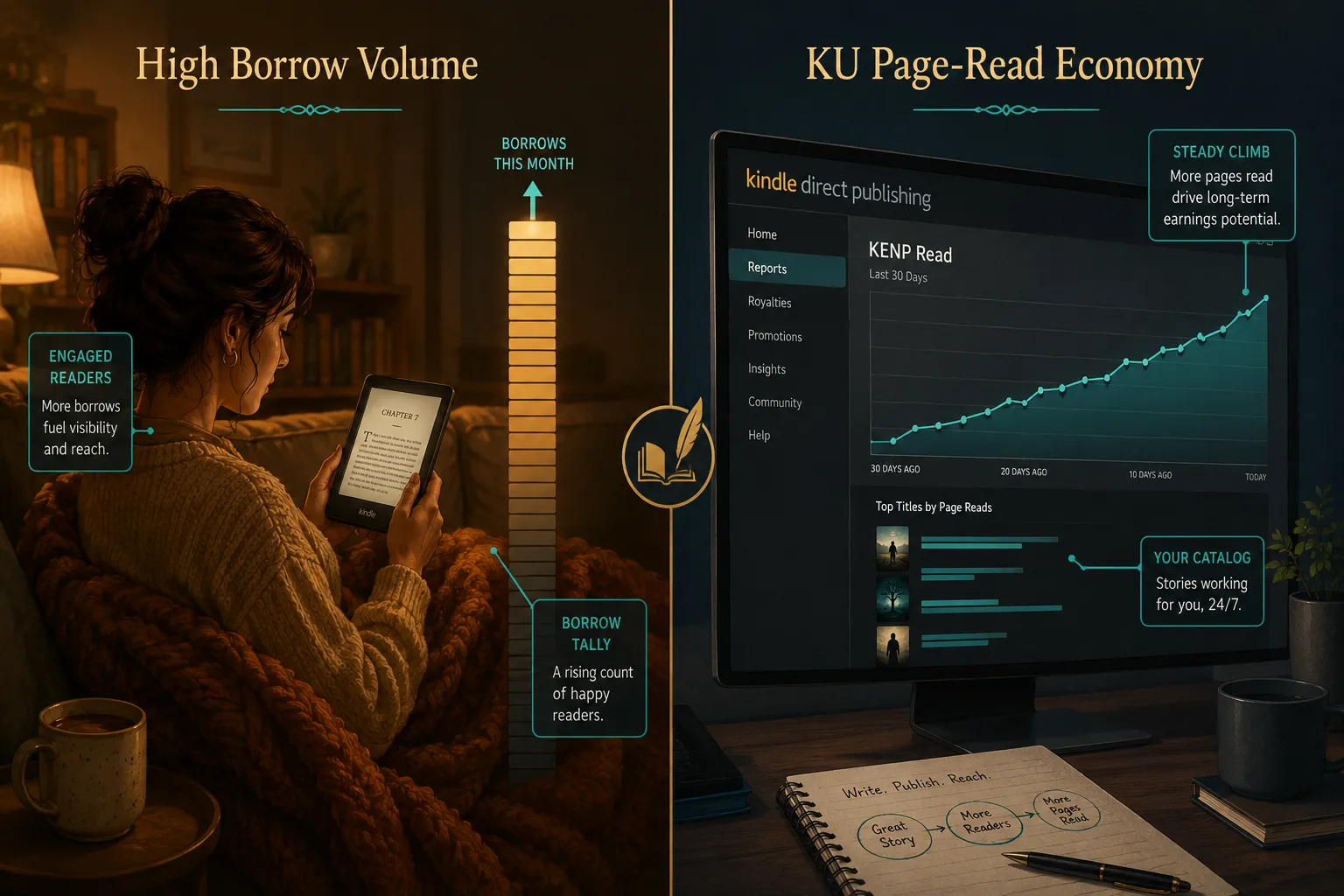
KU borrow trends are driven by page reads, not download counts. When a reader borrows a book and reads it, Amazon pays the author from a monthly Global Fund based on how many pages were actually read, not whether the book was finished or even whether it was purchased.
In April 2026, the per-page payout rate was approximately $0.00482, with the May 2026 Global Fund reported at $70.3 million. Since 2014, Amazon has paid an estimated $3.5 billion to KU authors through this model [2]. Amazon does not publicly disclose total KU subscriber counts, so category-level dominance claims should be understood as relative, based on borrow rank, bestseller position, and author-reported data rather than platform-wide statistics [2].
What this means for clean Christian fiction specifically:
- A 300-page cozy mystery that gets read cover-to-cover earns roughly $1.45 per borrow at current rates
- A 10-book series where a loyal reader reads all 10 generates roughly $14.50 in page-read income from one reader
- Authors who write series in trusted content categories, where readers binge, benefit disproportionately from the page-read model
This is why coordinated KU promotions for clean Christian romance, like the March 2026 campaign marketing books as “exclusively in Kindle Unlimited” with PG-content standards, make strategic sense: they concentrate discovery and borrow activity in a defined window [4].
Is Clean Christian Fiction Only for Religious Readers
No. Clean Christian fiction draws a meaningful share of readers who don’t identify as practicing Christians but want content they can trust. The appeal isn’t always theological, it’s structural.
Readers who’ve been burned by unexpected graphic content, explicit scenes, or gratuitous violence in mainstream fiction often migrate toward clean Christian titles because the content contract is reliable. They’re not necessarily reading for the faith, they’re reading because the faith-rooted standard happens to produce the kind of story they want.
Who reads clean Christian fiction beyond the core faith audience:
- Readers recovering from content fatigue in mainstream thrillers or romance
- Parents who want to read the same books their adult children recommend without worrying about content
- Readers who simply prefer stories where moral consequence matters, where choices cost something and grace isn’t handed out cheaply
- Fantasy and western readers who want faith under fire as a story element, not a sermon
The distinction matters for authors and publishers: clean Christian fiction’s KU performance isn’t solely a measure of the Christian population’s reading habits. It’s a measure of how many readers, across belief backgrounds, are looking for stories rooted in earned redemption and real stakes.
What Makes a Book Count as Clean Fiction
A book qualifies as clean fiction when it avoids graphic violence, explicit sexual content, and profanity, but the standard isn’t purely about absence. In the clean Christian fiction space, the March 2026 KU promotion defined its standard explicitly as “kisses-only or closed-door” romance and a “PG rating” across all content [4].
Common clean fiction content markers:
- Romance: No explicit scenes; physical affection limited to kissing or implied off-page
- Violence: Conflict and consequence present, but not described in graphic physical detail
- Language: No profanity or crude language
- Themes: Dark themes (abuse, grief, moral failure) can appear, but handled with weight and care, not exploited for shock
The clean standard does not mean conflict-free or stakes-free. The best clean Christian fiction, the kind that actually moves borrow numbers, puts characters in genuine danger, moral complexity, and spiritual crisis. Hope in the dark is only meaningful if the dark is real. Sanitizing the darkness doesn’t produce clean fiction; it produces hollow fiction.
What’s the Difference Between Inspirational Fiction and Christian Fiction
Inspirational fiction uses faith as emotional texture, a character prays, attends church, or finds comfort in belief, but the story could function without those elements. Christian fiction makes faith load-bearing: remove the character’s belief and the plot changes, the choices change, the ending changes.
This distinction drives reader loyalty in the KU space. Readers who want walking with them, not talking at them, fiction that takes their faith seriously without preaching at them, can usually tell within a chapter which type of book they’re holding. Inspirational fiction is broader and often crosses into mainstream publishing. Christian fiction, especially clean Christian fiction, carries a more specific promise.
Quick distinction:
- Inspirational: Faith adds warmth and comfort; story works without it
- Christian fiction: Faith is structural; doubt, repentance, and grace are plot events, not decorations
Are There Downsides to the Clean Fiction Trend
Yes, and they’re worth naming honestly. The clean fiction category’s growth on KU has also produced a volume of formulaic, low-stakes titles where “clean” becomes a substitute for craft, books where faith is a label rather than a conviction, and the absence of darkness is mistaken for the presence of light.
Real tradeoffs in the clean Christian fiction space:
- Formula fatigue: When clean romance or cozy mystery becomes a production template, readers notice. Borrow-and-return behavior (reading a few pages and abandoning) affects author income under the page-read model.
- KU exclusivity costs: Authors in KDP Select give up 90 days of distribution on Apple Books, Kobo, Google Play, and library channels for each enrollment period [3]. Readers on those platforms, including many international readers, can’t access those titles.
- Preachiness risk: The faith-forward positioning that attracts core readers can repel others if the story resolves too cleanly or delivers grace without cost. Redemption that costs something is what separates durable Christian fiction from disposable Christian fiction.
- Wide distribution as an alternative: Christian Writers Sanctuary recommends a “wide” distribution stack, KDP non-Select, IngramSpark, Draft2Digital, for authors who want bookstore ordering, library access, and non-Amazon reader reach [3].
The clean fiction trend is real and commercially significant. But the books that hold their borrow numbers over time are the ones where the clean standard serves the story, not the other way around.
How Has Christian Fiction Readership Changed in Recent Years
The clearest signal of growth isn’t a single data point, it’s the infrastructure building up around the category. A Christian fiction subscription box (The Joyful Reader) launched in Australia and New Zealand in September 2025 and was still actively promoting new boxes in mid-2026 [10]. Coordinated KU-only promotions for clean Christian romance ran in March 2026 with explicit content standards and author participation across multiple titles [4]. Amazon’s own browse filters for Christian fiction have expanded to include fantasy and suspense alongside the historically dominant romance category [7].
What these signals suggest together: the audience has grown large enough and consistent enough to support commercial infrastructure beyond Amazon’s own store. That’s not a trend in early formation, it’s a category that has reached enough scale to attract subscription commerce, coordinated author marketing, and international retail attention.
FAQ
Does Kindle Unlimited pay authors differently for Christian fiction than other genres? No. KU pays all authors from the same monthly Global Fund based on pages read, regardless of genre. The advantage Christian fiction authors have is reader loyalty and series length, both of which drive higher page-read totals per subscriber [2].
Can a book be in Kindle Unlimited and also sold on other platforms? No, not the ebook version. KDP Select enrollment, required for KU inclusion, mandates ebook exclusivity to Amazon for 90-day periods. Print editions and audiobooks can be distributed elsewhere [3].
How many Christian fiction books are on Kindle Unlimited? Amazon’s Kindle Store returns over 50,000 results for KU-eligible Christian fiction, though this figure includes overlapping sub-categories and varies with catalog updates [7].
What’s the best entry point for readers new to clean Christian fiction? Cozy mystery is the most accessible entry point, low-stakes setting, familiar structure, faith woven in naturally. The Mercy House Mysteries series (A Donation to Die For) is a strong starting place for readers who want small-town warmth with real moral weight.
Do clean Christian fiction readers only read romance? No. While Christian romance is the highest-volume sub-category on KU, borrow trends show active readership in cozy mystery, suspense, historical fiction, and fantasy. The clean content standard travels across genres.
Is clean Christian fiction appropriate for teens? Generally yes, though individual titles vary. The clean standard, no explicit content, no graphic violence, no profanity, aligns with YA-adjacent content expectations, but most clean Christian fiction is written for adult readers.
What does “closed-door romance” mean in clean Christian fiction? Closed-door means any physical intimacy happens off the page. The reader knows it occurred, but the scene is not written. This is distinct from “no romance,” which means romantic relationships are absent entirely, as in the Mercy Line western series.
Why do some Christian fiction authors choose wide distribution over KU? Wide distribution lets authors reach readers on Apple Books, Kobo, Google Play, and through library systems. The tradeoff is losing KU’s discovery engine and page-read income. Authors with strong direct audiences or international readership often find wide distribution more sustainable long-term [3].
Can non-Christians enjoy clean Christian fiction? Yes. Many readers outside the faith read clean Christian fiction for the content reliability, the moral stakes, and the story quality, not the theology. The faith is present and real, but the best clean Christian fiction doesn’t require belief to be compelling.
What is “earned grace” in the context of Christian fiction? Earned grace means a character’s redemption or restoration comes after real cost, failure, consequence, honest reckoning, not as a shortcut that bypasses the hard parts. It’s the opposite of cheap grace, where forgiveness arrives without the story doing the work to make it mean something.
Conclusion
Why clean Christian fiction dominates Kindle Unlimited comes down to something simpler than algorithm or marketing: it serves a reader who reads a lot, cares about what she puts in her mind, and will stay loyal to an author who handles faith honestly. Borrow trends don’t lie about that. The page-read model rewards exactly the kind of series loyalty that clean Christian fiction builds, one borrowed book at a time, one trusted author at a time.
The category’s growth across cozy mystery, frontier western, epic fantasy, psychological thriller, and LitRPG shows that the clean Christian standard is not a niche constraint. It’s a worldview that travels. Readers who want mercy and justice in the same story, who want faith under fire rather than faith as decoration, are finding that content across more genres than ever before.
Actionable next steps for readers:
- Browse KU-eligible Christian fiction using Amazon’s genre filters to find your entry point, cozy mystery, suspense, fantasy, or western [7]
- Start with a first book in a series rather than a standalone; the binge-read structure is where clean Christian fiction earns its reputation
- If you’re new to the category, A Donation to Die For (Mercy House Mysteries) and When Hannah Sleeps (The Gathering Light) offer two very different tones, cozy warmth and clean psychological suspense, both rooted in the same conviction that grace isn’t cheap and stories aren’t decoration
For authors considering KU enrollment:
- Weigh the page-read income against the exclusivity cost honestly; wide distribution through IngramSpark and Draft2Digital remains a strong alternative for authors with non-Amazon readership [3]
- Series structure and content consistency are the two biggest drivers of borrow performance, not metadata tricks
The readers are there. The infrastructure is growing. And the books that hold their place in that space are the ones where the faith is real, the stakes are earned, and the grace, when it finally arrives, costs something worth paying.
References
[1] Christian Fiction Kindle Unlimited Eligible – https://www.amazon.com/Christian-Fiction-Kindle-Unlimited-Eligible/s?rh=n:6190467011,p_n_feature_nineteen_browse-bin:9045887011
[2] Sampling Christian Fiction Kindle Unlimited – https://readingismysuperpower.org/2018/01/17/sampling-christian-fiction-kindle-unlimited/
[3] Kdp Vs Ingramspark Where Christian Authors Should Distribute Their Books – https://christianwriterssanctuary.com/resources/kdp-vs-ingramspark-where-christian-authors-should-distribute-their-books/
[4] Christian Kindle Unlimited Recommendations – https://www.reddit.com/r/CozyMystery/comments/15jyto1/christian_kindle_unlimited_recommendations/
[8] Kindle Unlimited Is It Worth It – https://www.amoderndayfairytale.net/2023/02/kindle-unlimited-is-it-worth-it.html
[10] The Joyful Reader Past Boxes – https://sparkjoyandencourage.com.au/the-joyful-reader-past-boxes