
Last updated: October 29, 2026
Quick Answer
The 2026 Christian Fiction Trend Watch comes down to this: readers are choosing faith, healing, and high-concept genre blends because the old split, either a clean story or a gripping one, stopped holding. Religious presses grew 9.3% to $2.2 billion in U.S. revenue for calendar year 2025, outpacing the broader trade market, while adult fiction rose 3.9% to $7.1 billion [1]. The books gaining ground pair real plot engines (suspense, mystery, quest, frontier justice, game progression) with characters who doubt, fail, and find grace that cost something.
Key Takeaways
- Religious publishing grew faster than general trade in 2025, though that figure covers Bibles and nonfiction too, not Christian fiction alone [1].
- There is no single national tracker for Christian fiction sales, so every “boom” claim rests on proxies: retailer lists, library circulation, and platform data [2].
- Healing is functioning as a plot mechanism, not a closing paragraph, grief, estrangement, foster care trauma, and medical crisis show up in October 2026 release lists [3].
- “High-concept” means a premise you can state in one sentence that already contains the moral problem.
- Romantic suspense remains the clearest commercial hybrid; fantasy, western, cozy mystery, and LitRPG are following the same logic.
- Readers increasingly reject sermon-shaped fiction while still wanting faith to be load-bearing.
- Most trending titles live on Kindle Unlimited, where borrow behavior rewards series and clean content contracts.
What is Christian fiction, and why is it trending in 2026?
Christian fiction is fiction written from a Christian worldview, where faith shapes character choice and consequence rather than sitting in the background as set dressing. It’s trending in 2026 because faith-positioned publishing kept growing while general trade softened, and because the category widened from inspirational romance into thriller, fantasy, western, mystery, and game-world fiction [1][4].
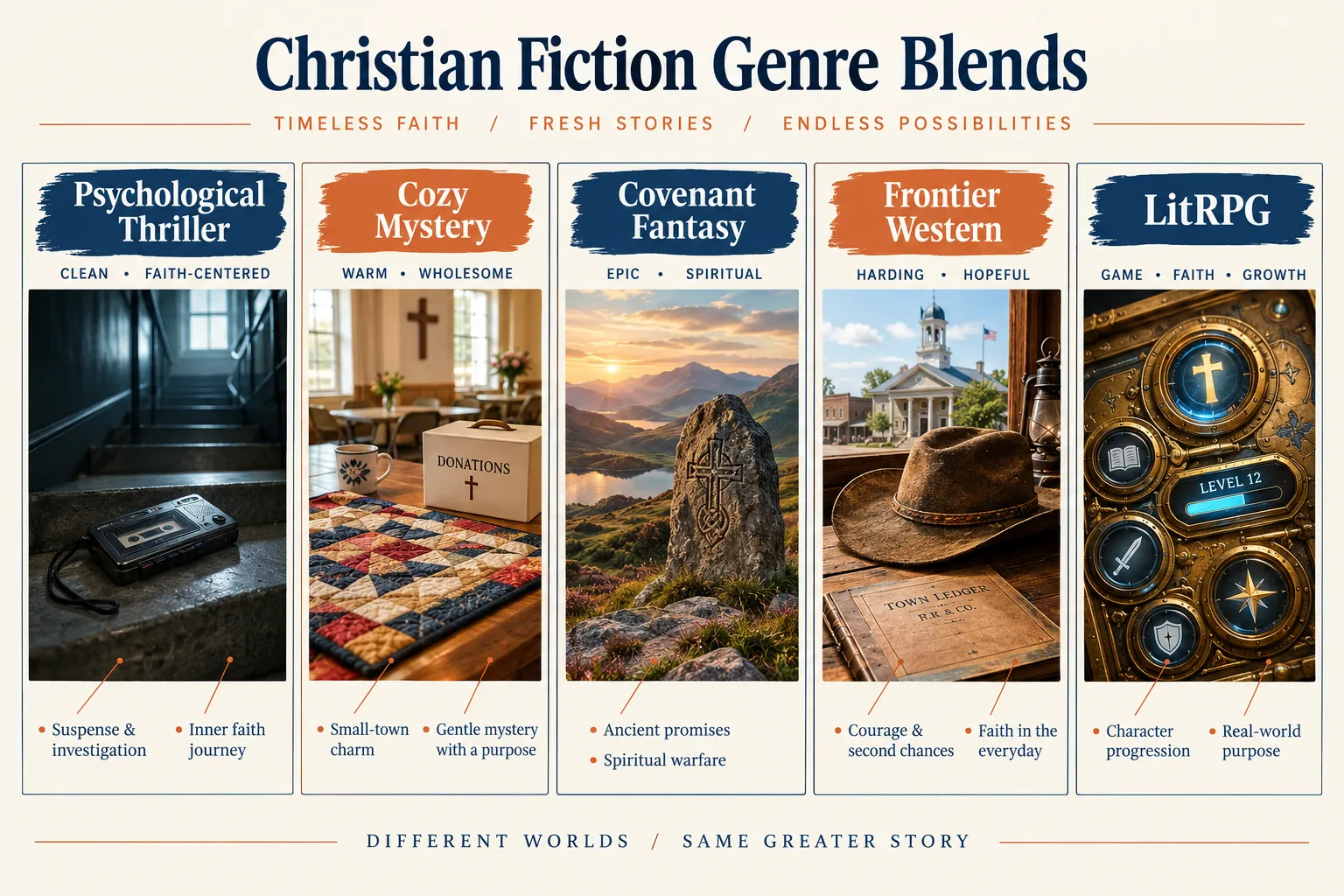
The honest version: the category isn’t one aesthetic anymore. It’s a shelf organized by a promise about how faith gets handled, not by setting or plot shape. A reader who trusts that promise will follow it from a church-social whodunit into a railroad-court western without flinching.
Decision rule: if the faith content could be deleted without changing a single plot decision, it isn’t Christian fiction, it’s clean fiction with a church in it. Both are fine. They’re not the same product.
Why do people read Christian fiction for mental health and recovery?
Readers use Christian fiction as a reflective practice because story lets a person approach grief, fear, or guilt at a safe distance and still feel it honestly. Commentary on 2026 reading habits points to demand for narratives about emotional healing, relational repair, trauma, and mental health embedded inside compelling plots rather than instructional structures [4].
What that looks like on the page:
- A character prays and nothing visibly changes, and the book stays with it.
- Forgiveness takes three books, not three chapters.
- The comfort arrives after the cost, not instead of it.

More on this pattern in how readers use Christian stories for reflection, healing, and everyday spiritual practice and how Christian fiction turns scripture into story-level comfort for readers processing grief.
Best Christian fiction books with healing themes right now
October 2026 release roundups cluster heavily around recovery plots, estrangement, family wounds, medical crisis, foster-care trauma, second chances, including Denise Hunter’s Falling into Us, Krystina Renae Rankin’s More Than Enough, and Delores Topliff’s Mercy’s Rose [3]. Publishers are buying in this direction too: Penguin Random House Christian Publishing Group acquired Johanna Sjoberg’s memoir on grooming, survival, and reclaimed faith for September 2027, and Moody picked up world rights to Saved by Shipwreck by Tessa Afshar and Heidi Chiavaroli [1].
Healing that works on the page is slow, specific, and inconvenient. A tidy conversion scene is a shortcut, and readers can smell it.
Common mistake: choosing a healing-themed book expecting gentleness, then being blindsided. Titles about trauma are often the hardest reads in the category. Check the first chapter sample, not the cover palette.
What does high-concept mean in Christian fiction genre blends?
High-concept means the premise can be stated in one sentence and the sentence already contains the moral dilemma. Not “a woman investigates a death,” but “a transcriptionist who records other women’s worst nights finds her own testimony in someone else’s file.”
High-concept premises that carry faith organically share three traits:
- A record at the center, a ledger, a prayer list, a survey plat, a position series. Something that claims to be the truth.
- A cost attached to telling it, reputation, safety, family.
- No neutral option. Silence is also a choice with consequences.
| Blend | Plot engine | Where faith lives |
|---|---|---|
| Clean psychological thriller | Who controls the record | A character choosing truth against self-interest |
| Cozy mystery | Small-town secret surfaces | Community obligation, mercy toward the guilty |
| Covenant fantasy | Empire vs. covenant | Obedience when nothing confirms it |
| Frontier western | Law runs out | What a man answers to |
| Christian LitRPG | Earned progression | Debt, stewardship, no cheap grace |
Can Christian fiction have romance and fantasy together?
Yes, and romantic suspense is the clearest proof that hybrids sell. The model pairs romance’s emotional promise with thriller urgency, built around forgiveness, second chances, danger, and family protection. Author interviews in 2026 describe genre blending happening organically, one novelist moved into romantic suspense after an editor noticed her romances already had mystery bones.
Fantasy blends work the same way. A covenant-fantasy world can hold courtship, political intrigue, and a magic system without the faith layer becoming decorative. See Christian suspense romance and how faith-driven tension works without explicit scenes.
Edge case: some series run a deliberately romance-absent contract, frontier westerns built entirely around conscience and consequence. That’s a feature for readers who want stakes without a love plot.
Christian fiction with sci-fi, mystery, or game-world elements
Speculative blends are the fastest-widening corner of the category. Christian fantasy release trackers list a steady stream of upcoming titles [5], and Christian LitRPG, faith inside progression-system fiction, has moved past novelty into a working subgenre about earned advancement and real debt.
Starting points by taste:
- Quest and fellowship: Christian epic fantasy for readers who love Lord of the Rings
- Stats and progression: why Christian LitRPG is moving beyond dungeon crawls
- Grit and moral weight: Christian frontier stories without the preaching
Christian fiction vs. secular fiction: what’s actually different?
The difference isn’t content restrictions, it’s what the story treats as true. Secular fiction can end in meaninglessness and call it honest. Faith-rooted fiction assumes the moral universe has weight, so a character’s choice costs something real and grace, when it comes, is earned.
Practical differences readers notice:
- Resolution: hope in the dark rather than nihilism, but not guaranteed happy endings.
- Villains: culpable, and occasionally redeemable at a price.
- Language and content: generally clean, though that’s a side effect of the worldview, not its definition.
How to find Christian fiction that isn’t preachy or heavy-handed
Sample the first three pages. If a character explains the theme out loud, or scripture arrives as commentary rather than something a person actually reaches for, the book is talking at you instead of walking with you.
A quick screen:
- Does faith cost the protagonist anything by page 50?
- Is there a conversion scene that solves the plot? (Red flag.)
- Do characters doubt without being corrected by the narrator?
- Does the ending fix everything? (Earned grace leaves scars.)
Useful for list-building: navigating Goodreads lists to find hidden clean reads.
Is Christian fiction only for religious readers, and why are faith-based stories going mainstream?
No. Readers outside the faith pick these books up for the same reasons they watch a well-made western, moral clarity, earned stakes, and endings that mean something. Fall 2026 religion publishing is engaging polarization, climate anxiety, and the future of American evangelicalism rather than offering only devotional reassurance, which signals appetite for faith literature that handles instability head-on.
Mainstream drift is also commercial. Clean content expands the audience rather than narrowing it: nobody who reads graphic fiction is excluded by its absence, but plenty of readers are excluded by its presence. See why clean Christian fiction outsells graphic alternatives.
Most popular Christian fiction authors and books in 2026, and where to read them
Amazon’s Christian fiction new-release charts are the most current public ranking signal, refreshed hourly [6], with library newsletter lists and market roundups filling in what retailers don’t show [3][7][8]. Named 2026 release-list authors include Denise Hunter, Tessa Afshar, Heidi Chiavaroli, Krystina Renae Rankin, and Delores Topliff [1][3].
Where to find trending titles:
- Kindle Unlimited, the dominant discovery channel for series readers.
- Amazon new-release charts by subcategory [6].
- Public library digital catalogs, circulation data is a real popularity proxy [2].
- Christian bookstores and publisher sites for print.
A broader map: best Christian fiction authors across cozy mystery, western, fantasy, thriller, and LitRPG.
How much do Christian fiction books cost?
Indie Kindle titles commonly run $0.99,$5.99, traditionally published ebooks $8.99,$14.99, paperbacks roughly $12,$18, and hardcovers $22,$30. Kindle Unlimited is a flat monthly subscription, which makes series reading the cheapest path for heavy readers. Prices shift by publisher and promotion, so treat these as typical ranges rather than fixed figures.
What are common mistakes people make reading Christian fiction?
The biggest one is assuming “Christian” means “safe from difficulty.” Many of these books handle abuse, grief, and violence, just without graphic rendering.
Others worth avoiding:
- Judging the whole category by one subgenre (usually romance).
- Expecting every book to resolve its faith question cleanly.
- Skipping series order where protagonists are linked.
- Dismissing fantasy or LitRPG as unserious about faith.
- Reading a trauma-centered healing novel during an acute personal crisis without checking content notes first.
Frequently asked questions
Is Christian fiction growing in 2026? Religious presses grew 9.3% to $2.2 billion for calendar year 2025, outpacing general trade [1]. That category includes Bibles and nonfiction, so it isn’t a Christian-fiction-only growth rate.
Is there official data on Christian fiction sales? No single comprehensive U.S. database tracks Christian fiction readership independently. Available proxies are publisher revenue, retailer bestseller lists, library circulation, and platform data [2].
What does “clean Christian fiction” mean? No profanity, no graphic violence, no explicit content, with faith treated as lived experience rather than a lesson.
Can Christian fiction be genuinely suspenseful? Yes. Tension comes from moral jeopardy and what a character stands to lose, not from graphic detail.
Do I need to read a Christian series in order? For linked-protagonist series, yes. Standalone-per-book series like many psychological thrillers can be entered anywhere.
Is Christian LitRPG a real genre? Yes, progression fiction where leveling carries spiritual cost rather than pure stat grinding.
Are these books appropriate for teens? Most clean Christian fiction is, though thrillers dealing with abuse or trauma suit older teens and adults.
What’s the cheapest way to read widely in the category? Kindle Unlimited plus library digital borrowing covers most trending titles.
Conclusion: where to start
The 2026 Christian Fiction Trend Watch isn’t really about faith, healing, and high-concept genre blends as separate trends. It’s one trend: readers want the plot to do the spiritual work.
Three next steps:
- Pick the blend that matches a genre you already love, mystery, western, fantasy, thriller, or game-world, rather than starting with “Christian fiction” as a category.
- Sample before you commit. Three pages tells you whether faith is load-bearing or decorative.
- Follow the author, not the shelf. When the worldview is consistent, genre-hopping stops being a risk.
Start with a clean Christian fiction reading list for 2026 that goes beyond romance, and look for the book that makes grace cost something.
References
- 101562 Religion Book Deals Oct 21 2026. publishersweekly.com.
- Christian Fiction Book Statistics. kymforrest.com.
- B40d5db0 Ca04 4f2f A87e 472057654a31. libraryaware.com.
- Article Ecf6b382 C5b5 589a A286 F968c35e1f02. wboc.com.
- Christian Fantasy. risingshadow.net.
- Ref=zg Bs Tab T Digital Text Bsnr. us.amazon.com.
- Best Selling Christian Novels 2026 Data Driven Market Analysis Top Titles. alibaba.com.
- 2026 S Top 5 Best Selling Christian Novels 1 2b Market Growth Trends. alibaba.com.