
Last updated: October 7, 2026
Quick Answer
The best Christian fantasy series for readers who want Percy Jackson-style quests with clean magic and deeper moral stakes are The Wingfeather Saga (Andrew Peterson), The Green Ember (S. D. Smith), The Wilderking Trilogy (Jonathan Rogers), The Dream Keeper Saga (Kathryn Butler), and for adult readers, covenant-fantasy series like The Sarel Chronicles and The Kethara Chronicles. Each delivers a road-trip quest, invented mythology, and a hero who pays a real price for doing right, without occult ritual, graphic violence, or a sermon stapled to the last chapter.
Key Takeaways
- Wingfeather is the closest bridge to Percy Jackson. Funny, fast, mythology-rich, and built on calling and sacrifice rather than simple good-guy-wins plotting; it has sold over a million copies.
- Green Ember is the pick for near-zero magic. Courage, loyalty, and resistance carry the stakes instead of spell work, across 14 world books as of September 2026.
- Wilderking retells David’s story as original fantasy for roughly ages 9-12, reissued in 20th-anniversary editions in 2024.
- Dream Keeper is the most openly allegorical of the middle-grade options, with stewardship-based powers rather than power-for-its-own-sake.
- Clean magic isn’t no magic. The usual line is drawn at source: gift from a Maker (fine) versus summoning, divination, or necromancy (not fine) [6][8].
- Christian fantasy’s good-versus-evil runs through the protagonist, not just the villain, the hero has to repent, not just win [7].
- Adults have real options too, including covenant fantasy, allegory, and Christian LitRPG with earned progression [1].
- Decision rule: younger or sensitive reader → Green Ember. Percy Jackson energy → Wingfeather. Bible-adjacent adventure → Wilderking. Explicit gospel parallels → Dream Keeper. Adult political-moral weight → Sarel or Kethara.
What is Christian fantasy, and how is it different from regular fantasy?
Christian fantasy is fantasy written from a worldview in which moral law is real, grace is possible, and the universe has an author. The genre doesn’t require allegory or a Christ-figure, it requires that the story’s moral physics actually hold. A betrayal costs something. Mercy costs more.
The difference from general-market fantasy usually shows up in three places:
- The source of power. Secular fantasy often treats magic as neutral technology. Christian fantasy tends to make power a loan with a lender [8].
- The shape of the ending. Hope is permitted. Not guaranteed, not cheap, but permitted, which is why many readers describe the genre as hope in the dark rather than grimdark.
- The cost of redemption. The turn is earned on the page. A villain who repents in the last chapter without consequence breaks the contract.
Faith in good Christian fantasy is load-bearing, not decorative. Take it out and the plot collapses.
Readers who want the full case for why big secondary worlds still carry big meaning can read more on Christian epic fantasy and the search for hope.
What makes a fantasy book appropriate for Christian readers?
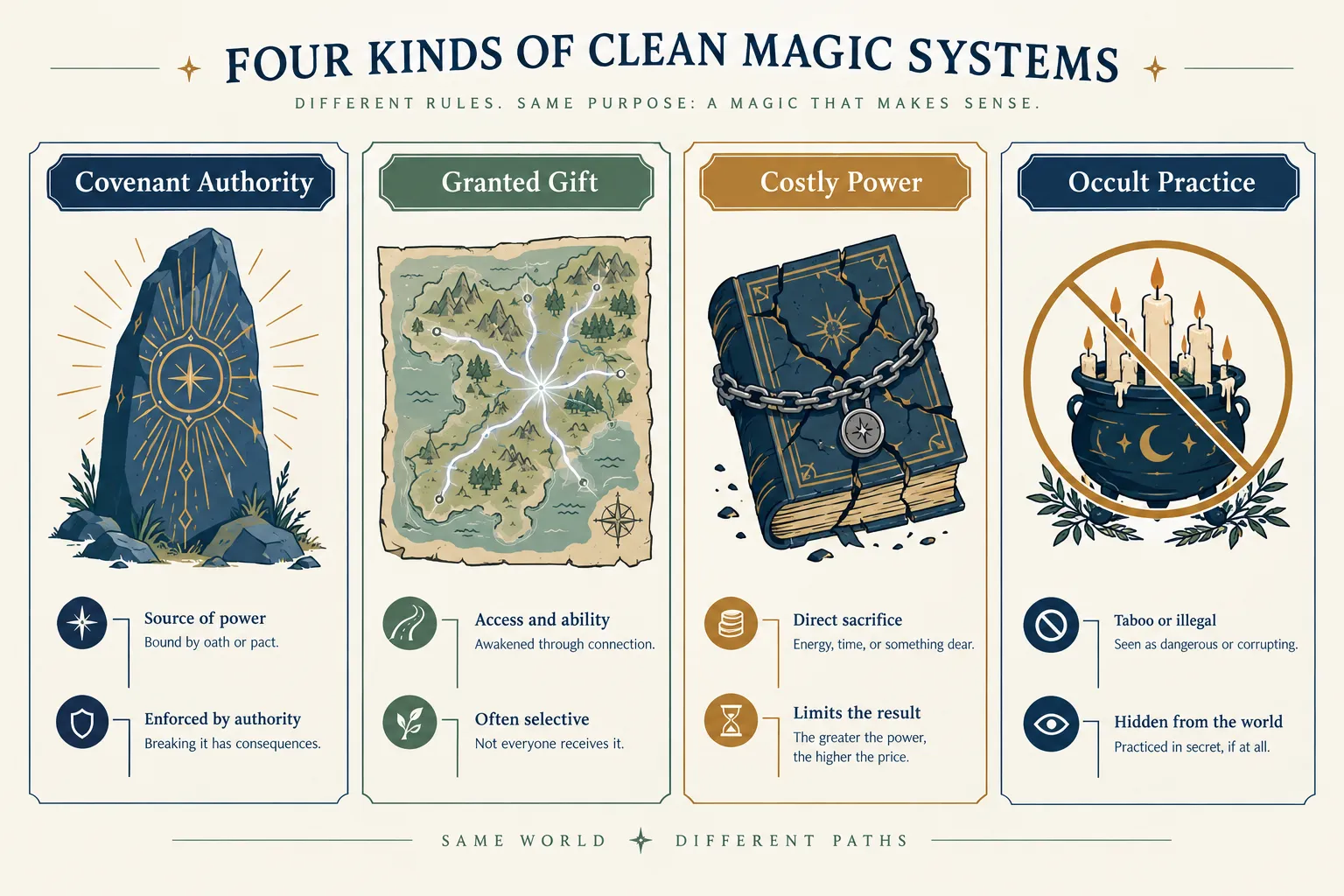
Most Christian readers aren’t screening for the word “magic.” They’re screening for where power comes from and what the book believes about it. A story where a character is given a gift and held accountable for it reads very differently than one where a character summons a spirit and pays nothing.
A practical screening checklist:
- Power source, gift, covenant, or inherited ability versus summoning, divination, séance, necromancy [6].
- Moral framework, does the book treat cruelty as actually wrong, or just inefficient?
- Content level, violence implied rather than lingered over; no explicit material; language clean.
- Consequence, do bad choices cost the hero something, including the likable hero?
- Tone toward faith, lived and doubted, or lectured?
Common mistake: rejecting a book because a map has a wizard on it, then handing a child a “clean” series where the protagonist lies, wins, and is never challenged. The second book is the riskier one.
Fantasy books with clean magic systems and no dark content
The cleanest systems in the genre draw a bright line between received power and seized power. Four examples, ranked loosely from least to most magical:
| Series | Magic boundary | Quest structure | Age range | Moral engine |
|---|---|---|---|---|
| The Green Ember | Almost no conventional magic; songs, prophecy, craft | Exile, resistance, restoration of a kingdom | 7-12, reads older | Loyalty under pressure, “my place beside you, my blood for yours” ethos |
| The Wilderking Trilogy | Low magic; frontier wonder, no spellcasting | Shepherd boy to reluctant king, swamp wilderness quests | 9-12 | Obedience before promotion; David’s story recast |
| The Wingfeather Saga | Invented creatures, ancient song-power, no occult ritual | Family on the run, hidden heritage, lost kingdom | 10-12 and up | Calling, sacrifice, trust in the Maker |
| The Dream Keeper Saga | Dream-realm creation and stewardship, framed as in-world gift | Girl crosses into a dream kingdom, five-book arc | 8-12 | Explicit redemption allegory; courage, grief, restoration |
Choose by boundary, not label. If any spell language is a hard no in your house, start with Green Ember. If invented mythology is welcome as long as nothing resembles real-world occult practice, Wingfeather and Dream Keeper both clear the bar.
For magic built around grace rather than raw ability, see Christian cozy fantasy and magic systems rooted in grace.
Percy Jackson alternatives with religious elements and similar world-building
The Wingfeather Saga is the single best Percy Jackson alternative, and the comparison most publishers actually make is to Narnia: WaterBrook publisher Laura Barker described the series as having “Narnia-like appeal” both inside and outside Christian publishing. The series has sold more than a million copies, and its animated adaptation reached its Season 3 finale on Angel by May 26, 2026, rare visibility for the category.
What transfers from Percy Jackson:
- Comic narrator energy. Wingfeather’s footnotes and invented bestiary work the same muscle as Riordan’s wisecracking first person.
- Invented mythology with rules. Sarel’s silver roads, Anniera’s lost kingdom, and Marat-Sol’s covenant highlands all function like Riordan’s pantheon: a system a reader can learn and theorize about.
- Found-family road quest. Siblings, mentors, hard travel, a destination that turns out to be a person rather than a place.
What’s different: Riordan’s gods are capricious and the stakes are mostly survival. In the Christian versions, the Maker is good, which paradoxically raises the stakes, because now the hero’s failures matter morally and not just tactically. A Christian mom’s review of the Percy Jackson material noted the series’ Greek pantheon content is the main discernment point for faith-based families [9].
Young adult Christian fantasy with quests and adventures, and picks for teens who like action and mythology
For teens who want action and mythology, the strongest path is Wingfeather first (it reads up easily), then Wilderking for biblical adventure, then adult covenant fantasy once they want political weight. Straight YA Christian fantasy is the thinnest shelf in the category, so crossover reading is normal.

Teen-specific guidance:
- Ages 11-14, action-first: Wingfeather books 2-4 escalate sharply; the later volumes carry genuine grief.
- Ages 12-16, mythology-curious: Wilderking’s swamp culture and warrior codes scratch the same itch as a pantheon without borrowing one.
- Ages 14+, wants adult complexity: covenant fantasy with institutions, records, and empire, see the Kethara and Sarel paragraphs below.
- Gamers: Christian LitRPG now exists as a real subgenre with stat-sheet progression tied to character cost. Background here: the rise of Christian LitRPG.
Curated faith-based lists for tweens and teens remain one of the fastest ways to find overlooked titles [2][10].
How does Christian fantasy handle good versus evil differently?
Christian fantasy tends to put the moral fault line inside the protagonist rather than only between armies. The villain is still a villain, but the book’s real question is whether the hero will become one.
Three structural differences:
- Evil is a parasite, not a peer. It corrupts rather than balances. There’s no yin-yang equilibrium to maintain [7].
- Repentance is a plot event. A character’s turn triggers consequences, not an instant reset.
- Victory is often a surrender. The climactic act is frequently a refusal, to retaliate, to claim a throne, to publish a damning record.
Edge case worth naming: a few series flatten evil into orcs-with-no-interiority, which makes the moral stakes shallower, not cleaner. Redeemed Reader’s assessment of Wingfeather points the other way, identifying calling, sacrifice, and trust in the Maker as the books’ moral architecture, with the children’s obedience costing them something real.
For the same conversation applied to grimdark prestige fantasy, read Christian epic fantasy compared to House of the Dragon.
Are there Christian fantasy books that aren’t preachy?
Yes, and the best-selling ones are explicitly built that way. Andrew Peterson told Publishers Weekly that his faith influences everything he does, but that he wanted to write the best story possible rather than “shoe-horning” a message into it. The Gospel Coalition praised the Wilderking Trilogy on the same grounds: themes integrated into the narrative rather than delivered as detached instruction.
How to spot a non-preachy Christian fantasy before you buy:
- Read the first page. If a character is already explaining the theme, the whole book probably will.
- Check whether anyone fails and stays failed for a while. Instant forgiveness signals cheap grace.
- Look for specificity. Preachy books are vague about place and sharp about doctrine. Good ones are the reverse.
That’s the whole argument behind redefining clean Christian fiction beyond heavy-handed messages, fiction that walks with readers instead of talking at them.
Christian fantasy recommendations for adults, not just kids
Adults who want moral and ethical dilemmas rather than chosen-one simplicity should look at covenant fantasy, where the antagonist is usually a system, an archive, an empire, a bureau of certified truth. The genre for grown readers is small but growing, with curated adult lists now appearing regularly [1][3].
Three adult-facing options under the Silas Bellhaven catalog:
- The Sarel Chronicles, in Sarel, silver roads mark the prayers the Maker-Who-Hears has answered, all of them certified by the House of Witness. Elya Renn, a disgraced map-scribe, finds a black road appearing on her skin during the Great Map’s unveiling, belonging to a boy the House refused to record. Quest structure: pilgrimage past the edge of official cartography. Start with The Map of Unanswered Prayers.
- The Kethara Chronicles, an empire wants every act of mercy counted and contained. In the highlands of Marat-Sol, Amara and Sela carry a covenant word the auditors cannot own. Begin with The Stone That Remembered.
- The Measured Debt, Christian LitRPG at Federated Record, where a collapse isn’t over when the walls stop falling but when the position series decides who’s to blame. Earned progression, no shortcuts. Open with The Cost of Being Chosen.
Why adult Christian fantasy stays harder to find: middle grade is a brand-led market. At Bologna Children’s Book Fair 2026, agents told Publishers Weekly that middle-grade success skews toward recognizable brands and short, accessible formats, often 30,000 words or fewer. One 2026 market compilation estimated middle grade at roughly 7% of fantasy sales in 2023 against 38% for YA and 55% for adult, directional rather than definitive, since it’s a secondary compilation. The practical result is that established kids’ series out-discover excellent independent adult titles.
How to pick your next series in five minutes
- Set your magic boundary. No spell language at all, invented gift-magic only, or anything short of real-world occult practice?
- Pick your age target. 7-10, 10-14, or adult.
- Choose your quest shape. Road trip and found family (Wingfeather), exile and restoration (Green Ember), rise of a reluctant king (Wilderking), crossing-over portal (Dream Keeper), institutional reckoning (Sarel, Kethara).
- Decide how explicit you want the theology. Dream Keeper is openly allegorical; Wingfeather is woven in.
- Read 10 pages before committing. Voice is the real compatibility test.
- Track what worked. Faith-based reader lists are the best discovery tool going, see finding clean Christian fiction lists on Goodreads.
FAQ
Is Percy Jackson okay for Christian readers? Many Christian families read it with discussion, since the Greek pantheon is treated as literal in-world religion. Reviews from Christian parents generally flag the mythology as the main discernment point rather than content issues like language or sexuality [9].
Which Christian fantasy series is most like Percy Jackson? The Wingfeather Saga. It shares the humor, pace, invented mythology, and found-family quest structure, and publishers compare its reach to Narnia’s.
What’s the best Christian fantasy with almost no magic? The Green Ember. The conflict runs on courage, loyalty, resistance, and hope rather than spell work, across 14 world books listed as of September 2026.
Are there Christian fantasy series for adults? Yes. Covenant fantasy, allegorical epic fantasy, and Christian LitRPG all serve adult readers, with curated adult recommendation lists now available [1][3].
Does clean magic mean no magic at all? No. Most Christian fantasy permits invented, gift-based power while avoiding depictions of real-world occult practice such as divination, summoning, or necromancy [6][8].
What age is The Wingfeather Saga for? Reviewers generally place it around ages 10-12 and up, with later volumes carrying heavier grief and higher stakes.
Is the Wilderking Trilogy still in print? Yes. All three books were reissued by Rabbit Room Press in 2024 in 20th-anniversary editions with new illustrations and added material.
Which series is best for families who want clear gospel parallels? The Dream Keeper Saga. Its author frames the allegory as pointing toward redemption through Christ, with courage, grief, sacrifice, and restoration as recurring themes.
Do Christian fantasy books avoid real moral complexity? The good ones don’t. The strongest titles put the moral pressure on the protagonist, requiring repentance and cost rather than a clean win [7].
Where do I start if I’ve never read Christian fantasy? Wingfeather book one for all ages, Green Ember for younger readers, and The Map of Unanswered Prayers if you want adult-level stakes immediately.
Conclusion
The shelf is smaller than Percy Jackson’s but deeper than its reputation. Start with one title matched to your actual magic boundary and age range, Green Ember for the lowest-magic entry, Wingfeather for the closest tonal match, Wilderking for biblical adventure in fantasy dress, Dream Keeper for open allegory, and Sarel or Kethara when you want an empire that files mercy in triplicate.
Then do the thing that makes the genre worth defending: read it alongside someone. Ask what the hero gave up and whether it was worth it. That question does more work than any afterword.
Grace shows up in these books, but it arrives late and it arrives expensive. That’s not a flaw in the storytelling. That’s the point.
References
[1] Magical Christian Fantasy Books For Adults – https://fruitfulreader.com/magical-christian-fantasy-books-for-adults/ [2] 30 Books For Christian Tween Teen – https://www.theunlikelyhomeschool.com/2015/07/30-books-for-christian-tween-teen.html [3] Best Christian Fantasy Books – https://www.christianwebsite.com/best-christian-fantasy-books/ [6] Books That Bring Christ Into Clean Fantasy – https://www.crosswalk.com/slideshows/books-that-bring-christ-into-clean-fantasy.html [7] Why The World Needs More Christian Fantasy – https://www.talenawinters.com/wintersdayin/2025/5/19/why-the-world-needs-more-christian-fantasy [8] Christian Fantasy Books – https://faithgiant.com/christian-fantasy-books/ [9] A Christian Moms Review Of Percy – https://natalieglaser.substack.com/p/a-christian-moms-review-of-percy [10] Christian Fiction – https://redeemedreader.com/category/book-reviews/christian-fiction/