
Last updated: September 29, 2026
Quick Answer
Christian epic fantasy and the search for hope explain why readers still want big worlds with big meaning: readers are drawn to secondary worlds where good and evil are visible, mercy costs something real, and hope survives contact with darkness instead of pretending darkness isn’t there. The genre works because it shows faith through choice and consequence, not narration, inside stakes large enough to make that choice matter.
Key Takeaways
- Christian epic fantasy uses secondary worlds to make moral and spiritual stakes visible without stopping the story to explain them.
- Readers return to the genre for hope in the dark, not for guaranteed happy endings, the difference matters.
- The best entries show faith through plot and character choice, never through dropped-in scripture or sermon.
- Christian fantasy has grown well past Tolkien-and-Lewis imitation into hopepunk, progression fantasy, and covenant-based worldbuilding [1][6].
- A growing convention and awards scene, Realm Makers, the Christy Award, Enclave Publishing, signals real audience infrastructure, not a niche footnote.
- Non-religious readers can enjoy the genre for the same reason they enjoy any well-built world: clear stakes and earned endings.
- Common author mistakes include allegory that’s too on-the-nose and grace that arrives without cost.
- Series worth starting with include The Sarel Chronicles and The Kethara Chronicles, alongside broader-market names like Gillian Bronte Adams and Sara Ella.
What Is Christian Epic Fantasy and How Is It Different From Secular Fantasy?
Christian epic fantasy is secondary-world storytelling, kingdoms, magic systems, quests, built on the conviction that moral order is real and that mercy and justice are not opposites but partners. Secular fantasy can explore the same moral weight, but it isn’t obligated to resolve toward redemption; Christian fantasy usually is, even when the road there is long.
The real difference isn’t dragons versus no dragons. It’s what the world believes underneath the plot:
- Secular epic fantasy often treats power, fate, or personal will as the ultimate authority in the world.
- Christian epic fantasy treats a moral order outside the characters, a Maker, a covenant, a law, as the thing the plot has to answer to.
- Both can have flawed heroes, real loss, and gray-area choices. The difference shows up in what the story is willing to call true.
A quick example: in a secular epic, a character might win by becoming powerful enough to make his own rules. In Christian epic fantasy, winning usually means the character finally submits to a rule he didn’t write, and it costs him something to do it. That’s the shape readers come back for, and it’s the same shape found in non-romance Christian epic fantasy built for adventure and faith rather than subplot filler.
Why Do People Read Christian Fantasy Books?
People read Christian fantasy for the same reason they always have, to see hope survive something real. A secondary world lets a reader watch grace, sacrifice, and consequence play out at a scale that ordinary life rarely offers, without the story flinching away from cost.
That’s the whole engine behind Christian Epic Fantasy and the search for hope: why readers still want big worlds with big meaning. Readers are exhausted by two extremes, cheerful stories that never risk anything, and grim stories that never redeem anything. Epic fantasy rooted in faith sits between them. It lets characters:
- Fail publicly and still be worth following
- Doubt God without the story punishing them for it
- Earn restoration instead of receiving it as a plot convenience
Industry gatherings have started naming this appetite directly. Realm Makers’ 2026 conference and expo drew nearly 350 in-person attendees and 72 online participants, and its programming leaned into “hopepunk”, hopeful, wonder-filled storytelling arriving after years of dystopian fatigue. That’s not a coincidence; it’s a readership telling the market what it wants next.
How Does Hope Work as a Theme in Epic Fantasy Stories?
Hope in epic fantasy works best when it’s earned inside the plot, not announced by the narrator. A world has to threaten a character with real loss before hope means anything, otherwise “hope” is just a mood, not a theme.
Big worlds with big meaning make this easier to show because the stakes are visible: a kingdom, a covenant, a bloodline, a map that records every unanswered prayer. When hope shows up in that context, it looks like:
- A character choosing mercy when justice would be easier
- A promise kept long after it stopped being convenient
- A restoration that still carries the scar of what it cost
This is hope in the dark, not hope instead of the dark. The darkness has to be real, grief, betrayal, exile, or the hope reads as cheap. Kathryn Butler, author of The Dream Keeper Saga, has argued that fantasy communicates this kind of hope more powerfully through image and story than through direct explanation, because grief in a story only means something if it’s pointing somewhere. That’s the same logic behind progression fantasy built on earned grace rather than cheap grace: the character has to actually pay for the growth.
What Makes a Fantasy World Feel Meaningful to Readers?
A fantasy world feels meaningful when its rules are moral, not just mechanical. Readers can tell the difference between a magic system built for spectacle and one built to test character, and they trust the second one more.
Concrete markers of a meaningful world:
- Consequences that track. Power has a cost the story actually pays.
- Institutions that can be wrong. Courts, temples, and maps that claim authority but sometimes lie.
- Small acts that matter as much as battles. A quiet mercy changes the plot as much as a sword does.
This is why questions of wealth, status, and moral compromise land so hard in secondary worlds, the same reason Christian epic fantasy borrows moral questions from classics like The Great Gatsby to explore what power does to a soul. A world doesn’t need to be enormous to feel meaningful. It needs rules that a character can be judged by.
Does Christian Fantasy Have to Be Preachy, or Can It Just Tell a Good Story?
Christian fantasy does not have to be preachy, and the genre’s best entries almost never are. Faith shows up through what a character chooses under pressure, not through a paragraph explaining what the reader should learn from it.
The test is simple: if a scene stops the plot to explain its own meaning, it’s preaching. If the meaning is only visible through what the character does next, it’s storytelling. Readers who want fiction that walks with them instead of talking at them can usually feel the difference within a chapter. That’s the whole difference between a sermon with a plot attached and faith-rooted character development that earns its spiritual arcs instead of announcing them.
How Do Authors Balance Faith Themes With Fantasy Worldbuilding?
Authors balance faith and worldbuilding by making faith structural, built into the magic system, the law, or the covenant, rather than decorative. When belief is load-bearing, the story can’t be told without it; when it’s decorative, the reader can feel the seam.
Practical ways this shows up:
| Approach | What it looks like | Reader effect |
|---|---|---|
| Faith as law | A covenant or oath governs magic or power | Stakes feel morally real |
| Faith as record | A map, ledger, or witness-stone tracks truth | Faith becomes plot, not narration |
| Faith as cost | Grace requires sacrifice from the character | Redemption feels earned, not handed out |
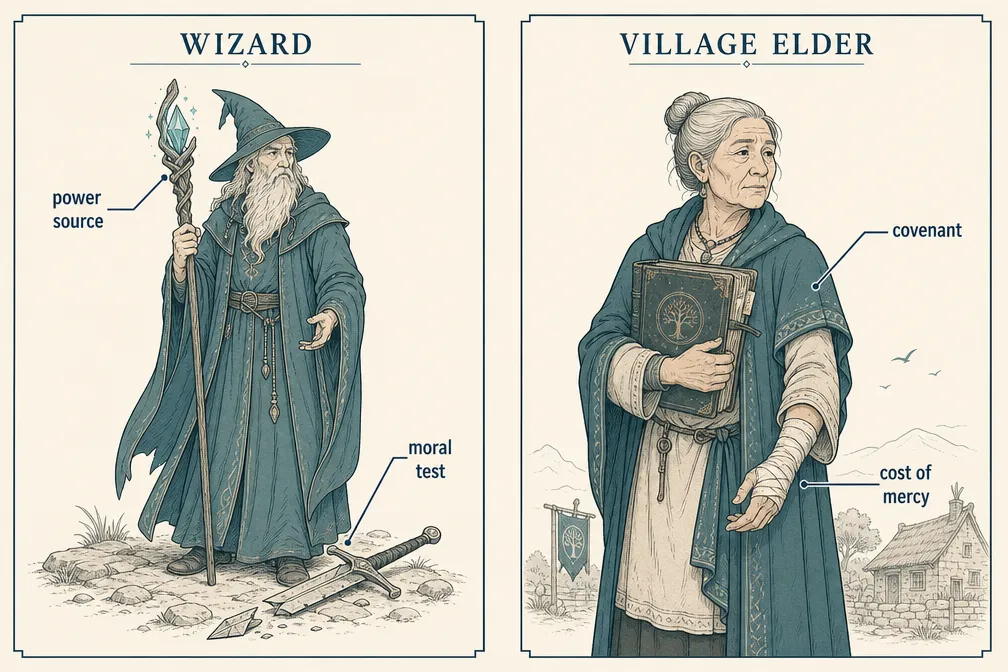
Realm Makers’ own 2026 programming framed worldbuilding this way in a session titled “Building Worlds and Creating Myths,” treating secondary-world creation as a way to explore moral struggle and redemption rather than pure escapism. That’s the same instinct behind keeping pace without losing depth, the subject of how Christian epic fantasy authors balance action and faith without losing momentum.
Is Christian Epic Fantasy Only for Religious Readers?
No. Christian epic fantasy is written for readers who want clear moral stakes and an earned ending, and that appeal isn’t limited to religious readers. A well-built covenant world or a magic system with real consequences works the same way for a reader with no faith background as it does for one with deep faith.
What the genre isn’t for:
- Readers wanting moral ambiguity as the point of the story rather than a stage in it
- Readers who want explicit content or grimdark violence as the main draw
- Readers allergic to any resolution that leans toward redemption
What it is for: readers across the wider clean Christian fiction landscape who want adventure, real danger, and an ending that means something without requiring shared belief to enjoy the ride.
Common Mistakes Authors Make Writing Christian Fantasy
The most common mistake is allegory that announces itself, a lion who is obviously God, a villain who is obviously the devil, spelled out early and often. The second most common mistake is grace that shows up without cost, which flattens the very tension that makes redemption meaningful.
Other recurring problems:
- Sermon breaks. Pausing the plot for a character to explain the moral.
- Villains without weight. Evil that exists only to be defeated, never to tempt.
- World rules that bend for convenience. A magic system that suddenly works differently to save the hero.
- Faith with no doubt in it. Characters who never wrestle read as furniture, not people.
Avoiding these is less about softening faith and more about trusting the story to carry it, the same principle behind redefining clean Christian fiction around story-first faith instead of heavy-handed messaging.
Best Christian Epic Fantasy Series to Start With
Start with a series built on a clear moral engine, a covenant, a map, or a ledger that the plot has to answer to, rather than one that leans on setting alone.
| Series | Core premise | Good starting point for readers who want… |
|---|---|---|
| The Sarel Chronicles | A map records every answered prayer; a disgraced scribe finds the ones it never recorded | Faith shown through record and consequence, not sermon |
| The Kethara Chronicles | An empire tries to count and contain every act of mercy | Covenant-driven stakes with a clear moral villain |
| Enclave Publishing finalists (2026 Christy Award, speculative category) | Gillian Bronte Adams’s Of Dawn and Embers and Daniel Schwabauer’s Maxine Justice: Public Offender | Broader-market Christian speculative fiction beyond one house’s catalog |
| 2026 Realm Awards fantasy finalists | J. J. Fischer’s Caligo, Rachelle Nelson’s Embergold, Sara Ella’s Glass Across the Sea, H. R. Hess’s The Poet of the Leawold | A wider range of tone, from fantasy romance to general epic |
New readers can also browse the full tag archive for Christian epic fantasy to compare tone and scope before committing to a series.
Christian Fantasy Books That Don’t Feel Like Allegory (and Alternatives to Tolkien-Style Epics)
Christian fantasy avoids the allegory trap when its faith elements are load-bearing plot mechanics, a covenant, a ledger, a witness-stone, instead of stand-ins for a Bible story. The genre has also moved well past imitating Tolkien’s scale or Lewis’s talking-animal frame.
What’s replaced the old template:
- Progression and LitRPG structures, where earned grace replaces cheap power-ups
- Covenant fantasy, where law and mercy are the central conflict instead of a Dark Lord
- Hopepunk-adjacent epics, built around wonder returning after despair rather than despair as the whole point
The 2026 fantasy publishing landscape reflects this spread, September alone saw multiple Christian fantasy releases across fairy-tale retellings, dragon stories, and hybrid formats rather than a single dominant epic mold [1]. That growth tracks with a broader rise in the Christian fiction market overall [7], and with renewed mainstream appetite for fantasy and myth-driven fiction more generally [4][6]. Readers who want the covenant-and-consequence structure without a single “hero saves the world” arc can look at how Christian epic fantasy is breaking out beyond Narnia retellings in 2026.
FAQ
Is Christian epic fantasy the same as inspirational fiction? No. Inspirational fiction usually centers on encouragement and tone; Christian epic fantasy centers on plot-driven stakes, kingdoms, covenants, magic systems, where faith is tested through consequence, not through uplifting narration.
Do I need to know the Bible to enjoy Christian fantasy? No. The best entries build their own world’s moral logic clearly enough that no outside knowledge is required to follow the stakes or root for the characters.
Why do some readers avoid Christian fantasy? Some readers have been burned by heavy-handed allegory or sermon-style dialogue in earlier decades of the genre. Newer entries built on structural faith rather than narrated faith tend to avoid that problem.
What separates hope from a “happy ending” in this genre? A happy ending resolves conflict. Hope survives conflict that didn’t fully resolve, it’s what a character carries forward even after loss, not a guarantee that loss won’t happen.
Are Christian fantasy worlds always medieval? No. Covenant fantasy, frontier-adjacent settings, and LitRPG-style game worlds all fall under the broader Christian speculative umbrella alongside classic secondary-world epics.
Can Christian fantasy include morally gray characters? Yes. Gray characters who wrestle with doubt and failure are usually more convincing than characters who never struggle, the wrestling is where faith under fire actually shows up.
Conclusion
Christian epic fantasy and the search for hope keep pulling readers back for one reason: big worlds make big questions visible, and readers still want to watch mercy cost something before it’s given. That’s not nostalgia for Tolkien and Lewis, it’s a live appetite showing up in convention halls, award shortlists, and September release calendars alike.
For a next step, start with one series that treats faith as structure rather than decoration, a covenant, a ledger, a map, and read it the way it’s meant to be read: for the story first, letting the meaning arrive the way it’s supposed to, through what the characters actually do when it costs them something.
References
[1] Christian Fantasy – https://www.risingshadow.net/new-book-releases/christian-fantasy [4] Faucis Diary Joe Rogan And The Magic Boom In Fiction – https://www.authormedia.com/faucis-diary-joe-rogan-and-the-magic-boom-in-fiction/ [6] Fantasy Publishing Trends – https://the-blip-side.com/fantasy-publishing-trends/ [7] The Rise Of Christian Fiction Market Trends Regional Dynamics And Future Predictions For 2026 – https://www.alibaba.com/product-insights/the-rise-of-christian-fiction-market-trends-regional-dynamics-and-future-predictions-for-2026.html