
Last updated: September 15, 2026
Quick Answer: Redefining clean Christian fiction for modern readers means moving faith from the foreground narration into the bones of the story, where it shapes character choices, drives consequences, and earns its place through plot rather than proclamation. The best faith-rooted stories don’t preach at readers; they walk alongside them. Clean content (no graphic violence, profanity, or explicit material) and authentic faith integration are not the same thing, and the most compelling Christian novels in 2026 treat them as separate but equally important commitments.
Key Takeaways
- Clean fiction and Christian fiction overlap but aren’t identical. A book can be clean without any faith content, and a Christian novel can handle faith poorly despite avoiding graphic content.
- The “preachy” problem is a craft problem, not a faith problem. It happens when authors tell readers what to believe instead of showing characters living (and struggling) with belief.
- Story-first faith means faith is load-bearing, not decorative. It shapes what characters want, fear, choose, and lose, not what they say in dialogue.
- Modern readers, including non-religious ones, respond to earned grace: redemption that costs something, mercy that arrives after real consequence, hope that doesn’t skip over the hard part.
- The clean Christian fiction market is growing. Industry data points to consistent demand for faith-friendly stories with real stakes across mystery, western, fantasy, thriller, and LitRPG genres. [1][5]
- Dialogue is the most common failure point. Characters who speak in scripture references or deliver tidy theological summaries break reader immersion immediately.
- Faith under fire is more compelling than faith on display. Characters who doubt, fail, repent, and find grace in the ordinary Tuesday are more believable than characters who simply model correct doctrine.
- “Walking with them, not talking at them” is the clearest standard for whether faith is integrated or imposed.
What Is Clean Christian Fiction, and How Is It Different from Regular Fiction?
Clean Christian fiction is fiction that avoids graphic violence, profanity, and explicit sexual content, while also treating faith, specifically Christian belief, as a genuine, load-bearing element of the story. That’s two separate commitments, and conflating them causes real confusion for both readers and authors.
Regular fiction (secular) has no content contract and no faith framework. General “clean reads” remove graphic content but carry no faith dimension. Clean Christian fiction does both: it holds a content standard and treats God, prayer, conscience, and moral consequence as real forces in the story world.
The distinction matters practically:
- A cozy mystery with no profanity but no faith element = clean read, not Christian fiction
- A novel with scripture-quoting characters and a conversion climax but no real plot tension = Christian fiction, but possibly poor craft
- A frontier western where a man’s conscience costs him something real, where mercy arrives after genuine consequence, where faith is tested rather than demonstrated = clean Christian fiction done well
For a deeper look at what “clean” actually means to readers versus what authors assume it means, see Clean Christian Fiction: What ‘Clean’ Really Means to Readers (And How Authors Can Deliver It).
Is Clean Fiction the Same as Christian Fiction?
No. Clean fiction and Christian fiction are overlapping categories, not synonyms. Many readers search for both, but they’re asking for different things.
Clean fiction is a content filter. It tells a reader what won’t be in the book. Christian fiction is a worldview filter. It tells a reader what will shape the story’s moral logic.
A book can be both, either, or neither. The confusion arises because Christian publishers have historically used “clean” as a shorthand for faith-safe, which trained readers to treat the terms as equivalent. They aren’t.
The more useful framing for 2026 readers: Does this book treat faith as real? Not “does it mention God”, but does belief actually change what characters do, what they risk, what they lose? If yes, it’s functioning as Christian fiction regardless of whether the word “God” appears on every page.
Why Do Some Christian Books Feel Preachy, and How Can Authors Avoid That?
A Christian novel feels preachy when the author’s message is more visible than the story. The fix is almost always a craft correction, not a faith correction.
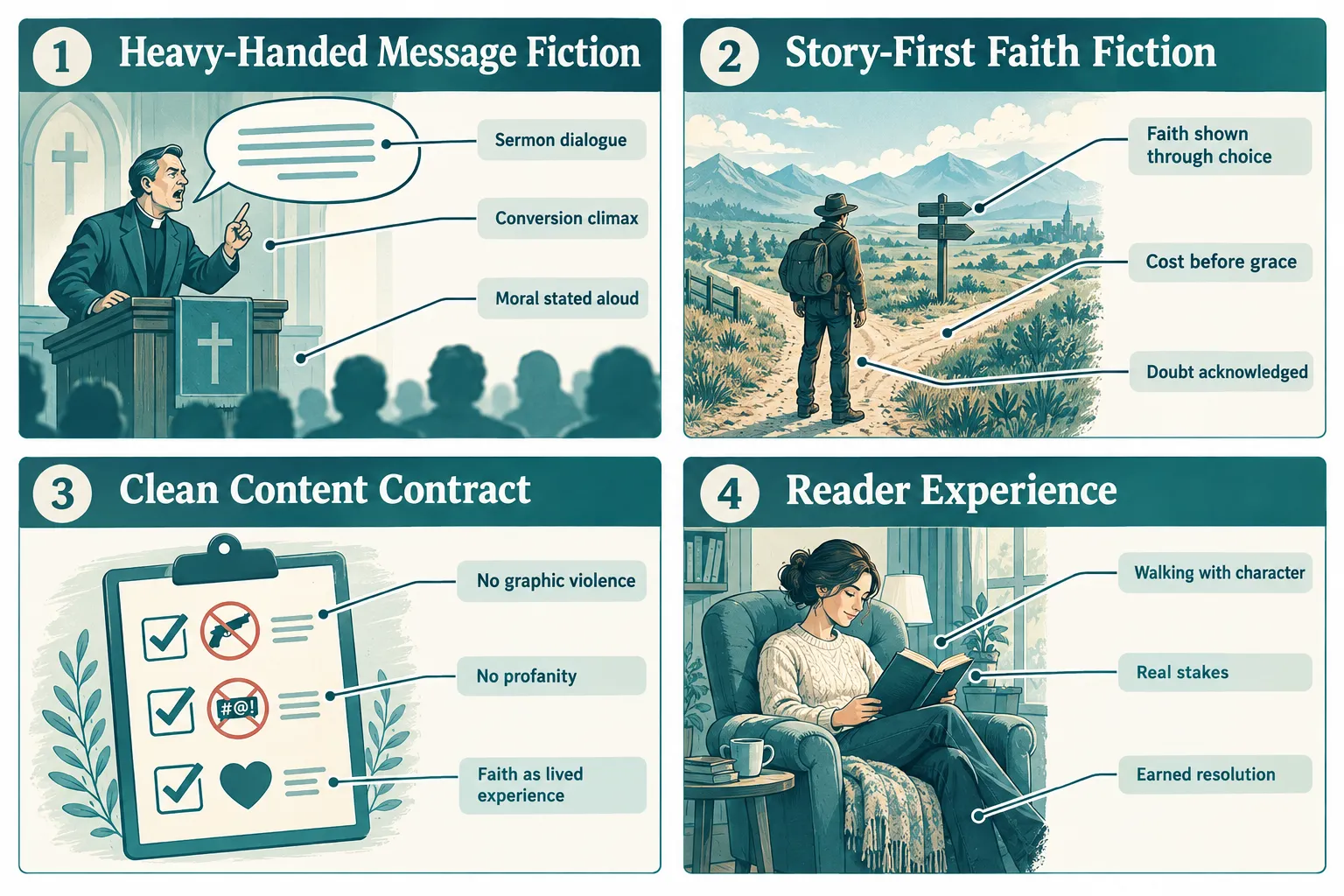
The most common causes:
1. Dialogue that teaches instead of reveals When a character explains Christian doctrine to another character who exists mainly to receive that explanation, readers feel the author’s hand. Real people don’t speak in theological summaries. They speak from need, fear, habit, and hope, and their faith (or lack of it) comes through in what they choose, not what they announce.
2. Conversion as plot resolution When a character’s faith commitment arrives at the climax as the solution to the story’s problem, it signals that the story was always a vehicle for the message. Earned grace looks different: the cost comes first, the consequence is real, and the mercy that arrives afterward is unexpected rather than scheduled.
3. Narration that editorializes Third-person narrators who pause to explain the spiritual significance of what just happened pull readers out of the story. Trust the scene. If a character makes a costly choice for a righteous reason, readers will feel the weight without being told to feel it.
4. Characters without genuine doubt Faith that has never been tested isn’t interesting to read about. Characters who doubt, wrestle, and sometimes get it wrong before they get it right are the ones readers trust, because they reflect how faith actually works in a human life.
The craft standard that cuts through all of this: faith under fire. Show belief being tested by the plot, not illustrated by the dialogue.
How to Write Christian Fiction That Prioritizes Story Over Message
Story-first faith means the plot requires the faith element to function. Remove the faith, and the story collapses, not because the author removed the message, but because the character’s choices no longer make sense.
Practical steps for story-first integration:
Anchor faith to motivation, not vocabulary. Ask: Why does this character make this choice when the easier path is right there? If the answer is rooted in conscience, covenant, or conviction, that’s faith doing structural work.
Let consequences be real. Cheap grace arrives before the cost. Earned grace arrives after it. A character who chooses rightly and pays for it, then finds mercy on the other side of that cost, is more theologically honest than one whose faith insulates them from consequence.
Use setting as spiritual texture. A church social in a small Tennessee town, a frontier railroad court where law runs out, a covenant highland where an empire wants to audit mercy, these settings carry faith without stating it. The world itself can be theologically shaped.
Resist the tidy resolution. Real faith lives with unresolved things. A chapter that ends with something still hanging, a benediction that doesn’t close everything off, a character who is changed but not fixed, these honor the reader’s own experience of belief.
For a genre-specific look at balancing faith content with story tension, Faith in Fiction Across Genres: How Much Is Too Much? covers the practical calibration across mystery, western, fantasy, and LitRPG.
What Do Readers Actually Want from Contemporary Christian Novels?
Modern Christian fiction readers want real stakes. They want characters who actually doubt, serve, fail, repent, and find grace in the ordinary Tuesday that suddenly isn’t ordinary anymore. They don’t want to be preached at, they want to be walked with.
Industry signals in 2026 confirm this. The clean Christian fiction segment has shown consistent growth, with faith-friendly stories across non-romance genres gaining ground on Kindle Unlimited. [1][5] Publishers Weekly has noted that agents and acquisitions editors are specifically flagging demand for authenticity over authority, readers want fiction that reflects how faith actually functions in a life, not how it functions in a sermon. [4]
What readers say they want (and what review patterns confirm):
- Characters who feel like real people, not moral examples
- Plots with genuine tension, stakes that aren’t resolved by a prayer at the right moment
- Faith that shows up in small moments, not just crisis points
- Mercy and justice held in tension, not traded off against each other
- Clean content as a baseline expectation, not a selling point that needs to be announced
The readers who leave negative reviews for Christian fiction most often cite the same complaint: I felt like I was being told what to think. That’s a craft failure, and it’s fixable.
How Much Faith Content Should Be in a Christian Novel?
There’s no correct ratio, but there is a correct test. Faith content belongs in a Christian novel wherever it’s doing something: shaping a choice, creating conflict, complicating a relationship, or costing a character something real. Faith content that isn’t doing any of those things is probably decoration, and decoration is where preachiness lives.
A useful calibration:
| Faith Element | Story-First Use | Heavy-Handed Use |
|---|---|---|
| Prayer | Character wrestles with silence or unexpected answer | Character prays and immediately receives clarity |
| Scripture | Surfaces through a character’s memory at a cost moment | Character quotes it to explain the story’s theme |
| Conversion | Arrives after genuine consequence and doubt | Arrives as the plot’s resolution |
| Church community | Creates loyalty, conflict, and accountability | Exists as a backdrop of warm, supportive people |
| Doubt | Drives character arc and raises real stakes | Gets resolved quickly to restore the character’s faith |
The question isn’t “how much faith?” It’s “is the faith load-bearing?” If you removed every faith element from the story and the plot still worked the same way, the faith wasn’t integrated, it was applied on top.
Common Mistakes Christian Authors Make with Dialogue and Character Development
The two biggest craft failures in Christian fiction both live in dialogue and character construction.
Dialogue mistakes:
- The theological download: One character explains Christian doctrine at length while another character nods. This reads as a lecture, not a conversation.
- The convenient witness: A character shares their faith at exactly the moment another character needs to hear it, with no organic setup. Readers feel the author’s hand immediately.
- Scripture as punctuation: Dropping a verse at the end of a tense scene to signal its meaning. Trust the scene.
Character development mistakes:
- The static believer: A character whose faith never wavers, never costs them anything, and never looks foolish. This character is not interesting and is not honest about how faith works.
- The faith-shaped villain: Antagonists who represent secular values while protagonists represent Christian ones. This flattens both characters and makes the story feel like a debate rather than a narrative.
- The conversion arc as the only arc: When a character’s entire development is moving from unbelief to belief, with nothing else at stake, the story has one note.
For specific guidance on how Christian authors can build suspense without relying on darkness, the craft principles transfer across genres.
Who Reads Clean Christian Fiction Besides Religious Audiences?
Clean Christian fiction draws readers well beyond practicing Christians. The content contract (no graphic violence, profanity, or explicit content) appeals to readers who simply prefer lower-intensity fiction, regardless of their faith background. [8]
Readers who find their way to clean Christian fiction from outside the church:
- Readers recovering from darker fiction who want genuine tension without graphic content
- Parents reading alongside teenagers or choosing books for family read-alouds
- Readers drawn to moral complexity who find that faith-rooted stories handle ethical stakes more seriously than much of secular fiction
- Genre readers (mystery, western, fantasy) who discover that the faith element adds depth rather than limiting the story
The growth of Christian speculative fiction, fantasy, thriller, LitRPG, has brought in readers who came for the genre and stayed for the worldview. [6] An epic fantasy where covenant and mercy are structural to the world-building doesn’t require the reader to be Christian to find those themes compelling.
Can Christian fiction appeal to non-religious readers? Yes, when the faith is doing story work rather than message work. A character whose conscience costs them something, whose mercy is unexpected and undeserved, whose doubt is honest, that character is recognizable to any reader who has ever faced a hard choice.
Redefining Clean Christian Fiction: What Makes a Faith-Based Novel Feel Authentic vs. Forced?
Redefining clean Christian fiction for modern readers comes down to one question: does the faith feel like it belongs to the character, or does it belong to the author?

Authentic faith in fiction has these qualities:
- It’s specific to this character, not generic Christian experience. A frontier lawman’s faith looks different from a cozy mystery amateur sleuth’s faith, which looks different from a covenant fantasy protagonist’s faith.
- It has a history. The character’s belief was shaped by something, a loss, a rescue, a promise kept or broken. That history doesn’t need to be explained in backstory; it shows up in how they react.
- It costs them something at least once. Faith that never requires sacrifice is not interesting and not honest.
- It coexists with doubt. Not resolved doubt, coexisting doubt. The character believes and wonders, and sometimes acts on the wondering.
Forced faith, by contrast, arrives when the plot needs it, speaks in complete theological sentences, and resolves conflicts that the story couldn’t otherwise resolve. It feels like a tool the author is using, not a reality the character is living.
The clearest marker: hope in the dark. Authentic Christian fiction can sit in hard places, grief, injustice, betrayal, without rushing to the comfort. The hope arrives, but it’s earned. That’s what separates faith-rooted storytelling from both secular nihilism and Christian sentimentality.
Are There Christian Fiction Books That Don’t Mention God or Church?
Yes. Some of the most effectively faith-rooted fiction carries its theology entirely through structure, consequence, and character, without a single scene set in a church or a single line of explicit prayer.
This is more common in Christian fantasy and Christian western fiction, where the world-building itself carries the theological weight. In a secondary world where covenant and mercy are structural realities, the author doesn’t need to name God, the story’s logic is the theology.
In frontier westerns, a man’s conscience operating in a space where law has run out is a profoundly Christian premise without requiring any church attendance. The question “what do you answer to when no one is watching?” is a faith question whether or not it’s framed in explicitly religious language.
The risk of this approach is that the faith becomes invisible rather than implicit. The test: would a thoughtful Christian reader recognize the worldview? Not because it’s labeled, but because the story’s moral logic, mercy and justice, earned grace, redemption that costs something, is unmistakably rooted in faith.
For readers interested in how faith themes work across genres without heavy-handed framing, Clean Christian Fiction That Isn’t Just Romance covers mystery, western, fantasy, thriller, and LitRPG examples.
Examples of Faith-Based Books That Work as Great Stories First
The benchmark for story-first Christian fiction has always been C.S. Lewis. Readers who found him through Narnia followed him into wildly different genres because the brand promise, this author handles faith with intelligence and imagination, transferred across every book. The faith was never the decoration. It was the architecture.
In contemporary clean Christian fiction, the same principle applies across genres:
- Cozy mystery: A small-town sleuth who keeps finding bodies where she meant to find donations, and secrets the church socials never sing about. The faith shows up in how she weighs loyalty against truth, not in how often she quotes scripture. (The Mercy House Mysteries)
- Frontier western: A man in railroad country where law runs out, deciding what obedience is worth when the warrant is false. The conscience question is the plot. (The Mercy Line)
- Psychological thriller: A woman whose own testimony starts appearing in someone else’s file, and the question of who controls the record of someone’s truth. (The Gathering Light)
- Epic fantasy: A world where the Maker’s answered prayers are mapped in silver roads, and a disgraced map-scribe discovers that the unanswered ones are also real. (The Sarel Chronicles)
What these have in common: the faith is structural. Remove it, and the story’s logic collapses. That’s the standard.
For readers exploring the western genre specifically, Why Christian Readers Love Frontier Westerns explains the appeal and what sets faith-rooted frontier stories apart.
Conclusion: What Redefining Clean Christian Fiction for Modern Readers Actually Requires
Redefining clean Christian fiction for modern readers isn’t about softening the faith or making it more palatable to secular audiences. It’s about making the faith do real work inside the story, so that readers encounter it the way they encounter faith in real life: through cost, consequence, doubt, and the mercy that arrives after all of that, not instead of it.
The shift the market is asking for in 2026 is a craft shift, not a theological one. [2][4] Readers want stories that walk with them, not talk at them. They want characters whose belief is specific, tested, and costly. They want clean content not as a disclaimer but as a natural quality of the prose. And they want hope in the dark, not hope that skips the dark, but hope that has been through it.
Actionable next steps for readers:
- If you’re new to story-first Christian fiction, start with a genre you already love, cozy mystery, western, fantasy, thriller, and look for titles where the faith is in the character’s choices, not the chapter headings.
- Browse Kindle Unlimited Christian Fiction to find faith-rooted stories across genres that hold a clean content standard without sacrificing real stakes.
- For writers: read your dialogue aloud. If a character sounds like they’re teaching a Sunday school lesson, rewrite the scene so the same truth shows up in what they do instead.
The best clean Christian fiction doesn’t announce itself. It simply tells the truth about what it costs to believe something, and what grace looks like when it finally arrives.
FAQ
What is the difference between clean fiction and Christian fiction? Clean fiction is a content standard (no graphic violence, profanity, or explicit content). Christian fiction is a worldview standard, faith shapes the story’s moral logic. A book can be one without the other. The strongest faith-rooted fiction is both.
Why do Christian novels sometimes feel preachy? Preachiness is a craft problem: the author’s message becomes more visible than the story. It happens most often through dialogue that teaches rather than reveals, and through conversion moments that function as plot resolutions rather than earned character changes.
Can non-Christians enjoy clean Christian fiction? Yes. When faith is doing story work, shaping character choices, creating genuine conflict, costing characters something real, readers of any background respond to it. The moral stakes are universally human even when the framework is specifically Christian.
How much faith content is too much in a Christian novel? There’s no correct amount. The test is whether the faith is load-bearing: does it shape choices, create conflict, and cost characters something? Faith content that isn’t doing any of those things is probably decoration, and decoration is where preachiness lives.
What makes a Christian character feel authentic? Authentic Christian characters have faith that is specific to them (not generic), has a history, costs them something at least once, and coexists with genuine doubt. Faith that never wavers and never costs anything is neither interesting nor honest.
Is there Christian fiction that doesn’t mention God or church? Yes, particularly in Christian fantasy and western fiction, where the theological framework is carried through world-building and moral consequence rather than explicit religious language. The test is whether a thoughtful Christian reader would recognize the worldview, not whether it’s labeled.
What genres are growing in clean Christian fiction? Mystery, western, fantasy, psychological thriller, and LitRPG are all showing growth in the faith-rooted fiction space, particularly on Kindle Unlimited. [1][6] The growth is driven by readers who want their faith represented honestly across genres, not just in romance.
What does “earned grace” mean in fiction? Earned grace means mercy arrives after real cost and consequence, not instead of it. A character who chooses rightly and pays for it, then finds grace on the other side of that cost, reflects how grace actually functions, as gift, not as exemption from consequence.
How do I find clean Christian fiction that isn’t just romance? Look specifically for mystery, western, fantasy, and thriller titles with a faith-rooted content marker. The Clean Christian Fiction That Isn’t Just Romance guide covers the full genre landscape.
What’s the single biggest mistake Christian authors make? Trusting dialogue to carry the faith instead of trusting the plot. When characters say what the story means, readers feel lectured. When characters live what the story means, and pay for it, readers feel it.
References
[1] Christian Fiction 14 7 Yearly Surge Dramatic Market Expansion Data – https://www.firmenpresse.de/pressrelease734029/christian-fiction-14-7-yearly-surge-dramatic-market-expansion-data.html
[2] 99268 The Top Religion Stories Of 2025 – https://www.publishersweekly.com/pw/by-topic/industry-news/religion/article/99268-the-top-religion-stories-of-2025.html
[4] 82636 Agents Highlight Leading Christian Publishing Trends – https://www.publishersweekly.com/pw/by-topic/industry-news/religion/article/82636-agents-highlight-leading-christian-publishing-trends.html
[5] Faith Based Publishing Shows Steady Momentum Heading Into 2026 – https://www.einpresswire.com/article/868266864/faith-based-publishing-shows-steady-momentum-heading-into-2026
[6] Evangelical Fantasy Christian Speculative Fiction Growth – https://www.christianitytoday.com/2025/01/evangelical-fantasy-christian-speculative-fiction-growth/
[8] Christian Book Statistics – https://powelld.com/christian-book-statistics