
Last updated: October 8, 2026
Quick Answer
A Christian LitRPG feels like a real game when its numbers carry consequence. Stats must measure something the reader can predict and spend, classes must close doors as well as open them, crafting must cost materials someone had to go get, and choices must leave permanent marks on reputation, relationships, and ability. Faith belongs inside those rules, not above them, prayer, confession, and service should change what a character can do, not just how the narration sounds.
Key Takeaways
- Stats earn their place when they answer four questions: what’s measured, how it changes, what actions move it, and why the number matters next chapter.
- A class system works when the build is a trade. Choosing the healer path should mean giving up something real, permanently.
- Crafting is the quietest honesty test in the genre, it forces scarcity, labor, and waiting into a story that could otherwise hand out power for free.
- Choice feels meaningful through consequence, not branching. Research on game agency emphasizes the player’s sense that a decision mattered, which fiction can deliver through persistent reputation and resource change.
- Christian LitRPG differs from secular LitRPG less in content than in what the system rewards: stewardship, mercy, and community progression alongside combat power.
- Dark themes belong here. Grace without cost reads as a cheat code. Faith under fire is the whole engine.
- The market is crowded, not empty. LitRPG releases grew from 917 in 2023 to 2,642 in 2025 [1][6], so a clear first-book rule set matters more than ever.
- Non-gamers can read these. The best books teach the system the way a good tutorial does: one mechanic at a time, with a cost attached.
What is a LitRPG, and how does it differ from regular fantasy novels?
LitRPG is fantasy or science fiction in which game mechanics are literally part of the story world, characters see stat screens, gain levels, accept quests, and manage inventory, and the reader sees those numbers too. Regular fantasy may have a magic system with internal rules; LitRPG puts the rulebook on the page.
The practical difference comes down to three things:
| Element | Traditional fantasy | LitRPG |
|---|---|---|
| Power growth | Implied, described in prose | Quantified, visible, tracked |
| Rules | Author knows them; reader infers | Reader is told them directly |
| Tension source | Will the hero survive? | Can the hero afford this? |
That third row is where the genre lives. In LitRPG, tension often comes from a budget: limited stat points, a cooldown, a crafting material that takes three days to gather. Readers who love progression fantasy with real stakes are usually responding to that arithmetic of consequence.
Common mistake: writing a novel with a stat screen pasted on top. If removing every interface panel wouldn’t change the plot, it isn’t a LitRPG, it’s a fantasy novel wearing a HUD.
How do stats and leveling systems work in Christian LitRPGs?
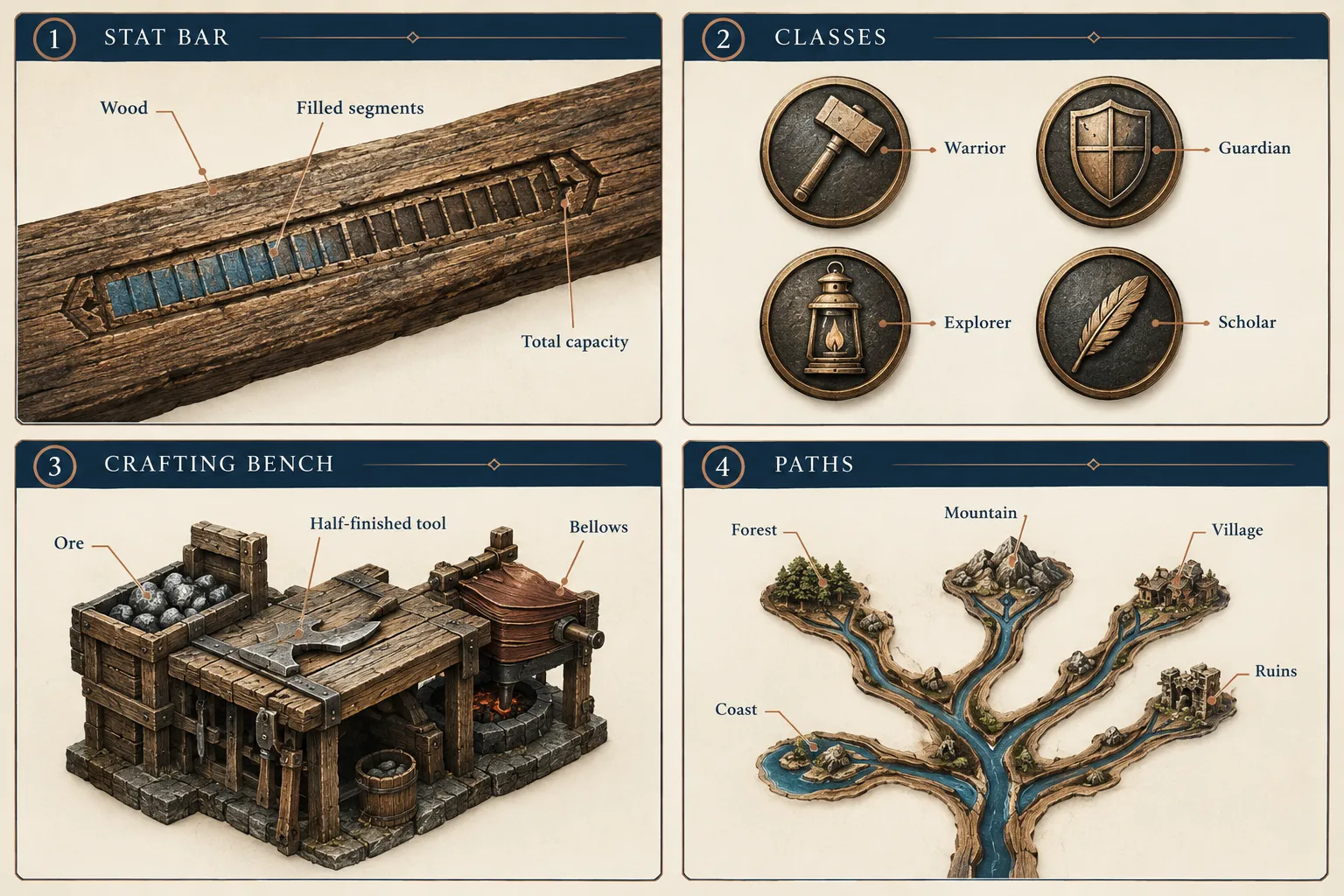
Stats work when each one is a lever the character can pull and the reader can anticipate. A convincing stat system tells you what’s being measured, how the value changes, which actions improve it, and what breaks if it stays low.
“Faith 12” means nothing on its own. It means something once the reader learns that below Faith 10, a healing prayer has a chance of failing mid-cast, and that the stat rises through practiced obedience rather than combat kills.
Stat categories that tend to work in faith-rooted systems:
- Measured capacity, strength, endurance, precision. Standard, and useful precisely because it’s familiar.
- Measured formation, discipline, discernment, patience. Slow-moving, hard to grind, visible under pressure.
- Measured standing, trust within a household, a guild, a congregation. Can be lost in one scene.
- Measured debt, what the character owes, and to whom. The most interesting number on any sheet.
Decision rule: if a stat never appears in a decision where the character must choose between two things they want, cut it. It’s decoration.
For a deeper look at how numerical growth and moral growth can run on separate tracks, see character arcs in Christian LitRPG and leveling up faith alongside stats.
What makes player choice feel meaningful in LitRPG stories?
Choice feels meaningful when the system responds in a way that persists. A 2024 analysis in the International Journal of Serious Games frames agency as the relationship between a player’s intentional action and the system’s response, requiring freedom to choose, control over the choice, and commitment to its results.
For fiction, that translates into a simple test. After a choice, at least one of these must change and stay changed:
- Resources (money, materials, remaining uses)
- Relationships (who will open a door for the character later)
- Abilities (what’s now possible or permanently closed)
- Risk exposure (what hunts them now)
- Future options (which quests the system will even offer)
Research published in November 2025 on perceived agency argues that a player’s sense that a decision mattered can matter more than the number of objectively distinct story paths. That’s good news for novelists: a Christian LitRPG doesn’t need twelve endings. It needs convergent plotting with permanent residue, a scar in the reputation column, a tool sold to pay someone else’s fine, a vow that now constrains the build.
A choice that costs nothing isn’t a choice. It’s a menu.
Edge case: choices made under coercion. When a character is forced, the system should still log it, and the story should treat the difference between “chose wrong” and “had no choice” as unresolved, not tidy.
How important is crafting and inventory management in LitRPGs?
Crafting matters more than most authors expect, because it’s the mechanic that enforces scarcity. Combat can be won with courage; a forge cannot. You either have the iron or you don’t.
Good crafting in a faith-rooted system does three jobs:
- It makes labor visible. Someone mined the ore. Someone waited for the kiln.
- It creates honest trade-offs. One rare ingredient, two people who need it.
- It rewards knowledge over power. The reader who’s paying attention can see the solution before the protagonist does.
Inventory management works best as pressure, not accounting. Twelve slots and thirteen necessary items is a scene. An itemized list of everything in a bag is a chore.
Common mistake: crafting that only produces better swords. Let the bench produce splints, water filters, a repaired roof, a copied ledger. When game mechanics become spiritual discipline and discipleship explores how repetition and practice can carry theological weight without a single sermon.
Christian LitRPG vs. secular LitRPG: what’s the difference?
The difference is rarely content filtering. It’s what the system rewards. Secular LitRPG typically optimizes toward individual power accumulation. Christian LitRPG can make community, stewardship, and sacrifice into progression vectors with actual mechanical weight.
| Design question | Typical secular build | Faith-rooted build |
|---|---|---|
| Primary growth path | Personal power | Power plus communal capacity |
| Role of sacrifice | Tactical cost | Mechanically generative |
| Reputation | Unlocks vendors | Carries moral consequence |
| Victory condition | Clear the dungeon | Who’s still standing, and at whose expense |
The Player Experience of Need Satisfaction model links progression to competence, choice to autonomy, and social bonds to relatedness. Christian fiction has an unusual advantage on that third pillar: a character can advance through mentoring, reconciliation, shared vows, or cooperative building, not only through kill counts.
Scholarship on religious games makes a related point, religious games land harder when the mechanics themselves enact theology rather than merely depicting religious characters. Grace, confession, forgiveness, and service should alter available actions. Not award good-person points.

Best Christian LitRPG books with detailed class systems, and where to find recommendations
The subgenre is small and young, so “best” currently means “most mechanically committed.” Two reference points are worth knowing.
Canthany Rising: A Christian LitRPG Adventure by Kenneth Bliss, published June 22, 2026, integrates health points, stats, levels, abilities, prayer, and sacrifice, with prayer functioning as a power source and sacrifice producing effects [5]. At roughly 85 pages it reads closer to a novella than the long-form progression series that dominate the market, but it’s a genuine proof of concept.
The Measured Debt takes the long-form route. In The Cost of Being Chosen, Eamon Kersey is the strongest hand in every wrecked corridor at Federated Record, and the position series keeps proving it, until what he’s spent stops adding up. The Remembered Route puts a corridor he swears he never walked into the record twice, and The Borrowed Yield collects on numbers that were never fully his.
Where to find recommendations and reviews:
- LitRPG Critic publishes market analysis and new-release tracking [8]
- LitRPGTools issues periodic state-of-the-genre reports [6]
- Rising Shadow maintains a LitRPG release listing [9]
- Reader-curated Kindle Unlimited lists, start with building a clean, faith-filled TBR across genres
Common mistakes authors make writing LitRPG mechanics
The recurring failure is mechanics that describe instead of decide. Here’s the short list, in rough order of damage done.
- Stat dumps with no consequence. A full character sheet in chapter two, never referenced again.
- Inflation. Levels arriving faster than the stakes. By book two the numbers are large and meaningless.
- Deus ex interface. A new ability appearing exactly when needed, never foreshadowed in the rules.
- Classes without closed doors. If the paladin can also sneak, craft, and heal, there was no class choice.
- Grace as a reset button. The specific temptation in faith-rooted LitRPG, forgiveness that erases the mechanical cost. Forgiveness should restore relationship, not refund the resource.
- Teaching nothing. The reader should be able to predict a trade-off by chapter ten.
How do you balance game mechanics with story, and how fast should characters level up?
Lead with the scene, support with the number. A mechanic should appear when a character needs it to make a decision, and the pacing of levels should follow emotional escalation, not a spreadsheet.
A workable pacing frame for a first book:
- Chapters 1-3: one system revealed, with its cost
- Chapters 4-10: the character learns to work within the limit
- Midpoint: a level or class gain that creates a new problem, not just new power
- Final third: the system’s rules are used against the character
- Ending: a gain that cost something the reader will remember
On speed: the genre’s consumption data suggests series momentum matters enormously. One 2026 analysis found roughly 76% of six-month consumption went to Book 2 or later, with the top ten works capturing about 30% of tracked consumption [1][6]. Practically, that means a first book must establish rules fast and leave the ladder visible, slow-burn systems that don’t pay off until book three risk never getting read.
Decision rule: if a level-up solves a problem without creating a new one, delay it.
Are Christian LitRPGs good for readers who don’t like games, and what age group is this written for?
Yes, if the book teaches as it goes. Readers with no gaming background can follow a LitRPG when each mechanic is introduced one at a time, attached to a concrete decision, and explained through character need rather than exposition. Readers who want the rules without the interface may prefer epic fantasy with deep faith themes and no allegory.
On audience: most Christian LitRPG is written for adult and upper-YA readers, roughly 16 and up, with clean content standards throughout. The genre skews younger than Christian cozy mystery but the moral complexity often runs deeper. Christian speculative fiction overall has been expanding, Christianity Today reported in January 2025 that Enclave Publishing moved from 16 titles in 2023 to 20 in 2024, and that the Evangelical Christian Publishers Association tracked a 38% rise in speculative-category entries between 2018 and 2023.
Choose Christian LitRPG if you enjoy systems, consequences, and watching competence get built. Skip it if visible numbers break your immersion.
Can you have dark themes in a Christian LitRPG?
Yes, and the system usually requires them. A progression story about grace needs a real ledger of damage, or the grace registers as a cheat code. The constraint isn’t subject matter, it’s handling.
What works: moral injury, complicity, institutional corruption, failure that can’t be ground away, grief that doesn’t resolve on schedule. What breaks the contract: graphic violence for shock, despair without a horizon, and the tidy conversion scene that cancels every consequence.
Keep the mercy and justice tension live. A character can be forgiven and still owe restitution. That’s not a contradiction; it’s the most game-like thing in the book, because the system keeps the record even after the heart changes. Faith-rooted stories across genres handle this the same way, see how Christian western fiction differs from secular westerns on exactly this point about earned grace.
FAQ
Does a Christian LitRPG need a visible stat screen? No, but it needs visible rules. Some books use ledgers, position series, guild records, or covenant tallies instead of interface panels. The requirement is that the reader can audit the cost.
How do faith and spirituality factor into game mechanics? Best practice is to make them playable. Prayer affects reliability or access, confession restores standing, service unlocks cooperative abilities, and sacrifice produces effects no solo build can reach.
Is LitRPG the same as progression fantasy? Overlapping, not identical. Progression fantasy tracks increasing power; LitRPG adds explicit game-system framing. Most LitRPG is progression fantasy, but not all progression fantasy is LitRPG.
How many stats are too many? If the reader can’t name them from memory by chapter ten, there are too many. Six to eight is a workable ceiling for a first book.
Should classes be changeable mid-series? Only at real cost. A reclass that loses progress, breaks a vow, or disappoints a mentor is a story event. A free respec is a vending machine.
Can community be a progression system? Yes, and it’s underused. Shared crafting, trained apprentices, rebuilt infrastructure, and reconciled relationships can all function as measurable advancement.
Is the Christian LitRPG market crowded? The broader LitRPG market is. Releases rose from 917 in 2023 to 2,642 in 2025 [1][6], with cozy fantasy and LitRPG both flagged as fast-growing niches for 2026 [10]. The Christian corner remains thin.
Where should a new reader start? With book one of a completed or actively releasing series, so the progression ladder is still being built. Browse Christian LitRPG titles and discussion to narrow it down.
Conclusion
A Christian LitRPG feels like a real game when the numbers hold someone accountable. That’s the whole design brief. Stats that predict, classes that cost, crafting that enforces scarcity, and choices that leave a mark the record won’t let anyone forget.
Three next steps, depending on which side of the page you’re on:
- Readers: pick one series and track a single stat across three chapters. If it never influences a decision, try a different book.
- Writers: take your character sheet and delete every stat that hasn’t forced a trade-off. Rebuild from what’s left.
- Both: notice what the system rewards. That’s the theology of the book, whether the author wrote it down or not.
The best of these stories don’t explain what grace means. They make you watch what it costs, line by line, and let the ledger stay open a little longer than is comfortable.
References
[1] 2026 08 10 State Of Litrpg 2026 Discovery Crisis Market Analysis – https://litrpgcritic.com/blog/2026-08-10-state-of-litrpg-2026-discovery-crisis-market-analysis/ [5] Canthany Rising Brings Christian Faith And Litrpg Adventure Together In An Epic New Fantasy By Kenneth Bliss – https://www.einpresswire.com/article/913878546/canthany-rising-brings-christian-faith-and-litrpg-adventure-together-in-an-epic-new-fantasy-by-kenneth-bliss [6] For The Fans State Of Litrpg – https://www.litrpgtools.com/insights/for-the-fans-state-of-litrpg [8] New Releases – https://litrpgcritic.com/new-releases/ [9] Litrpg – https://www.risingshadow.net/new-book-releases/litrpg [10] Zeitgeist Cozy Fantasy And Litrpg Surge As Hottest Niches In 2026 – https://www.authormedia.com/zeitgeist-cozy-fantasy-and-litrpg-surge-as-hottest-niches-in-2026/