

Last updated: October 15, 2026
Quick Answer
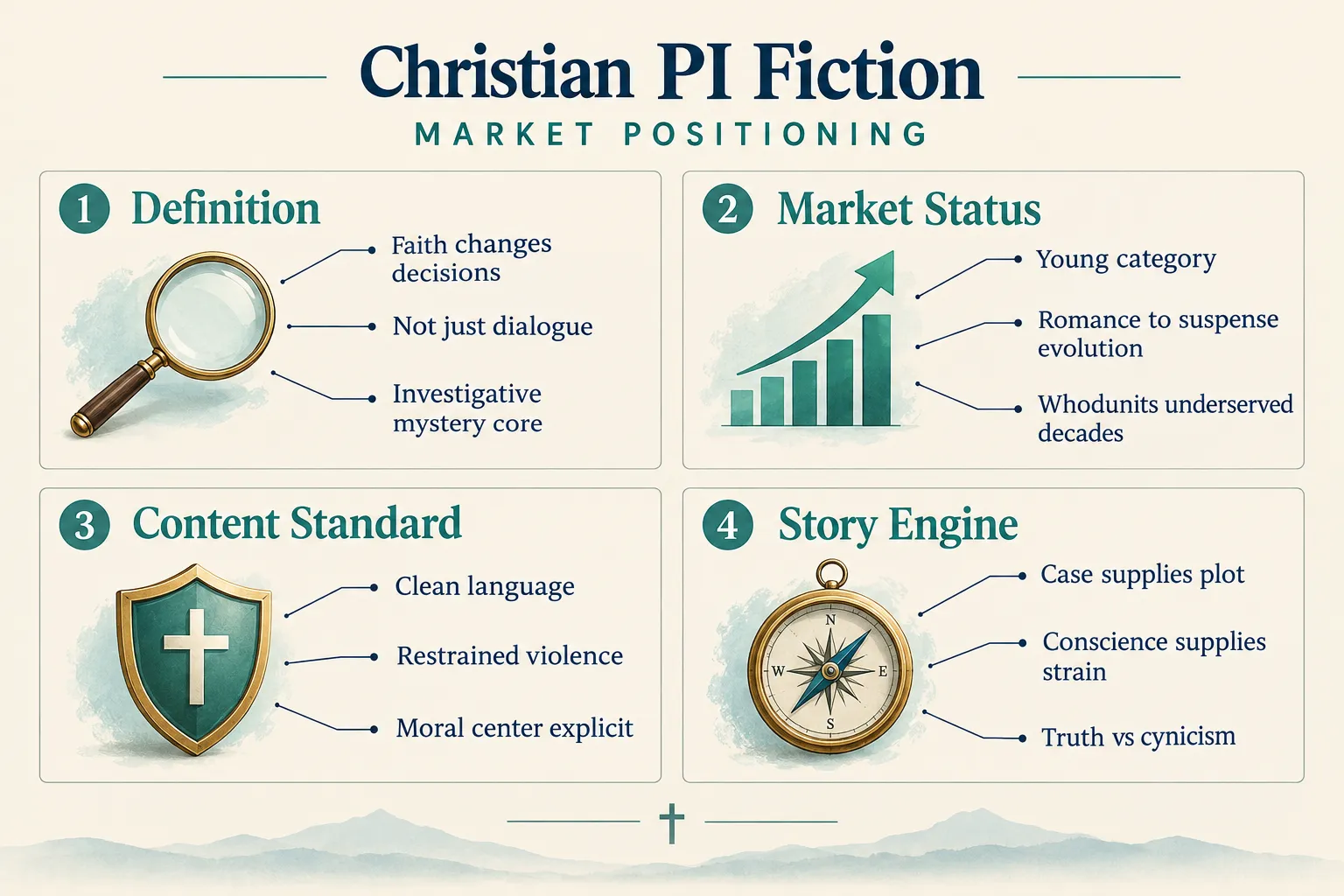
Christian private investigator fiction follows licensed or informal investigators who solve cases while their faith is actively tested by the work, bribes, vengeance, fabricated evidence, and the temptation to punish instead of pursue justice. Unlike standard PI novels, these stories keep content clean (no profanity, graphic violence, or explicit scenes) and resolve on conscience rather than cynicism. The subgenre is growing: Publishers Weekly reported in 2026 that mysteries are “on the rise” in Christian fiction, with editors seeing demand for clean, faith-centered investigative stories [1].
Key Takeaways
- Definition: A Christian PI novel is an investigative mystery where faith changes the investigator’s decisions, not just the dialogue.
- The market is young. Christian fiction grew from romance into romantic suspense, so traditional whodunits and PI stories were underserved for decades [1].
- Clean is an editorial standard, not a legal one. Publishers generally define it as no explicit sex, no profanity, no graphic violence, individual imprints go stricter [7].
- Christian noir exists, but it bends. The hardboiled shell works; the nihilism at its center does not survive a conscience.
- Redemption has to cost something. A good arc in this subgenre requires confession, restitution, or real loss before relief arrives.
- Where to buy: Kindle Unlimited, Amazon, Christianbook, library apps, and Goodreads lists are the main discovery routes.
- Audiobooks are uneven. Trade-published Christian suspense usually has narration; indie PI titles often don’t yet.
- Best entry point for beginners: amateur-sleuth and cozy-adjacent investigator stories before hardboiled or psychological titles.
What is Christian private investigator fiction?
Christian private investigator fiction is a mystery subgenre in which an investigator, professionally licensed, formerly law enforcement, or functioning as one without the badge, works a case while holding a faith that makes the easy answer unavailable. The case supplies the plot. The conscience supplies the pressure.
The practical markers:
- A case structure. Client, question, evidence, reversal, answer.
- A moral cost built into the solution. Telling the truth hurts someone the investigator cares about.
- Clean content. Violence happens off-page or in consequence rather than in detail.
- Faith shown through choice. No sermon at the midpoint, no tidy conversion at the end.
One 2026 release demonstrates the shape clearly. Stephen Lee Stanley’s Cobalt Blues, announced in September 2026, follows Johnny Cobalt, a Christian private investigator whose professional obligations collide with his convictions, the publisher’s stated themes are faith, conscience, and redemption [1].
A record can be accurate and still be a lie. What a Christian investigator does when he’s holding both is the whole story.
How is Christian fiction different from regular mystery novels?
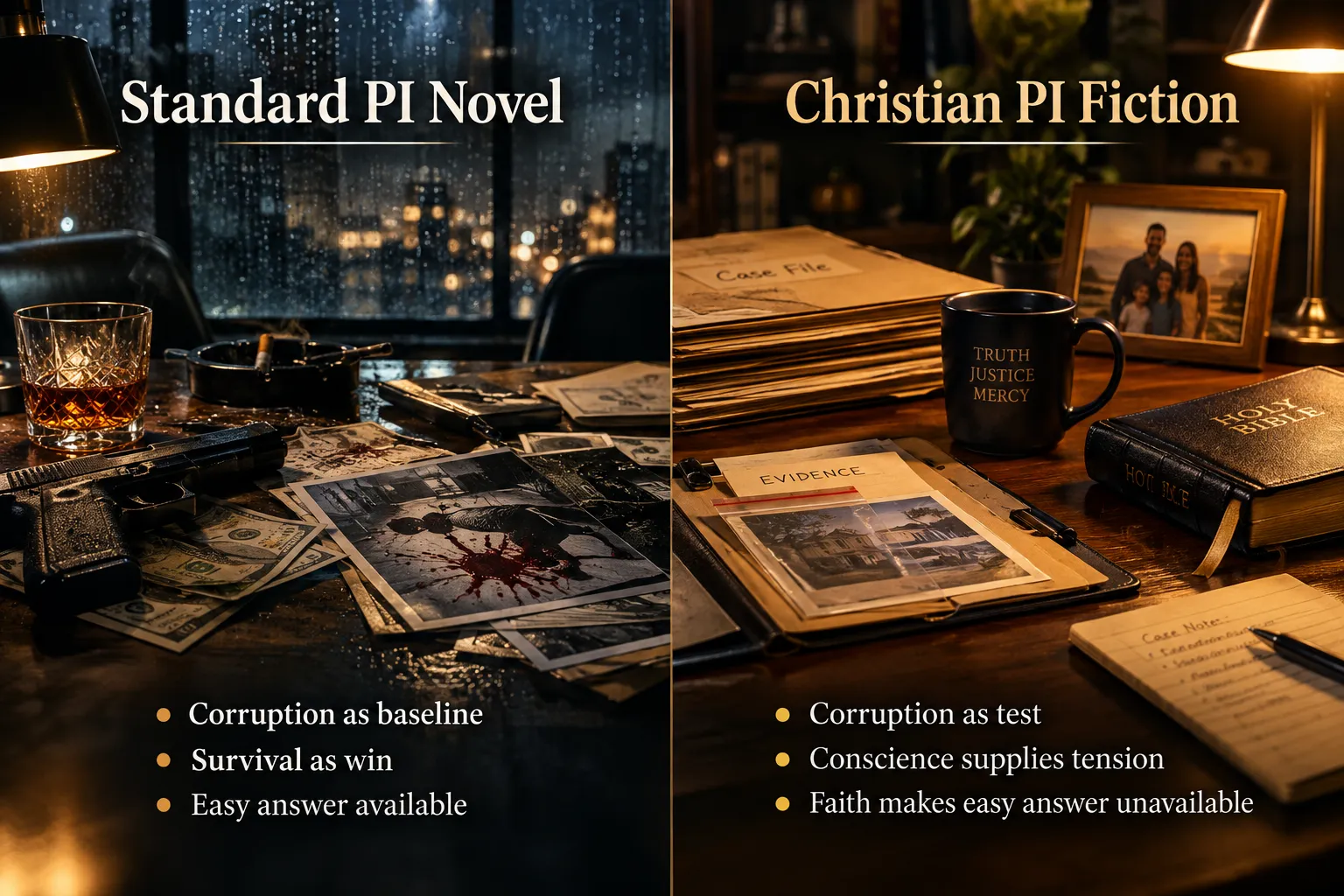
The difference is where the story locates its moral center. A standard PI novel often treats corruption as the baseline and survival as the win. Christian PI fiction treats corruption as real, then asks what the investigator owes God and neighbor anyway.
| Element | Mainstream PI novel | Christian PI novel |
|---|---|---|
| Content | Explicit language, on-page violence common | No profanity, violence kept off-page [7] |
| Investigator’s motive | Money, grudge, obsession, curiosity | Duty, restitution, protecting the vulnerable |
| Moral arc | Erosion, hardening, weary survival | Conviction tested, then costly obedience |
| Antagonist | Often irredeemable | Sometimes redeemable, always accountable |
| Ending | Ambiguity or bleak closure | Hope in the dark, earned rather than handed over |
Decision rule: If you want a book where the detective’s cynicism is the appeal, read mainstream. If you want tension that resolves toward mercy and justice rather than exhaustion, read Christian. More on that balance in this guide to balancing spiritual themes with story across Christian genres.
Common mistake: Assuming clean means low-stakes. Clean restricts depiction, not jeopardy. A faked custody document, a forged ledger, a missing child, all available, all devastating, none graphic.
Best Christian private investigator novels and series to read
Start with trade-published Christian mystery and suspense, since that’s where the most vetted investigative fiction currently sits, then branch into indie PI titles.
Recent and forthcoming PI-adjacent titles worth tracking:
- Cobalt Blues (Stephen Lee Stanley, 2026), the clearest recent example of a working Christian PI protagonist [1].
- Taken Without a Trace (Hope Welborn, October 2026), pairs a Georgia special agent with private investigator Maya Reid on a missing-person and cold-case investigation.
- Murders in the Marquee (Dana Mentink, September 2026), launch of the historical Murder Most Fowl Mysteries from Love Inspired Trade [1].
- All the Suspects on Campus (January 2027), the next Christie Club Mystery, continuing the clean whodunit tradition editors compare to Agatha Christie [1].
- The Crown Conspiracy (Connie Mann), 2025 Christy Award winner for Mystery/Suspense/Thriller, with finalists including Jaime Jo Wright, Lynette Eason, and Nancy Mehl.
Series with an investigator-shaped protagonist: The Mercy House Mysteries follow Nora Bell Hartley in Juniper Gap, Tennessee, where donation boxes and church socials keep surrendering records nobody meant to leave behind, A Donation to Die For opens with a mislabeled box, a ledger, and a deacon who died just before he could confess. For why non-licensed sleuths carry this subgenre so well, see why amateur sleuths fit faith-based fiction.
Christian detective stories about faith, conscience, and moral dilemmas
The strongest Christian PI stories put the investigator’s belief under operational strain, not conversational strain. The dilemma has to be unresolvable by policy.
Recurring pressure points that actually work on the page:
- The bribe that would pay a real debt. Not greed, rent, medicine, a daughter’s tuition.
- Confidentiality against harm. The client’s secret protects a predator.
- Evidence that’s true but obtained wrongly. Does the investigator use it?
- Vengeance disguised as justice. The case lets him punish someone who hurt him once.
- The guilty party who has genuinely repented. Mercy and justice refuse to agree.
Quick example: An investigator confirms a church treasurer skimmed funds nine years ago and has quietly repaid every dollar since. Reporting it destroys a family and a congregation. Burying it makes the investigator the new keeper of the lie. There’s no clean exit, that’s the point.
Readers who like this kind of pressure often also read Christian psychological thrillers with clean content and real moral stakes.
Are there Christian noir or hardboiled detective books?
Yes, though the subgenre is thin and it changes noir from the inside. The style survives, rain, debt, bad clients, a city that doesn’t care. The philosophy doesn’t, because noir’s engine is futility and Christian fiction’s engine is accountability.
What Christian noir keeps and discards:
- Keeps: First-person voice, moral ambiguity in secondary characters, institutional rot, a weary protagonist.
- Keeps: Bleak settings and genuine danger.
- Discards: Nihilism as a conclusion, glamorized vice, on-page brutality.
- Replaces: The “nothing matters” ending with a costly act of truth-telling that changes almost nothing publicly and everything privately.
Edge case: Some readers want the grit without any religious language at all. Baker Publishing Group’s Haven imprint, launched in 2026 for clean and wholesome fiction without sex, profanity, or graphic violence, and without requiring overt religious content, signals where that market may land [7].
Clean mystery books without violence or profanity: what to expect
Clean mystery in this space means a murder can drive the plot while the discovery is restrained, the language is clean, and the aftermath carries the emotional weight instead of the act. Industry reporting shows no regulatory rule governing this; it’s an editorial and market standard, applied differently by each imprint [7].
Typical content boundaries:
- Violence: Implied, reported, or discovered, rarely depicted.
- Language: None, or mild and non-profane.
- Romance: Varies widely; some lines are closed-door, some romance-absent entirely.
- Faith content: Ranges from explicit prayer to a values framework with no salvation language [7].
If you’re filtering a reading list, this walkthrough on finding clean reads and avoiding graphic content on Goodreads saves a lot of sample-reading.
Where to buy Christian private investigator books (and find audiobooks)
Amazon and Kindle Unlimited carry the widest selection, Christianbook stocks trade-published suspense, and library apps like Libby cover both. Audiobook availability is the weakest link.
Buying checklist:
- Kindle Unlimited, best for indie Christian mystery series and binge-reading; see this guide to clean Christian fiction on KU across genres.
- Christianbook.com, reliable for Love Inspired Trade, Bethany House, and Revell titles.
- Libby / Hoopla, free library access, often includes audio.
- Audible / Chirp, search the author name plus “audiobook”; trade-published Christian suspense is usually narrated, while newer indie PI releases frequently launch ebook-first.
Audiobook reality check: If a Christian PI title released in the last twelve months from an independent author, assume no audio edition unless the listing shows one. Trade imprints produce audio far more consistently.
Christian private investigator books for beginners
Start with a cozy-adjacent investigator series or a single-case standalone before moving to psychological or hardboiled titles. The reading progression matters because tolerance for darkness varies a lot inside this audience.
A sensible four-step ramp:
- Small-town amateur investigator. Low violence, strong community stakes. See small-town Christian cozy mystery tropes explained for new readers.
- Licensed PI with a cold case. More procedure, still restrained.
- Romantic suspense with an investigator lead. Higher action, established tradition in Christian publishing [1].
- Clean psychological thriller. Interior pressure, unreliable records, no graphic content.
Choose X if: You loved Agatha Christie, start at step one or two. You loved Criminal Minds, start at step four.
How do faith themes work in mystery plots, and what makes a good redemption arc?
Faith works in a mystery plot when it narrows the investigator’s options. Redemption works when it costs something the character cannot easily pay.
Four tests for a redemption arc that earns its ending:
- Recognition before relief. The character names the wrong specifically, not vaguely.
- Restitution attempted. Money returned, testimony given, a name cleared.
- A consequence that stays. Grace doesn’t erase the record; it changes who holds it.
- No conversion as plot solution. If belief functions as a magic key, the arc is cheap.
The creative opportunity in this subgenre isn’t evangelism. It’s moral pressure, bribery, vengeance, fabricated evidence, the pull to punish rather than pursue justice, working on someone who actually answers to God. Faith under fire reads as story. Faith as exposition reads as filler.
FAQ
Is Christian private investigator fiction a large category? Not yet. Publishers Weekly reported in 2026 that editors see mystery as a credible emerging niche in Christian fiction, with marketing still difficult because the category isn’t historically established [1].
Do these books include murder? Often, yes. The crime drives the plot; the depiction stays restrained.
Is there romance in Christian PI novels? Sometimes. Christian fiction grew from romance into romantic suspense, so many investigator stories include a romantic thread [1]. Some series deliberately exclude it.
What’s the difference between clean fiction and Christian fiction? Clean fiction avoids explicit content; Christian fiction adds an explicit faith framework. Imprints like Haven publish clean without requiring overt religious content [7].
Are Christian mysteries only for Christian readers? No. Publishers increasingly market clean, values-oriented fiction to readers of any faith or none [7].
Has Christian mystery won major awards? Yes. Connie Mann’s The Crown Conspiracy won the 2025 Christy Award for Mystery/Suspense/Thriller, with finalists including Jaime Jo Wright, Lynette Eason, and Nancy Mehl.
Can a Christian PI story have a morally compromised hero? Yes, as long as the compromise has weight and consequence rather than being treated as cool.
Where do new readers find recommendations? Goodreads lists, Kindle Unlimited category browsing, and Christianbook’s suspense page.
Conclusion
The appeal of this subgenre isn’t that the investigator is nice. It’s that he keeps choosing truth when cynicism would be easier, cheaper, and more satisfying, and pays for it. Christian private investigator fiction holds the clean case story and the hard moral question in the same hand, which is exactly why readers who grew tired of bleak detective novels keep finding their way back to mystery.
Next steps:
- Pick your entry point using the four-step ramp above.
- Sample two chapters before committing, check language, violence depiction, and whether faith is shown or told.
- Build a shelf: one cozy investigator series, one cold-case standalone, one clean psychological thriller.
- Watch the 2026-2027 release calendar; trade imprints are actively expanding this space [1].
Start with A Donation to Die For if you want a small-town investigator who finds a ledger before she finds a body, or browse the full Silas Bellhaven catalog. What a record proves and what it means are not the same thing. That gap is where these stories live.
References
[1] 100974 Mysteries On The Rise In Christian Fiction – https://www.publishersweekly.com/pw/by-topic/industry-news/religion/article/100974-mysteries-on-the-rise-in-christian-fiction.html [7] 99493 Christian Novelists Seek Readers Of All Faiths Or None – https://www.publishersweekly.com/pw/by-topic/industry-news/religion/article/99493-christian-novelists-seek-readers-of-all-faiths-or-none.html