
Last updated: October 17, 2026
Quick Answer
Christian historical romance set during the Reformation: courtship, conviction, and cultural change is a subgenre where a love story unfolds against the religious upheaval of roughly 1517 to 1648, and where the characters’ beliefs carry real personal cost. The best examples dramatize doctrine through decisions, a broken vow, a banned book, a marriage that defies canon law, rather than through sermons or debate scenes. Readers do not need Reformation history to enjoy them, but authors need it to make the stakes believable.
Key Takeaways
- The subgenre’s engine is collision, not backdrop: private affection running headlong into public conviction, with consequences that can’t be undone by an apology.
- Jody Hedlund’s Luther and Katharina: A Novel of Love and Rebellion remains the most visible Reformation-set Christian romance in retail, built on Katharina von Bora’s move from convent to marriage [Historical Novel Society].
- The Reformation era for fiction purposes usually spans 1517 (Luther’s Ninety-five Theses) to 1648 (Peace of Westphalia), with 1517-1560 the most common window.
- Christian historical romance differs from secular historical romance mainly in content boundaries and in whether faith drives the plot or decorates it.
- Reviewers reward theology that’s dramatized through fear, grief, temptation, and hope rather than delivered as exposition [The Living Church].
- Accuracy matters to this audience. Authenticity, factual grounding, and a transparent theological stance are listed as reader-selection criteria for Christian historical novels [The Witness].
- The genre has broadened considerably. Publishers continue investing in historical fiction, historical romance, romantic suspense, Amish, and women’s fiction [4].
- No major Reformation-specific Christian romance launch was clearly documented in publicly indexed sources during August, October 2026; recent release roundups skew Western, Roman, Australian, and twentieth-century American.
- The craft trap to avoid: keeping the actual upheaval off-stage and letting characters discuss it instead of live it.
What Is a Christian Historical Romance Novel?
A Christian historical romance novel is a love story set in a documented past era where the characters’ faith shapes their choices, and where the content stays clean, no explicit scenes, no profanity, no graphic violence. The romance and the spiritual thread are braided, not parallel.
Descriptions of authors like Sarah E. Ladd emphasize that faith, trust, redemption, and historical texture function as mutually reinforcing elements rather than separate “romance” and “religious” tracks. That’s the structural distinction. A secular historical romance can include a devout character; a Christian historical romance makes belief load-bearing, so if you removed it, the plot would fall over.
Choose this genre if you want emotional payoff and a hero or heroine whose conscience actually costs them something. Skip it if you want ambiguity about whether conviction is worth the price, these books generally argue that it is, though the good ones make you feel the bill.
What Time Period Counts as the Reformation Era for Historical Fiction?
For fiction purposes, the Reformation era runs from 1517, when Martin Luther published the Ninety-five Theses, to 1648 and the Peace of Westphalia. Most Christian historical romance set in this period clusters in the first forty years.
| Window | What’s happening | Romance potential |
|---|---|---|
| 1517-1530 | Theses, Diet of Worms, early reform spread | Highest drama: secrecy, exile, broken vows |
| 1530-1560 | Confessions, Calvin’s Geneva, English break with Rome | Political marriage, loyalty under a shifting crown |
| 1560-1600 | Huguenot conflict in France, Dutch revolt | Refugee storylines, cross-border courtship |
| 1600-1648 | Thirty Years’ War, Puritan migration | War-separated lovers, emigration plots |
Edge case: the English Reformation operates on its own clock. A novel set during Mary I’s reign (1553-1558) is Reformation fiction even though the reformers are the ones in danger, which flips the usual moral geometry and makes for unusually rich conflict.
How Does the Reformation Affect Romance Storylines in Historical Fiction?
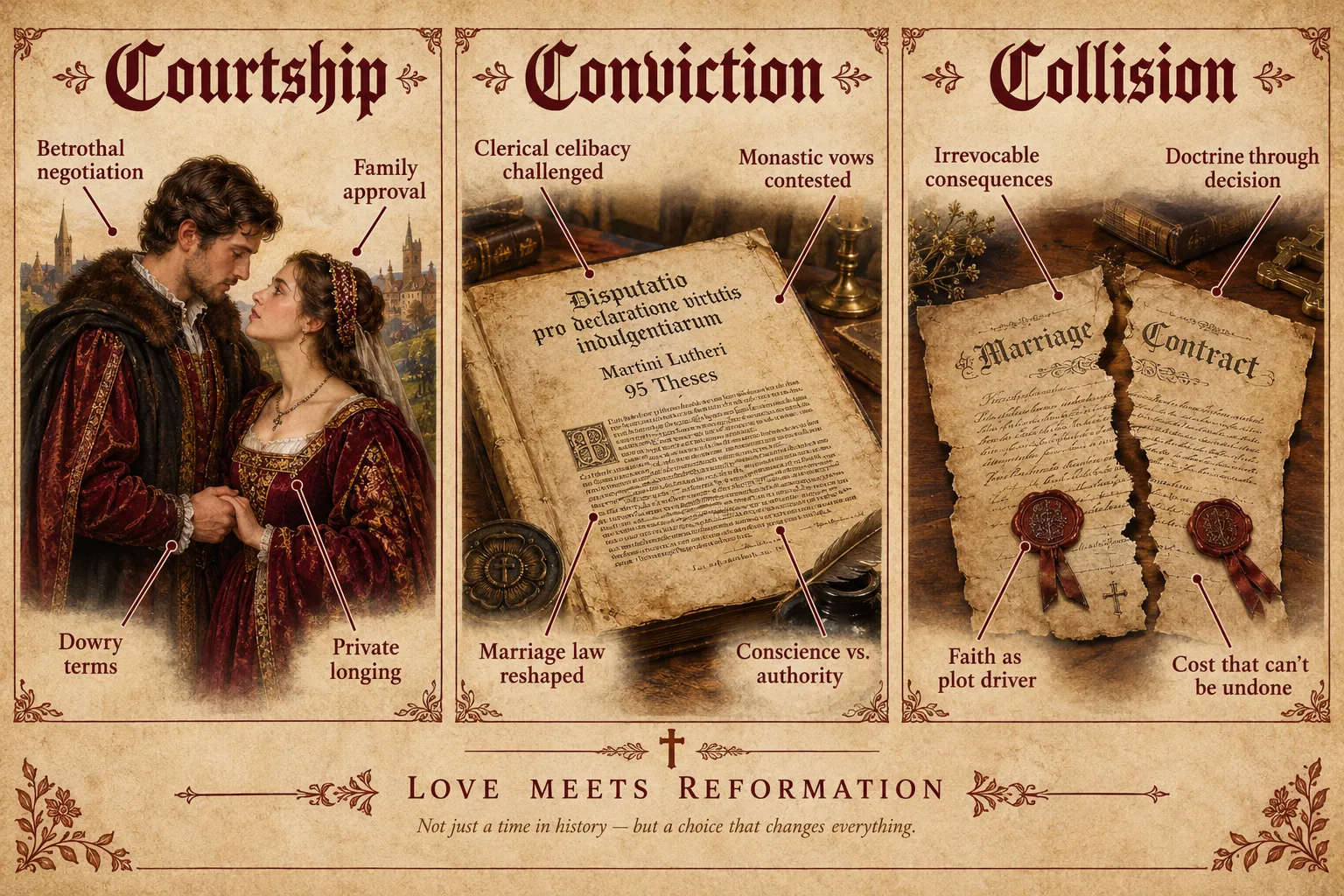
The Reformation reshaped who was allowed to marry whom, and that single legal fact generates most of the genre’s plots. Clerical celibacy, monastic vows, dowry law, and parental consent all became contested ground, which means a courtship in 1525 could be a theological argument with two people inside it.
Concrete pressures authors can use:
- Vow-breaking as plot, not backstory. A nun leaving a convent or a priest marrying wasn’t a private choice; it carried the risk of arrest.
- Books as contraband. A vernacular Bible or a smuggled pamphlet makes a fine love token and a fine piece of evidence.
- Family rupture. A reforming son and a Catholic father aren’t having a debate, they’re dividing an inheritance.
- Geography as fate. Crossing from one prince’s territory to another could change whether your marriage was legal.
In Luther and Katharina, Katharina von Bora’s movement from convent life toward marriage is tied directly to Luther’s challenge to clerical celibacy and his positive account of vocation and family [Historical Novel Society]. The romance isn’t happening near the theology. It is the theology, worked out in one household.
The question driving a good Reformation romance isn’t “will they marry?” It’s “what will they lose if they do?”
Christian Historical Romance vs. Secular Historical Romance: What Are the Differences?
The practical differences are content boundaries and the function of faith. Secular historical romance may include religion as period color; Christian historical romance makes conviction a plot driver and keeps heat levels clean.
| Element | Christian historical romance | Secular historical romance |
|---|---|---|
| Physical intimacy | Closed-door or absent | Varies widely, often explicit |
| Faith’s role | Drives decisions and consequences | Usually atmospheric |
| Moral resolution | Repentance, forgiveness, restored relationship | Personal fulfillment, autonomy |
| Antagonist logic | Often institutional pressure or self-deception | Often a rival or social obstacle |
| Audience expectation | Spiritual formation alongside romance | Emotional and sensual satisfaction |
Industry coverage notes that Christian fiction’s appeal has rested substantially on readers seeking stories free of graphic content while still offering real emotional weight [2][9]. More recent reporting shows the category has grown less tidy, with publishers willing to take on messier subject matter without abandoning the content contract [1].
If you want a modern parallel in a different era, the same braiding shows up in frontier love stories with real danger and real faith, different century, same structural logic.
Reformation-Era Courtship Customs and How They Appear in Romance Novels
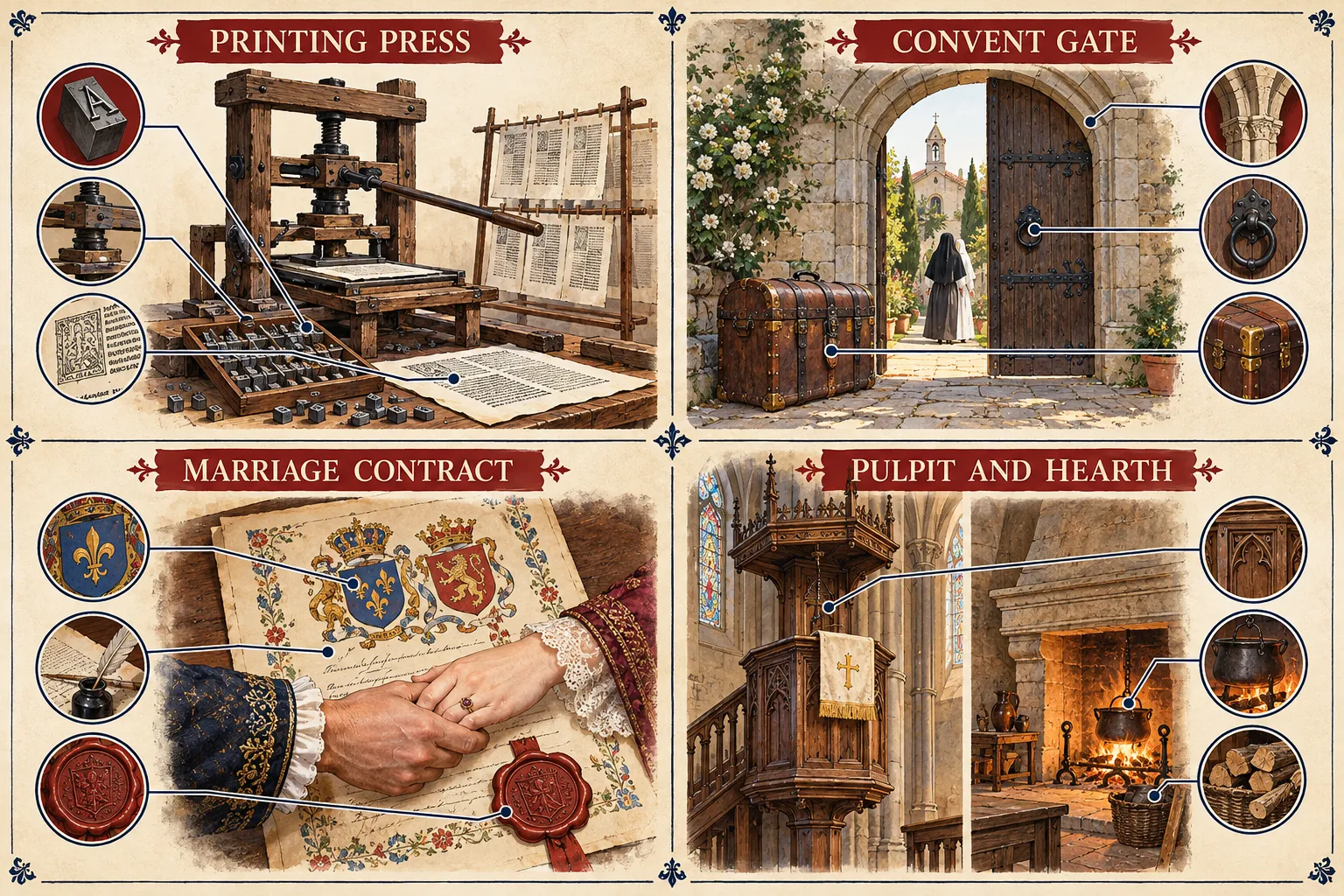
Sixteenth-century courtship was family business, not private negotiation, and the best novels treat that as a constraint rather than an inconvenience to be waved away. Betrothal often carried near-marital legal weight, dowries required negotiation, and banns were read publicly.
What appears most often on the page:
- Negotiated betrothal, a contract the couple may or may not have shaped.
- Chaperonage and the stolen interval, a few unobserved minutes carry enormous charge.
- Letters, literacy becomes intimacy, and letters become evidence.
- Public banns, a three-week window where any objector can speak.
- The household as destination, reformers elevated marriage and domestic vocation, so a shared kitchen table reads as theological victory.
Common mistake: writing a modern dating arc in period costume. If a heroine simply decides whom to marry with no family, pastor, or magistrate in the way, the setting has become wallpaper.
Best Christian Historical Romance Books Set During the Reformation
The most durable and widely available title is Jody Hedlund’s Luther and Katharina: A Novel of Love and Rebellion, a Christy Award winner about Martin Luther and Katharina von Bora, still listed by major Christian retailers. For readers wanting more theological depth, Amy Mantravadi’s Reformation novels have been praised for making doctrinal conflict accessible by routing it through personal relationships, fear, grief, temptation, and hope [The Living Church].
Honest context on the current market: searches across August, October 2026 release roundups turned up no clearly documented major Reformation-specific Christian romance launch. Recent listings lean toward the American West, Rome, Australia, and twentieth-century America, for example, September 2026 roundups highlighted Tamera Alexander’s In These Hills. Tracie Peterson’s A Life So True (Bethany House, July 7, 2026) and Jamie Ogle’s Daughter of the Rebellion (Tyndale Fiction, May 12, 2026) show the historical category is active, just not Reformation-focused at the moment.
Treat retail search results as discovery evidence, not proof of market size. No audited sales dataset for Reformation-specific Christian romance was available at the time of writing.
Christian Romance Books Where Faith Is Central to the Plot
Faith is central when removing it collapses the story. Test it this way: if the heroine could make the same choice as an atheist with the same social pressures, faith is decoration.
Signals that belief is genuinely load-bearing:
- The protagonist’s conscience creates the central obstacle, not an external villain.
- Prayer or Scripture appears as struggle, not as a reassuring interlude.
- The cost arrives before the grace, and it doesn’t get refunded.
- Doubt is allowed to stay unresolved for long stretches.
This is the same principle at work in psychological thrillers that use faith as the engine of suspense rather than an afterthought. Genre changes; the load-bearing test doesn’t.
Common Themes in Reformation Period Historical Fiction
Reformation fiction returns to a handful of pressures again and again: conscience against authority, literacy against gatekeeping, and the family divided by belief.
- Conscience vs. institution. Someone must decide what a sworn obedience is actually worth.
- The record and its keeper. Who controls the written account, indulgence receipts, vow registers, trial transcripts, and what happens when it’s wrong.
- Vocation. Reformers argued that ordinary work and marriage were holy callings, a radical idea with direct romantic application.
- Exile and hospitality. Refugees arrive; someone decides whether to open the door.
- Mercy and justice in tension, where the lawful answer and the right answer part ways.
How Do Authors Balance Religious Conviction With Romance in Historical Novels?
Dramatize the doctrine through a decision a character cannot take back, and let the romance absorb the consequence. The failure mode is a debate scene; the success mode is a scene where two people who love each other want different things because of what they believe.
A workable method:
- Give each lead a sincere position with real reasons, including the one you disagree with.
- Attach a cost to each position, property, family, safety, standing.
- Force a choice on the page rather than reporting it afterward.
- Let the cost land. Grace that arrives before the bill reads as cheap.
- Keep period vocabulary in dialogue and your argument in the plot.
Tracie Peterson has described research and firsthand historical accounts as central to her method, tying historical detail directly to emotionally credible fiction [Bookish Flights, 2026]. The research isn’t ornamental; it supplies the specific pressures that make a choice hurt.
The major craft risk: keeping the upheaval off-stage. The Historical Novel Society praised the romance in Luther and Katharina while noting that much of the larger political and religious turmoil was conveyed through dialogue rather than dramatized action. If your riot, your trial, or your burning happens in a reported conversation, the reader is being told the era was dangerous instead of feeling it.
How Historically Accurate Are Christian Historical Romance Novels?
Accuracy varies by author, and the range is wide. The strongest titles cite primary sources, keep real figures in their documented positions, and invent only in the gaps; weaker ones use the period as costume.
Quick reliability checks before committing:
- Does the author’s note name specific sources?
- Are real people’s documented views represented fairly, including opponents?
- Does material culture hold up, currency, travel times, food, clothing?
- Is the theology period-appropriate, not a modern position in a ruff?
A 2025 overview of Christian historical novels identifies authenticity, factual accuracy, and awareness of the author’s theological perspective as important reader-selection criteria [The Witness]. Reader reviews in this category tend to punish anachronism harder than in most romance subgenres.
Do I Need to Know Reformation History to Read These Books?
No. Competent Reformation romance supplies what you need inside the story, usually through a character who also has to figure it out. Knowing the broad shape, a monk challenged the church, Europe split, marriage law changed, is plenty.
If you want a gentle entry point, start with a novel built around one household rather than one shaped by a war or a council. Domestic scale teaches the stakes without requiring a timeline.
Christian Romance Books With Strong Female Characters During the Reformation
The era produced women whose circumstances forced agency: Katharina von Bora negotiated her own marriage terms after leaving a convent, Argula von Grumbach published theological defenses, and Marguerite de Navarre sheltered reformers. Fiction drawing on this material tends to produce heroines with actual leverage.
What “strong” means here isn’t swordplay. It’s a woman who:
- Holds a position she can defend and pays for holding it.
- Carries practical authority, a household, a press, a purse, a safe house.
- Is permitted to be wrong and to change her mind.
Readers who like capable heroines under institutional pressure often also enjoy Christian western romance with a female marshal, where authority and vulnerability sit together.
Where to Find Christian Historical Romance That Isn’t Preachy
Look for books that let characters be wrong for a long time. Preachiness usually shows up as a character who voices the author’s conclusion early and is never seriously challenged.
Practical filters:
- Sample the first ten pages. If a sermon lands before the problem does, move on.
- Check reviews for “message” complaints, readers flag it reliably.
- Prefer novels where the antagonist has a real argument.
- Watch for a conversion scene used as a plot solution. That’s the tell.
Kindle Unlimited makes this low-risk; browse the Kindle Unlimited Christian fiction archive or the non-preachy Christian novels collection and return anything that lectures. The standard worth holding: fiction that walks with readers rather than talking at them.
Christian Historical Romance Recommendations for Beginners
Start with a single-household story in a familiar language setting, then widen. A reasonable four-step path:
- Begin with Luther and Katharina for the canonical Reformation romance and a real historical couple.
- Add Mantravadi if you want theology handled with more weight.
- Branch to adjacent eras, Tudor England, the Huguenot diaspora, to see how the same pressures translate.
- Cross into other faith-forward historical subgenres such as Christian historical romance with suspense elements and clean danger once you know what pacing you prefer.
Decision rule: if you mostly read for the couple, choose domestic-scale Reformation novels. If you read for history, choose war-and-council-scale ones and accept a slower romance.
Frequently Asked Questions
Is Reformation romance a large subgenre? No. It’s a small niche within Christian historical romance, which itself sits inside a historical category that publishers continue to support [4]. Most recent releases favor Western, Tudor, or twentieth-century settings.
Are these books suitable for teen readers? Generally yes for the romance content, which is closed-door. Reformation plots can include executions, imprisonment, and religious violence, usually handled without graphic detail.
Do Reformation romances take a denominational side? The strong ones represent opposing convictions as sincerely held and let consequences do the arguing. If a novel reads as a brief for one confession, that’s a signal it’s closer to apologetics than fiction.
What’s the difference between Reformation fiction and Tudor fiction? Overlapping but distinct. Tudor fiction centers the English court and dynasty; Reformation fiction centers religious change across Europe. A Tudor novel about Cranmer is both.
Can a Reformation romance work without real historical figures? Yes, and often better. Invented characters can take risks and die in ways documented figures can’t, which frees the plot.
Why do so few new Reformation romances release each year? Research load is heavy, and the theological landscape is contested enough that publishers tread carefully. Current roundups show the market leaning toward settings with lighter research demands.
Is Christian historical romance mostly read by women? Historically yes. Commentary on the category has noted that Christian fiction publishing has struggled to retain male readers, with romance-forward lines a frequent factor [3].
Where does the romance usually end? Marriage, almost always, with the wedding functioning as the theological claim, that ordinary domestic life is a calling, not a concession.
Conclusion
Reformation romance works when a love story and a conviction are forced into the same room and only one can walk out unchanged. The research supplies the pressure, the courtship customs supply the friction, and the doctrine supplies the cost, but none of it should arrive as explanation. It should arrive as a choice someone makes at a specific door on a specific afternoon, and then has to live inside.
Next steps:
- Start with Luther and Katharina to see the subgenre’s central collision done well.
- Note which parts of the upheaval stay off-stage, and seek books that dramatize them.
- If you’re writing in the period, pick one legal constraint, vows, dowry, banns, territorial law, and build the whole conflict on it.
- Keep a short list of titles where the antagonist’s argument is honest. Those are the ones that last.
Grace is worth more on the page when someone has already paid for it.
References
[1] Christian Fiction Finally Has Issues Messy Clean – https://www.christianitytoday.com/2023/12/christian-fiction-finally-has-issues-messy-clean/ [2] 73661 Christian Fiction Keeps Its Allure – https://www.publishersweekly.com/pw/by-topic/industry-news/religion/article/73661-christian-fiction-keeps-its-allure.html [3] Five Reasons Why Christian Fiction Publishers Have Lost Male Readers Pt 1 – https://www.mikeduran.com/2019/12/02/five-reasons-why-christian-fiction-publishers-have-lost-male-readers-pt-1/ [4] 91841 Publishers Remain Faithful To Fiction – https://www.publishersweekly.com/pw/by-topic/industry-news/religion/article/91841-publishers-remain-faithful-to-fiction.html [9] Onward Christian Readers: Keeping the Faith With Clean Novels – https://www.voanews.com/a/onward-christian-readers-keeping-the-faith-with-clean-novels-self-help-books-/4705937.html