Last updated: September 18, 2026
Quick Answer: Christian historical romance and suspense set on the frontier combines 19th-century American settings with clean romantic tension, genuine physical danger, and faith that functions as a living part of the story, not a decorative afterthought. These books are written for readers who want love stories where the stakes are real, the faith is honest, and the content stays clean. They differ from secular historical romance primarily in how they handle intimacy, moral consequence, and the role of belief in character decision-making.
Key Takeaways
- Christian historical romance and suspense places faith at the center of plot and character, not just in a character’s background or church attendance.
- Frontier settings, land disputes, false warrants, railroad towns, territorial law, create natural suspense without requiring graphic violence.
- Clean content means no explicit sexual scenes, no profanity, and no gratuitous gore; romantic tension is built through emotional proximity and moral stakes.
- Most Christian frontier romance ebooks are available on Kindle Unlimited, making them accessible at low cost for subscribers.
- The genre has grown steadily through 2025-2026, with romantic suspense identified as one of the fastest-expanding segments in Christian fiction [8][10].
- Common tropes include the reluctant lawman, the widow defending her land, the circuit preacher caught between mercy and justice, and the stranger who carries a secret.
- Authors like Lynette Eason have helped establish Christian romantic suspense as a commercially serious genre, not a niche afterthought.
- Faith in these stories shows up through character choice under pressure, not through sermon-like passages or convenient conversion moments.
- Readers are primarily women ages 35-65 who subscribe to Kindle Unlimited and want emotionally satisfying stories that reflect their values.
- The best frontier Christian romance series build across multiple books, deepening both the romantic arc and the faith questions.
What Is Christian Historical Romance Fiction?
Christian historical romance fiction is a genre that sets love stories in past eras, most commonly the 19th-century American frontier, while treating faith as a structural element of the narrative, not a surface label. The characters’ beliefs shape their choices, their conflicts, and the cost they pay for doing the right thing.
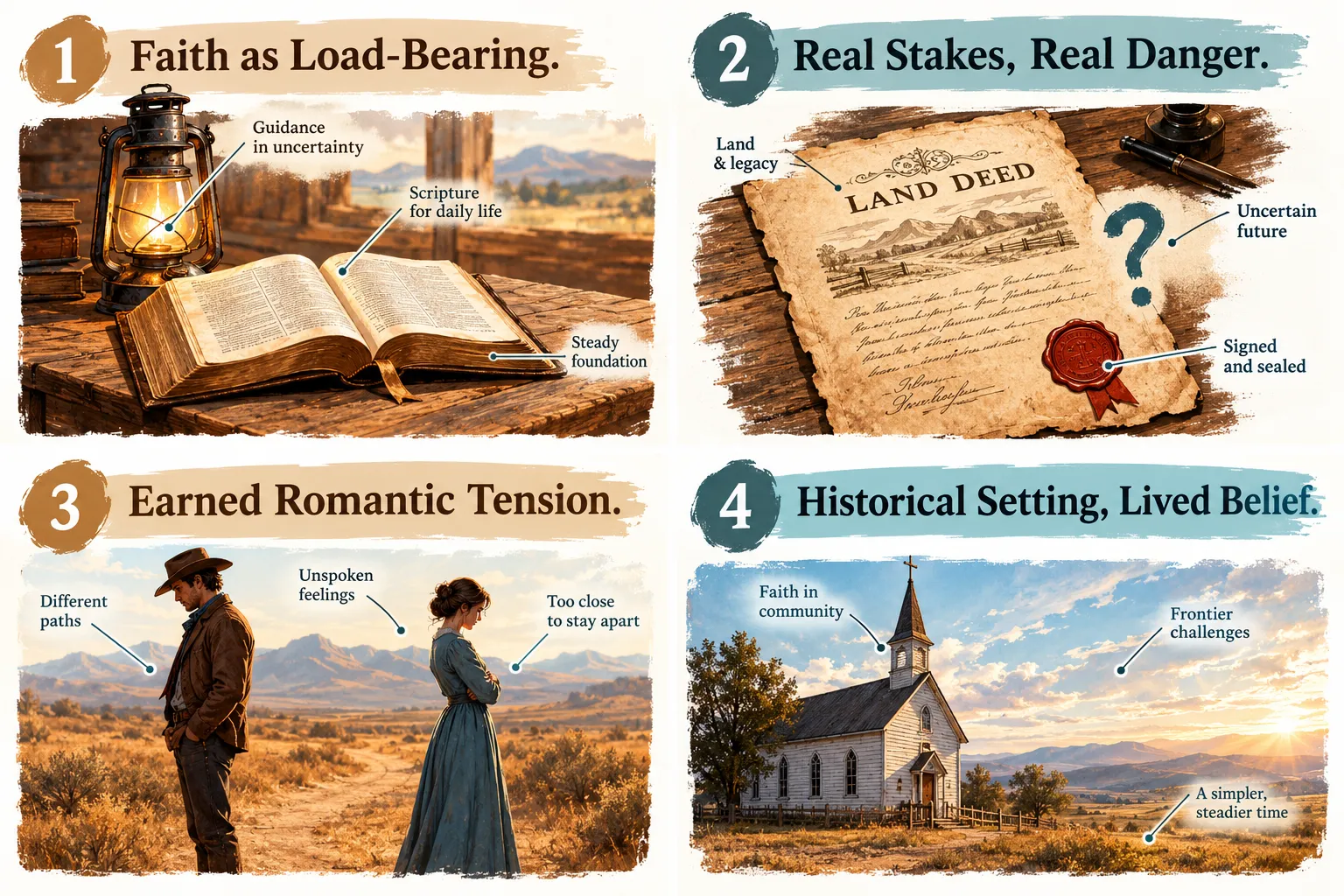
This is not the same as a romance novel that happens to mention church. In genuine Christian historical romance and suspense, the faith question is load-bearing: a character’s decision to tell the truth, protect a stranger, or refuse a corrupt bargain flows directly from what they believe about God, mercy, and accountability. That distinction is what separates the genre from inspirational fiction that uses faith as mood rather than motive.
The historical setting matters because the 19th-century frontier was genuinely dangerous. Land fraud, false legal instruments, territorial corruption, and physical isolation created conditions where moral choices had immediate, serious consequences. That historical reality gives Christian frontier love stories their suspense backbone, and makes the faith element feel earned rather than imported.
Christian Historical Romance vs. Secular Romance: Key Differences
The core difference is content and moral framework, not quality or emotional depth. Christian historical romance and suspense holds to clean content standards, no explicit sexual scenes, no graphic violence, and no profanity, while secular historical romance often includes all three.
Beyond content, the structural difference is in how moral consequence works. In secular romance, a character’s choices might carry emotional weight but rarely answer to a higher moral order. In Christian historical romance, the question “what does God require of me here?” is often the engine of the plot. A marshal who holds a false warrant isn’t just facing a legal dilemma, he’s facing a test of what obedience actually costs. That moral architecture gives the genre its distinctive tension.
Quick comparison:
| Element | Christian Historical Romance | Secular Historical Romance |
|---|---|---|
| Sexual content | None (closed-door or fade-to-black) | Often explicit |
| Profanity | Absent | Common |
| Faith role | Load-bearing, structural | Absent or decorative |
| Moral stakes | Tied to belief and conscience | Tied to social/personal consequence |
| Violence | Present but not graphic | Often graphic |
| Romantic tension | Built through emotional proximity | Built through physical proximity |
For a deeper look at how these content standards play out across genres, see Christian suspense romance: balancing tension, intimacy, and faith without crossing into explicit content.
Christian Frontier Love Stories With Action and Danger
The frontier is one of the most naturally suspenseful settings available to Christian historical romance writers, and the best books in this space use that setting honestly. Danger on the 19th-century frontier wasn’t manufactured, it was structural.
What creates genuine danger in frontier Christian romance:
- Land fraud and false legal instruments, a forged deed or a falsified warrant could strip a family of everything overnight
- Territorial corruption, law enforcement answerable to railroad companies or land speculators rather than justice
- Physical isolation, no quick rescue, no telegraph, no backup
- Weather and natural disaster, flood, fire, drought as genuine plot forces
- Outlaws and vigilante justice, the line between lawman and criminal was often thinner than the badge suggested
These dangers are not decorative. They force characters into choices that reveal what they actually believe. A woman defending her late husband’s land claim against a corrupt land agent isn’t just fighting for property, she’s fighting for the truth of a record, and her faith either holds or it doesn’t under that pressure.
This is the territory Silas Bellhaven’s The Mercy Line series occupies: a frontier western where law runs out and a man finds what he answers to. Books like The False Warrant and The Orchard Claim put characters in exactly these positions, where the legal record and the moral record are two different things, and someone has to decide which one they’ll stand behind.
For more on how faith functions in frontier settings without becoming preachy, see quiet miracles on the frontier: integrating subtle supernatural elements in Christian westerns.
Common Tropes in Christian Frontier Romance
Christian historical romance and suspense on the frontier has developed a recognizable set of character types and plot situations that readers return to because they work, they create the right conditions for both romantic tension and faith under fire.
The most reliable tropes:
- The reluctant lawman, a man with a violent past who carries a badge he’s not sure he deserves, trying to do justice without becoming what he once was
- The widow defending her land, a woman alone, holding a claim against men who assume she’ll fold, whose faith is the only thing steadier than her rifle
- The circuit preacher with a secret, a man of God whose past complicates his present ministry, whose sermons ring hollow until he settles what he’s been running from
- The stranger who knows too much, an outsider who arrives with information that threatens the town’s comfortable version of events
- The false record, a forged deed, a falsified warrant, a tampered ledger that someone has to correct at personal cost
- Forced proximity under danger, a storm, a pursuit, a siege that puts two people together long enough for trust to form
These tropes work in Christian frontier romance because they create natural conditions for earned grace, the moment where a character’s faith costs them something real before it gives them anything back. That’s the difference between a story that uses faith as comfort and one that takes it seriously.
Do Christian Romance Books Have Explicit Content?
No. Christian historical romance and suspense, by genre definition, does not include explicit sexual content. Romantic tension is built through emotional intimacy, moral proximity, and the slow development of trust, not through physical scenes.
The content standard across the genre is sometimes called “closed-door romance”: physical affection may be present (a hand held, a near-kiss, a moment of comfort), but sexual scenes either fade to black or don’t appear at all. This isn’t a limitation, it’s a structural choice that forces the romantic arc to be carried by character depth rather than physical escalation.
The same standard applies to violence (present but not graphic) and language (clean throughout). For readers who have been burned by books marketed as “clean” that weren’t, the best signal is the publisher or author’s track record and the genre label itself. Books shelved under Christian romance or inspirational romance hold to these standards consistently.
For a detailed breakdown of what “clean” actually means across different Christian fiction categories, see clean Christian fiction vs. inspirational romance: content standards, faith focus, and reader expectations.
Where to Find Christian Historical Romance Series and How Much They Cost
The primary marketplace for Christian historical romance ebooks in 2026 is Amazon, with most series available through Kindle Unlimited (KU). KU subscribers can read unlimited titles for a flat monthly fee, making it the most cost-effective way to binge a multi-book frontier romance series.
Typical pricing structure:
- Kindle Unlimited: Included in subscription (approximately $11.99/month in the US as of 2026)
- Kindle ebook purchase: $2.99,$6.99 per title for most indie and small-press Christian frontier romance
- Traditional publisher ebooks (e.g., Love Inspired Historical): $4.99,$7.99
- Print editions: $9.99,$14.99 for paperback
Monthly new release roundups from curators like Iola Goulton [7] and Sarah Hamaker [8][10] track Christian fiction releases including historical romance, making them useful for finding new series. Library curation also surfaces Christian historical fiction regularly, and many titles are available through Libby/OverDrive for library cardholders.
For readers building a KU reading list across Christian frontier fiction and other faith-based genres, see Kindle Unlimited Christian reads: how to build a clean, faith-filled TBR across mystery, western, fantasy, thriller, and LitRPG.
Who Reads Christian Historical Romance and Suspense?
The core audience for Christian historical romance and suspense is women between 35 and 65 who are active Christian fiction readers, primarily on Kindle or Kindle Unlimited. This is a well-documented, commercially significant audience, not a niche.
Reader profile:
- Active church-going or faith-practicing women who want fiction that reflects their values without being preachy
- Readers who have left secular romance because of explicit content but still want emotionally satisfying love stories
- Historical fiction readers who want the period detail and adventure of secular historicals without the content
- Suspense readers who want genuine tension but not graphic violence or horror
- KU subscribers who read multiple books per month and look for series they can binge
The genre’s growth in 2024-2026 has been driven partly by this audience’s migration to Kindle Unlimited, where series pricing rewards binge-reading behavior [8][10]. Podcast communities and Christian fiction blogs have also created discovery ecosystems that help readers find new series quickly.
Christian Romance With Real Conflict and Stakes: What Separates Good From Generic
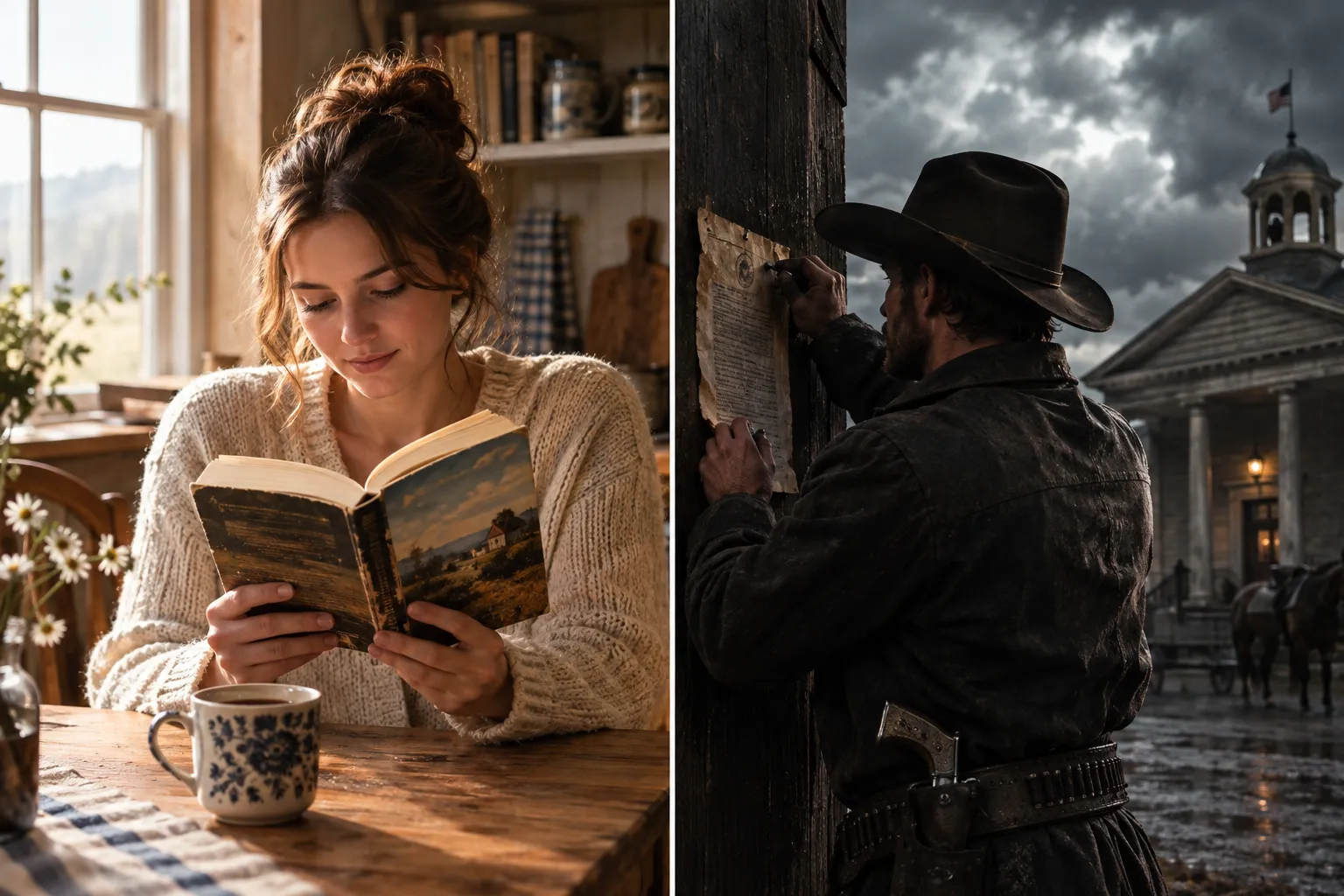
The difference between a memorable Christian frontier romance and a forgettable one is whether the faith element is load-bearing or decorative. Generic Christian romance uses faith as a character trait, the heroine prays before bed, the hero quotes a verse in a moment of comfort. Strong Christian historical romance and suspense uses faith as the engine of conflict.
Signs of real stakes in Christian frontier romance:
- A character’s faith costs them something specific: a legal claim, a relationship, a reputation
- The moral question doesn’t resolve cleanly, the right choice is hard and the wrong choice is tempting for understandable reasons
- Redemption, when it comes, arrives after the cost has been paid, not instead of it
- The romantic relationship is tested by the same moral pressure that tests the faith, love and conscience are not separate tracks
This is what the best authors in the genre understand: hope in the dark is only meaningful if the dark is real. A story where the danger is mild and the faith question is easy isn’t a faith story, it’s a faith-flavored comfort read. Both have their place, but readers who want genuine Christian historical suspense romance know the difference.
For more on building protagonists whose faith is tested rather than performed, see faith-rooted character development in Christian fiction: authentic spiritual arcs without sermonizing.
Best Authors of Christian Historical Suspense Romance
Several authors have shaped what Christian historical romance and suspense looks like in 2026, both in traditional publishing and the indie/KU space.
Established voices:
- Lynette Eason, arguably the most prominent name in Christian romantic suspense, with a catalog spanning contemporary and historical settings. Her work helped establish the genre’s commercial credibility.
- Tracie Peterson, prolific in Christian historical romance, particularly frontier and prairie settings, with a long track record at traditional publishers.
- Karen Witemeyer, known for humor and warmth in Christian frontier romance, with strong romantic tension and period-accurate settings.
- Mary Connealy, western-set Christian romance with action and comedy, consistently popular in the KU space.
Indie and KU-native voices:
The 2024-2026 period has seen significant growth in indie Christian historical romance, particularly in the KU ecosystem. New releases tracked by Christian fiction curators show consistent monthly output in the frontier romance category [7][10]. Silas Bellhaven’s The Mercy Line series represents a frontier western approach that prioritizes conscience and moral stakes over romance (it maintains a romance-absent content contract), but sits in the same thematic territory as frontier romance for readers drawn to the setting and the faith questions.
How to Write Christian Historical Romance With Authenticity
Writing Christian historical romance and suspense that feels honest rather than formulaic requires getting three things right: the historical setting, the faith element, and the romantic tension. Failing any one of them produces a book that feels either preachy, anachronistic, or emotionally flat.
Practical principles:
Research the danger specifically. Frontier peril is most convincing when it’s rooted in actual historical mechanisms, land law, territorial governance, railroad contracts, weather patterns. Generic “outlaws” are less frightening than a corrupt land agent with a forged deed and a judge in his pocket.
Let faith show through choice, not narration. A character who prays and then acts in contradiction to that prayer is more interesting, and more honest, than one whose faith produces immediate, tidy results. Show the gap between belief and behavior, and let the story close it slowly.
Earn the romantic arc. In frontier settings, trust is a survival resource. Two characters who fall in love because they’ve had to depend on each other under genuine pressure feel more real than two characters who fall in love because they’re both attractive and kind.
Avoid the sermon. If a character’s faith can be summarized in a speech they give another character, it’s probably a sermon. Faith in fiction works best when it’s expressed through what a character does when no one is watching, or when everyone is watching and the cost is high.
Let grace cost something. Earned grace is the phrase that separates Christian fiction with real stakes from Christian fiction that uses faith as a shortcut. Redemption that arrives before the character has paid anything is cheap. Redemption that comes after the cost has been paid, and that doesn’t erase the cost, is the kind that stays with readers.
For writers working across Christian fiction genres, see faith in fiction across genres: how much is too much, balancing spiritual themes with story in Christian mystery, western, fantasy, and LitRPG.
FAQ
What makes a romance “Christian historical romance” rather than just historical romance? The faith element is structural, not decorative. Christian historical romance treats belief as a driver of character choice and moral conflict, holds to clean content standards, and frames the romantic arc within a moral universe where God’s presence is real and consequential.
Are Christian frontier romance books appropriate for teens? Most are. The clean content standard (no explicit content, no graphic violence, no profanity) makes Christian historical romance appropriate for older teens and adults. Individual books vary, check the publisher’s content notes or reader reviews for specifics.
Is Christian historical romance the same as inspirational romance? They overlap significantly. “Inspirational romance” is the broader industry term used by traditional publishers (including Harlequin’s Love Inspired line). “Christian romance” is more specific about the faith tradition. Most Christian historical romance would also qualify as inspirational, but not all inspirational romance is explicitly Christian.
Do Christian frontier romance books have to be set in America? No, though the American West is the dominant setting. Christian historical romance is also set in the British Isles, colonial Africa, Australia, and other frontier or pioneer contexts. The setting matters less than the combination of historical danger and faith-driven character.
How long are most Christian frontier romance series? Standalone novels and two-to-four book series are most common in traditional publishing. In the KU/indie space, longer series (six to twelve books) are more common because the subscription model rewards series depth. Readers who like to binge will find more options in the indie market.
What’s the difference between Christian romantic suspense and Christian historical romance? Setting and time period. Christian romantic suspense is typically contemporary, a detective, a witness, a threat in the present day. Christian historical romance is set in the past. Some series blend both by setting suspense plots in historical periods; these are sometimes called Christian historical suspense romance.
Can men enjoy Christian frontier romance? The primary audience is women, but men who enjoy frontier westerns with moral stakes often find the genre satisfying, particularly series that weight the suspense and faith elements more heavily than the romantic arc. Silas Bellhaven’s The Mercy Line is an example of frontier Christian fiction written specifically for male readers, with no romance and a focus on conscience and justice.
Where do I start if I’ve never read Christian historical romance? Start with a standalone or a series opener. Authors like Karen Witemeyer and Mary Connealy offer accessible entry points with strong romantic arcs. For frontier suspense with heavier moral stakes, The False Warrant from The Mercy Line is a strong starting point for the western side of the genre.
How is faith handled in these books, does it feel preachy? In the best examples, no. Faith shows up through what characters choose to do when the cost is real, not through speeches or scripture-dropping. The genre has a preachy reputation in some circles, but that reputation comes from weaker entries, not the genre as a whole.
Are these books available in print or only ebook? Both. Traditional publishers release print editions alongside ebooks. Many indie authors offer print-on-demand paperbacks through Amazon KDP. Ebook and KU access is more common for indie titles; print is more reliably available for traditionally published series.
Conclusion
Christian historical romance and suspense, frontier love stories with real danger and real faith, occupies a specific and valuable space in Christian fiction. It takes the emotional core of romance (two people learning to trust each other), puts it inside a genuinely dangerous historical world, and asks what faith looks like when the stakes are actual rather than theoretical.
The genre is not for readers who want faith as comfort without cost. It’s for readers who want to watch a character’s belief get tested by a corrupt land agent, a false warrant, a storm, or a secret, and come out the other side not because the danger was easy, but because the faith held.
Next steps for readers:
- Browse the Christian Western Fiction Kindle Unlimited series worth binge-reading for curated series recommendations
- Explore The Mercy Line series page for frontier Christian fiction rooted in conscience and justice
- Check monthly new release roundups at curators like Iola Goulton [7] and Sarah Hamaker [8] to stay current on the genre
- For writers: revisit the principles in the writing section above, and read widely in the genre before writing in it, the best Christian frontier romance is more specific, more historically grounded, and more honest about faith than the genre’s reputation suggests
The frontier was a hard place. The best stories set there don’t pretend otherwise, and that’s exactly why the faith in them means something.
References
[1] New Releases April 2024 – https://www.iolagoulton.com/new-releases-april-2024/ [2] Christian Fiction New Releases March 2025 – https://www.narelleatkins.com/christian-fiction-new-releases-march-2025/ [3] New Releases Jun 2024 – https://www.iolagoulton.com/new-releases-jun-2024/ [4] New Releases In Christian Fiction November 2024 – https://janetsketchley.ca/new-releases-in-christian-fiction-november-2024/ [5] New Releases July 2024 – https://www.iolagoulton.com/new-releases-july-2024/ [6] Freed By Frontier Spotlight Giveaway – https://www.amoderndayfairytale.net/2026/07/freed-by-frontier-spotlight-giveaway.html [7] New Releases 2 – https://www.iolagoulton.com/new-releases-2/ [8] December 2024 New Releases In Christian Fiction – https://sarahhamakerfiction.com/2024/12/10/december-2024-new-releases-in-christian-fiction/ [9] Top Rated Fiction – https://www.christianbook.com/page/top-rated/top-rated-fiction [10] October 2024 New Releases In Christian Fiction – https://sarahhamakerfiction.com/2024/10/08/october-2024-new-releases-in-christian-fiction/