Last updated: October 19, 2026
Quick Answer
Christian fiction set in a church community generates conflict because a congregation is a closed system where people are obligated to each other. Worship, service rosters, and local ties force characters who distrust one another into the same room every week, which is why a church setting produces mysteries, grief, buried resentment, and reconciliation without any external villain. The genre’s strength is that it turns ordinary commitments, a casserole, a committee vote, a prayer list, into pressure a character cannot simply walk away from.
Key Takeaways
- A church community works as a story engine because membership is voluntary but hard to leave, which traps characters inside conflicts they cannot escape.
- Worship scenes create tension when the ritual stays steady and the person inside it does not.
- Service, food pantries, flood relief, backpack drives, gives characters legitimate reasons to handle other people’s money, records, and secrets.
- The best church fiction asks what faithfulness looks like when the congregation itself is divided, not whether a character will convert.
- Christian fiction is not the same as inspirational romance; the first is defined by worldview, the second by a romance structure with faith elements.
- Dark themes are allowed and increasingly common, addiction, abuse, grief, and institutional failure all appear in current faith fiction.
- The most common failure is a sermon in dialogue form. Faith has to cost a character something on the page.
- Religious-press revenue rose 9.3% in 2025 to $2.2 billion, the strongest gain among major publishing segments, creating a favorable market for church-set stories.
What Is Christian Fiction and How Is It Different From Regular Fiction?
Christian fiction is fiction written from a Christian worldview, where belief is load-bearing rather than decorative. The difference from general fiction isn’t subject matter or content restrictions, it’s that God’s reality is treated as a fact of the story world, affecting what characters owe each other and what consequences mean.
That distinction matters more than the clean-content shorthand readers often use. A general-market novel can include a church, a funeral, or a believing character. A Christian novel assumes that prayer is addressed to someone, that guilt points at something real, and that mercy is not merely a psychological coping strategy. Plenty of these books contain no conversion scene at all.
Market signals support a broadening definition. Baker Publishing Group’s Haven imprint, announced for 2026, is built for general-market readers and offers a Christian viewpoint without requiring overt Christian themes. For church-community stories, that shift favors indirect conflict, belonging, forgiveness, institutional responsibility, over doctrinal debate.
Decision rule: If you removed the faith element and the plot still worked unchanged, it’s a novel with a church in it, not Christian fiction.
How Do Church Communities Create Conflict in Stories?
A congregation creates conflict because it combines three things fiction rarely gets to stack together: forced proximity, moral accountability, and shared property. People who have wronged each other still sit six feet apart on Sunday.
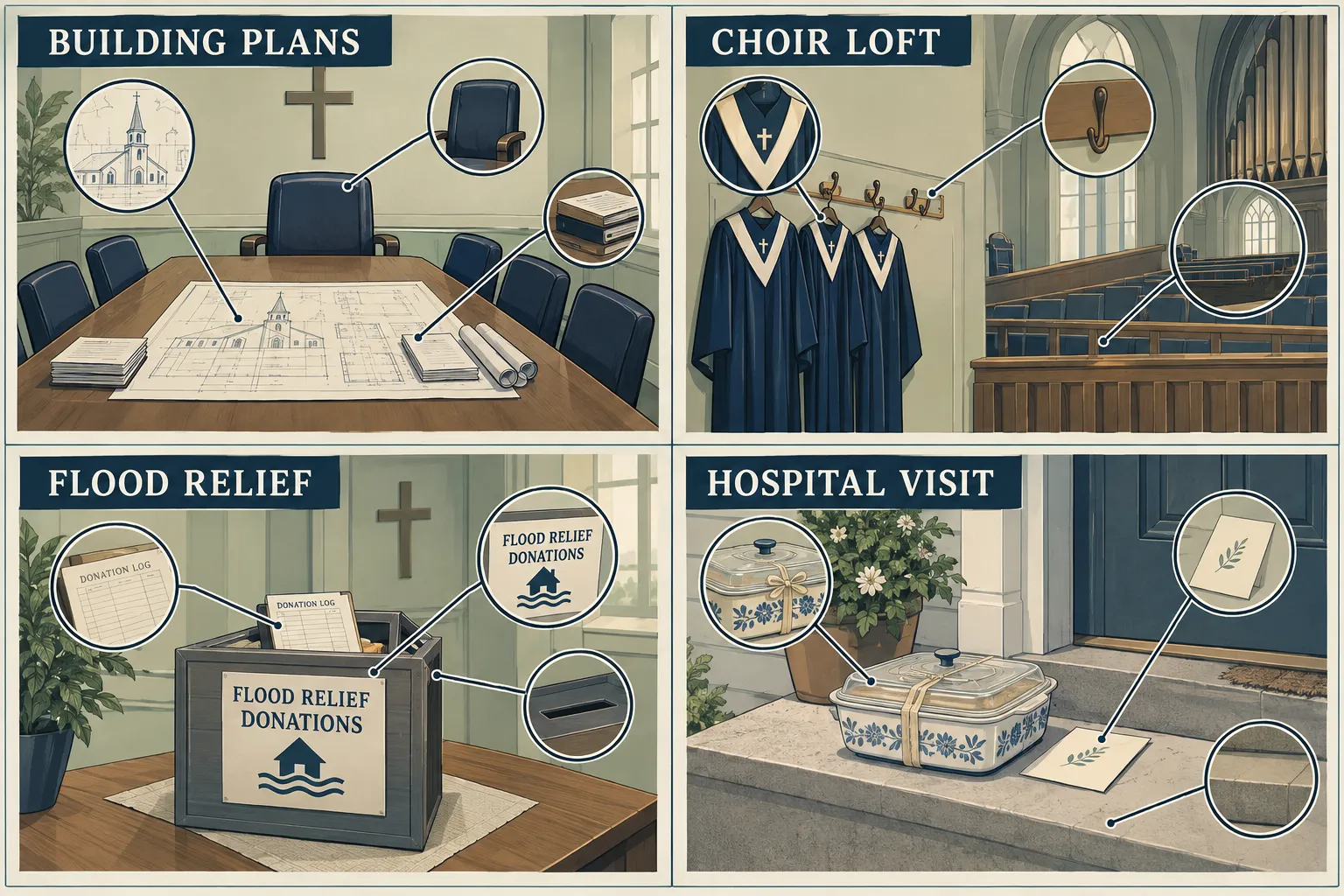
Here’s how the mechanism works in practice:
- Forced proximity. A character can avoid a neighbor. She cannot avoid the woman who runs the nursery rotation she signed up for in January.
- Public identity vs. private failure. The congregation presents itself as a caring body. The plot tests whether it actually notices who is drowning.
- Shared assets. Buildings, benevolence funds, cemetery plots, and donated goods all have paperwork, and paperwork has owners, histories, and errors.
- Authority without enforcement. A pastor or deacon board carries moral weight but no legal power, so disputes escalate sideways into gossip, resignation, and quiet sabotage.
- Generational layering. Families have been in the same pews for eighty years. Every current argument is sitting on top of an older one.
A church building can function at once as sacred space, contested property, family inheritance, and public institution. Recent releases lean into this directly, A Bookshop for Christmas by Heidi Chiavaroli centers on relatives converting a saved church into a community bookshop while old family resentment surfaces underneath the renovation.
A committee disagreement over a parking lot easement is not a small story. It is a story about who gets to decide what a community is for.
How Do Worship Scenes Work in Fiction Without Stalling the Plot?
Worship scenes work when the liturgy stays fixed and the character’s relationship to it changes. The ritual is the control variable; the character is the experiment.
Ways to make a service carry plot weight:
- Put information in the room. Someone who shouldn’t be there walks in during the offertory. A name is read off the prayer list that stops a character cold.
- Use the fixed order against the character. A woman who hasn’t spoken to her brother in four years has to pass him the communion plate.
- Let the music do the interior work. A hymn’s third verse says the exact thing the character has been refusing to admit, without a single line of explanatory narration.
- Keep it short. Three paragraphs of a service, placed at the right moment, outperform six pages of sermon transcript.
Common mistake: writing the sermon. Readers skim it. Write the congregation instead, who’s crying, who’s checking a phone, who left early.
The Mercy House Mysteries use this repeatedly. In The Hymnal Margin Murder, a penciled note in the margin of an old hymnal becomes evidence, which only works because the hymnal is an object a congregation handles weekly without ever really looking at.
Can Christian Fiction Have Dark Themes and Realistic Church Problems?
Yes. Current Christian fiction regularly handles trauma, addiction, abuse, mental illness, race, and broken families, and church-community novels are a natural place for those subjects because the congregation is often where the failure to help happened.
Christianity Today’s analysis of the genre describes exactly this shift toward messier lives, and Tyndale editor Stephanie Broene has argued that readers respond to stories reflecting hard real-life experience when compassion or hope is still on offer. The hope cannot be a shortcut, though. Grace that arrives before the cost reads as dishonest, and faithful readers notice.
Realistic church problems worth writing:
| Problem | Why it generates plot |
|---|---|
| Benevolence fund with no oversight | Money plus trust plus no audit trail |
| A beloved leader quietly protected | Forces every character to choose between loyalty and truth |
| Grief the congregation handles badly | Casseroles for two weeks, silence for two years |
| Building debt vs. mission spending | Splits the body along lines nobody wants named |
| A returning member with a history | Tests whether forgiveness is doctrine or practice |
The When the Prayer List Opens premise in The Gathering Light runs on this: a woman finds her own name on a retreat’s prayer list in the handwriting of someone who was supposed to be safe. The horror isn’t supernatural. It’s institutional.
How to Balance Faith Themes Without Being Preachy
Show faith through choice and consequence, never through a character explaining the theme. If a reader can identify the lesson before the character pays for it, the scene has failed.
Practical tests before you keep a faith beat:
- The cost test. Does believing this cause the character to lose something? If not, cut it.
- The disagreement test. Does any sympathetic character in the book hold a different view and keep their dignity?
- The silence test. Could this moment land with no dialogue at all, just an action?
- The Tuesday test. Does faith show up on an ordinary day, or only during crisis?
Scripture-dropping is the most frequent offender. One verse, recalled at the moment it actually hurts, outweighs twelve quoted to make a point. For a longer treatment of the mechanics, see this guide on keeping story first while exploring spiritual themes.
How to Write Believable Church Characters
Believable church characters have specific jobs, specific grudges, and specific reasons for being there. Stereotypes come from writing roles instead of people.

Start with these:
- Give everyone a function. Who counts the offering? Who unlocks the building? Who has a key they shouldn’t still have? Function creates access, and access creates suspects.
- Vary the faith. A congregation holds the devout, the doubting, the dutiful, the socially obligated, and the newly curious. Write at least four of those five.
- Avoid the two clichés. The hypocrite deacon and the saintly grandmother are both shortcuts. If the deacon is corrupt, give him one genuine act of sacrifice. If the grandmother is wise, let her be wrong about something that matters.
- Let the pastor be tired. Pastoral characters fail most often by being either a mouthpiece or a villain. The truer version is exhausted, underpaid, and holding twelve confidences he can’t discuss.
Edge case: small congregations. In a church of sixty, there is no anonymity and no replacement volunteer. Everyone’s absence is noticed, which raises the stakes on every choice.
Common Mistakes in Christian Fiction Writing
The recurring failures are structural, not stylistic. Most come from resolving the faith question too early or too cleanly.
- The clean conversion. A dramatic altar moment that fixes the character’s arc in one scene. Grace that costs nothing isn’t grace.
- The sermon in dialogue. Two characters agreeing at length about theology while the plot waits.
- Conflict with no teeth. Stakes limited to hurt feelings. Readers who want real jeopardy will leave.
- Content as marketing. Announcing that a book is clean rather than letting the prose demonstrate it.
- The church as backdrop. A sanctuary used for scenery while the actual plot happens elsewhere.
- Villain-as-unbeliever. Lazy, and it collapses the moral complexity that makes the genre worth reading.
- Grief resolved in a chapter. Real congregations handle death badly over long stretches. Use that.
Is Christian Fiction Only for Religious Readers, and Who Actually Reads It?
No. Christian fiction draws plenty of readers who want strong plot without graphic content, and church-set mysteries in particular attract general cozy readers. The genre’s core audience skews toward women aged roughly 35 to 65, many of them heavy Kindle Unlimited borrowers, but the edges are wider than the label suggests.
Reader motivations vary:
- Faith readers who want belief handled honestly instead of prettily
- Clean-content readers who care about the absence of explicit material more than theology
- Genre readers, cozy mystery, western, fantasy, thriller, following a setting or structure they already love
- Book club members; faith-based book clubs have grown as reading events expand [3]
Serialized and short-form faith fiction has also widened access for readers who prefer shorter commitments [5]. If you’re browsing by subgenre, this breakdown of Christian fiction subgenres ranked by reader engagement maps where church-set stories tend to land.
Christian Fiction vs. Inspirational Romance: What’s the Difference?
Christian fiction is defined by worldview; inspirational romance is defined by genre structure. Inspirational romance is a subset, it must deliver a central love story and an emotionally satisfying ending, with faith woven through. Christian fiction broadly has no romance requirement at all.
| Christian fiction | Inspirational romance | |
|---|---|---|
| Defining element | Faith as load-bearing worldview | Central romance plot with faith content |
| Required ending | Hope, not necessarily happy | HEA/HFN required |
| Romance | Optional, sometimes absent | Mandatory |
| Typical conflict | Moral, institutional, spiritual | Relational obstacles |
| Subgenre range | Mystery, western, fantasy, thriller, LitRPG | Primarily romance |
Choose inspirational romance if you want the relationship to be the plot. Choose broader Christian fiction if you want conflict driven by conscience, records, or community failure. Readers who specifically avoid romance plots can look at non-romance Christian fiction.
Best Christian Fiction Books Set in Churches and Where to Find Recommendations
Church-set Christian fiction clusters in cozy mystery, small-town drama, and holiday fiction. October 2026 releases included The Pastor’s Christmas Prayer by Mindy Obenhaus (a widowed youth pastor and an annual community event), A Bookshop for Christmas by Heidi Chiavaroli, and The Sisterhood of Unlikely Friends by Sara Brunsvold [6].
For congregation-as-crime-scene reading, the Mercy House Mysteries run on exactly this premise in Juniper Gap, Tennessee:
- A Donation to Die For, a mislabeled donation box, a ledger, and a deacon who died before he could confess
- The Flood Box Murder, flood-relief giving with more water damage than anyone can explain
- The Benediction Tape Murder, a recorded blessing holding an unfinished confession
Where to look for more:
- Goodreads lists, filtered carefully, this walkthrough covers finding clean reads and avoiding graphic content on Goodreads
- Kindle Unlimited category browsing by subgenre rather than by “Christian” alone
- Author-curated reading lists, such as this faith-focused list spanning cozy mystery, western, fantasy, and thriller
- Church and online book clubs, which increasingly drive discovery [3]
- The Christian cozy mystery reading guide for small-town clue structures specifically
What Makes a Good Christian Fiction Novel?
A good Christian novel earns its grace. The character pays, the community is implicated, and the resolution leaves something unrepaired.
Quality markers worth checking in the first fifty pages:
- The protagonist’s faith is tested by plot events, not discussed in conversation
- At least one sympathetic character doubts, and that doubt is taken seriously
- The church is a place with logistics, not a symbol
- Consequences persist past the chapter in which they occur
- The ending offers hope in the dark without pretending the dark wasn’t real
Industry conditions support this kind of ambition. Religious-press revenue climbed 9.3% in 2025 to $2.2 billion, and editors report growing appetite for mysteries, split-time structures, genre blending, and unconventional points of view [1][8]. A single congregation can hold a romance, a suspense plot, a social-problem story, and a historical thread without the setting straining.
FAQ
Does Christian fiction have to include a conversion scene? No. Many strong Christian novels follow believers through testing rather than unbelievers toward belief. The dramatic question is often “what does faithfulness cost here?” not “will this person convert?”
Can a church-set novel include murder? Yes, and the Christian cozy mystery category depends on it. The congregation supplies motive, access, and a closed suspect pool while keeping violence off the page.
What age group reads Christian fiction? The heaviest readership is adults, concentrated among women roughly 35 to 65, with significant overlap into Kindle Unlimited subscribers and church book clubs [3].
Is Christian fiction the same as clean fiction? No. All Christian fiction is typically clean, but clean fiction may have no faith content at all. Clean describes content limits; Christian describes worldview.
How do you avoid stereotyping a congregation? Give every church character a specific job, a specific grudge, and a specific reason for staying. Stereotypes appear when writers assign roles instead of motives.
Should worship scenes include full sermons? Rarely. A few lines of liturgy or one hymn verse placed at a turning point carries more weight than a transcribed message, and readers skim long sermons.
Can Christian fiction portray a corrupt church? Yes, and it’s increasingly common. The genre now handles institutional failure, cover-ups, and abuse, provided the story pursues truth rather than cynicism.
Where should a new reader start with church-community fiction? Begin with a cozy mystery series set in a single congregation. The recurring cast teaches the community’s logistics fast, which makes later conflicts land harder.
Conclusion
A church community is one of the few settings where a writer can put grief, money, authority, secrecy, and obligation in the same room on a recurring weekly schedule, and where characters can’t walk away without everyone noticing. That’s the whole engine. Worship holds the pattern, service hands people access to each other’s lives, and local ties ensure no one escapes the consequences of what they choose.
Next steps worth taking:
- Readers: pick one church-set series and read three books. The third is where the community’s real fault lines show.
- Writers: draft your congregation’s volunteer roster before your plot outline. Function creates access; access creates story.
- Both: audit one favorite faith novel against the cost test. Did grace arrive before or after the character paid?
The congregation that sings together on Sunday is the same one that will decide, on Thursday, whether to believe the person telling the truth. Write that Thursday.
References
[1] Christian Fiction 14 7 Yearly Surge Dramatic Market Expansion Data – https://www.firmenpresse.de/pressrelease734029/christian-fiction-14-7-yearly-surge-dramatic-market-expansion-data.html [3] ChristShare Highlights Faith-Based Book Clubs as Reading Events Grow – https://news.marketersmedia.com/christshare-highlights-faith-based-book-clubs-as-reading-events-grow/89191519 [5] ChristShare Highlights Growth of Serialized Christian Fiction Content – https://markets.financialcontent.com/worldnow.wgem/article/marketersmedia-2026-4-26-christshare-highlights-growth-of-serialized-christian-fiction-content [6] New Christian Fiction Releasing in October 2026 – https://louallenwriter.wordpress.com/2026/10/01/new-christian-fiction-releasing-in-october-2026/ [8] Top Selling Christian Fiction – https://www.accio.com/business/top-selling-christian-fiction