Last updated: October 1, 2026
Quick Answer
A Christian cozy mystery is a clue-driven whodunit set in a small, close community, solved by an amateur sleuth, with violence kept off the page and faith handled as lived experience rather than a lesson. This Christian Cozy Mystery Reading Guide: Small-Town Clues, Amateur Sleuths, and Gentle Justice covers what the subgenre is, which series to start with, how it differs from standard crime fiction, and where to find it. Most readers come for the comfort of a known town and stay for the puzzle, the murder matters, but so does who still sits in the pew next to whom afterward. Publishers Weekly reported in 2026 that Christian publishers are actively expanding their mystery lists, much of it modeled on classic Agatha Christie structure.
Key Takeaways
- Christian cozy mysteries are puzzle mysteries first. Clues, suspects, red herrings, motive, revelation, the faith element runs underneath the structure, not over it.
- The sleuth is almost always an amateur: a church volunteer, baker, quilter, librarian, or pastor’s wife who notices what professionals overlook.
- Violence happens off-page. You get the body and the consequences, not the gore.
- Series length matters more than in most genres. Many run 8-20 books, which is why readers binge them on Kindle Unlimited.
- Faith-centered mystery is a credible niche, not a proven boom. Agent Cynthia Ruchti has described publishers as cautiously “dipping their toes back into” the category.
- You don’t have to be religious to enjoy them, the appeal is community, fair-play puzzles, and a resolution that holds.
- Romance is usually minor or absent. Some series run a slow-burn thread; others, like The Mercy House Mysteries, keep the focus on community and conscience.
- Core readership skews women 35-65, but the content suits teens through grandparents.
What is a Christian cozy mystery book?
A Christian cozy mystery is a short-to-mid-length mystery novel in which an untrained sleuth solves a crime inside a tight community, while her faith shapes the choices she makes under pressure. The crime is real. The danger is real. What’s absent is explicit content: no graphic violence, no profanity, no bedroom scenes.
The distinguishing mark isn’t a Bible verse on page three. It’s that moral weight sits inside the plot. When a character has to choose between protecting a friend’s reputation and telling the truth about what’s in the ledger, that’s where faith shows up, in the cost of the decision, not in a speech about it.
What makes it specifically Christian:
- The community itself is often a congregation, ministry, or church-adjacent organization
- Mercy and justice pull against each other, and the sleuth has to hold both
- Forgiveness is offered, but it costs something; nobody gets a clean exit
- Prayer, doubt, and failure appear as ordinary parts of a character’s week
Decision rule: If you want faith as a theme worked out through consequence, look for Christian cozy mystery. If you want faith as explicit instruction, you’re looking for inspirational fiction with a didactic bent, a different reading experience. For more on where that line falls, see this breakdown of how much faith is too much in Christian genre fiction.
What’s the difference between a cozy mystery and a regular mystery novel?
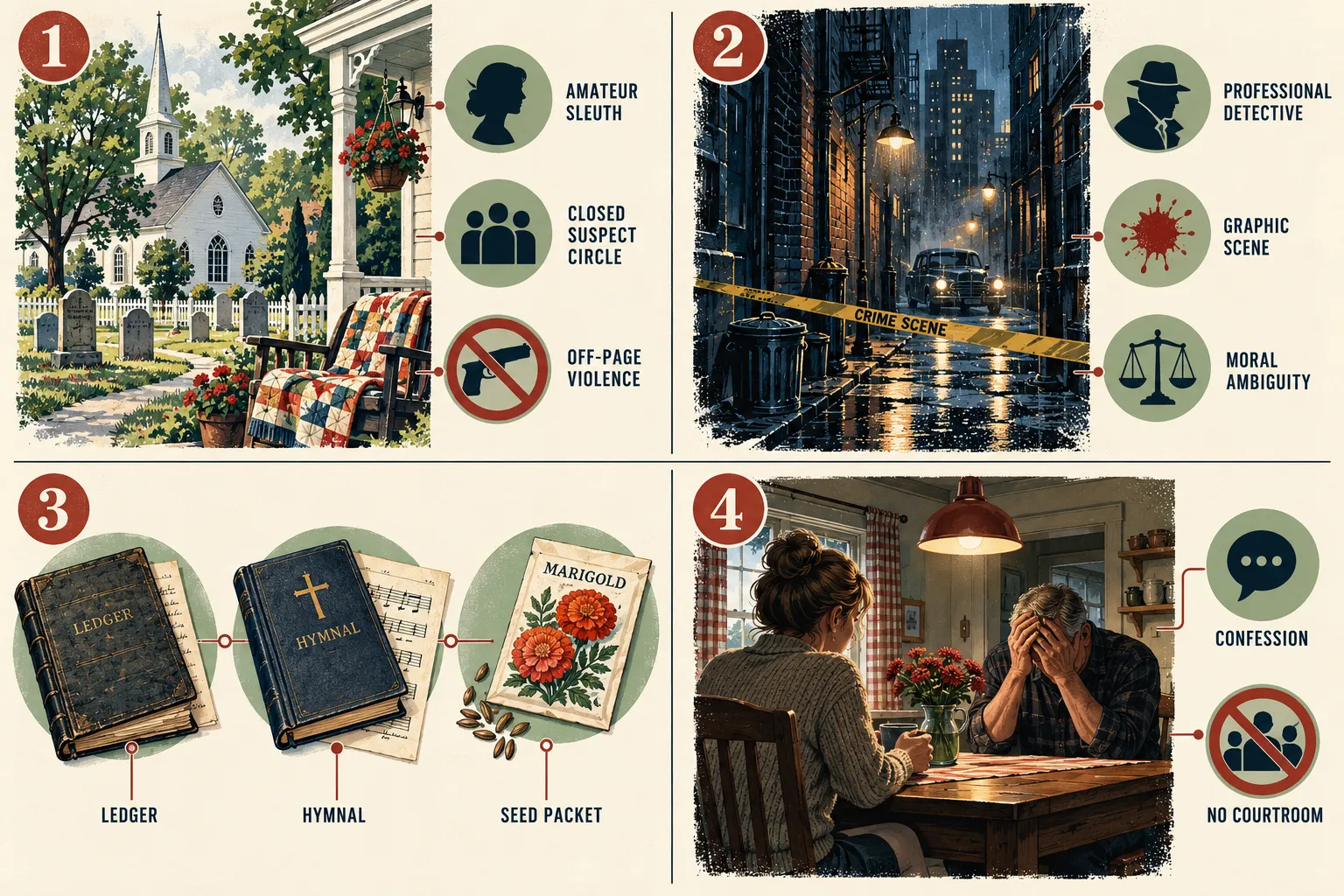
Cozy mysteries keep the puzzle and remove the brutality. A regular mystery or crime novel often features a professional investigator, on-page violence, procedural detail, and moral ambiguity; a cozy features an amateur, a closed circle of suspects, off-page violence, and a resolution that restores order to the community.
)
| Element | Cozy mystery | Standard crime / thriller |
|---|---|---|
| Sleuth | Amateur with a day job | Detective, agent, forensic pro |
| Setting | Small town, village, single institution | City, multi-jurisdiction |
| Violence | Off-page, discovered after | On-page, often detailed |
| Tone | Warm, humorous, community-focused | Tense, bleak, isolating |
| Length | 180-280 pages typically | 350-500 pages |
| Ending | Order restored, relationships intact | Order partially restored, cost lingers |
Common mistake: Assuming “cozy” means low stakes. The stakes are emotional and communal rather than apocalyptic. When the suspect is the woman who’s taught your Sunday school class for twenty years, that’s a sharper knife than a car chase.
Edge case: Christian romantic suspense gets shelved near cozies but behaves differently, faster pacing, more physical danger, a central couple. Agent Rachelle Gardner has noted that Christian publishing developed strongly around romance and romantic suspense first, which is partly why the pure puzzle mystery stayed underbuilt for years.
What are the best Christian cozy mystery series to start with?
Start with a series that has at least five published books so the town has time to become familiar, and pick one whose community setting actually appeals to you. The setting is the real product in this genre, you’re moving in, not visiting.
Starting points worth considering:
- The Mercy House Mysteries by Silas Bellhaven, ten books set in Juniper Gap, Tennessee, where Nora Bell Hartley sorts church donations and keeps turning up bodies. Begin with A Donation to Die For, where a mislabeled donation box holds a ledger and a deacon who died just before he could confess. The full series page lists all ten in order.
- Love Inspired Trade’s mystery line, Publishers Weekly reported in 2026 that the imprint is continuing to invest in the category, including Heather Day Gilbert’s Christie Club Mystery series and Dana Mentink’s historical Murder Most Fowl Mysteries.
- Bethany House frontlist mystery, Naomi Stephens’s Don’t Upstage the Body: A Mystery (June 2026) signals that traditional Christian houses are testing the category beyond independent authors.
- Independent cozy releases, monthly roundups track a steady stream of clean and Christian cozy titles across independent and small-press channels [1][2].
Decision rule: Choose a church-set series if you want congregational politics and ministry detail. Choose a craft or culinary series if you want recipes, shops, and gentler stakes. Choose a historical cozy if you want period texture over contemporary small-town friction. This guide to small-town Christian mysteries on Kindle Unlimited goes deeper on binge-friendly picks.
Which Christian cozy mysteries feature amateur sleuths and female detectives?
Nearly all of them. The amateur sleuth with no badge is the structural engine of the subgenre, and in Christian cozies she’s most often a woman in her forties through sixties whose community role gives her access no detective could get.
Typical amateur sleuth roles:
- Church volunteer or donation coordinator
- Pastor’s wife or widow
- Bakery, diner, or tea shop owner
- Quilter, gardener, or craft-circle member
- Small-town librarian or church secretary
- Retired teacher or nurse
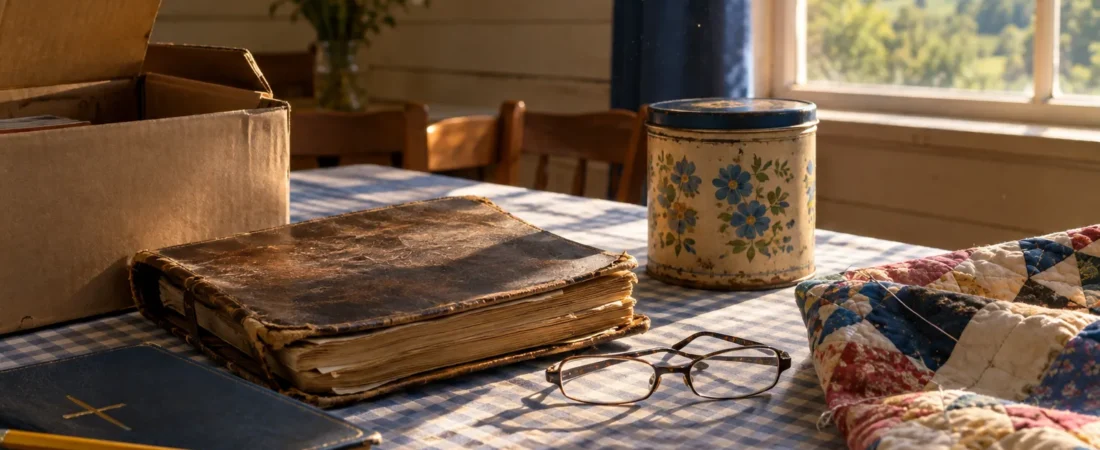
Nora Bell Hartley in The Mercy House Mysteries fits the first category, she runs a donation ministry, which means she handles other people’s discarded possessions, and discarded possessions keep records. A quilt square with an old fair ledger stitched inside. A hymnal margin with a name in it. A recipe tin holding something nobody wanted found.
The genre’s quiet argument is that small acts of attention are a form of faithfulness. The woman who notices the mismatched handwriting is doing holy work, even if she’d never call it that.
Why female leads dominate: The amateur sleuth needs a believable reason to be inside everyone’s business without raising alarm. Women running church ministries, shops, and social networks have exactly that standing. For more on these protagonists, browse the cozy mystery heroines archive.
Why are cozy mystery books set in small towns?
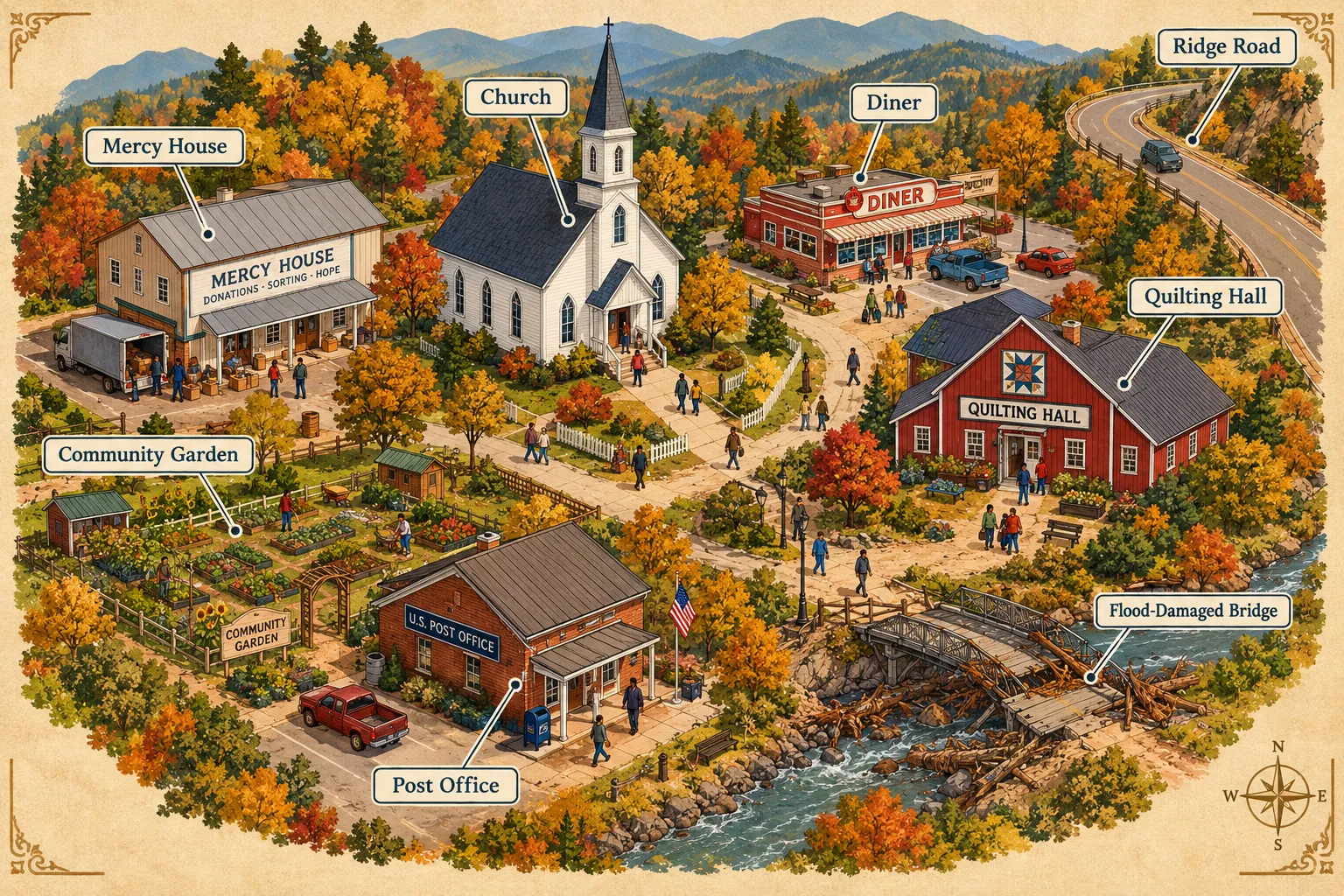
The small town is a closed suspect circle with built-in emotional stakes. Everybody knows everybody, which means every suspect is also a neighbor, and solving the crime means somebody in the choir is going to prison.
)
What the setting does mechanically:
- Limits suspects to a believable, memorable cast
- Gives the amateur sleuth access that a stranger wouldn’t have
- Supplies motive through decades of shared history, old grudges, and family secrets
- Raises the cost of truth, the sleuth has to live with her verdict every Sunday
Quick example: In a city procedural, a stolen relief fund is a line item. In a town of 1,400, it’s the money that was supposed to rebuild the Hendersons’ flooded kitchen, collected in a box the whole church touched. Same crime, entirely different weight.
Recurring community institutions do heavy lifting: the church, the fellowship hall, the diner, the quilting guild, the annual fair, the food pantry. This analysis of how church life and local traditions shape the whodunit covers that machinery in detail.
What are the common tropes in Christian cozy mysteries?
The reliable tropes are a found body in a familiar place, a skeptical local law officer, a nosy best friend, a red herring built on gossip, and a confession scene that happens in a kitchen rather than an interrogation room.
Plot tropes:
- An ordinary object holds the evidence (ledger, recipe card, photograph, tape recording)
- The victim was about to tell the truth about something
- The sheriff or deputy initially dismisses the sleuth, then grudgingly relies on her
- A character the reader likes turns out to be hiding something smaller but shameful
- The killer’s motive traces back to protecting reputation, not greed
Faith tropes done well vs. done poorly:
| Done well | Done poorly |
|---|---|
| Sleuth prays and still doesn’t know what to do | Prayer immediately reveals the answer |
| Forgiveness requires confession and restitution | Killer repents on the last page, no consequence |
| Doubt appears and isn’t resolved neatly | Doubt is corrected by a wiser character |
| Scripture surfaces in a character’s memory | Scripture quoted to explain the theme |
Common mistake readers make: Dismissing the genre as formulaic. Formula is the contract, the pleasure is watching an author honor it while making each case feel new. For writers, there’s a full treatment of keeping every new case fresh without losing the small-town comfort.
Are there Christian cozy mysteries without violence or graphic content, and can non-religious readers enjoy them?
Yes to both. The subgenre’s defining content standard is that the murder happens off-page and the investigation stays free of profanity, gore, and explicit scenes [5]. And because the appeal rests on puzzle structure plus community warmth, readers who don’t share the faith can read these the way many read Father Brown or Miss Marple, the moral framework is visible, and you don’t have to sign it to find the story satisfying.
What you can expect content-wise:
- A body discovered, described without graphic detail
- Tension and threat, usually resolved without a shootout
- No sexual content; romance, when present, stays chaste
- Language free of profanity throughout
Choose a Christian cozy if you want a fair-play puzzle, a town you’d actually want to live in, and an ending where justice arrives without cruelty. Skip it if you want forensic realism, moral bleakness, or an unresolved ending.
For readers assembling a broader list, see these clean Christian fiction recommendations for 2026 and this explanation of what “clean” actually means to readers.
Where can you buy Christian cozy mystery books?
Amazon Kindle and Kindle Unlimited are the dominant channels, since most Christian cozy series are published independently or through imprints with strong digital distribution. Christian bookstores, ChristianBook.com, and public library apps like Libby carry the traditionally published titles.
Best channel by reading habit:
- Binge readers: Kindle Unlimited, whole series available for one subscription
- Collectors: Amazon paperback or ChristianBook for physical editions
- Budget readers: Libby through your local library, plus frequent Kindle sale pricing
- Audio listeners: Audible and Chirp, though independent cozy series have thinner audio coverage
- Discovery: Cozy mystery release-tracking sites and monthly new-release roundups [3][7][8]
The Silas Bellhaven author page lists the full catalog across cozy mystery, western, fantasy, and thriller.
How many books are in popular Christian cozy mystery series, and do they have romance subplots?
Most established cozy series run between 8 and 20 books, with new installments released every few months. Romance is typically a minor thread at most, a slow-burn friendship across many books, and some series deliberately keep it out entirely.
Series length expectations:
- Independent cozy series: 8-20+ books, rapid release
- Traditionally published series: 3-6 books, annual or semi-annual
- The Mercy House Mysteries: 10 books, from A Donation to Die For through The Benediction Tape Murder
On romance: Readers who want a central love story should look to Christian romantic suspense instead, where the relationship drives the plot. Cozy readers generally prefer the sleuth’s attention on the case and the community. This comparison of Christian suspense romance for readers who avoid graphic content sorts out which shelf you actually want.
What age group are Christian cozy mysteries for?
The core audience is women ages 35-65, but the content is suitable for mature middle-grade readers through seniors. There’s no explicit content to screen, so the practical age floor is reading comprehension and interest in puzzle plots rather than content concerns.
- Teens (13+): Fine content-wise; may find the pacing slower than YA thrillers
- Adults 25-40: Growing segment, especially via Kindle Unlimited
- Adults 40-65: Primary readership, strong series loyalty
- 65+: Long-standing cozy audience, often print and large-print buyers
Edge case: Grandparent-to-grandchild sharing is common in this genre precisely because nothing needs vetting first.
Frequently Asked Questions
Do Christian cozy mysteries always involve a murder? Most do, but some center on theft, fraud, arson, or disappearance. The body is the genre convention, not a requirement.
Is the violence described in detail? No. The crime typically occurs before the reader arrives, and the discovery is handled without graphic description.
Can you read Christian cozy mystery series out of order? Each book’s mystery resolves on its own, so yes. But character relationships and town history build across the series, so book one gives the best entry.
Are Christian cozy mysteries the same as inspirational mysteries? Overlapping but not identical. “Inspirational” is a publishing category that can include suspense and romance; cozy describes the puzzle structure, amateur sleuth, and small-town setting.
Is the Christian cozy mystery market growing? Publishing activity increased through 2026, with multiple imprints adding mystery titles. Agent Cynthia Ruchti has cautioned that Christian-market cozy sales still trail the general market, so the trend isn’t settled.
Who are Christian cozy mystery authors similar to each other? Readers who enjoy church-set amateur sleuth series tend to move between Silas Bellhaven’s Mercy House Mysteries, Heather Day Gilbert, Dana Mentink, and Naomi Stephens. All share the fair-play puzzle plus closed-community structure [5].
Do these books include recipes or craft patterns? Culinary and craft cozies often do. Church-ministry cozies more often include community detail, fair schedules, donation logs, hymn references, than back-matter extras.
How long does it take to read one? Typically three to six hours. The shorter length is part of the appeal for readers who finish a series in a few weeks.
Conclusion: Building Your Christian Cozy Mystery Reading Guide
The thing worth remembering about this subgenre is that gentle justice isn’t soft justice. The truth still has to come out, somebody still has to answer for it, and the sleuth still has to look that person in the eye at the next potluck. That’s not comfort by avoidance. That’s comfort earned by honesty about how much telling the truth actually costs in a town where everyone’s names are already written in the same church directory.
Next steps:
- Pick one series with at least five books and read the first one, commit to the town, not just the case.
- Note whether you prefer church-ministry settings, culinary cozies, or historical mysteries, then filter future picks by that.
- If you’re on Kindle Unlimited, queue three series at once and see which town you miss when the book ends.
- Start with A Donation to Die For if you want a donation box, a ledger, and a deacon who ran out of time before he could say the rest of it.
A hymnal margin, a recipe tin, a quilt square with an old ledger sewn inside. Somebody kept a record. Somebody else has to decide what to do with it.
References
[1] New Releases Sept 2026 – https://www.iolagoulton.com/new-releases-sept-2026/ [2] New Releases – https://www.iolagoulton.com/category/new-releases/ [3] Coming Soon Cozy Mystery New Releases For September 2026 – https://www.bookfrolic.com/coming-soon/coming-soon-cozy-mystery-new-releases-for-september-2026/ [5] 50 Best Christian Mystery Books 2026 Ultimate Reading Guide – https://thebookdecoder.com/50-best-christian-mystery-books-2026-ultimate-reading-guide/ [7] 2026 New Releases – https://cozymysterycat.com/category/2026-new-releases/ [8] New Cozy Mysteries 2026 – https://thecozymysteries.com/articles/new-cozy-mysteries-2026