
Last updated: September 10, 2026
Quick Answer: Christian cozy mystery leads all Christian fiction subgenres in Kindle Unlimited reader engagement, driven by binge-friendly series structures and strong reader loyalty. Christian psychological thriller and frontier western follow closely, while epic fantasy and LitRPG show emerging growth with dedicated niche audiences. Subgenre choice matters less than series depth, pacing, and how honestly faith is handled inside the story.
Key Takeaways
- Christian cozy mystery ranks highest for KU borrow-and-continue behavior, largely because small-town series with recurring protagonists reward binge reading.
- Christian psychological thriller earns strong engagement from readers who want real stakes, faith under fire, not faith as decoration.
- Christian frontier western is an underserved lane with growing loyalty, especially among readers who want masculine-led, romance-absent clean fiction.
- Christian epic fantasy has a passionate audience but requires longer books and more worldbuilding investment before reader momentum builds.
- Christian LitRPG is the newest lane, small but distinctly loyal, with almost no competition at the clean/faith-based end.
- Series depth drives KU earnings more than subgenre alone, first-in-series hooks determine whether readers continue through a catalog.
- “Clean” and “Christian” are not the same thing to KU readers; some prefer faith-forward content, others prioritize low-spice comfort reads.
- Religious publishing revenue hit $2.2B in 2025, up 9.3% year over year, signaling a healthy and growing readership base [1].
- Amazon’s KU browse taxonomy lists at least seven distinct Christian fiction subcategories, confirming that reader segments are real and differentiated [2].
- Earned grace, not cheap resolution, is what separates high-engagement Christian fiction from titles that get borrowed once and never finished.
What Are the Main Christian Fiction Subgenres?
Christian fiction is not a single category, it’s a family of subgenres with distinct reader expectations, pacing conventions, and faith integration styles. Amazon’s KU browse taxonomy separates at least seven: Christian Romance, Christian Suspense, Christian Mystery, Christian Historical Fiction, Christian Fantasy, Christian Futuristic Fiction, and Christian Westerns [2].
For the purposes of reader engagement on Kindle Unlimited, the most active lanes in 2026 are:
- Christian cozy mystery, small-town amateur sleuth, gentle suspense, community-centered faith
- Christian psychological thriller, high internal stakes, institutional or domestic threat, faith tested by deception
- Christian frontier western, historical justice narratives, conscience-driven protagonists, earned moral resolution
- Christian epic fantasy, secondary-world covenant theology, spiritual warfare, quest-driven plots
- Christian romance / historical romance, the largest category by volume, faith woven into courtship and community
- Christian LitRPG, game-mechanic progression systems filtered through earned grace and spiritual discipline
- Christian suspense, contemporary threat, often overlapping with thriller but lighter on psychological intensity
Each subgenre attracts a distinct reader, and the mistake many authors make is treating them as interchangeable. A reader who borrows a cozy mystery for the church-social warmth of Juniper Gap, Tennessee, is not the same reader hunting for the institutional dread of a psychological thriller set inside a Christian retreat.
Christian Fiction Subgenres Ranked by Reader Engagement: What Works Best on Kindle Unlimited
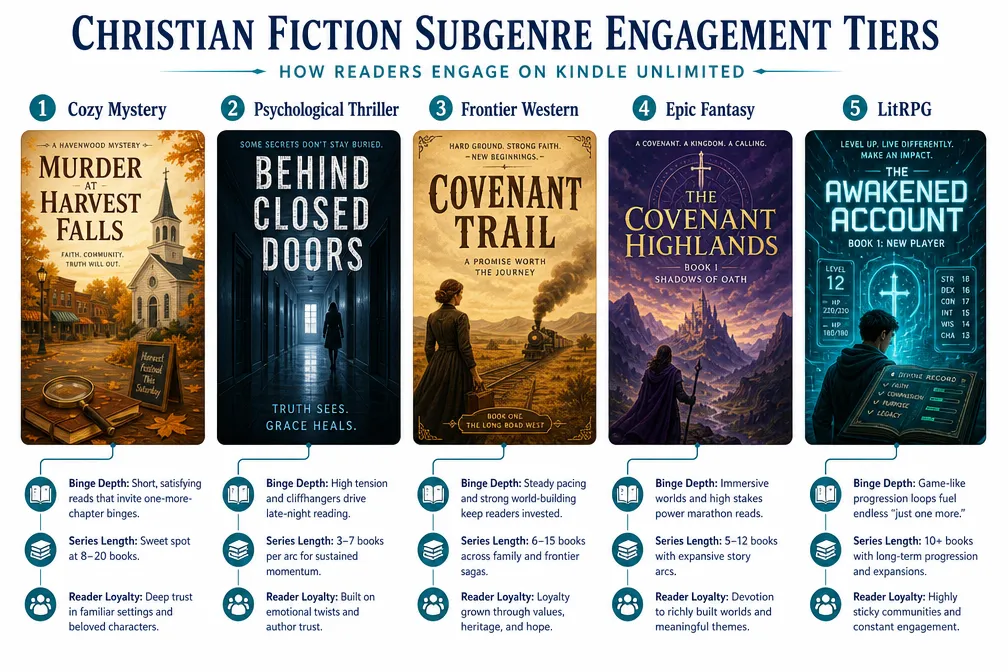
The ranking below is based on observable KU behavior patterns: series continuation rates, first-in-series borrow velocity, and the promotional ecosystem authors use to sustain discovery. These are not published platform statistics, Amazon does not release subgenre-level KENP data publicly, but the patterns are consistent across author roundups, reader community behavior, and the promotional infrastructure that has grown up around each lane [1][2].
1. Christian Cozy Mystery, Highest Sustained Engagement
Cozy mystery sits at the top because it is structurally built for KU binge behavior. Recurring protagonist, recurring setting, recurring community, each book resolves its central mystery while leaving the reader wanting more of the world. The Mercy House Mysteries series, set in Juniper Gap, Tennessee, is a working example: ten books in, with each title built around a specific object or record that holds a secret the town would rather keep buried. That kind of object-anchored mystery structure gives readers a reason to return without requiring them to remember complex plot continuity.
Reddit’s cozy mystery community has explicitly recommended Christian KU cozy series as comfort reads with real stakes, the faith element is seen as a feature, not a filter [7]. The Christian cozy mystery tropes readers love, the amateur sleuth, the small-town setting, the community that both shelters and conceals, translate directly into high page-read completion.
Why it works: Low barrier to entry, warm tone that earns trust quickly, and series structures that reward readers who stay.
2. Christian Psychological Thriller, Highest Per-Book Intensity
Psychological thriller readers borrow fewer books per session but read them more completely. The stakes are internal and institutional, who controls the record of someone’s truth, what happens when a system built on faith becomes the threat. The Gathering Light series (When Hannah Sleeps, When the Voice Breaks, When the Prayer List Opens) operates on exactly that tension: a Christian retreat that preserves testimonies word-for-word, until the system turns its own language on the women who built it.
For more on what separates this lane from secular alternatives, see best Christian psychological thrillers for clean-read fans.
Why it works: Readers who want faith under fire, not faith as comfort, but faith as the thing that gets tested and either holds or doesn’t, find almost nothing else in the clean-fiction market that delivers this.
3. Christian Frontier Western, Underserved, High Loyalty
Western is the most underserved lane in Christian KU fiction. The Mercy Line series, nine books built around the railroad town of Mercy Crossing, where land claims and labor bonds decide who gets justice, operates on a conscience line: where law runs out, a man finds what he answers to. That framing is distinctly Christian without being devotional. Readers who find it tend to stay.
The Christian western fiction Kindle Unlimited guide covers the lane in depth. The lack of competition means discoverability is easier, but it also means readers have to be found rather than arriving through category browsing.
Why it works: Almost no clean, faith-rooted western fiction exists at series length. Readers who want it are loyal precisely because supply is scarce.
4. Christian Epic Fantasy, Slower Build, Deep Loyalty
Fantasy requires more investment, longer books, more worldbuilding, slower first-read momentum. But readers who commit tend to read entire series. The 2026 Christian fantasy boom reflects genuine market growth beyond Narnia retellings, with covenant-theology frameworks and secondary-world settings that treat faith as load-bearing rather than decorative.
For readers who want adventure without romantic subplots, non-romance Christian epic fantasy on Kindle Unlimited is a growing search category.
Why it works: The C.S. Lewis reader, someone who follows an author across genres because the faith is handled with intelligence, is the target. That reader is loyal and vocal.
5. Christian LitRPG, Emerging, Niche, Almost No Competition
LitRPG is the newest lane and the smallest, but the clean/faith-based end of it is nearly uncontested. The Measured Debt series applies earned progression, no cheap grace, no stat inflation without cost, to a game-mechanic world where the record of what a character has done matters more than what they claim. For a full breakdown of the lane, Christian LitRPG on Kindle Unlimited is worth reading before entering.
Why it works: The audience is small but has no alternatives. First-mover advantage in a clean niche is a durable position.
How Do Christian Romance and Christian Suspense Compare in Reader Engagement?
Christian romance is the highest-volume subgenre by title count and promotional activity, new KU-enrolled Christian romance releases appear weekly, including titles like What Could Be Better (September 2026) and Leaves and Longing [3][4]. But volume does not equal per-reader engagement depth. Romance readers sample widely; suspense readers finish what they start.
The practical difference:
| Subgenre | Borrow Volume | Completion Rate | Series Loyalty |
|---|---|---|---|
| Christian Romance | High | Moderate | Moderate |
| Christian Suspense/Thriller | Moderate | High | High |
| Christian Cozy Mystery | High | High | Very High |
| Christian Western | Low-Moderate | High | Very High |
| Christian Epic Fantasy | Moderate | High | High |
Christian romance also blurs into “clean romance” for many KU readers. A 2026 promo by Sophie Toovey explicitly grouped “Christian Romance and Clean/No-Heat Romance” together, reflecting a real competitive boundary: many readers prioritize low-spice storytelling over explicitly faith-forward content [6]. That overlap is both an opportunity and a challenge, it expands the potential audience but dilutes the distinctly Christian positioning.
For a deeper look at where clean fiction and Christian fiction diverge, see clean Christian fiction vs. general clean reads.
What Makes Christian Fiction Successful on Kindle Unlimited?

Successful Christian fiction on KU shares four consistent traits, regardless of subgenre. Practitioner commentary from author roundups in 2026 consistently emphasizes “propulsive stories” with “complex layers,” high stakes, and relatable characters, not devotional content dressed as fiction [1].
The four drivers:
Series depth. KU readers are incentivized to start long series and keep reading. A standalone novel earns one borrow. A ten-book series with a strong first installment earns ten, and the algorithm rewards the catalog, not the single title.
First-in-series hooks. Author and blogger roundups in early 2026 explicitly highlighted “first in series” titles as the primary discovery mechanism [1]. The first book has to earn the second.
Pacing over preaching. Faith that shows up as character choice and consequence, not as narration or scripture-dropping, keeps readers reading. Walking with them, not talking at them. That’s the standard.
Clean content that earns trust early. Readers who pick up a Christian fiction title have a specific expectation. Breaking that expectation in chapter two (graphic violence, explicit content, heavy-handed moralizing) produces returns and negative reviews. Meeting it, and then exceeding it with real stakes, produces loyalty.
The clean Christian fiction guide for authors covers the balance between content standards and narrative tension in detail.
How Much Can You Earn From Christian Fiction on Kindle Unlimited?
KU pays authors per page read (KENP), with rates that have historically ranged between $0.004 and $0.005 per page, though Amazon adjusts the rate monthly based on the global KU fund. Religious publishing revenue reached $2.2 billion in 2025 (up 9.3% year over year), and U.S. adult fiction publisher revenue reached $7.1 billion, signals that the broader market is healthy [1].
Practical earning factors for Christian KU authors:
- A 300-page novel earning $0.0045/page generates roughly $1.35 per full read-through
- A 10-book series where 30% of first-book readers continue generates compounding KENP across the catalog
- Promo stacking (free/discounted first-in-series to drive borrows) remains the dominant acquisition strategy in 2026 [4]
- Cozy mystery and western series with 8-10 books can generate meaningful passive KENP if the series retains readers
No single subgenre guarantees higher rates, the rate is platform-wide. What changes by subgenre is completion rate and series continuation, which directly affect total pages read per reader acquired.
Who Reads Christian Fiction on Kindle Unlimited?
The core Christian fiction KU reader is a woman between 35 and 65 who identifies as Christian, reads for comfort and conviction both, and wants stories that handle faith honestly rather than formulaically. Pew-based figures show 62% of U.S. adults identify as Christian, 34% say they read religion-focused books, and 20% read devotional or inspirational literature weekly, a durable base for faith-rooted fiction [1].
What this reader wants:
- Characters who doubt, serve, fail, and find grace in the ordinary moment that suddenly isn’t ordinary
- Real stakes, not manufactured peril, but consequences that cost something
- Community and setting that feel specific, not generic (Juniper Gap, Tennessee matters more than “a small town”)
- Faith that functions as load-bearing structure, not as a disclaimer at the front of the book
This reader is not the same as the “clean romance” reader who simply wants low-spice content. She wants the faith to be real, tested and proven through the plot, not delivered as a sermon.
Is Christian Fantasy or Christian Romance More Popular on Kindle Unlimited?
By raw title count and promotional volume, Christian romance is significantly larger. Goodreads’ 2026 list of most-anticipated Christian fiction skews heavily toward romance and historical romance [5], and new KU-enrolled romance releases dominate weekly roundups [3].
But “popular” and “engaging” are different measurements. Christian fantasy readers are more likely to complete a series, more likely to leave reviews, and more likely to follow an author across genre lines, the C.S. Lewis dynamic in practice. Christian romance readers sample more broadly and are more price-sensitive.
Choose Christian fantasy if: You want deep reader loyalty, are willing to write longer books, and can build a secondary world that treats faith as structurally necessary rather than cosmetic.
Choose Christian romance if: You want faster discovery, higher borrow volume, and are comfortable in a crowded market where cover design and first-chapter hooks are decisive.
Common Mistakes Authors Make With Christian Fiction on Kindle Unlimited
The mistakes that kill KU performance in Christian fiction are consistent across subgenres.
- Preaching instead of plotting. A character who delivers a three-paragraph theological explanation mid-scene is not a character, she’s a pamphlet. Faith shows up through what people choose and what those choices cost.
- Cheap grace. Redemption that arrives without cost, conversion that resolves the plot rather than complicating it, forgiveness that costs the forgiver nothing, these read as false, and KU readers notice.
- Standalone books in a series-driven market. One book earns one borrow. The KU model rewards depth.
- Ignoring the content contract. A reader who picks up a “clean Christian fiction” title and finds graphic violence or explicit content in chapter three will not finish, will not return, and may leave a review explaining why.
- Conflating “Christian” with “safe.” Real stakes, honest doubt, and consequences that hurt are not violations of the Christian fiction contract, they’re what makes the grace mean something when it arrives.
For more on the tension between clean standards and narrative tension, see what ‘clean’ really means to readers.
How Long Should a Christian Fiction Book Be for Kindle Unlimited?
For KU specifically, length affects total KENP earned per borrow. A 70,000-word novel earns more per read-through than a 40,000-word novella, assuming completion rates are similar.
Practical length targets by subgenre:
- Cozy mystery: 55,000-75,000 words. Long enough to develop the community; short enough to finish in two or three sessions.
- Psychological thriller: 70,000-90,000 words. The internal tension requires space to build.
- Frontier western: 60,000-80,000 words. Plot-driven pacing rewards tighter structure.
- Epic fantasy: 90,000-120,000 words. Worldbuilding requires investment; readers expect it.
- LitRPG: 70,000-100,000 words. Progression systems need room to demonstrate cost and consequence.
Novellas (under 40,000 words) can work as series entry points or between-book bridges, but they should not be the primary KU product.
Can You Write Christian Fiction Without Being Religious?
Technically, yes, but it shows. The difference between faith handled as lived experience and faith handled as a genre convention is detectable on the page. Readers who pick up Christian fiction specifically because they want their belief represented honestly are not easily fooled by formula.
The more useful question is whether an author can write about faith with respect and accuracy without sharing the conviction. Some can. But the authors who build the deepest reader loyalty in this space tend to write from genuine belief, because the reader can feel the difference between a character who doubts and a character who performs doubt for narrative effect.
What’s the Difference Between Inspirational Romance and Christian Romance?
Inspirational romance is a broader category that includes faith themes without requiring explicitly Christian theology. A character might pray, attend a vague church, or reference God in general terms. The faith is present but not specific.
Christian romance is more theologically grounded, characters are identifiably Christian, faith is load-bearing in the plot, and the content contract typically includes no explicit content, no profanity, and no graphic violence.
In KU browse taxonomy, the two sometimes overlap, and many readers use the terms interchangeably. The practical distinction matters most for authors: Christian romance readers have a higher expectation that faith will be handled specifically and honestly, not as atmospheric background.
How Do You Market Christian Fiction on Kindle Unlimited?
The promotional ecosystem for Christian KU fiction in 2026 runs on three mechanisms.
1. First-in-series free/discounted promos. FreeBooksy’s Christian fiction feed and similar promo sites drive discovery through discounted or free first books, with the expectation that KU borrows follow [4]. This remains the dominant acquisition strategy.
2. Curated “first in series” roundups. Blogger and author roundups, like Heidi McCahan’s January 2026 faith-based KU list, explicitly highlight series entry points, signaling that readers and curators both understand the binge model [1].
3. Cross-genre catalog trust. An author who handles faith well in one subgenre earns the right to introduce readers to another. The C.S. Lewis dynamic: readers who trust the author follow the author, not the genre. For a practical TBR built on this principle, see the clean Christian fiction TBR for 2026.
FAQ
Which Christian fiction subgenre has the highest reader retention on Kindle Unlimited? Christian cozy mystery, because recurring characters and settings reward series continuation. Readers who finish book one are likely to borrow book two within days.
Does Christian fiction perform better than secular fiction on Kindle Unlimited? They serve different audiences. Christian fiction has a defined, loyal reader base, 62% of U.S. adults identify as Christian and a significant portion read faith-oriented books [1]. Within its audience, Christian fiction earns strong loyalty. It does not compete head-to-head with secular fiction for the same reader.
What’s the biggest mistake Christian fiction authors make on KU? Writing faith as sermon rather than story. When a character explains theology instead of living it, readers stop reading.
Is Christian western fiction worth writing for Kindle Unlimited? Yes, it’s one of the most underserved lanes in the market. Low competition and high reader loyalty make it a strong long-term position for authors willing to build a series.
How many books does a Christian fiction series need to perform well on KU? At minimum, three books to establish the series and give the algorithm something to work with. Five or more is where catalog depth starts generating meaningful passive KENP.
Do Christian LitRPG books sell on Kindle Unlimited? The audience is small but almost entirely unserved at the clean/faith-based end. First-mover advantage is real in this lane.
What do Christian fiction readers on KU dislike most? Cheap grace, redemption that costs nothing, faith that resolves problems rather than complicating them, and characters who convert rather than grow.
Is it necessary to include Bible verses in Christian fiction? No. Faith that shows up through character choice and consequence is more effective, and more honest, than scripture-dropping. The best Christian fiction earns its theology through the plot.
How does clean Christian fiction differ from general clean reads? Clean fiction prioritizes content standards (no explicit content, no graphic violence). Christian fiction adds a theological dimension, faith is load-bearing, not just absent from the content. For a full breakdown, see clean Christian fiction vs. general clean reads.
Can Christian fiction authors write across multiple subgenres? Yes, if the brand promise transfers. The key is that readers follow the author because of how faith is handled, not because of genre. That’s the C.S. Lewis model, and it works when the conviction behind the books is real.
Conclusion
Christian fiction subgenres ranked by reader engagement on Kindle Unlimited tell a clear story: cozy mystery leads because it’s structurally built for binge reading, psychological thriller earns the deepest per-book engagement, and frontier western is the most underserved lane with the highest loyalty-to-competition ratio. Epic fantasy and LitRPG serve smaller but fiercely loyal audiences with almost no clean/faith-based competition at the series level.
But the ranking is secondary to the principle underneath it. What drives engagement across every subgenre is the same thing: faith that costs something, grace that arrives after the cost, and characters who are walking through the story rather than being lectured through it. Readers can feel the difference between a story rooted in conviction and one that uses faith as a genre label.
Actionable next steps:
- If you’re a reader, start with the first book in a series, A Donation to Die For for cozy mystery, The False Warrant for western, When Hannah Sleeps for psychological thriller, or The Stone That Remembered for covenant fantasy.
- If you’re an author, build a series before you build a brand. The KU model rewards depth, and the Christian fiction reader rewards honesty.
- If you’re trying to find your lane, read the Kindle Unlimited Christian reads guide for a cross-genre TBR that covers all five subgenres.
Hope in the dark is not a genre convention. It’s a conviction. And on Kindle Unlimited, conviction is the one thing that keeps readers coming back.
References
[1] Faith Based Kindle Unlimited Books – https://heidimccahan.com/2026/01/24/faith-based-kindle-unlimited-books/ [2] 2026 Must Read Books – https://www.designingtomorrow.net/2026-must-read-books/ [3] New Releases September 2026 – https://www.nospicebooks.com/newsletter/new-releases-september-2026 [4] Christian Fiction – https://www.freebooksy.com/read/genre/christian-fiction/ [5] 225610.most Anticipated Christian Fiction 2026 – https://www.goodreads.com/list/show/225610.Most_Anticipated_Christian_Fiction_2026 [6] Clean Christian Romance Kindle Unlimited Promo Discover Your Next Wholesome Read 2 – https://sophietoovey.com/2026/03/01/clean-christian-romance-kindle-unlimited-promo-discover-your-next-wholesome-read-2/ [7] Christian Kindle Unlimited Recommendations – https://www.reddit.com/r/CozyMystery/comments/15jyto1/christian_kindle_unlimited_recommendations/ [8] June 2026 Acfw New Releases – https://www.sandraardoin.com/june-2026-acfw-new-releases/