Last updated: October 21, 2026
Quick Answer
Christian fiction about saints and sinners builds memorable fantasy characters by making moral change cost something on the page. A transformation reads as earned when the character keeps choosing under pressure, loses something real, and repairs damage rather than simply confessing feeling bad. Saints should be flawed and sinners should be free, otherwise the arc is a label, not a story. The craft question isn’t “how do I prove the theology,” it’s “what does this person give up to become someone different.”
Key Takeaways
- Repentance needs restitution. Inner realization alone isn’t dramatic evidence. Give something back, give something up, or accept blame publicly.
- Agency is the engine. A memorable sinner isn’t evil because the plot needs a villain. He chooses, repeatedly, with other options available.
- Saints must be flawed, pride, fear, exhaustion, self-righteousness, or they function as furniture.
- Faith shows in choice and consequence, not in dialogue that explains the lesson.
- Christian fantasy vs. fantasy with religious themes: the difference is whether the moral order of the world is load-bearing or decorative.
- Readers want clarity about what matters and ambiguity about who will choose rightly. Those aren’t opposites.
- Tolkien’s indirect method and Lewis’s explicit mythmaking can be blended: concrete religious institutions in the world, unpredictable people inside them.
- Christian fantasy is a live, growing shelf in 2026, with new releases spanning epic fantasy, retellings, and clean romantasy [1][2][3].
What makes a fantasy character’s moral transformation feel real and earned
A transformation feels earned when the cost arrives before the grace, and when something in the character’s world is permanently different afterward. Readers accept change they can price.
Scholarly readings of Tolkien’s moral structure point to a consistent pattern: temptation, genuine free will, the real possibility of redemption, and the equally real possibility of refusing it. Boromir works because he admits what he did, tries to make amends, and dies doing it, the arc has receipts.
Practical tests for any arc:
- Can you name the price? Reputation, inheritance, command, a friendship, a limb, a lie he’d been living in.
- Did someone else benefit? Private contrition is cheap. Restitution is costly.
- Was refusal plausible? If the character had no real alternative, there’s no choice to admire.
- Does the world remember? A ledger corrected, a name restored, a grave marked.
- Is there a scar? Grace doesn’t un-happen the harm.
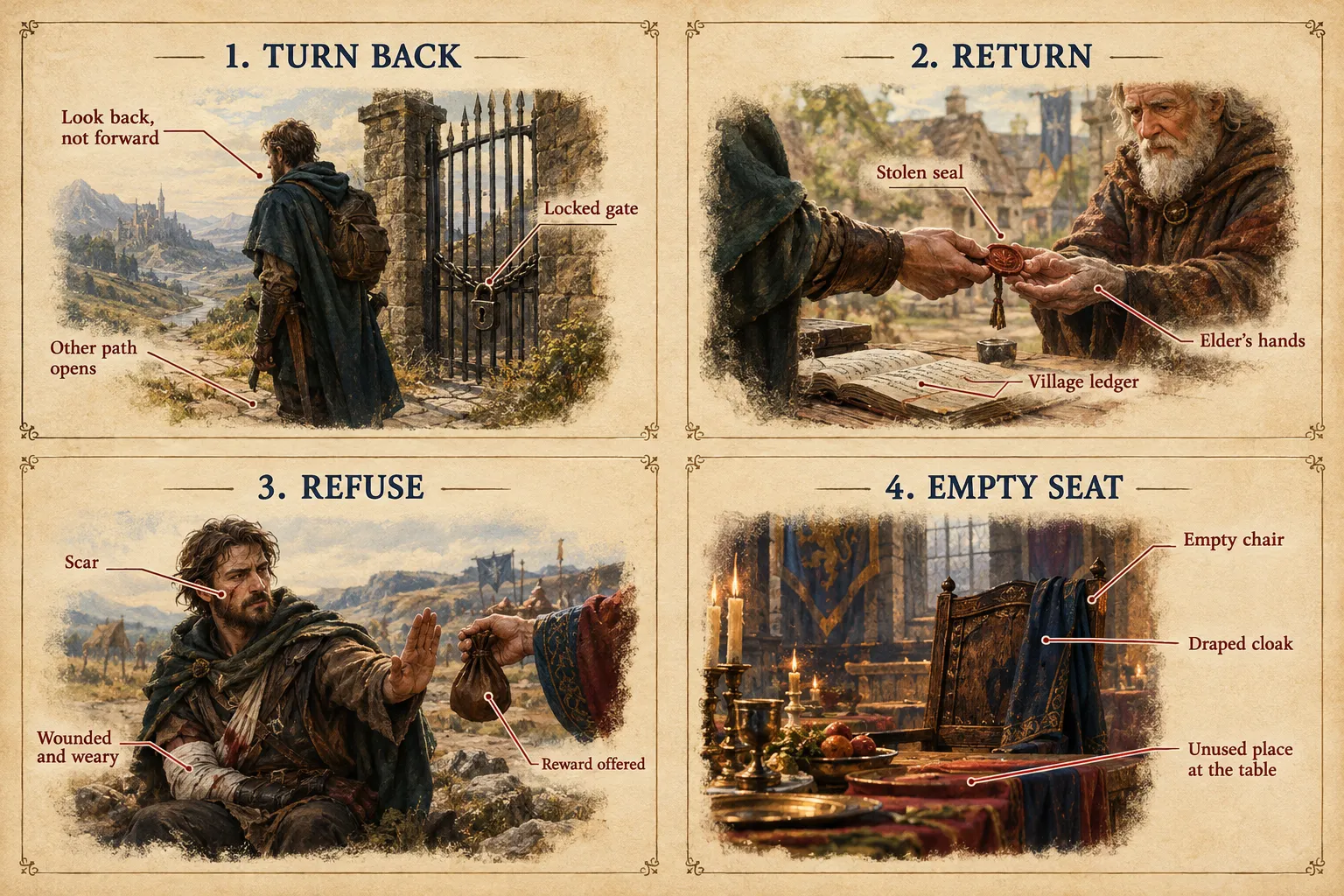
A confession is a sentence. A restitution is a plot.
Common mistake: staging the turn at the climax. Put the first small turn early, a refused bribe in chapter four, so the big one in chapter thirty-one has a pattern behind it.
Best examples of saints and sinners in Christian fantasy novels
The strongest examples pair a legible moral order with people who are not legible at all.
- Boromir (Tolkien), the gold standard for a sinner’s arc with restitution baked in.
- Edmund Pevensie (Lewis), betrayal, ransom, and a changed boy who still has a temper.
- Karen Hancock’s Return of the Guardian-King, rereleased September 22, 2026, a touchstone for covenant-shaped epic fantasy [1].
- Lindsey Lewellen’s Karabos (Enclave Escape, October 13, 2026), part of the current wave of Christian fantasy and fairy-tale retellings [1].
- Silas Bellhaven’s Kethara Chronicles and Sarel Chronicles work the same seam: an empire that wants mercy counted, and people who won’t let the record have the last word.
For a broader shelf, see this faith-focused reading list across cozy mystery, western, fantasy, thriller, and LitRPG.
How to write redemption arcs without being preachy
Write the consequence, skip the commentary. If a scene already shows a man paying for what he did, any line explaining the meaning will subtract from it.
Five habits that keep the sermon out:
- No character speaks the theme. If a sentence could be cross-stitched, cut it.
- Let the other characters disagree. A village that forgives too fast flattens the stakes.
- Delay absolution. Mercy that arrives one scene after the sin reads as cheap.
- Keep doubt unresolved somewhere. One honest unanswered prayer buys credibility for everything else.
- Trust the image. A returned seal, a corrected ledger line, a name read aloud at a graveside.
More on arc mechanics in the role of redemption arcs in Christian thrillers and dark fantasy.
How to avoid dialogue that feels like a sermon
Sermon-dialogue happens when a character knows more than he’s earned. Fix it by giving the line resistance: let the listener push back, change the subject, or walk out. Replace abstractions (“God is faithful”) with specifics (“I signed that warrant and I knew”). Keep spiritual speech short and under duress, people who are frightened don’t monologue. And never let the wisest character in the room be the one who explains the book.
What’s the difference between Christian fantasy and fantasy with religious themes
Christian fantasy treats the moral order as load-bearing: grace, guilt, and consequence actually govern how the world works. Fantasy with religious themes uses temples, priests, and prophecy as texture, while the underlying logic stays neutral or nihilistic.
| Christian fantasy | Fantasy with religious themes | |
|---|---|---|
| Moral order | Real and binding | Cultural flavor |
| Mercy | Costly, available | Often naive or absent |
| Prophecy/prayer | Answered, delayed, or refused, but heard | Plot device |
| Villain | Could have chosen otherwise | Function of the plot |
| Ending | Hope earned through cost | Irony or entropy |
Choose Christian fantasy framing if you want the reader to feel that choices land somewhere. Compare approaches in Christian epic fantasy vs. House of the Dragon.
Common mistakes writers make with morally conflicted characters
The most common failure is a character whose conflict is announced rather than dramatized.
- Stated guilt, unstated cost. He “carries a heavy burden” and never pays a cent.
- Villain with no exits. If temptation never offered him anything he actually wanted, the fall is mechanical.
- Instant conversion. One vision, one altar moment, character solved.
- Saint as scenery. Perfect, patient, plot-irrelevant.
- Moral spokesman. A character who exists to be right at other characters.
- Punishment as redemption. Suffering isn’t repentance. Direction change is.
- Forgiveness without consent. The wronged party should get a vote.
Edge case: the character who repents and still faces the gallows. That’s allowed, and often stronger, mercy and justice aren’t the same office.
Can you have a saint character who’s also flawed in fantasy
Yes, and you should. A saint in fiction isn’t a person without sin; it’s a person whose direction is set and whose weaknesses still show.
Flaws that make saints readable without making them hypocrites: impatience with slow learners, pride in their own restraint, fear of being wrong in public, exhaustion that curdles into coldness, a blind spot about one specific person. The rule: the saint’s flaw should create problems for other characters, not just internal discomfort.
Quick example: an abbess who hides a refugee is brave. An abbess who hides a refugee and lies to a friend to do it, then has to live with that friend’s ruined reputation, is memorable.
How to balance moral messaging with good storytelling
Let the reader experience the moral structure before anything explains it. Story first, meaning as aftertaste.
A working order of operations:
- Build the world’s consequences (law, record, debt, custom) so morality is structural.
- Give the protagonist a want that conflicts with what’s right.
- Make the right choice expensive and the wrong one comfortable.
- Pay the consequence honestly.
- Let grace arrive after the cost, not instead of it.
- Stop. Don’t explain.
Tolkien argued for the internal integrity of a secondary world and resisted fiction that disguises a predetermined lesson. Lewis went the other direction with explicit mythmaking, Aslan, substitution, deeper magic, which buys clarity at the risk of characters becoming functions. Most contemporary authors blend them: explicit institutions, unpredictable people. See faith-integrated magic systems using prophecy, prayer, and miracles.
How much should faith influence a character’s arc in fantasy
As much as it genuinely shapes behavior under pressure, and no more. Faith that only appears in calm scenes is decoration; faith that changes what a character does when it costs him is structure.
Calibrate by asking what the belief forbids. A character who believes mercy is owed to enemies must, at some point, be given a defenseless enemy. That’s faith under fire, the scene does the theology without a word of it.
Decision rule: if you removed the faith element and the plot still worked identically, it isn’t load-bearing yet.
Is Christian fiction only for religious readers
No. Clean content, moral clarity, and earned hope attract a wider readership than the label suggests, particularly among readers avoiding graphic material. The religious-publishing category has shown steady commercial activity, and demand analyses in 2026 suggest Christian speculative fiction has readers outpacing available supply [3][4].
October 2026 release catalogs remain weighted toward romance, suspense, and general inspirational fiction, with fantasy a smaller but clear segment [2][5]. For fantasy authors that means leading with the speculative premise and the emotional hook, not the shelf label. Readers who want thrones-size stakes without grimdark content are a genuine crossover market.
Do fantasy readers want moral clarity or ambiguity
Both, in different places. Readers want clarity about what’s good and ambiguity about who will choose it. Ambiguity about the moral order itself tends to read as nihilism, which is exactly what most faith-driven fantasy readers are leaving behind.
Practical split:
- Clear: the cost of betrayal, the weight of a broken oath, who the vulnerable are.
- Ambiguous: whether the captain will keep his word, whether the thief stays changed, whether the abbey deserves its reputation.
Examples of villains who undergo genuine transformation in books
Genuine villain transformation requires three things: a real appetite that drove the evil, a moment of recognition they can’t unsee, and an act of repair that costs more than the original crime gained.
- Boromir, wants to save his city, takes the wrong instrument, dies defending the people he threatened.
- Edmund, wants to matter more than his siblings, is ransomed at enormous cost, becomes useful rather than sweet.
- The compromised official archetype, common in Bellhaven’s work: a man who signed the paper, then spends the rest of the book undoing what his signature made lawful.
Non-example: the henchman who switches sides because the hero was nice to him.

How to make sin and redemption compelling in speculative fiction
Make sin productive for the character before it’s ruinous. Nobody sins for no reason. Then let the fantasy element make the consequence visible in a way realism can’t, a stone that remembers, a map that won’t draw a road, a ledger that writes itself.
Checklist for a compelling fall-and-return:
- The sin solved a real problem.
- Someone innocent paid for it.
- The character benefited and knew it.
- Discovery is partial, he could still hide.
- He tells the truth anyway, and loses.
- Mercy arrives, and doesn’t erase the loss.
Resources and books on writing Christian fantasy characters
- Tolkien’s “On Fairy-Stories”, sub-creation and the case against disguised allegory.
- Lewis’s Narnia and his essays, explicit Christian mythmaking, with its tradeoffs.
- Current release trackers for the Christian fantasy shelf [1][2][6].
- Market demand analysis for Christian science fiction and fantasy publishing [3].
- Craft reading on creating epic quests with the scope of a fantasy universe and the hope of the gospel.
FAQ
What does “earned grace” mean in fiction? Grace that arrives after the character has paid a real cost, rather than in place of it. The loss stays on the page.
Should a Christian fantasy villain always be redeemed? No. The refusal to repent is a valid, often more honest ending, and it makes the redemptions that do happen credible.
How early should a transformation start? Plant the first small turn in the first third. Big reversals need a pattern behind them.
Can a saint character lose faith? Yes. Doubt is a form of engagement, not the opposite of belief. Leave at least one question open.
Does clean content limit emotional stakes? No. Restraint moves tension to consequence and conscience, which tends to raise stakes rather than lower them.
What’s the fastest way to spot preachy dialogue? Read it aloud. If the listener in the scene has nothing to say back, it’s a sermon.
Is allegory a mistake? Not inherently. Allegory gives clarity; it costs unpredictability. Blend explicit institutions with unpredictable people.
How much theology does the reader need? Almost none. The world’s consequences should teach it.
Conclusion
Memorable saints and sinners come from the same place: a person with real freedom, a real appetite, and a real bill. Christian fiction about saints and sinners earns its characters by letting them choose badly, pay for it, and turn anyway, with something broken left over.
Next steps for writers:
- Pick your sinner’s arc and write the price before you write the turn.
- Give your saint one flaw that damages someone else.
- Delete every line where a character explains the theme.
- Add one unanswered prayer and leave it unanswered.
Next steps for readers: start with The Stone That Remembered or The Map of Unanswered Prayers, then decide whether the record gets the last word.
References
- Christian Fantasy. risingshadow.net.
- New Release Fiction. christianbook.com.
- 2026 Market Analysis of Christian Science Fiction and Fantasy Book Publishing Demand Exceeds Supply. creativecornerstones.com.
- 2026 S Top 5 Best Selling Christian Novels 1 2b Market Growth Trends. alibaba.com.
- Fiction. christianbook.com.
- New Releases. australasianchristianwriters.com.