
Last updated: October 30, 2026
Quick Answer
Christian young adult fantasy books for readers who want healing, identity, and clean adventure are secondary-world or portal stories where faith functions as load-bearing structure rather than a closing sermon, characters doubt, fail, repent, and pay for grace. Strong current entry points include The Door Within by Wayne Thomas Batson, Once a Queen by Sarah Arthur, Ruthless by Candice Pedraza Yamnitz, and Illusion in Ink by Keilah Jude. Most new titles in this space are independently published and discovered through reader lists, not bookstore front tables [1][2].
Key Takeaways
- Christian YA fantasy differs from general fantasy mainly in moral architecture: mercy costs something, and consequence follows choice.
- The healing-centered coming-of-age arc (grief, generational wounds, displacement) is the dominant theme in recent releases.
- Most titles are romance-light or romance-absent, with no explicit content and no profanity [3].
- Typical age fit is 12-18, though some books read closer to upper middle grade and others cross into adult fantasy.
- Demand in Christian speculative fiction currently outpaces supply, which is why indie releases drive the category [4].
- Allegory is optional. Plenty of these books are not Bible retellings at all.
- Best beginner order: a portal adventure first, then a redemption arc, then an epic trilogy.
- Check the author’s back matter and series description, marketing labels alone are unreliable.
What makes Christian YA fantasy different from regular fantasy books?
The difference is structural, not decorative. In Christian YA fantasy, the moral logic of the world is real: betrayal has weight, forgiveness has a price, and the universe is not indifferent to what a character chooses.
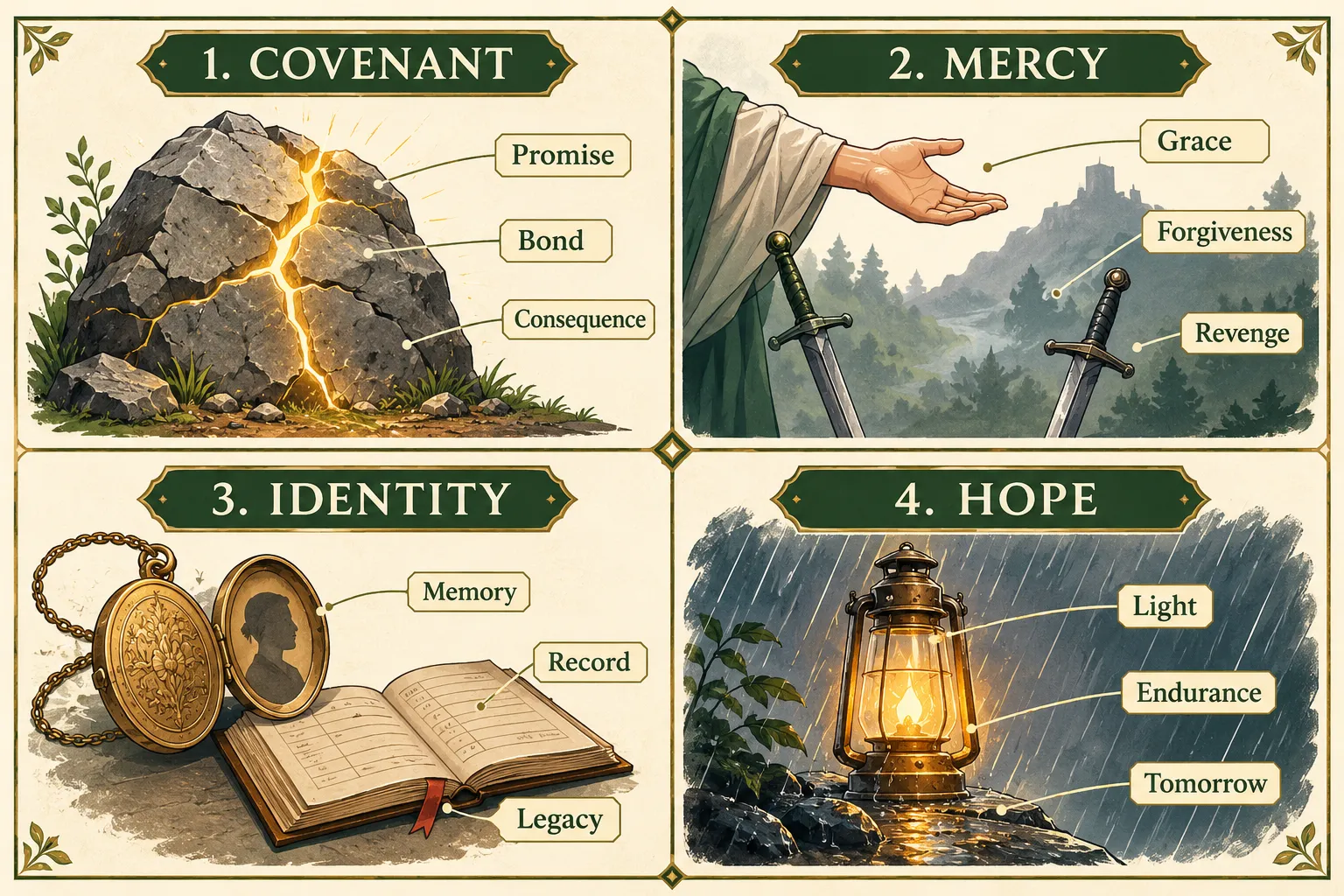
Practical markers that separate the two:
- Earned grace. Redemption arrives after cost, not instead of it.
- Consequence stays attached. A character who lies is not quietly forgiven by the plot.
- Hope in the dark. Endings are hard-won rather than bleak or cheaply triumphant.
- Content restraint. No graphic violence, no explicit scenes, little or no profanity.
Decision rule: if the book’s climax is solved by raw power alone with no moral reckoning, it’s general fantasy with religious set dressing. For a longer breakdown of how authors build this without lecturing, see faith-integrated epic fantasy worldbuilding.
)
Best Christian young adult fantasy series about healing and identity
Start with books where the wound comes first and the magic comes second. Four stand out.
| Title | Core theme | Best for |
|---|---|---|
| Once a Queen, Sarah Arthur | Generational wounds, family secrets, hidden portals | Readers who want quiet, literary healing |
| The Door Within, Wayne Thomas Batson | Displacement, courage, belonging | First-time readers of the category |
| Ruthless, Candice Pedraza Yamnitz | Repentance, freedom, offered forgiveness | Teens who love redemption arcs |
| Illusion in Ink, Keilah Jude | Grief, guilt, found family | Readers wanting faeries and multiple realms |
Once a Queen follows fourteen-year-old Eva into an English manor where a grandmother’s forgotten reign and painful family history surface together; its publisher preview features endorsements describing a redemptive theme about the healing of generational wounds. The Door Within opens with Aidan uprooted to care for an ill grandfather, socially isolated, sleeping badly, before an invitation arrives from another world; it holds roughly 3.96/5 across more than 8,600 Goodreads ratings, making it the most road-tested starting point. Ruthless gives seventeen-year-old assassin Cottia a prince who offers forgiveness where she expected a sentence.
Grace is never cheap, never comes from a clean exit, and is not the same thing as reputation.
Christian YA fantasy books that aren’t preachy or heavy-handed
The least preachy books show belief through what a character does when no one is watching, and never stop the plot to explain the lesson. Look for three signals before buying.
- No scripture-dropping in dialogue used to resolve conflict.
- A protagonist who actually doubts and stays doubting for chapters, not paragraphs.
- Thematic images instead of thesis statements, a stone, a ledger, a map, a letter.
Common mistake: assuming a book is preachy because the publisher is Christian. Redeemed Reader’s booklist of fantasy from Christian publishers shows a wide tonal range, from straight allegory to adventure with almost no explicit theology [3]. The Kethara Chronicles handle this through objects rather than speeches, in The Stone That Remembered, an empire wants every act of mercy counted and filed, and a buried witness-stone refuses to cooperate.
Do these books have clean romance and no explicit content?
Yes, almost without exception. Current Christian fantasy listings routinely carry reader-facing labels like “no spice,” “clean,” and “nonmagical fantasy,” and Illusion in Ink is described by readers as having no explicit sexual content and no profanity [2].
- Romance-absent: some series carry no romantic subplot at all.
- Slow-burn clean: attraction, courtship, restraint, nothing past a kiss.
- Fairy-tale retelling: Of Shadows and Snow by Kaytlin Phillips (October 26, 2026) is tagged Christian fantasy, fairy-tale retelling, and no-spice romance [2].
If a reader wants pure adventure with no romantic thread, start with non-romance Christian epic fantasy for Kindle Unlimited readers.
What age is Christian YA fantasy actually appropriate for?
Most titles fit readers 12 to 18, with the lower bound set by emotional content rather than language. How the Winterlilies Grow (October 6, 2026), which follows a young woman seeking a healing flower for her dying mother, is positioned for roughly eighth grade and up.
- Ages 10-13: The Door Within trilogy, portal adventures, lighter peril.
- Ages 13-16: Once a Queen, Illusion in Ink, grief, family secrets, battle sequences.
- Ages 15+ / crossover: J. J. Fischer’s Song of the Khan (September 2026) and the rerelease of Karen Hancock’s Return of the Guardian-King (September 2026) read closer to adult epic fantasy.
Edge case: a book can be language-clean and still emotionally heavy. A story about a parent’s terminal illness may be harder for a sensitive eleven-year-old than a battle scene.
Christian fantasy authors for teens dealing with trauma or loss
For a teen carrying real grief, choose books where the healing is slow and the questions stay open. How the Winterlilies Grow explicitly handles healing through medicine, through divine action, and through waiting when healing simply does not come, which is rare and valuable.
- Grief and guilt: Illusion in Ink (Ophelia’s guilt, belonging, adoption into a new community).
- Family rupture: Once a Queen.
- Wrongful accusation and identity loss: Stephanie Cardel’s Into the Crashing Waves, a WordCrafts Press YA novel about wrongful conviction, escape, and assuming a new identity [5].
- Neurodivergent teens: Lauren Thell’s independently published Edges & Other Hard Things, faith-based YA with a neurodivergent protagonist [6].
Where to find Christian YA fantasy with diverse characters and settings
The most reliable discovery routes are reader-curated lists and release roundups, because the category is heavily author-led and community-discovered rather than bookstore-driven [5].
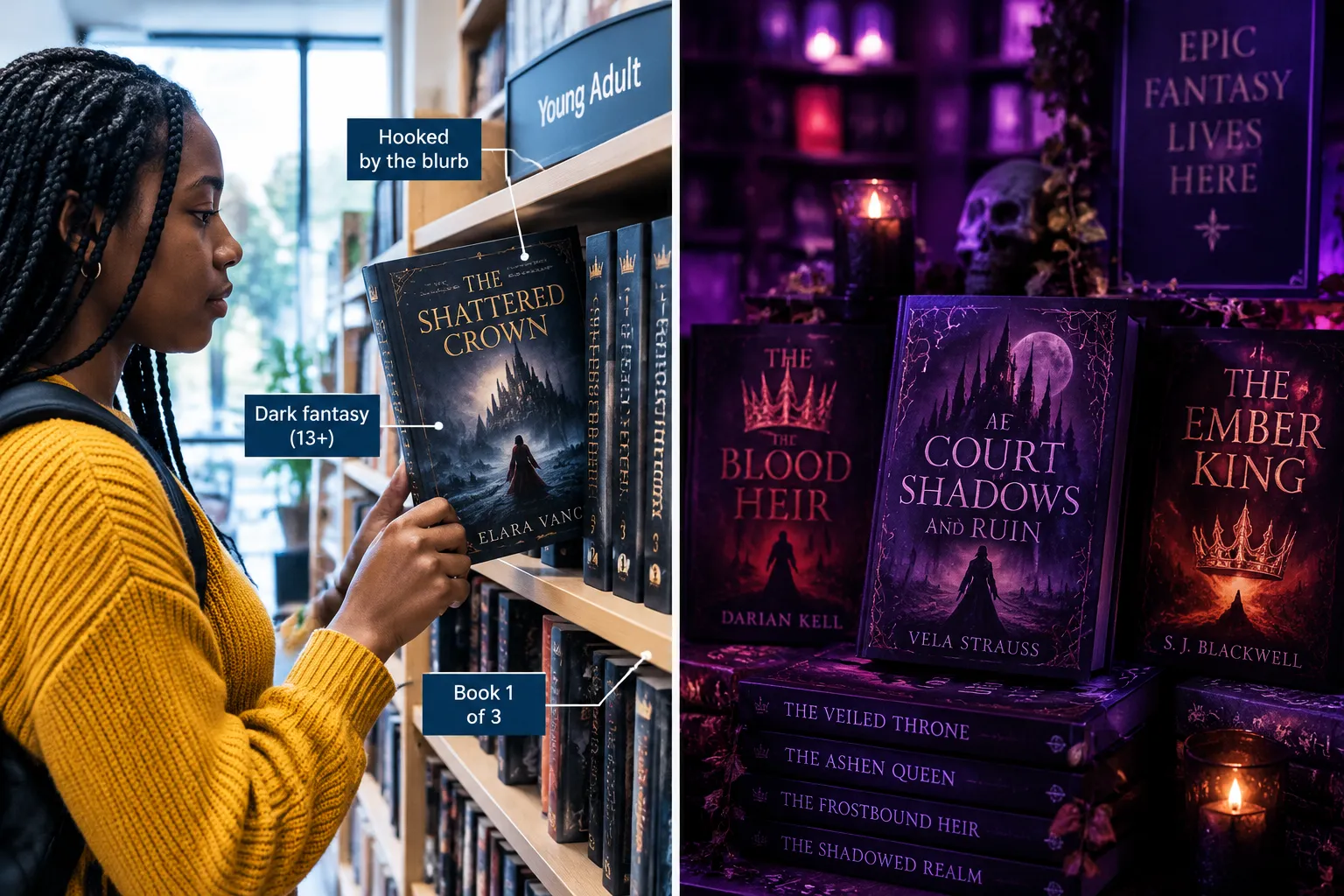
- Rising Shadow’s Christian fantasy release feed for new and upcoming titles [1][2].
- Goodreads lists for Christian series aimed at YA and middle grade.
- Redeemed Reader for publisher-sourced booklists with age notes [3].
- Author newsletters and Kindle Unlimited category browsing.
Secondary-world settings vary widely, highland covenant cultures, invented city-states, fairy-tale Northern kingdoms. A 2026 market analysis of Christian science fiction and fantasy publishing found demand exceeding supply, which is exactly why new voices and settings keep arriving through indie channels [4]. For list-hunting technique, see finding clean Christian fiction lists on Goodreads.
)
Christian YA fantasy vs. secular fantasy with spiritual themes
Secular fantasy with spiritual themes uses religion as material; Christian YA fantasy treats it as true. Both can feature prophecy, gods, and sacrifice, the difference is whether the story believes its own moral claims.
| Christian YA fantasy | Secular fantasy with spiritual themes | |
|---|---|---|
| Moral order | Objective, binding | Often relative or ironic |
| Sacrifice | Costly and meaningful | May be subverted |
| Ending | Hope earned through cost | Ambiguous or nihilistic |
| Content | Clean by design | Varies widely |
Choose Christian YA fantasy if you want hope that survived the plot. Choose the other if you want the question left permanently open. More on the tonal split in Christian fantasy quest stories without grimdark cynicism.
Can you find Christian fantasy books with LGBTQ+ representation?
Within books marketed specifically as Christian YA fantasy, explicit LGBTQ+ representation is uncommon, since most titles come from publishers and indie authors holding traditional sexual ethics. Readers looking for both faith themes and queer representation will generally find them in general-market fantasy with spiritual or religious content rather than in the Christian fiction category.
Practical approach: read the publisher’s statement of faith or the author’s site, check reader reviews on Goodreads for content notes, and don’t rely on category tags alone.
Are there books here that don’t feel like Bible retellings?
Many. Allegory is one option in this category, not the house style. Illusion in Ink runs on faeries, magical abilities, and multiple realms; Of Shadows and Snow is a fairy-tale retelling rather than a scriptural one [2].
Look for descriptions that lead with world, stakes, and character wound instead of “a retelling of.” The Sarel Chronicles, for example, build an entire civic system around silver roads that mark certified answered prayers, The Map of Unanswered Prayers is about a map-scribe, a bureaucracy, and a boy nobody recorded.
How do I know if a book is actually Christian YA fantasy or just marketed that way?
Read the first chapter sample and the author’s back matter. Marketing copy can attach “Christian” to a book where faith never appears, and it can also hide genuine faith content behind a neutral blurb.
A five-point check before committing:
- Does the sample show moral weight, or only aesthetics?
- Does the author bio indicate lived belief rather than category positioning?
- Do reviews mention faith as integrated or as “tacked on at the end”?
- Is the publisher a Christian press, or does the indie author state a faith basis?
- Does the series description name a spine question rather than just a vibe?
Readers debating what “clean” even guarantees should read what clean Christian fiction really means.
Strong female protagonists on a healing arc, and what to read when secular YA feels too intense
For readers who want a young woman carrying a real wound through a real quest, three titles lead: Once a Queen (Eva, generational wounds), Ruthless (Cottia, repentance and freedom), and Illusion in Ink (Ophelia, grief and found family). How the Winterlilies Grow adds a heroine whose quest is medical and spiritual at once.
If secular YA has felt too dark, the practical fix is not less adventure but different pressure. These books keep the stakes and remove the graphic content, danger stays, cruelty doesn’t linger on the page. Readers who want this at adult scale can move to Christian epic fantasy built on big worlds with big meaning.
Best Christian YA fantasy series to start with as a beginner
Start with The Door Within. It’s the most widely read, the structure is clear, and the displacement-to-purpose arc is easy to settle into.
A three-book starter path:
- Portal adventure: The Door Within, courage, belonging, allegory handled plainly.
- Redemption arc: Ruthless, forgiveness offered before it’s deserved.
- Literary healing: Once a Queen, slower, family-centered, generational.
From there, move to covenant fantasy with adult scope, like The Stone That Remembered or the Sarel trilogy.
FAQ
Is Christian YA fantasy the same as Christian allegory? No. Allegory is one approach within the category. Many titles are straight secondary-world fantasy with Christian moral structure and no one-to-one symbolic mapping.
Do these books contain magic? Often yes, usually framed as gift, covenant, or created order rather than occult power. Some listings specifically label “nonmagical fantasy” for readers who prefer none [2].
Are Christian YA fantasy books available on Kindle Unlimited? Many indie-published titles are, since the category is largely author-led and KU is a primary distribution channel for independent Christian fiction.
What’s the newest notable release? Of Shadows and Snow by Kaytlin Phillips released October 26, 2026, tagged Christian fantasy, fairy-tale retelling, and no-spice romance [2].
Can adults read Christian YA fantasy? Yes, and many do. Crossover titles like Song of the Khan and Return of the Guardian-King read comfortably as adult epic fantasy.
How much violence is typical? Battles, pursuit, and peril appear, but injury and death are handled without graphic detail.
Is there a Christian YA fantasy with no romance at all? Yes. Several series maintain a romance-absent content contract across the whole catalog.
Why is so much of this category independently published? A 2026 market analysis found demand for Christian science fiction and fantasy exceeding available supply, leaving indie authors to fill the gap [4].
Conclusion
The category is small, scattered, and better than its shelf space suggests. Three next steps:
- Read one sample before buying three books. The first chapter tells you whether faith is load-bearing or ornamental.
- Match the book to the wound. Grief, displacement, guilt, and family rupture each have a clear best starting title above.
- Follow the lists, not the algorithm. Rising Shadow, Redeemed Reader, and Goodreads curated lists surface titles Amazon won’t [2][3].
A story that tells a teen the dark is real and the light still holds has done more work than a story that pretends the dark isn’t there. Read the ones that walk with you.
References
- Christian Fantasy. risingshadow.net.
- Christian Fantasy. risingshadow.net.
- Fantasy Books From Christian Publishers a Booklist. redeemedreader.com.
- 2026 Market Analysis of Christian Science Fiction and Fantasy Book Publishing Demand Exceeds Supply. creativecornerstones.com.
- October 2026 Fiction Finder New Releases. juliearduini.com.
- Clean Ya Fiction for Teen Boys. laurenthell.com.