
Last updated: October 2, 2026
Quick Answer
Christian fantasy quest stories for readers who want epic universe-building without grimdark cynicism are secondary-world adventures that keep the scale big, invented cultures, rival kingdoms, deep history, hard magic rules, while rejecting nihilism and graphic content. The best of them put real cost on the page: characters lose things, doubt God, and pay for every mercy they extend. What they don’t do is tell you that the cost was pointless. Hope survives, but it’s earned.
Key Takeaways
- Christian fantasy builds a secondary world whose moral architecture assumes sin, sacrifice, providence, and redemption are real forces, not just themes.
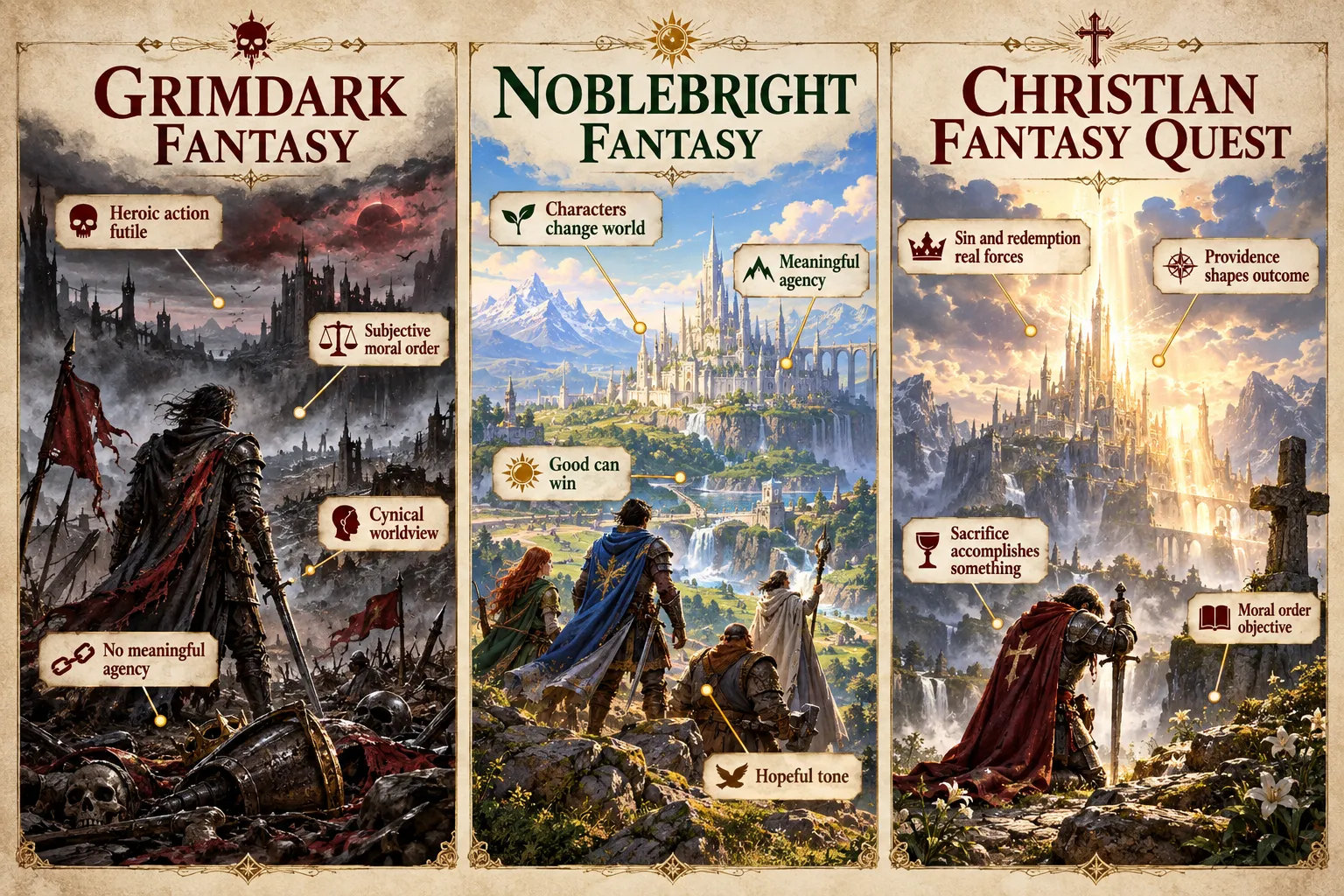
- Grimdark treats heroic action as mostly futile; noblebright gives characters meaningful agency to change their world [6].
- Christian fantasy and noblebright overlap but aren’t identical, noblebright can be virtuous without any theology.
- C.S. Lewis’s seven Narnia books (1950-1956) remain the model for implicit Christian world-building: biblical patterns without Bible retellings.
- The market is bigger than readers assume. One 2026 analysis estimates roughly 200-800 competing Christian fantasy titles on Amazon, with about 794 books shelved under “Christian Fantasy” on Goodreads [8].
- Non-Christian readers read this genre constantly, the Wingfeather Saga’s screen adaptation drew over 8,000 investors and $5 million from a crowdfunded model.
- The fastest way to avoid preachy fantasy: check whether the faith arrives through a choice with consequences or through a speech.
- Complex magic systems and Christian theology coexist fine when magic has a price, an authority above it, and limits the protagonist can’t argue away.
What is Christian fantasy fiction, and how is it different from regular fantasy?
Christian fantasy is secondary-world fiction built on a worldview where moral order is objectively real, where mercy costs something, sacrifice accomplishes something, and the universe is not indifferent. Regular fantasy may include all those elements too; the difference is that in Christian fantasy they’re load-bearing walls, not decoration.
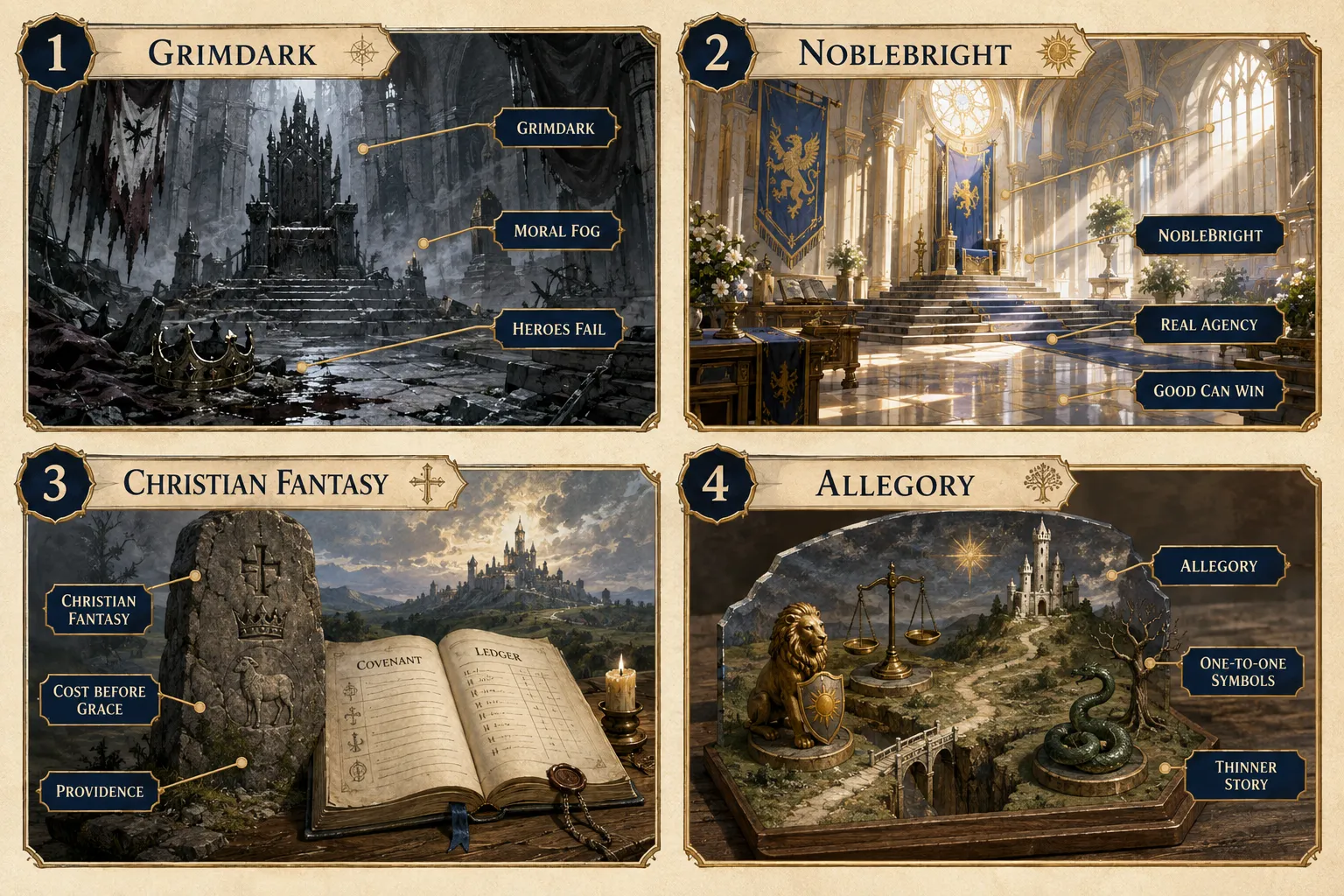
A practical test: remove the faith element and ask whether the plot still stands. In weak Christian fantasy, nothing changes, the theology was a coat of paint. In strong Christian fantasy, the whole story collapses, because the protagonist’s dilemma was a covenant question all along.
What it is not:
- Not automatically allegory (one-to-one symbol mapping)
- Not automatically clean-but-empty
- Not a sermon with swords
Britannica notes that The Chronicles of Narnia works through original fantasy narratives that echo biblical patterns, creation, sacrifice, resurrection, judgment, new creation, rather than retelling scripture directly. That’s the architecture worth copying.
For a longer treatment of this split, see the breakdown of Christian epic fantasy series with deep faith themes but no allegory.
Christian fantasy vs. secular fantasy: what’s the real difference?
The real difference isn’t content ratings. It’s the answer the world gives when a character does the right thing and loses anyway.
| Element | Grimdark secular fantasy | Christian fantasy quest story |
|---|---|---|
| Moral order | Subjective, usually cynical | Real, external, knowable |
| Heroic action | Often futile or self-defeating | Costly but meaningful |
| Institutions | Corrupt by nature | Corruptible, but not the final word |
| Suffering | Proof of meaninglessness | Tested ground where grace shows up |
| Endings | Ambiguous or bleak | Hopeful, rarely tidy |
One genre analysis frames noblebright fantasy as stories where good generally triumphs and characters hold genuine power to change their world, while grimdark leans on moral ambiguity, institutional rot, and the repeated failure of heroes [6]. Christian fantasy usually lives in that noblebright territory, then adds a theology of why the good holds.
Decision rule: if you want hard choices but refuse to believe the choices don’t matter, you want faith-rooted fantasy, not grimdark.
Christian fantasy without dark content or grimdark themes, what does that actually look like?
It looks like real violence happening off-page, real temptation ending in a cost rather than a titillation, and real despair that gets answered by something other than a shrug. Clean doesn’t mean soft.
Tension without graphic content comes from:
- Jeopardy you can’t buy your way out of, a signed record, a false witness, a sealed warrant
- Moral traps where every option costs the protagonist something they love
- Timeline pressure rather than gore
- Consequence memory, the story refuses to forget what chapter six cost
Edge case worth naming: some readers use “dark” to mean tone and others to mean content. A book can be tonally heavy and completely clean. If a reader wants light tone as well, cozy fantasy is the better fit, see Christian cozy fantasy and magic systems rooted in grace rather than power.
Best Christian fantasy quest books with good world-building
Start with the titles that actually invent cultures, not just set a quest in generic medieval Europe. Karen Hancock’s Legends of the Guardian-King is one of the clearest adult-scale examples, combining political conflict, spiritual warfare, invented peoples, and redemption; Return of the Guardian-King received a special hardcover edition in September 2026 [1].
Worth knowing about the current field:
- The Wingfeather Saga (Andrew Peterson), four-book fantasy adventure, animated series continuing into fall 2026, plus a 2026 graphic-novel adaptation
- Songs of the Adriels (Jennifer Kropf), YA fairy-tale-inflected quest fantasy; The Crimson Veil released September 30, 2026
- The Chronicles of Narnia (1950-1956), still the shortest route to understanding implicit Christian world-building
- Lorehaven’s curated genre lists remain a reliable starting map for the older canon [6]
For Silas Bellhaven readers, two series carry the quest shape directly. The Sarel Chronicles builds a world where silver roads on the Great Map record every prayer the Maker-Who-Hears has answered, and a disgraced map-scribe named Elya Renn discovers a black road on her own skin belonging to a boy the House of Witness refused to record (The Map of Unanswered Prayers). The Kethara Chronicles takes place in the covenant highlands of Marat-Sol, where an empire wants every act of mercy counted, contained, and owned (The Stone That Remembered).
Epic fantasy series with faith-based themes for adults, and where to start if you’re new
If you’re new, start with one short series rather than a nine-book commitment, and pick based on what you want tested, doubt, institutional power, or sacrifice.
A starter path that works:
- Narnia (any order, but The Lion, the Witch and the Wardrobe first) for the grammar of the genre
- The Wingfeather Saga for family-scale adventure with real peril
- Hancock’s Guardian-King books for adult political and spiritual scale [1]
- The Sarel Chronicles for a quest built on unanswered prayer rather than a dark lord
- Branch out using genre lists and new-release trackers [2][4]
Christianbook’s fiction and new-release pages are useful for tracking traditionally published faith fiction as it ships [3][9]. Readers who prefer community-curated shelves can work through Goodreads lists for clean Christian fantasy, cozy mystery, western, and LitRPG.
How to find Christian fantasy that isn’t preachy
Read three pages in the middle of the book, not the opening. Preachy fantasy reveals itself there, because that’s where an author who doesn’t trust the story will stop and explain the theme.
Five quick screens:
- The sermon check, does any character deliver a paragraph that could be lifted into a bulletin?
- The doubt check, is anyone allowed to doubt without being corrected within two pages?
- The conversion check, is the climax a clean dramatic conversion that solves the plot? That’s a red flag.
- The cost check, does grace arrive after someone pays, or instead of it?
- The villain check, is the antagonist an argument or a person?
Faith in fiction should feel like it’s walking with the reader, not talking at them. The moment the prose starts explaining its own meaning, the reader stops believing it.
More on calibration here: how much faith is too much across mystery, western, fantasy, and LitRPG.
Christian fantasy authors like Tolkien or Brandon Sanderson, including complex magic systems
Readers who love Tolkien usually want depth of invented history; readers who love Sanderson usually want rule-bound magic with escalating consequences. Christian fantasy can serve both, and the theology actually helps.
Tolkien gave the genre applicability over allegory, a Catholic moral universe expressed through languages, lineages, and mercy at scale. Lewis gave it pattern-echo. Sanderson’s contribution is mechanical: magic with hard costs, published rules, and an economy.
How a magic system stays theologically coherent:
- It has a price the user cannot dodge
- It has an authority above it, power is derived, never self-originating
- It has limits that hold even when the hero is desperate
- It can be misused, and the world records the misuse
That last point is where Christian fantasy gets interesting. In The Measured Debt, the Christian LitRPG line, progression is earned rather than granted, Eamon Kersey’s name keeps clearing every collapse until the position series starts asking why he’s always the one left standing (The Cost of Being Chosen). Mechanics as moral ledger. See also designing progression without power creep.
Lord of the Rings readers specifically should look at Christian epic fantasy with fellowship and kingdom-scale adventure.
Common mistakes in Christian fantasy world-building
The most common mistake is building a world that only works if the reader already agrees with the author. Good secondary worlds convince first and convict later, if at all.
Mistakes that break the spell:
- Thin allegory, characters become labels, and the reader solves the symbolism by chapter two
- Stakes without loss, nobody important ever actually pays
- Clean-as-a-feature, content standards stated as a promise instead of demonstrated by tone
- Theological shortcuts, divine intervention used to fix plot holes
- One-culture worlds, no rival kingdoms, no trade friction, no contested history, so the quest has no political weight
- Cheap grace, forgiveness that arrives before anyone understands what was broken
Edge case: a book can be richly built and still fail because the protagonist never risks their faith. If belief is never genuinely endangered, the resolution has nothing to prove.
Is Christian fantasy only for religious readers?
No. A reader doesn’t need to share the worldview to enjoy a well-built secondary world, any more than they need to be Norse to enjoy Ragnarök. What they need is competence, real stakes, real consequences, prose that doesn’t condescend.
Evidence that the audience is broader than the label suggests:
- The Wingfeather Saga’s screen adaptation raised $5 million from more than 8,000 investors
- A 2026 market analysis found demand outpacing supply, with Goodreads shelving roughly 794 Christian fantasy titles, small relative to reader appetite [8]
- The September 2026 release slate shows the genre blending with clean romantasy and fairy-tale retelling, drawing readers tagged toward “no spice romance,” dragons, and HEA endings rather than traditional allegory [2]
Mainstream fantasy fans tend to convert on world-building quality first and theme second. That’s covered further in why genre blending is opening new Kindle Unlimited paths in 2026.
Fantasy quests that balance adventure with hope and redemption themes
The balance holds when the spiritual question is the adventure question. A quest to recover a stolen covenant stone isn’t a plot device with a theme attached, the two are the same object.
What a well-balanced quest looks like structurally:
| Act | Adventure beat | Faith beat |
|---|---|---|
| Opening | The call, refused or accepted | A record proves something inconvenient |
| Middle | Rival kingdoms, failed alliances | Doubt becomes legitimate |
| Low point | Loss that can’t be reversed | Prayer goes unanswered |
| Climax | Costly choice under pressure | Faithfulness without confirmation |
| Resolution | World changed, not fixed | Grace arrives after the cost |
That “faithfulness without confirmation” line is the hard one. In Beyond the Maker’s Map, a mercy-house outside Sarel’s official roads sends a summons and the Great Map gives no answer at all, Elya has to carry obedience somewhere nothing validates it.
FAQ
What’s the difference between Christian fantasy and noblebright fantasy? Noblebright describes tone and agency: good can win, and characters can change their world [6]. Christian fantasy adds a specific theological account of sin, sacrifice, providence, and redemption. A book can be noblebright with no theology at all.
Does Christian fantasy have to be allegorical? No. Lewis’s Narnia echoes biblical patterns, creation, sacrifice, resurrection, new creation, without retelling scripture, and most strong modern entries follow that implicit model rather than strict one-to-one allegory.
Can Christian fantasy include magic? Yes, when magic is derived rather than self-originating, carries a real cost, and has limits the hero can’t argue past. Problems appear when magic functions as unlimited power with no moral accounting.
Is clean Christian fantasy suitable for teens and adults both? Often, but not always. Hancock’s Guardian-King books are written at adult scale; Wingfeather and the Songs of the Adriels series skew younger. Check the series’ intended age band rather than assuming clean equals juvenile.
How many Christian fantasy books are there? Estimates vary and aren’t audited. One 2026 market analysis cites roughly 200-800 competing Amazon titles and about 794 Goodreads shelf entries under “Christian Fantasy” [8].
Where can I track new Christian fantasy releases? Risingshadow maintains a running Christian fantasy new-release list [2], Christianbook tracks new traditional fiction [9], and Lorehaven curates genre recommendations [6].
What should I read if I want epic scale but hate bleak endings? Look for the noblebright signal plus explicit redemption arcs. Start with Narnia or Wingfeather, then move to adult-scale series like Legends of the Guardian-King or The Sarel Chronicles.
Is Christian fantasy growing in 2026? Signals point that way: a continuing Wingfeather screen adaptation, a 2026 graphic novel expansion, and a September 2026 release field heavy with series and clean romantasy crossover titles [2].
Conclusion
The case for Christian fantasy quest stories for readers who want epic universe-building without grimdark cynicism comes down to one claim: you don’t have to choose between scale and hope. Rival kingdoms, contested histories, hard magic, and genuine loss all survive inside a world that believes mercy means something.
Next steps:
- Pick one short series and finish it before branching, Narnia or Wingfeather if you’re new.
- Use the five-screen test (sermon, doubt, conversion, cost, villain) on the middle of any sample.
- Follow release trackers rather than algorithms [2][9].
- If you want adult scale with clean content, start with The Map of Unanswered Prayers or browse the Christian epic fantasy archive.
Grace that costs nothing isn’t grace. Build the world big enough for the cost, and hope stops being sentimental, it becomes the hardest thing in the book.
References
[1] lindashentonmatchett – http://www.lindashentonmatchett.com/ [2] Christian Fantasy – https://www.risingshadow.net/new-book-releases/christian-fantasy [3] Fiction – https://www.christianbook.com/page/fiction/ [4] Best Christian Fantasy Books – https://www.christianwebsite.com/best-christian-fantasy-books/ [6] The Best Of Christian Fantasy – https://lorehaven.com/magazines/spring-2020/the-best-of-christian-fantasy/ [8] 2026 Market Analysis Of Christian Science Fiction And Fantasy Book Publishing Demand Exceeds Supply – https://creativecornerstones.com/2026/05/25/2026-market-analysis-of-christian-science-fiction-and-fantasy-book-publishing-demand-exceeds-supply/ [9] New Release Fiction – https://www.christianbook.com/page/fiction/new-release-fiction