
Last updated: October 31, 2026
Quick Answer
Clean Christian psychological thrillers about family secrets and childhood trauma are suspense novels that build dread through buried history, withheld records, and emotional pressure rather than graphic violence, profanity, or explicit content. The tension comes from what a character knows and what it will cost to say it out loud. The best ones end in accountability and earned grace, not a tidy conversion scene or a hopeless twist.
Key Takeaways
- “Clean” refers to content, not intensity. No graphic violence, profanity, or explicit scenes, but a novel about childhood neglect can still land hard emotionally.
- The engine of the subgenre is a record: a letter, a file, a family Bible, a transcript. Who controls it controls the truth.
- Christian psychological thriller ≠ Christian suspense. Psychological thrillers work inward (memory, identity, doubt); suspense works outward (a threat closing in).
- Colleen Coble’s Edge of Dusk, a ranger still searching for the sister kidnapped when she was nine, is the clearest commercial touchstone for the family-secret strand.
- Retailers often shelve these books under “suspense and intrigue,” “family secrets,” or “overcoming pain” rather than “psychological thriller,” which is why they can be hard to find.
- Kindle Unlimited is the cheapest reliable way to sample the category; library apps like Libby are the free route.
- Most titles suit mature teens (15+) and up, but trauma content deserves a parent’s read-ahead.
- Twist endings are alive and well here. Faith narrows the options for resolution, not the plot’s capacity to surprise.
What makes a book a clean Christian psychological thriller?
Three things have to be true at once: the content stays clean, the suspense stays psychological, and the faith stays load-bearing.
- Clean content. No profanity, no graphic violence on the page, no explicit sexual content. Harm is acknowledged, not staged for the reader’s entertainment.
- Psychological mechanism. The threat is a memory, a document, a person who knows too much, or a version of events that doesn’t match the one you were raised on.
- Faith that’s doing work. Prayer, confession, discernment, and church community change the plot, they’re not decorative. Grace arrives after someone pays for the truth. That’s the difference between faith as the engine of suspense and faith as an afterthought.
Decision rule: if you removed the faith thread and the plot still worked unchanged, it’s a clean thriller with Christian decoration, not a Christian psychological thriller.
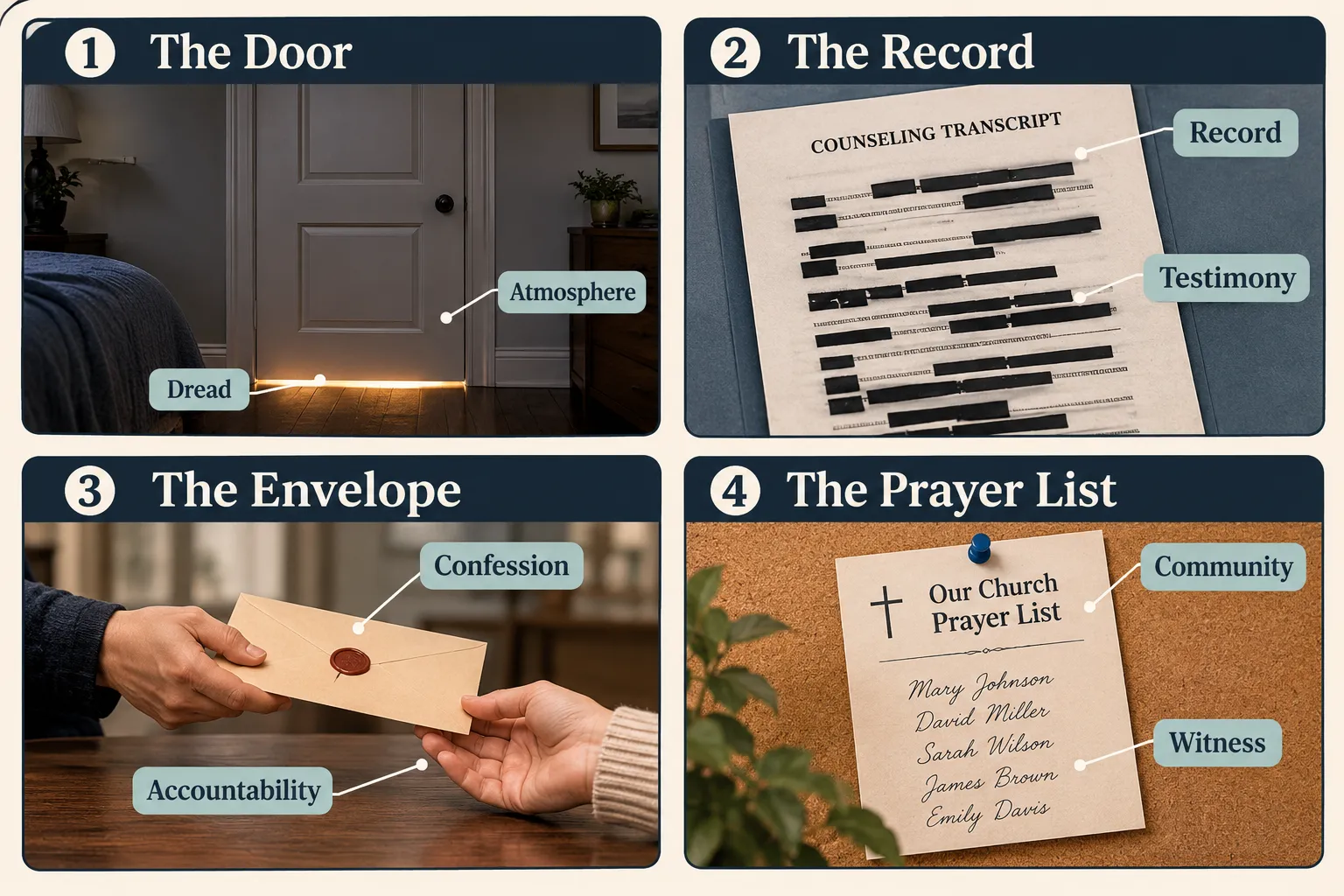
Common mistake: assuming “clean” means “gentle.” A story can contain zero profanity and still open with a woman transcribing other women’s worst nights.
Psychological thrillers vs. suspense novels in Christian fiction
Suspense asks will she survive? A psychological thriller asks was she ever told the truth about who she is? Both can be clean; they frighten you from different directions.
| Christian suspense | Christian psychological thriller | |
|---|---|---|
| Threat source | External, stalker, cartel, storm | Internal, memory, identity, a family’s official story |
| Pacing | Chase, deadline | Slow reveal, dread |
| Faith beat | Courage under threat | Discernment, confession, forgiveness |
| Typical setting | Small town, wilderness, city | A house, a church, a retreat center, a family archive |
| Ending | Rescue | Reckoning |
Choose suspense if you want momentum. Choose psychological if you’d rather be unsettled by a cardboard box in an attic. For craft readers, there’s more on how Christian authors build suspense without darkness.
Best clean Christian thrillers about family secrets
Start with these, then branch outward by theme rather than by author.
- Colleen Coble, Edge of Dusk, Annie Pederson’s sister was taken when Annie was nine. Twenty-four years later she’s a law-enforcement ranger, still asking, and someone wants the past to stay buried. The template for the whole strand.
- Colleen Coble’s Rock Harbor and Sunset Cove books, clean romantic suspense braided with adoption, estrangement, and hidden identity.
- Christianbook’s “suspense and intrigue” shelf, foster-family history, found family, and unresolved childhood pain show up constantly here, often under romantic-suspense labels.
- Silas Bellhaven’s The Gathering Light, three standalone households at a restoration retreat where every testimony is preserved word for word. Begin with When Hannah Sleeps, where a transcriptionist finds her own story in someone else’s file, then When the Prayer List Opens.
- For a cozier dose of the same theme, The Family Bible Secret and The Recipe Tin Murder put buried family history inside a small-town mystery frame.
Christian fiction readership has stayed commercially healthy through 2025-2026, with market coverage pointing to continued growth in faith-based titles [1][2][3], which is partly why this once-rare subgenre now has a real shelf.
Christian psychological thriller authors similar to Colleen Coble
If Coble is your baseline, sort your next read by which Coble element you loved.
- Loved the cold-case sibling mystery? Look for titles tagged “missing relatives” and “family secrets”, a recurring 2026 cluster in suspense roundups [4].
- Loved the romantic-suspense warmth? Try clean romantic suspense alternatives with slow-burn trust.
- Loved the lake-town atmosphere but want darker interiority? Move toward retreat-center and institutional-secret thrillers, where the antagonist is a filing system.
- Want no romance at all? Seek out series with a stated romance-absent content contract.
Edge case: some well-known Christian thriller writers lean political or military. Same shelf, very different nervous system. Check the blurb for the word family before you commit.
How graphic are clean Christian thrillers really?
Almost never graphic in depiction; frequently intense in implication. A clean thriller will tell you a child was hurt. It will not walk you through it.
What you can generally expect:
- Violence occurs off-page or in aftermath (a hospital hallway, a report, a scar).
- No profanity; anger is rendered through silence, clipped dialogue, or a slammed ledger.
- No explicit content; attraction stays at the level of a hand not taken.
- But: nightmares, dissociation, shame, estrangement, and self-blame are often on the page in full.
That emotional weight tracks with reality. SAMHSA reports that more than two-thirds of children experience at least one traumatic event by age 16, and the National Child Traumatic Stress Network’s ACE research, over 17,000 participants, found nearly 64% reported at least one childhood-trauma exposure. Novelists writing layered, multi-generational secrets aren’t exaggerating; they’re writing something plausible.
How to know if a Christian thriller is actually clean
Check four places before you buy. Most mislabeling happens because retailers use broad categories, not because publishers are hiding anything.
- Publisher or imprint. Faith-based imprints hold a consistent content standard.
- Subtitle and series page. Phrases like “a clean Christian psychological thriller” in the title line are an explicit promise.
- The one-star and three-star reviews. Readers who were surprised by content say so loudly and specifically.
- The “Look Inside” sample. Read the first five pages. Tone tells you more than any disclaimer.
Red flag: a book that advertises its cleanliness in a blurb but has no actual faith content. Green flag: a sample where nobody swears and the dread still works.
Christian thrillers with childhood trauma themes but not too dark
Pick books where the trauma is the inciting wound, not the ongoing spectacle. The distinguishing feature is forward motion toward accountability.
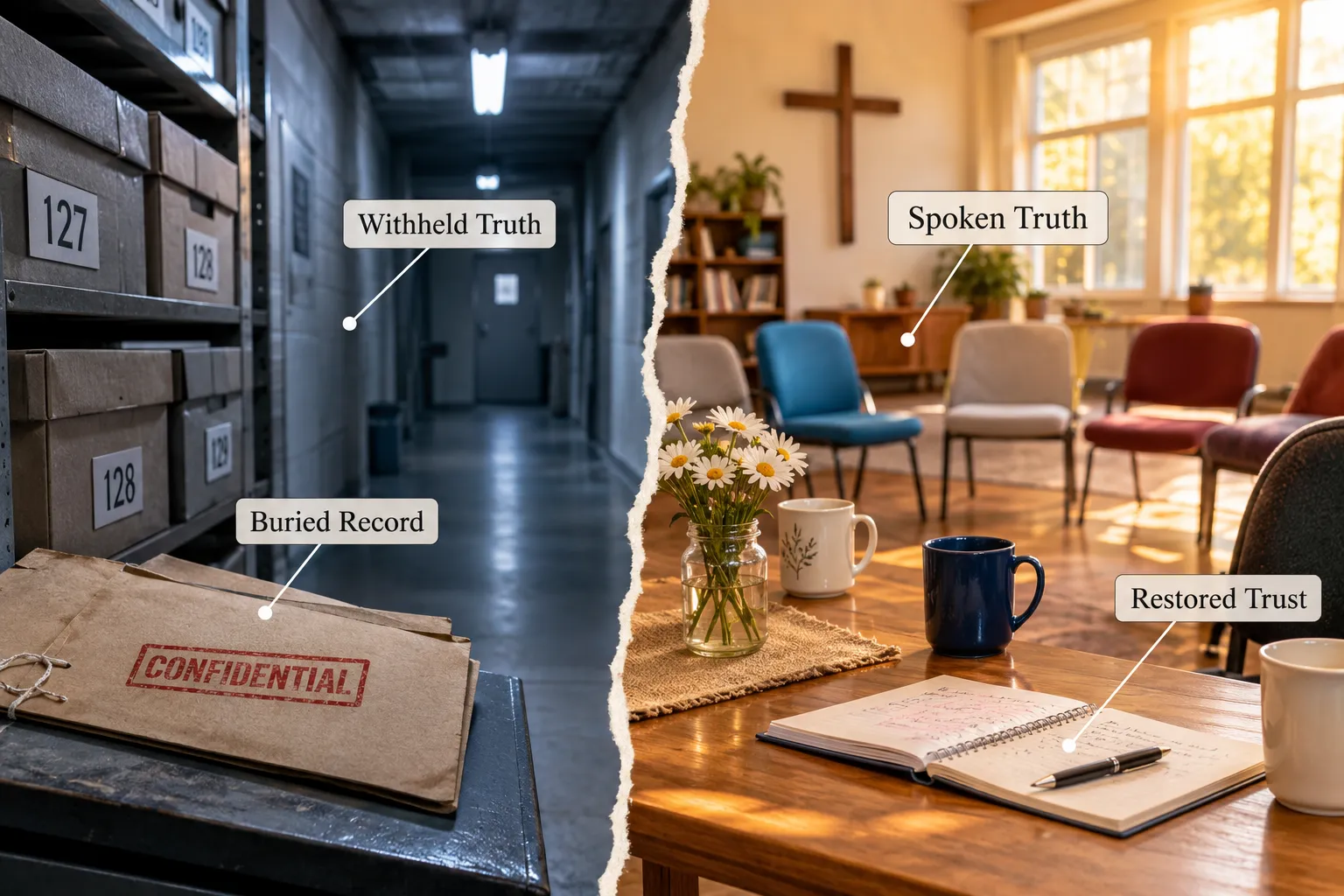
Look for these signals in a blurb:
- A protagonist who is already an adult and already functioning (ranger, nurse, archivist, transcriptionist).
- The word returns, resurfaces, or reopens, the trauma is past tense and the plot is about reckoning with it.
- A named community: a church, a town, a family that still gathers.
- Dual timelines handled with care, which one guide to two versions of the truth unpacks well.
Avoid if you’re sensitive: anything whose blurb centers a current child in active danger. That’s a different intensity.
Clean Christian thriller series about generational trauma
Generational trauma suits series structure because each book can take one branch of the family. The strongest versions follow a record through time rather than a single survivor.
- Silas Bellhaven’s The Gathering Light asks one spine question across three books: who controls the record of someone’s truth? New protagonist, new household, same inheritance of careful language.
- Cozy-adjacent option: The Mercy House Mysteries in Juniper Gap, Tennessee, where quilts, hymnals, and recipe tins keep turning out to be ledgers.
- Craft angle: faith raises the stakes in these books because forgiveness is a cost, not an off-ramp, more on how faith themes raise the stakes.
Where to find clean Christian thrillers online, free or cheap
Four reliable routes, cheapest first.
- Library apps (free). Libby and Hoopla carry most major Christian suspense imprints.
- Kindle Unlimited (subscription). The deepest well for indie clean-read series; borrow five at a time and abandon freely. Faith-based fiction performs unusually well there, as Kindle Unlimited borrow trends suggest.
- Christian bookseller category pages. Browse “suspense and intrigue,” then filter by family-secret themes, this is where the subgenre actually lives.
- Author newsletters. First-in-series books are frequently free.
Are clean Christian psychological thrillers good for young adults?
Usually yes for ages 15 and up, with a caveat: the content is clean, the subject matter is adult. A 15-year-old can handle a novel about a woman uncovering her family’s cover-up. A sensitive 12-year-old may not.
For teen readers:
- Good fit: books where faith, prayer, and a trustworthy adult are present in the story.
- Read ahead if the plot involves abuse, neglect, or suicide, even handled off-page.
- Better starting point for younger readers: Christian cozy mystery, which keeps the puzzle and drops the dread.
Fiction reading has been linked with emotion recognition and perspective-taking, the American Psychological Association has discussed how readers simulate characters’ motives, but that’s a reason to discuss a book, not a substitute for counseling.
Do clean Christian thrillers still have suspense and twist endings?
Yes. Removing gore removes a shortcut, not the suspense. The twist in this subgenre tends to be a reframe: the document everyone trusted was written by the wrong hand; the person protecting you was managing you.
What replaces shock value:
- Dread of disclosure. The scariest scene is often a conversation.
- Withheld information with a moral price. Someone chose silence, and the reader learns why.
- Moral reversal. The sympathetic character is complicit.
Grace in these books shows up after the cost, not instead of it. That’s what keeps the ending from feeling cheap.
FAQ
Is “clean” the same as “Christian”? No. Clean describes content; Christian describes worldview. A book can be clean and secular, or faith-based and surprisingly intense.
Are these books preachy? The good ones aren’t. Faith shows up in choices and consequences rather than speeches, fiction that walks with the reader instead of talking at them.
Do clean Christian thrillers show murder? Often, yes, but typically in aftermath rather than in act. Discovery scenes are brief and non-graphic.
What if I want no romance at all? Check the series description for a stated romance-absent contract. Several Christian suspense and western lines specify this explicitly.
Can these books help someone processing their own trauma? They can offer language, recognition, and comfort. They are not treatment. Pair a hard read with a pastor, counselor, or trusted friend.
Why are they hard to find by searching “Christian psychological thriller”? Retailers often file them under suspense, intrigue, family secrets, or overcoming pain instead. Search those terms too.
Which Silas Bellhaven book should I start with? When Hannah Sleeps, book one of The Gathering Light.
Are these good book-club picks? Very. Family secrets, accountability, and forgiveness generate better discussion than a chase plot.
Conclusion: Where to start this week
The subgenre rewards readers who want their faith handled honestly rather than politely. Clean Christian psychological thrillers about family secrets and childhood trauma work because they refuse both options most fiction offers, despair, or a shortcut to peace.
Next steps:
- Read a sample of Edge of Dusk and one indie clean-read thriller side by side; note which dread you prefer.
- Borrow one Kindle Unlimited series opener and one library hold this week.
- Keep a short list of content signals that matter to you, not generic ones.
- If a book hits a nerve, stop and talk to someone. Hope in the dark is the point; white-knuckling it isn’t.
- Begin The Gathering Light if you want a series where the record itself is the antagonist.
The truth is usually already in the house. The story is about what it costs to carry it out the front door.
References
- Christian Fiction 14 7 Yearly Surge Dramatic Market Expansion Data. firmenpresse.de.
- Christian Reading Trends 2026: Devotional Fiction Dominance Revealed. wboc.com.
- 2026 Best Selling Christian Fiction Books Market Trends Top Genre Insights. alibaba.com.
- Novels: Cults, Missing Relatives, Family Secrets. booksofbrilliance.com.