
Last updated: November 3, 2026
Quick Answer
Private investigator fiction for Christian readers works when the case structure stays honest, the investigator’s faith changes how they gather evidence, and the clean content boundaries are kept by craft rather than by cutting away. The best faith-based PI novels build tension from surveillance, interviews, and paper trails instead of gore, and they put the detective’s conscience on the line as directly as their safety. Publishers Weekly reported in 2026 that clean, faith-centered mysteries are becoming a credible niche inside Christian publishing, with editors naming growing demand for Agatha Christie, style puzzles [1].
Key Takeaways
- A PI case is built on access, not authority. The investigator can’t compel anyone, so every scene becomes persuasion, patience, or trespass.
- Faith shows up in method: refusing a pretext that would ruin an innocent person, returning a document, telling a client a truth they paid not to hear.
- Clean content isn’t the absence of violence. It’s violence placed off-page while its consequence stays fully on the page.
- Christian publishing currently favors FBI agents, marshals, and detectives over civilian PIs, which leaves the independent investigator unusually open territory.
- The strongest PI protagonists are stubborn, observant, and slightly tired, not quippy, not invincible.
- Romance is optional in a Christian PI novel and often weakens the spine. Client trust and moral conflict can carry the relationship load.
- Pacing errors, not content errors, kill most faith-based mysteries: reveals that arrive before the reader has earned them.
- Kindle Unlimited is the most affordable entry point for clean detective novels [2].
What makes a compelling private investigator character in fiction?
A compelling PI is defined by what they lack. No badge, no subpoena, no backup, so they have to earn information from people who owe them nothing. That constraint is the engine of the whole genre.
What separates a memorable investigator from a generic one:
- A specialty. Insurance fraud, missing persons, church security, estate disputes, digital evidence. Generalists are forgettable; a PI who knows how nonprofit books get cooked is instantly specific.
- A reason they left the system. Most good PIs used to be something else, deputy, claims adjuster, paralegal, chaplain. The exit should cost them something.
- A standing rule they won’t break. The reader needs to know the line before the plot pushes them to it.
- Physical habits. How they wait. What they eat in the car at 2 a.m. Whether they pray before knocking.
Decision rule: if your investigator could be swapped for a police detective without rewriting a single scene, the PI premise isn’t doing any work yet.
How do you structure a mystery plot for faith-based audiences?
Structure a faith-based mystery the same way you’d structure any fair-play mystery, then add one extra axis: a moral decision that runs parallel to the investigative one. The case resolves and the conscience resolves, and neither should resolve the other automatically.
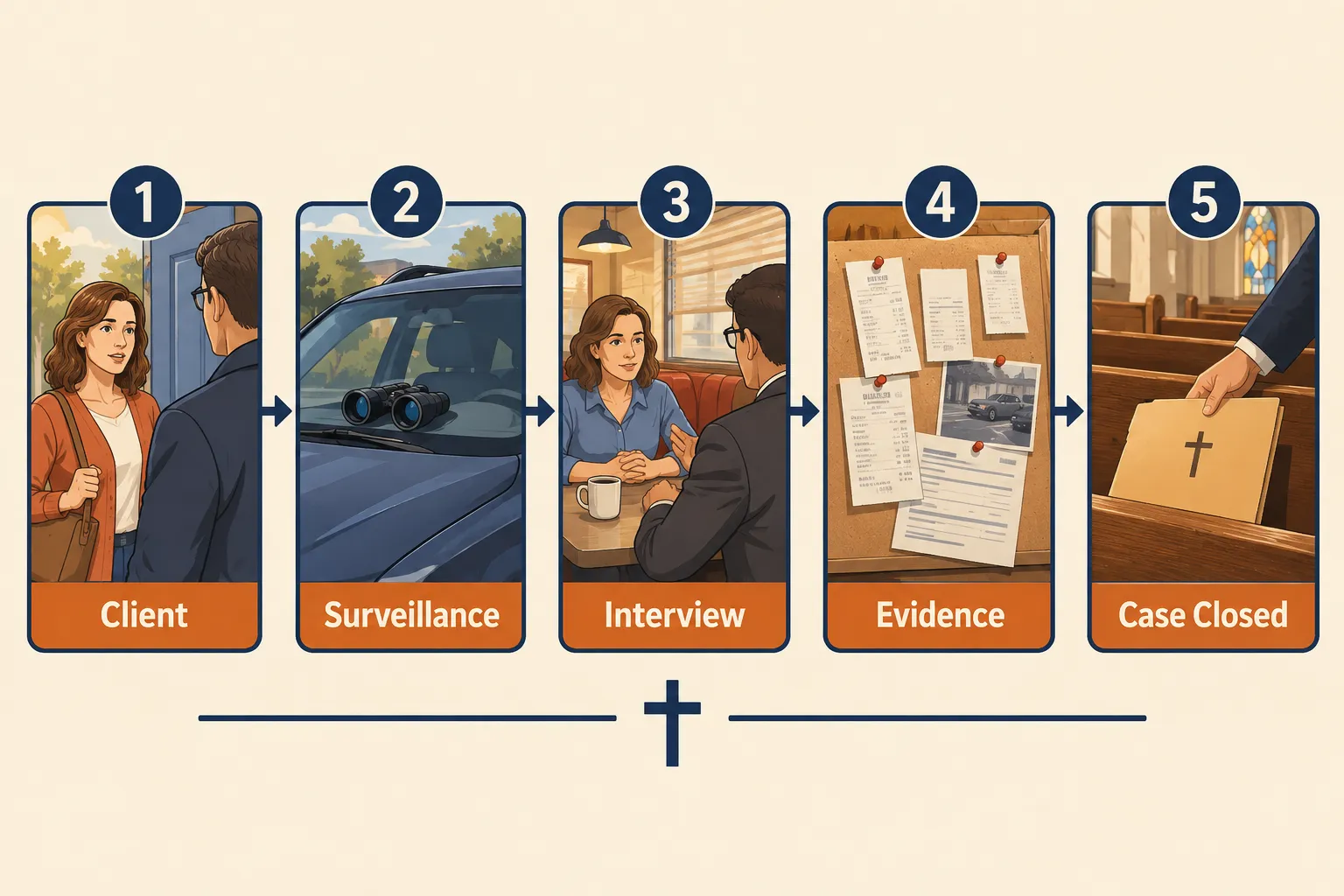
A workable five-beat PI case spine:
- The retainer. A client hires the PI for a reason that is partly false.
- Surveillance and first contact. Observable facts contradict the client’s story.
- Interviews. Three to five sources, each giving one true thing and one self-serving thing.
- The paper trail. A ledger, claim file, deed, prayer list, or receipt that can be checked independently.
- The reckoning. The PI decides who gets to hold the truth, and at what cost.
That fifth beat is where faith-rooted fiction separates from procedural. The question isn’t only who did it but what do you owe the people this answer will wreck. Writers working on the spiritual layer will find more on technique in this guide to weaving believable spiritual arcs into plot without preaching.
Can you write gripping mysteries without graphic content or language?
Yes, and the mechanics are well understood: suspense comes from anticipation and stakes, not depiction. A reader who knows a surveillance subject has noticed the car is more tense than a reader watching a fight.
Tools that raise tension without graphic content:
- Proximity. The threat is near, not landing.
- Time pressure. A deposition Friday, a flight Sunday, a hearing Monday.
- Information asymmetry. The reader knows one fact the PI doesn’t.
- Consequence over spectacle. Show the hospital bill, the limp, the empty chair in the second pew.
- Moral jeopardy. The PI can win the case by doing something small and dishonest.
For a deeper breakdown of that approach, see this piece on non-violent suspense in Christian psychological thrillers.
What content should you avoid in Christian mystery fiction, and how much violence is acceptable?
Avoid on-page sexual content, profanity, and lingering physical cruelty. Violence is generally acceptable when it occurs off-page or in brief summary, and when the story treats the victim as a person rather than a plot device. “Clean” is an industry label, not a standardized rating, so standards vary by publisher and reader [1].
Practical boundaries most faith-based readers expect:
| Element | Usually fine | Usually a problem |
|---|---|---|
| Death | Discovered, reported, mourned | Rendered in forensic detail |
| Assault | Aftermath, bruises, fear | Blow-by-blow on the page |
| Language | “He swore and walked out” | Reproduced profanity |
| Romance | Restraint, courtship, longing | Explicit scenes, fade-to-bed |
| Darkness | Despair that gets answered | Nihilism with no hope offered |
Common mistake: sanitizing the crime itself. A murder that doesn’t disturb anyone in the book won’t disturb the reader either, and the investigation loses its reason to exist. Honesty about hard things is what makes the comfort land.
Cozy mysteries vs hard-boiled detective stories for Christian readers
Cozy mysteries put an amateur sleuth inside a community they can’t leave; hard-boiled PI stories put a paid professional in a city that doesn’t care. Christian readers tend to split along tolerance for ambiguity rather than along violence.
Choose by reading appetite:
- Pick cozy if you want gentle justice, recurring friends, low body-shock, and a town that heals.
- Pick PI/hard-boiled-adjacent if you want procedure, ethical gray, and a protagonist who sometimes loses.
- Pick both if what you actually like is the puzzle. They share clue logic; they differ in tone.
A fuller comparison lives in this guide to Christian cozy mystery vs private investigator thrillers.
Should Christian detective novels include romance subplots?
Only if the romance changes the investigation. Christian romantic suspense has a prescriptive shape, danger early, a villain-driven threat, two leads solving it together, while a standalone PI mystery can run entirely on client trust, partnership, or family obligation.

When romance helps: the love interest is a source, a suspect, or the person the PI must lie to in order to close the case. When it hurts: it pauses the case to deliver feelings, then resumes. Romance-absent PI fiction is a legitimate and under-served lane, and readers who prefer it often look for clean Christian fiction that isn’t built on romance.
What personality types work best for detective protagonists?
The archetypes that hold up longest in faith-based PI fiction are the ones built around a flaw that is also a skill.
- The patient one. Tolerates boredom, stakeouts, and silence. Flaw: emotional distance.
- The recorder. Obsessed with documentation and accuracy. Flaw: trusts paper more than people.
- The former insider. Ex-deputy, ex-adjuster, ex-church administrator. Flaw: old loyalties.
- The pastoral listener. Gets confessions because people feel safe. Flaw: carries everyone’s weight.
- The repentant. Did real harm once and is still paying. Flaw: over-corrects, takes cases they shouldn’t.
That last one is where earned grace actually lives. Redemption that costs something is more compelling than a clean conversion scene, a point explored further in this look at redemption arcs in Christian thrillers and dark fantasy.
How do you pace mystery reveals without plot holes?
Pace reveals by tracking two lists: what the reader knows and what the investigator can prove. A plot hole is usually a reveal that arrived before the proof did.
A checklist that catches most structural failures:
- Every clue is planted before it’s used, in a scene with another purpose.
- Every reveal is sourced, the reader can name who told the PI and why.
- No character withholds information without a stated reason.
- The killer’s plan still works if the detective never shows up.
- The midpoint reveal reframes earlier scenes rather than adding new facts.
- The final confrontation uses something the reader already has.
Edge case: faith-based mysteries sometimes resolve through conviction, confession, or a witness choosing to speak. That’s legitimate, but only if the pressure that produced the confession was built on-page.
Who reads faith-based detective fiction, and where can you find clean detective novels online?
The core audience skews toward women 35-65 who read heavily on subscription, plus a growing number of men looking for clean procedural and frontier-adjacent fiction. Most of them discover titles through Kindle Unlimited browse categories, Christian retailer new-release pages, and reader blogs.
Affordable and reliable places to look:
- Kindle Unlimited’s Christian mystery and suspense category, the cheapest way to sample a dozen series [2].
- Amazon’s Christian fiction new-release lists, updated continuously [3][4].
- ChristianBook’s fiction releases for traditionally published suspense [5].
- Clean-fiction review blogs that tag content levels explicitly [6].
- Curated reader lists, like this roundup of Kindle Unlimited Christian hidden gems and underrated series.
Note the market pattern: recent Christian suspense lists lean heavily on FBI agents, marshals, and K-9 handlers rather than independent PIs [5]. That gap is an opportunity for writers.
Common mistakes writers make with mystery plots in Christian fiction
The most frequent failure is letting the faith element resolve the plot instead of complicating it. A prayer should cost the character something, not substitute for the investigation.
Others worth watching:
- The sermon beat. A character explains the theme out loud. Cut it; trust the image.
- The convenient confession. The suspect collapses for no built reason.
- Clean as disclaimer. Announcing the book’s standards inside the book.
- Toothless antagonists. Villains who aren’t sympathetic to anyone are not credible.
- Procedural fog. PIs who behave like police, serving warrants, arresting people, accessing sealed records with no cost.
- Resolution without repair. The case closes, nobody’s life changes.
FAQ
Is Christian fiction the same as clean fiction? No. Christian fiction is generally clean fiction plus faith content. Many clean novels have no spiritual layer at all [1].
Can a Christian PI novel have a murder? Yes. The body can be discovered and grieved; what’s typically avoided is graphic depiction of the killing.
Do faith-based PI stories need a conversion scene? No, and they’re usually stronger without one. Faith works better as pressure on choices than as a closing event.
What’s the ideal length for a Christian PI mystery? Most sit between 55,000 and 85,000 words, which matches reader expectation in cozy and suspense categories alike.
Can the investigator lie during an undercover pretext? It’s one of the genre’s best ethical dilemmas. Many faith-based PIs limit deception to omission, and the plot should make that limit expensive.
Are Christian mysteries growing as a category? Publishers Weekly reported in 2026 that publishers are expanding clean mystery frontlists, though the niche is less established than mainstream mystery [1].
Where do new Christian mystery readers start? Kindle Unlimited’s Christian mystery and suspense browse category, then series-first reading so the investigator’s arc accumulates [2].
Conclusion
A private investigator story asks one question a procedural never has to: what do you do when no authority backs you up and no one is watching? For Christian readers, that’s the whole appeal, the record is in the investigator’s hands, and the only thing deciding what happens next is conscience.
Next steps:
- Readers: pick one PI series and read three books in order before judging the voice. Build a shortlist using this Christian cozy mystery reading guide.
- Writers: draft your investigator’s one unbreakable rule, then write the scene where keeping it costs them the case.
- Both: notice which stories earn their hope in the dark and which simply avoid the dark. The difference is the genre.
Grace that costs nothing closes no cases.
References
- Mysteries on the Rise in Christian Fiction. publishersweekly.com.
- Christian Mystery Suspense Kindle Unlimited Eligible. us.amazon.com.
- Ref=zg Bsnr Nav Digital Text 5 6190469011. us.amazon.com.
- Amazon New Releases. us.amazon.com.
- New Release Fiction. christianbook.com.
- Clean Fiction. readingismysuperpower.org.