
Last updated: September 17, 2026
Quick Answer: Clean Christian psychological thrillers for readers who avoid horror focus on inner conflict, moral tension, and faith under pressure, not gore, jump scares, or graphic violence. These books deliver genuine suspense through character psychology and spiritual stakes, and they resolve with hope rather than dread. Many are available on Kindle Unlimited, making them easy to sample without financial risk.
Key Takeaways
- Clean Christian psychological thrillers use emotional and moral tension as their engine, not graphic content or horror tropes.
- The genre differs from horror in a fundamental way: the darkness is internal and relational, not supernatural or gory.
- Hopeful endings are a structural feature, not an afterthought, grace shows up after real cost, not as a shortcut.
- Kindle Unlimited carries a growing catalog of faith-based suspense, making discovery low-risk for new readers [7].
- Authors like Terri Blackstock, Colleen Coble, Irene Hannon, and Silas Bellhaven write page-turning suspense without profanity or explicit content [3].
- Faith in these books shows up through character choice and consequence, not sermons or scripture-dropping.
- Strong female protagonists are common in the genre, and many series are built around women navigating dangerous situations with faith as their actual resource.
- Young adults can generally read these safely, though some deal with mature emotional themes (manipulation, grief, spiritual crisis) that suit older teen readers.
- The best KU Christian suspense series offer multiple books per series, so binge-reading is genuinely possible.
- Readers who loved Francine Rivers or Terri Blackstock will find the tone familiar, serious about faith, honest about struggle, never preachy.
What Makes a Psychological Thriller Clean and Christian-Friendly
A clean Christian psychological thriller earns its tension through the mind and the conscience, not through blood or shock. The “clean” designation means no graphic violence, no profanity, and no explicit sexual content. The “Christian” layer means faith is load-bearing in the story, not a backdrop decoration, but the actual ground the characters stand on when everything else gives way.
What separates these books from generic inspirational fiction is that the faith gets tested. Characters doubt, make wrong choices, and carry real consequences. Mercy shows up, but it costs something first. That’s the difference between earned grace and cheap grace, and readers who’ve been burned by preachy fiction feel the distinction immediately.
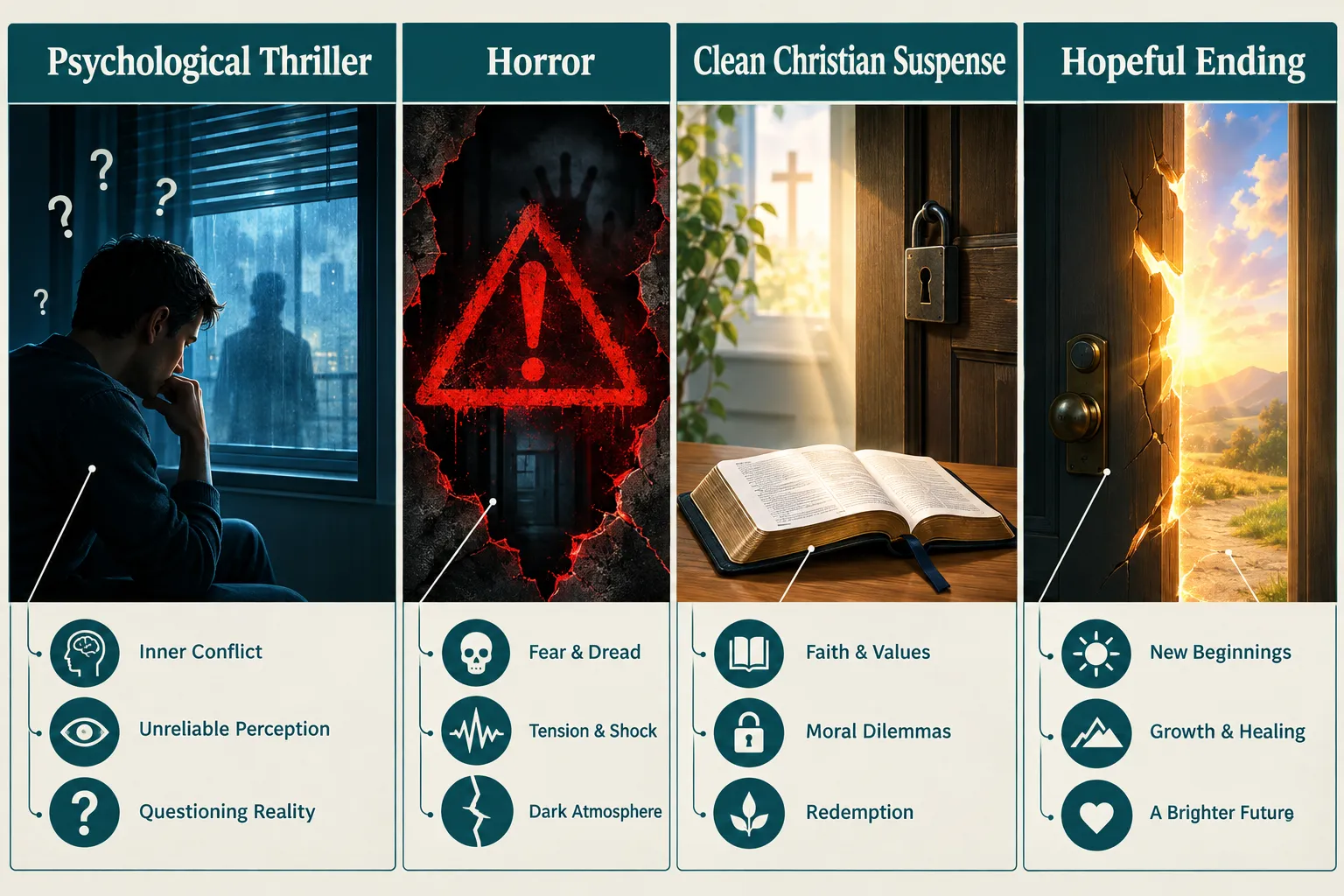
Practically, here’s what “clean” means on the page:
- No graphic depictions of violence, danger is present, consequences are real, but the camera doesn’t linger on gore
- No profanity, characters can be under extreme stress without the language crossing that line
- No explicit sexual content, romantic tension may exist, but physical intimacy stays off-page
- Faith as lived experience, prayer, doubt, scripture, and community appear as things characters actually do, not as lesson-delivery mechanisms
For a deeper look at how Christian authors build suspense within these constraints, see how Christian authors build suspense without darkness in psychological thrillers.
The Difference Between Psychological Thriller and Horror
Psychological thrillers and horror both create unease, but they do it through completely different mechanisms, and that distinction matters enormously for readers who want suspense without fear.
Horror generates dread through external threat: monsters, supernatural evil, graphic violence, or the breakdown of physical safety. The reader’s nervous system is the target.
Psychological thrillers generate tension through internal threat: an unreliable narrator, a character who can’t trust their own memory, a manipulator hiding in plain sight, a moral choice with no clean exit. The reader’s mind is the target.
For Christian readers, this distinction maps onto something theologically meaningful. The real danger in a psychological thriller is rarely a monster, it’s deception, pride, silence when truth is needed, or misplaced trust. Those are the exact territories faith speaks to most directly.
| Feature | Horror | Psychological Thriller | Clean Christian Psych Thriller |
|---|---|---|---|
| Primary tension | External threat | Internal/relational | Moral and spiritual |
| Violence level | Often graphic | Varies widely | None or minimal |
| Resolution | Often bleak | Ambiguous or dark | Hopeful, earned |
| Faith role | Absent or threatened | Rare | Load-bearing |
| Suitable for horror-averse readers | No | Sometimes | Yes |
Best Christian Suspense Books With Hopeful Endings
The best Christian suspense books with hopeful endings are ones where the resolution feels earned rather than handed to the reader. Hope in the dark isn’t the same as a tidy bow, it means the character has walked through something real and come out the other side changed, not unscathed.
Silas Bellhaven’s The Gathering Light series is built precisely on this structure. Each book in the series, When Hannah Sleeps, When the Voice Breaks, and When the Prayer List Opens, follows a different woman navigating a system that has turned the language of healing into a tool of control. The spine question running through all three: who controls the record of someone’s truth? Each book resolves with hope, but not before the character has paid for it.
Other authors known for suspense with redemptive resolutions include:
- Terri Blackstock, If I Run trilogy; characters on the run from both danger and their own past, faith tested across multiple books
- Colleen Coble, Rock Harbor series; mystery with strong faith themes and community
- Irene Hannon, Heroes of Quantico and Guardians of Justice series; romantic suspense with law enforcement protagonists and clean content [3]
- Frank Peretti, This Present Darkness; spiritual warfare thriller, though more intense than some readers prefer
- Ted Dekker, varies widely by series; some titles are more intense, but his Circle series and Thr3e are frequently cited by readers who want faith-integrated suspense [3]
For a curated list focused on high tension and clean content, see best Christian psychological thrillers for clean-read fans.
Psychological Thrillers Without Graphic Violence or Gore
Psychological thrillers without graphic violence or gore are entirely possible, and often more effective. The genre’s power comes from what the reader doesn’t know, not from what they see.
The mechanics of clean suspense include:
- Unreliable perception, a character who can’t trust what she remembers, or whose account of events is quietly being rewritten by someone else
- Institutional manipulation, a retreat, a church, a workplace where the rules seem reasonable until they aren’t
- Secrets held by ordinary objects, a prayer list, a recorded testimony, a file that shouldn’t exist
- Moral jeopardy, a character who must choose between self-protection and truth, with real stakes on both sides
None of these require a single drop of blood on the page. The tension is entirely psychological, and for many readers, especially those who’ve experienced manipulation, gaslighting, or spiritual abuse, that kind of suspense hits harder than any horror scene could.
For more on how the mechanics differ from secular thrillers, see Christian psychological thrillers vs. secular thrillers: why faith-based suspense feels different.
Christian Mystery Books Available on Kindle Unlimited
Kindle Unlimited carries a substantial and growing catalog of Christian mystery and suspense fiction [7]. The platform is particularly well-suited to series binge-reading, which is how most readers in this genre prefer to read.
Silas Bellhaven’s full catalog is available on Kindle Unlimited, including:
- The Gathering Light series, psychological thriller, three books
- The Mercy House Mysteries, Christian cozy mystery, ten books set in Juniper Gap, Tennessee
- The Mercy Line, Christian frontier western, nine books
Other KU-available Christian suspense authors frequently recommended by readers include Terri Blackstock, Irene Hannon, and Colleen Coble, though KU availability can change [6].
Tips for finding clean Christian suspense on KU:
- Search Amazon for “Christian suspense” filtered to Kindle Unlimited
- Check the book’s “Look Inside” for content signals, tone, faith integration, and violence level are usually apparent within the first chapter
- Look for series rather than standalones, series authors in this genre tend to maintain consistent content standards across books
- Reader communities on Reddit’s r/CozyMystery and r/ChristianFiction regularly share KU recommendations [6]
For a broader look at what’s available across genres, see clean Christian fiction that isn’t just romance: mysteries, westerns, fantasy, thrillers, and LitRPG for KU readers.
Christian Suspense Authors Similar to Francine Rivers
Readers who love Francine Rivers are drawn to her willingness to write about hard things, addiction, abuse, shame, spiritual failure, without flinching, while still landing in grace. That combination is rarer than it sounds.
Authors who share that sensibility:
- Terri Blackstock, closest in tone; writes about grief, addiction, and family fracture with the same honest compassion
- Irene Hannon, cleaner and more plot-driven, but shares the commitment to earned resolution
- Colleen Coble, slightly lighter, but strong on community and faith under pressure
- Silas Bellhaven, particularly the Gathering Light series, which handles institutional spiritual abuse and personal identity with the same refusal to look away that Rivers brings to her historical fiction
The common thread is that none of these authors use faith as an escape hatch. Characters don’t get rescued from their problems by a convenient conversion moment. They work through them, sometimes fail, and find grace on the other side of the cost.
How to Find Faith-Based Books That Aren’t Preachy
Faith-based books that aren’t preachy show faith through what characters do under pressure, not through what they say about it. The test is simple: if you removed every explicit faith reference, would the story still feel like it was written from a Christian worldview? In the best books, the answer is yes, because the values are structural, not decorative.

Practical signals that a book handles faith well:
- Characters doubt, faith that never wobbles isn’t faith, it’s a costume
- Prayer is specific and sometimes unanswered, not a vending machine, but a real practice with real uncertainty
- The moral stakes are genuine, the character could actually choose wrong, and sometimes does
- Grace arrives after cost, redemption that costs nothing means nothing
- Scripture appears naturally, quoted by a character in context, not inserted by a narrator to make a point
Signals that a book is likely to feel preachy:
- The villain exists only to be converted or defeated
- Every conflict resolves through a prayer scene
- Secondary characters exist to deliver spiritual lessons
- The protagonist never genuinely doubts
For more on this distinction, see redefining clean Christian fiction for modern readers: beyond heavy-handed messages and into story-first faith.
Clean Suspense Books With Redemption Themes
Clean suspense books with redemption themes are the core of what this genre does best. Redemption in fiction works the same way it works in theology: it requires an honest accounting of what was lost or broken before restoration means anything.
In The Gathering Light series, each protagonist has participated, sometimes unknowingly, in a system that harms the people it claims to heal. The redemption arc isn’t about being forgiven for something minor. It’s about recognizing complicity, bearing the cost of speaking truth, and choosing integrity when silence would be safer.
That’s the kind of redemption that resonates with readers who are tired of stories where grace is cheap. Earned grace, redemption that costs something, is both better fiction and truer theology.
Other redemption-centered clean suspense titles worth noting:
- Terri Blackstock’s Intervention series, centers on a family dealing with addiction; redemption is messy, slow, and real
- Irene Hannon’s Pelican Point series, quieter suspense with strong themes of second chances and restored trust
- Colleen Coble’s Hope Beach series, community-based suspense with forgiveness and reconciliation as recurring themes
Are Christian Thrillers Appropriate for Young Adults
Most clean Christian psychological thrillers are appropriate for mature young adults (roughly 16 and up), but the emotional content warrants attention. These books don’t contain graphic violence or explicit content, but they often deal with manipulation, spiritual abuse, grief, and moral complexity, themes that are meaningful for older teens but may be heavy for younger readers.
Choose based on the specific book, not just the genre label:
- Cozy mysteries in the Christian fiction space (like the Mercy House Mysteries) are generally appropriate for teens 13 and up
- Psychological thrillers like The Gathering Light series deal with institutional manipulation and identity, suitable for mature teens 16+, particularly those with some life experience
- Spiritual warfare thrillers (Peretti, some Dekker) can be intense; parents should preview before recommending to younger teens
The absence of graphic content doesn’t mean the absence of weight. Some of the most affecting moments in clean Christian suspense come from emotional and spiritual honesty, which is exactly what makes them valuable for young adults who are ready for it.
Psychological Suspense vs. Christian Romance: What’s the Difference
Psychological suspense and Christian romance share a readership but serve different emotional needs. Understanding the difference helps readers find what they actually want.
Christian romance prioritizes the relationship arc, two people moving toward each other, with faith shaping how they handle attraction, conflict, and commitment. Suspense, when present, is secondary to the emotional journey of the couple.
Christian psychological suspense prioritizes the threat arc, a character in danger (physical, emotional, or spiritual) working to understand and survive what’s happening to them. Romance may be present but is not the engine of the story.
Choose psychological suspense if:
- You want to be genuinely uncertain about what’s happening
- You’re drawn to unreliable narrators and hidden motives
- You want faith tested by circumstances, not just by attraction
- You prefer a single protagonist’s perspective over a dual POV romance
Choose Christian romance if:
- The relationship resolution is what you’re reading toward
- You want warmth and emotional safety as the dominant tone
- Suspense elements are welcome but not the main course
For readers who want both, Christian romantic suspense (Irene Hannon’s work is the gold standard) blends the two with genuine skill. See also Christian suspense romance: balancing tension, intimacy, and faith without crossing into explicit content.
How to Avoid Books With Dark Themes and Trigger Warnings
Avoiding dark themes in Christian suspense requires knowing which content signals to look for, because “Christian” alone doesn’t guarantee a clean or gentle read.
Practical steps:
- Read the editorial description carefully, phrases like “spiritual warfare,” “demonic,” or “graphic” in the blurb are signals worth noting
- Check reader reviews for content mentions, KU readers in particular tend to flag content that surprised them
- Use the “Look Inside” feature, the first chapter usually establishes tone and content level clearly
- Look for series with consistent content contracts, authors like Irene Hannon and Silas Bellhaven maintain consistent content standards across their catalogs
- Check author websites or blogs, many Christian fiction authors explicitly describe their content standards
For readers specifically avoiding horror tropes, the key phrases to look for in descriptions are: “psychological,” “clean,” “cozy,” “faith-based,” and “hopeful ending.” Avoid descriptions that emphasize “darkness,” “supernatural evil,” or “graphic” even in a Christian context.
The Christian fiction market has grown significantly in recent years [4][8], which means more options, but also more variation in content standards. Doing a quick content check before committing to a full read is always worth the two minutes it takes.
Christian Psychological Thrillers With Strong Female Protagonists
Clean Christian psychological thrillers with strong female protagonists are the dominant pattern in the genre, and for good reason. The psychological thriller’s core dynamic (a character who must figure out who to trust when her own perception is in question) maps naturally onto the experiences many women bring to their reading.
The Gathering Light series centers entirely on women navigating systems of control:
- Hannah Garrick (When Hannah Sleeps), a transcriptionist who discovers her own testimony appearing in someone else’s file
- Caris Weller (When the Voice Breaks), a woman who built her career on careful language, until the retreat’s system starts speaking for her
- Taryn Vickers (When the Prayer List Opens), who finds her own name on the prayer list, written by someone who was supposed to be safe
Each woman is competent, faith-rooted, and genuinely in danger, not from a monster, but from the quiet machinery of institutional deception. Their faith isn’t a rescue mechanism; it’s the thing that keeps them honest when dishonesty would be easier.
Other strong-protagonist Christian suspense series worth noting:
- Terri Blackstock’s If I Run series, Casey Cox is one of the most fully realized protagonists in the genre
- Irene Hannon’s Code Teal series, FBI agent protagonists with genuine professional competence
- Colleen Coble’s Rock Harbor series, search-and-rescue protagonist Bree Matthews
For more on doubt, redemption, and moral complexity in this genre, see Christian psychological thrillers: doubt, redemption, and moral complexity for readers who want suspense with hope.
FAQ
What is a clean Christian psychological thriller? A clean Christian psychological thriller is a suspense novel that builds tension through inner conflict, moral stakes, and relational danger, without graphic violence, profanity, or explicit content. Faith is integrated into the story as a genuine element of character, not a lesson delivered to the reader.
Are Christian psychological thrillers available on Kindle Unlimited? Yes. Kindle Unlimited carries a growing catalog of Christian suspense and psychological thriller titles. Silas Bellhaven’s Gathering Light series and Mercy House Mysteries are both fully available on KU, as are many titles from Terri Blackstock, Irene Hannon, and Colleen Coble [7].
How is a psychological thriller different from horror? Horror creates fear through external, often graphic threats. Psychological thrillers create tension through internal and relational dynamics, unreliable perception, hidden motives, moral jeopardy. Clean Christian psychological thrillers stay entirely in that internal space, with no horror tropes or graphic content.
Do Christian thrillers always have happy endings? Not always happy, but hopeful. The best ones resolve with earned grace rather than a tidy rescue. Characters may have lost something real by the end, but they’ve also found something true. That’s different from both the false comfort of a too-easy resolution and the despair of a nihilistic ending.
Who are the best Christian suspense authors for readers who avoid horror? Irene Hannon, Terri Blackstock, Colleen Coble, and Silas Bellhaven are consistently recommended for clean suspense with faith integration and no horror content [3]. Irene Hannon is particularly known for maintaining strict content standards across her catalog.
Is The Gathering Light series appropriate for readers sensitive to spiritual abuse themes? The series deals directly with institutional manipulation within a faith-based retreat setting. It handles those themes honestly rather than graphically, and resolves with hope, but readers who are currently processing spiritual abuse experiences should be aware the subject matter is present and treated seriously.
Can I read these books if I’m not religious? Yes. Readers who don’t share the faith of the characters often find these books engaging because the faith is shown through character choice and consequence rather than stated as doctrine. The moral stakes and psychological tension work regardless of the reader’s personal beliefs.
What’s the difference between Christian cozy mystery and Christian psychological thriller? Cozy mysteries are lighter in tone, community-centered, and typically resolve without significant emotional cost to the protagonist. Psychological thrillers are darker in emotional weight, protagonist-centered, and involve genuine threat to the character’s safety or identity. Both can be clean and faith-rooted.
Are there Christian psychological thrillers with male protagonists? Yes, though they’re less common in the KU market. Ted Dekker’s work often features male protagonists, and Silas Bellhaven’s Mercy Line western series follows masculine leads through moral and legal jeopardy, though that series is frontier western rather than psychological thriller.
How do I know if a Christian thriller will be too intense for me? Read the first chapter using the “Look Inside” feature. The opening pages establish tone, content level, and how the author handles tension. If the first chapter feels manageable, the rest of the book almost certainly will be.
Conclusion
Clean Christian psychological thrillers for readers who avoid horror aren’t a compromise between suspense and safety, they’re a distinct genre with its own strengths. The tension is real. The stakes are genuine. The faith is earned rather than performed. And the endings carry hope that means something because the characters paid for it.
Actionable next steps:
- Start with When Hannah Sleeps on Kindle Unlimited, it’s the entry point to The Gathering Light series and establishes the tone clearly within the first chapter
- Browse the full Silas Bellhaven catalog for KU-available options across psychological thriller, cozy mystery, western, and fantasy
- If you’re new to the genre, try a cozy mystery first (the Mercy House Mysteries are a gentler on-ramp) before moving into the psychological thriller series
- Use the content signals in this guide to vet new authors before committing to a full read
- Check the 2026 clean and Christian Kindle Unlimited book hauls for current reader recommendations
Stories rooted in faith don’t have to be soft. They just have to be honest, about the dark, about the cost, and about what waits on the other side of both.
References
[1] Blog – https://heatherdaygilbert.com/blog/ [3] Christian Suspense Authors – https://christiansuspensenovels.com/christian-suspense-authors [4] Christian Fiction 14 7 Yearly Surge Dramatic Market Expansion Data – https://www.firmenpresse.de/pressrelease734029/christian-fiction-14-7-yearly-surge-dramatic-market-expansion-data.html [6] Christian Kindle Unlimited Recommendations – https://www.reddit.com/r/CozyMystery/comments/15jyto1/christian_kindle_unlimited_recommendations/ [7] Best Christian Fiction On Kindle Unlimited – https://flourishingmama.com/best-christian-fiction-on-kindle-unlimited/ [8] The Rise Of Christian Fiction Market Trends Regional Dynamics And Future Predictions For 2026 – https://www.alibaba.com/product-insights/the-rise-of-christian-fiction-market-trends-regional-dynamics-and-future-predictions-for-2026.html