
Last updated: September 21, 2026
Quick Answer: Christian epic fantasy and House of the Dragon both deliver high-stakes political drama, war, and morally complex characters, but they diverge sharply on one question: does the story believe anything costs anything, or does it treat every value as negotiable? Christian epic fantasy compared to House of the Dragon reveals that faith-based world-building can carry the same dramatic weight as prestige nihilistic fantasy while offering something House of the Dragon deliberately withholds, the possibility that mercy, justice, and earned grace actually matter to the shape of the story.
Key Takeaways
- Moral nihilism in prestige fantasy like House of the Dragon isn’t the same as moral complexity, one says nothing matters, the other says the right things are genuinely hard to choose.
- Christian epic fantasy uses faith as a load-bearing story structure, not a decorative backdrop or a sermon delivery system.
- House of the Dragon Season 3 averaged 34 million viewers per episode [4], proving massive audience appetite for epic fantasy, an appetite Christian fantasy can serve differently, not less compellingly.
- Narnia is the most recognized Christian fantasy, but it is allegory; the strongest modern Christian epic fantasy integrates faith into world logic without requiring one-to-one symbol mapping.
- Authors like C.S. Lewis, Brandon Sanderson (whose faith shapes world structure even when not foregrounded), and newer voices in the genre show that faith-rooted fantasy can reach non-religious readers.
- Earned grace, redemption that costs something before it arrives, is the structural alternative to nihilism, and it produces higher emotional stakes, not lower ones.
- Clean Christian epic fantasy is not sanitized fantasy; it is fantasy where consequences are real and mercy is not free.
- The Christian fiction market was estimated at $75,$85 million in September 2026 coverage, with major publishers maintaining dedicated faith-based imprints, the infrastructure for this genre is established and growing.
What Is Christian Epic Fantasy and How Does It Differ from Secular Fantasy?
Christian epic fantasy is secondary-world fiction, stories set in fully imagined worlds with their own histories, peoples, and conflicts, where faith in a divine being or covenant relationship with a Creator shapes how the world works, how characters make choices, and what the story ultimately argues is true. It differs from secular fantasy not in scale or ambition, but in what the world is built on top of.
In secular epic fantasy, the moral framework is usually constructed by the author from scratch, which is fine, but it also means the framework can be dismantled just as easily. In Christian epic fantasy, the moral order has weight because it reflects something the author actually believes is real. That conviction shows up in the story’s bones, not just its dialogue.
The practical differences look like this:
| Feature | Secular Epic Fantasy | Christian Epic Fantasy |
|---|---|---|
| Source of moral order | Author-constructed, often relative | Rooted in divine covenant or transcendent truth |
| Redemption arcs | Optional, often ironic | Structurally central; grace costs something |
| Consequences | May be arbitrary or absent | Tied to moral choices; actions have weight |
| Magic/power systems | Usually neutral or amoral | Often linked to faith, covenant, or spiritual cost |
| Tone | Wide range, including nihilistic | Hopeful without being naive; honest about darkness |
Christian epic fantasy doesn’t require a church, a Bible, or a conversion scene. It requires a world where the moral stakes are real because something beyond human opinion is holding them in place.
For a deeper look at how this works in practice, see Christian epic fantasy worldbuilding: integrating faith without preaching.
Why Is House of the Dragon Considered Morally Nihilistic?
House of the Dragon is not nihilistic because it shows bad things happening. It is nihilistic because it is structured to suggest that good things happening would be naive. The show’s world, Westeros, operates on a single principle: power is the only currency, and every character who reaches for something beyond power is punished for the reach.
A September 2026 cultural review described the show as defined by “dead-eyed ruthlessness” [8], which captures something precise: the characters don’t just do terrible things, they do them without the story registering any moral cost. Betrayal, infanticide, and political manipulation are presented as the natural order, and the audience is invited to admire the craft of the cruelty rather than grieve the loss of anything better.
Season 3 premiered June 21, 2026, drew 21.5 million global viewers in its first three days, and averaged more than 33 million global viewers per episode [9], numbers that confirm the show’s cultural dominance. Nielsen data for the week of August 3-9, 2026 showed it at 940 million streaming minutes [3]. The audience is real and enormous.
But audience size is not the same as audience satisfaction. By early September 2026, multiple outlets were reporting the show slipping on streaming charts even while remaining a major franchise title [8], suggesting the initial surge had passed. Viewers who want scale and political drama are not necessarily committed to the nihilism that comes with it, which is exactly the opening Christian epic fantasy occupies.
How Do Faith-Based Fantasy Worlds Handle Moral Complexity?
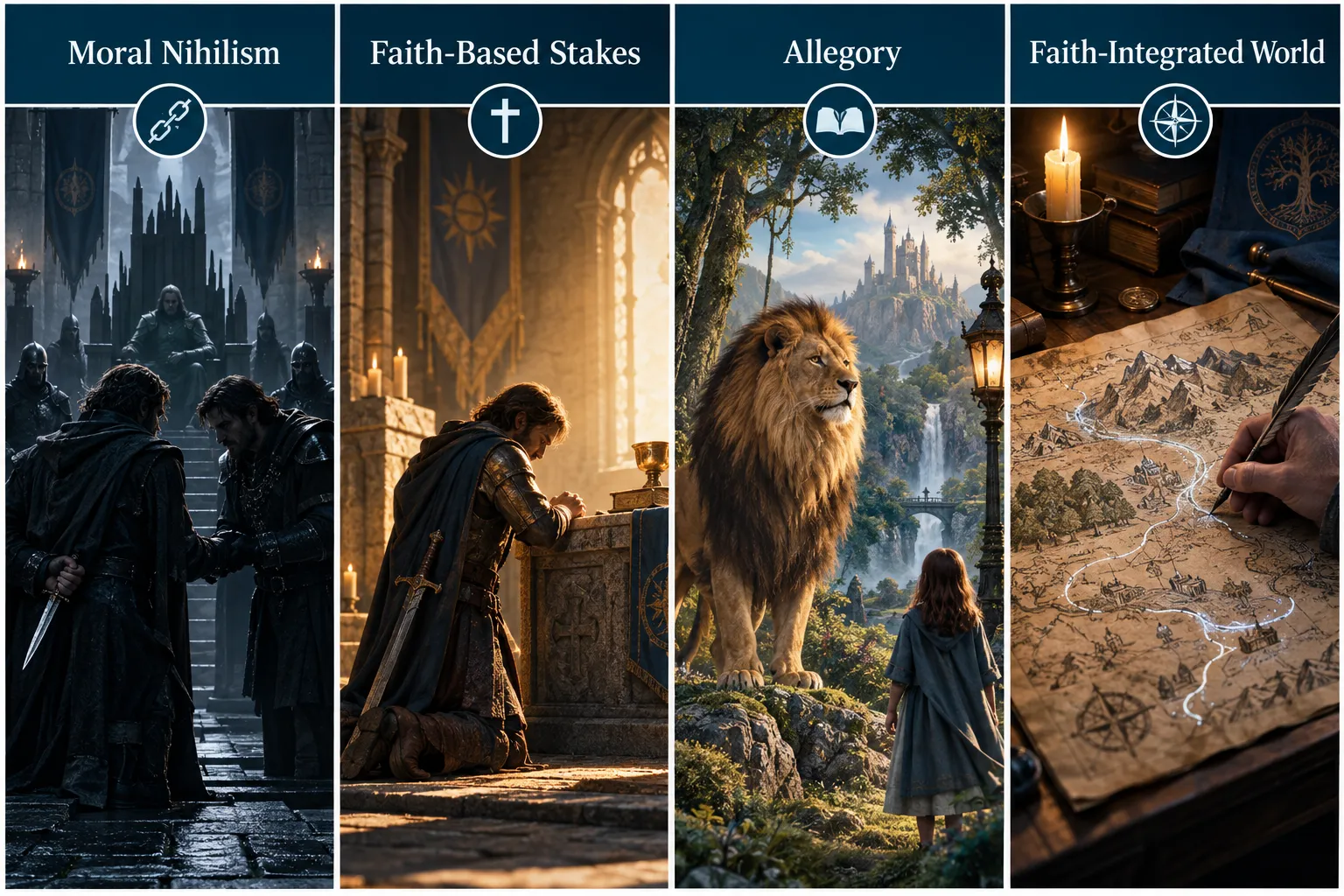
Faith-based fantasy worlds handle moral complexity by treating it as genuinely costly rather than ultimately meaningless. The difference is not that characters always make the right choice, they often don’t, but that the wrong choice carries real weight, and the right choice requires something real to be given up.
A May 2026 essay on religion in fantasy noted that modern secular fantasy frequently treats religion as worldbuilding, politics, horror, or symbol rather than as lived faith, and specifically observed that it tends to avoid “the inner experience of faith itself.” [27] That inner experience, doubt, surrender, the moment a character chooses faithfulness when unfaithfulness would be easier, is exactly what Christian epic fantasy is built to carry.
What moral complexity looks like in faith-based worlds:
- A character who holds a covenant obligation and is tempted to break it for a sympathetic reason, and the story takes both the temptation and the obligation seriously
- Villains who have coherent worldviews, not just appetites for cruelty
- Mercy that costs the person offering it, not just the person receiving it
- Doubt that is honest rather than resolved by a convenient miracle
- Justice and mercy in tension with each other, both treated as real values
This is faith under fire, not faith as a comfortable backdrop, but faith tested by the plot and proven (or broken) through what characters actually do.
Can Epic Fantasy Have Strong Morality Without Being Preachy?
Yes, and the key distinction is between a story that argues a moral position and one that enacts it through character choice and consequence. Preachy fiction tells the reader what to think. Faith-integrated fiction shows a world where certain things are true and lets the reader watch characters navigate that truth.
The brand distinction that matters here: fiction that walks with readers, not talks at them. A character who chooses mercy when vengeance would be easier, and pays a real price for that choice, communicates more about grace than three paragraphs of theological reflection ever could.
Practical markers of non-preachy faith-based fantasy:
- Faith shows up in decisions, not in narration
- Scripture or religious language appears as part of the world’s texture, not as lesson delivery
- Characters doubt without the story punishing them for doubting
- The “right” choice is hard enough that the reader feels the cost
- Grace arrives after the cost, not instead of it
Authors who manage this well, C.S. Lewis in the Space Trilogy, Brandon Sanderson in the Cosmere (where his faith shapes world-structure even when not foregrounded [27]), and newer voices in the Christian epic fantasy space, all share this quality: the conviction is real, but it’s carried in the architecture of the story rather than announced from a pulpit.
For more on faith-rooted character development in Christian fiction without sermonizing, the approach translates across genres.
Is Narnia Considered Christian Epic Fantasy?
Narnia is Christian fantasy, but it is primarily allegory rather than faith-integrated epic fantasy in the modern sense. In allegory, story elements map directly onto theological concepts, Aslan is Christ, the White Witch is evil, the Stone Table is the cross. The faith content is encoded in the symbols and decoded by the reader.
Modern Christian epic fantasy tends to work differently. Rather than building a symbol system that points back to Christian theology, it builds a world where the logic of the world reflects Christian convictions, about the nature of covenant, the cost of grace, the reality of evil, the possibility of redemption, without requiring the reader to decode a one-to-one map.
Allegory vs. faith-integrated world-building:
- Allegory: Story elements represent theological concepts. Works best when the reader knows the source material being allegorized.
- Faith-integrated world-building: The world’s moral and spiritual logic reflects Christian conviction, but the story stands on its own terms. Works for readers who don’t share the faith, because the world’s rules are internally consistent.
Narnia opened the door. The stronger modern tradition, including the work being done in series like The Sarel Chronicles and The Kethara Chronicles, builds worlds where faith is structural rather than symbolic.
For a broader view of the genre’s current shape, see best Christian epic fantasy series for readers who want deep faith themes without allegory.
What Makes House of the Dragon Different from Christian World-Building?
The sharpest difference is not content rating, it is what the story believes about consequences. House of the Dragon is built on a world where power is the only real value and every other value is a performance of power. Christian world-building is built on a world where some things are genuinely true regardless of who holds the throne.
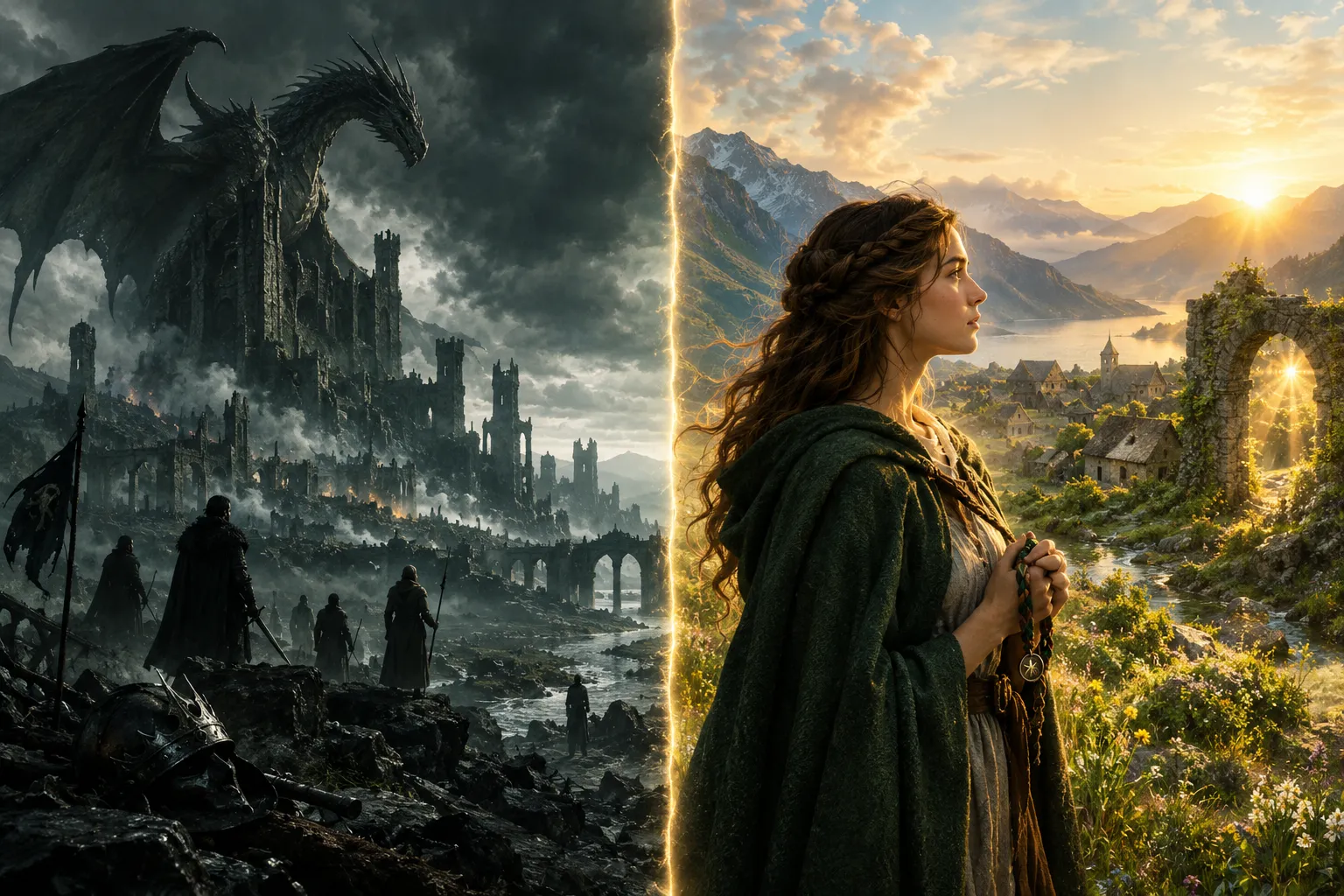
Side-by-side on the structural level:
| Story Element | House of the Dragon | Christian Epic Fantasy |
|---|---|---|
| What drives the plot | Power, dynasty, survival | Covenant, justice, mercy, redemption |
| What betrayal costs | Tactical disadvantage | Moral and spiritual weight; real loss |
| What mercy looks like | Weakness or strategy | A choice that costs the one offering it |
| How the story ends | Pyrrhic, ironic, or tragic | Earned, grace arrives after cost |
| What the world believes | Nothing is sacred | Something is sacred, and the story proves it |
The finale of House of the Dragon Season 3 drew 21 million global viewers in its first three days [4][6]. That audience is hungry for scale, politics, and consequence. Christian epic fantasy can deliver all three, and add the one thing prestige nihilistic fantasy structurally cannot: the possibility that the right choice was worth making.
Best Christian Fantasy Books Like Lord of the Rings
The Lord of the Rings is the template for epic fantasy with moral weight, Tolkien was a devout Catholic and his faith saturated the world’s structure, even without explicit religious content. Readers looking for that combination of scale, moral seriousness, and hope in the dark have several strong options in 2026.
Starting points for readers coming from Tolkien or prestige fantasy:
- The Sarel Chronicles (The Map of Unanswered Prayers, The Roads That Lied, Beyond the Maker’s Map), a covenant fantasy world where silver roads mark answered prayers and a disgraced map-scribe discovers what the official record refuses to hold. Faith under fire, earned grace, and a world where the Maker-Who-Hears is real and present without being convenient. Browse the series.
- The Kethara Chronicles (The Stone That Remembered, The Cord That Loosened, The Name That Returned), an empire trying to count and contain every act of mercy, and two women carrying a covenant word the auditors cannot own. Browse the series.
- C.S. Lewis’s Space Trilogy (Out of the Silent Planet, Perelandra, That Hideous Strength), less read than Narnia, more theologically dense, and genuinely epic in scope.
- Stephen Lawhead’s Pendragon Cycle, Arthurian epic fantasy with deep Christian conviction and real moral complexity.
The 2026 Christian fantasy landscape is broader than it has ever been, with major publishers maintaining dedicated imprints (WaterBrook, Multnomah, Zondervan) alongside a thriving independent and Kindle Unlimited ecosystem. For a current survey, see the 2026 Christian fantasy boom: how epic faith-focused series are breaking out beyond Narnia retellings.
Does Christian Epic Fantasy Appeal to Non-Religious Readers?
It can, and the best of it does, for the same reason Tolkien appeals to readers who have never thought about Catholicism. When faith is structural rather than decorative, the story works on its own terms. A reader who doesn’t share the author’s convictions can still feel the difference between a world where consequences are real and a world where they aren’t.
What non-religious readers tend to respond to in well-written Christian epic fantasy:
- Moral stakes that feel earned, choices matter because the world is built to make them matter
- Characters who believe something and pay for it, conviction under pressure is compelling regardless of what the conviction is
- Hope that isn’t cheap, a story that earns its hopeful ending is more satisfying than one that delivers despair as a substitute for depth
- Absence of gratuitous content, many readers who don’t identify as Christian still prefer clean fiction simply because graphic content doesn’t add to their reading experience
The risk is when faith-based fiction becomes a genre signal for “safe and sanitized” rather than “honest and grounded.” The strongest Christian epic fantasy avoids that trap by being genuinely honest about hard things, doubt, failure, injustice, the cost of mercy, while refusing to mistake darkness for depth.
What’s the Difference Between Allegory and Faith-Integrated Fantasy?
Allegory encodes a message in symbols and asks the reader to decode it. Faith-integrated fantasy builds a world whose internal logic reflects the author’s convictions, without requiring the reader to map story elements onto theological concepts.
The practical test: In allegory, removing the theological layer collapses the story. In faith-integrated fantasy, the story stands on its own, the faith is in the structure, not the surface.
A July 2026 interview with author L. Jagi Lamplighter Wright described the goal as “Christian magic, or maybe a better term would be Christian wonder”, prayer and Scripture as part of the creative process, not as content to be inserted into the narrative. [63] Author Kate Stradling framed her worldbuilding question in April 2026 as: “What would a Messianic faith look like in a world that didn’t host the mortal Christ?” [61] Both approaches produce worlds where faith is generative rather than illustrative.
For readers who find allegory too on-the-nose but want faith genuinely present in their fantasy, the distinction matters enormously. See the tag page for fantasy allegory for further reading on where the line falls.
Christian Fantasy Authors Who Avoid Heavy-Handed Messaging
The authors who handle this best share a common discipline: they trust the story to carry the conviction without announcing it. Faith shows up in what characters choose, what those choices cost, and what the world does with the cost, not in narrative commentary or dialogue that sounds like a devotional.
Authors and series worth knowing in 2026:
- C.S. Lewis, the standard-setter; faith as world-logic, never as lecture
- J.R.R. Tolkien, Catholic conviction in every structural layer, almost never on the surface
- Brandon Sanderson, faith shapes the deep architecture of the Cosmere even when religion isn’t foregrounded [27]
- Stephen Lawhead, historical and epic fantasy with genuine theological weight
- Silas Bellhaven (The Sarel Chronicles, The Kethara Chronicles), covenant fantasy built on the question of what it costs to tell the truth once you’re holding it
The shared quality: none of these authors use fiction as a vehicle for a lesson. They use fiction as a place where faith gets tested, doubted, and proven, or broken, through what actually happens in the story.
For readers building a reading list, the best Christian epic fantasy series for readers who want deep faith themes without allegory is a strong starting point.
Conclusion
The appeal of House of the Dragon, scale, political stakes, consequence, a world that feels genuinely dangerous, is real, and the numbers confirm it. [4][9] But moral nihilism is not the same as moral seriousness, and “everything is corrupt” is not the same as “everything is at stake.” Christian epic fantasy compared to House of the Dragon reveals a genuine alternative: worlds built on the conviction that mercy and justice are real, that redemption costs something before it arrives, and that hope in the dark is earned rather than naive.
Actionable next steps for readers:
- If you’re coming from prestige fantasy and want the same scale with real moral stakes, start with The Map of Unanswered Prayers (browse the Sarel Chronicles) or The Stone That Remembered (browse the Kethara Chronicles).
- If you want to understand how faith-based world-building works structurally, read Christian epic fantasy worldbuilding: integrating faith without preaching.
- If you’re a writer building a secondary world with faith at its center, the Christian epic fantasy with faith-integrated magic systems resource covers the craft side in depth.
- Browse the full Silas Bellhaven catalog, Christian frontier western, covenant fantasy, cozy mystery, psychological thriller, and LitRPG, at the Amazon author page.
The audience for high-stakes fantasy is enormous. The audience for high-stakes fantasy that believes something is worth fighting for, that’s the one Christian epic fantasy is built to serve.
FAQ
What is Christian epic fantasy? Christian epic fantasy is secondary-world fiction where faith in a divine being or covenant relationship shapes the world’s moral logic, the characters’ choices, and the story’s outcome. It differs from secular fantasy in that the moral stakes are grounded in something the author believes is genuinely true, not just constructed for narrative convenience.
Is House of the Dragon morally nihilistic? By most critical readings, yes. The show is structured around the premise that power is the only real value and that every other value, loyalty, mercy, family, is either a performance or a liability. A September 2026 cultural review described it as defined by “dead-eyed ruthlessness.” [8] That’s a structural choice, not just a content rating.
Can Christian fantasy have complex villains and moral gray areas? Yes. Moral complexity and moral nihilism are not the same thing. Christian epic fantasy can and should feature characters who make genuinely difficult choices, villains with coherent worldviews, and situations where mercy and justice pull in opposite directions. What it won’t do is treat all of those tensions as equally meaningless.
What’s the difference between Narnia and modern Christian epic fantasy? Narnia is allegory, story elements map onto theological concepts. Modern Christian epic fantasy tends to be faith-integrated rather than allegorical, meaning the world’s internal logic reflects Christian conviction without requiring readers to decode a symbol system. The story stands on its own terms.
Does Christian epic fantasy have to be clean? Most Christian epic fantasy is clean in the sense of avoiding graphic violence, explicit content, and profanity, but “clean” doesn’t mean “stakes-free.” The best of it is honest about hard things while refusing to use darkness as a substitute for depth.
Who are the best Christian epic fantasy authors? C.S. Lewis, J.R.R. Tolkien, Stephen Lawhead, and Brandon Sanderson are the most recognized. In the current Kindle Unlimited and indie space, Silas Bellhaven (The Sarel Chronicles, The Kethara Chronicles) represents the newer generation building covenant fantasy worlds with earned grace at the center.
Does Christian epic fantasy appeal to non-Christian readers? It can, especially when faith is structural rather than preachy. Readers who don’t share the author’s convictions can still respond to a world where moral stakes are real, consequences are earned, and hope isn’t cheap.
What is earned grace in fiction? Earned grace means redemption arrives after real cost, the character has genuinely failed, genuinely paid, and the mercy that follows is proportional to what was lost. It’s the structural opposite of cheap grace, where forgiveness arrives without consequence and the story doesn’t require anything from its characters.
How does faith-based world-building raise the stakes in fantasy? When the world is built on the conviction that some things are genuinely sacred, that covenant matters, that mercy is real, that justice has weight, the stakes of violating those things are higher than in a world where everything is negotiable. The reader feels the cost of betrayal more acutely when the story believes betrayal actually costs something.
What Christian epic fantasy series should I read first in 2026? Start with The Map of Unanswered Prayers (Sarel Chronicles) for covenant epic fantasy, or The Stone That Remembered (Kethara Chronicles) for a more intimate faith-under-pressure story. Both are available on Kindle Unlimited.
References
[2] House Of The Dragon Season 3 Nielsen Charts July 2026 – https://www.cbr.com/house-of-the-dragon-season-3-nielsen-charts-july-2026/
[3] House Dragon Season 3 Finale Viewership 1818595 – https://www.ibtimes.co.uk/house-dragon-season-3-finale-viewership-1818595
[4] House Of The Dragon Season 3 Finale Ratings 39384 – https://au.variety.com/2026/tv/news/house-of-the-dragon-season-3-finale-ratings-39384/
[6] House Of The Dragon Season 3 Finale Ratings 39384 – https://au.variety.com/2026/tv/global/house-of-the-dragon-season-3-finale-ratings-39384/
[8] House Of The Dragon Streaming Charts Fall September 2026 Binge Fail – https://screenrant.com/house-of-the-dragon-streaming-charts-fall-september-2026-binge-fail/
[9] House Of The Dragon Season 3 Averages Over 33 Million Global Viewers Per Episode – https://wikiofthrones.com/house-of-the-dragon-season-3-averages-over-33-million-global-viewers-per-episode
[10] Streaming Ratings Aug 3 9 2026 1236690077 – https://www.hollywoodreporter.com/tv/tv-news/streaming-ratings-aug-3-9-2026-1236690077/