

Last updated: September 25, 2026
Quick Answer
Christian cozy mystery series design stays fresh by rotating the suspect network around a stable town, not by rotating the town itself. The core cast, the church, the recurring shops, and the protagonist’s household stay fixed while each book introduces a new institution, a new secret, and a new set of consequences that cost the community something real. Faith works through the choices characters make under pressure, never as a shortcut that solves the case for them.
Key Takeaways
- Comfort comes from repetition of place, not repetition of plot. The same porch, the same pew, a different shadow crossing it.
- Readers stay past book five when the town’s history keeps deepening instead of resetting each time.
- Christian cozies differ from secular cozies mainly in consequence: sin has weight, and grace still costs something.
- A series can run 8-12+ books before feeling stale if secrets escalate instead of repeating.
- New characters should marry into, move into, or get hired into the existing web, never replace it.
- The most common pacing mistake is a body that drops too late and a faith moment that arrives too on-the-nose.
- Overlapping mysteries work if book one plants a loose thread book five is allowed to pull.
What Makes a Cozy Mystery Feel Cozy vs. Just Slow-Paced
A cozy mystery feels cozy when the reader trusts the world enough to relax inside the tension, not when the plot simply moves slowly. Pace and cosiness are separate variables, a book can move briskly and still feel warm, or crawl along and feel merely tired.
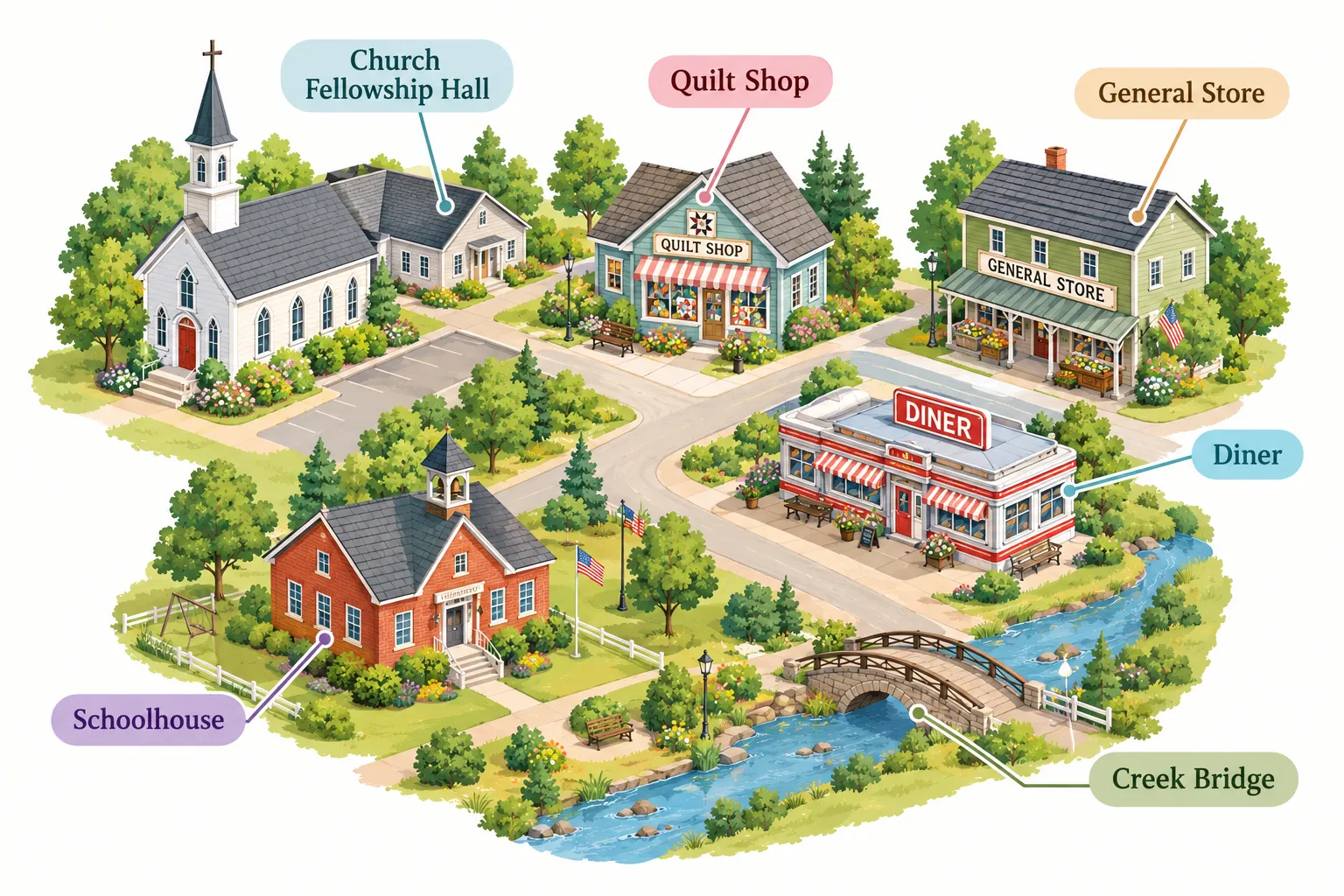
Coziness comes from three things working together:
- A contained, knowable community where the reader recognizes names before the second chapter ends.
- A protagonist whose moral compass is never really in doubt, even when her judgment is.
- Consequences that land on relationships, not just on a body count.
Slowness without those three elements is just a slow book. A scene where nothing happens for ten pages doesn’t create comfort; it creates skimming. The comfort readers actually want is the certainty that the town will still be standing, and mostly kind, by the last page, even after something ugly surfaces inside it.
Christian Cozy Mystery Series Design: The Town as Recurring Character
Good Christian Cozy Mystery Series Design treats the town itself as a character with a memory, not a set piece that gets redressed for each new plot. Every book should reveal a new room in a house readers already live in, rather than building a new house.
Genre guidance on cozy structure describes the setting as a “small, contained world” carried by recurring characters, where the town functions as more than backdrop, and that principle holds whether the community gathers at a diner counter or a church potluck. A useful production habit: keep a loose map of the protagonist’s home, workplace, and the streets between them, but resist locking down every business and institution too early. Leaving some geography open lets later books add a new clinic, a farm co-op, or a historical society without breaking continuity.
Best small-town settings for Christian cozy mysteries share a few traits:
- A church that functions as a real social hub, not a prop, potlucks, hymnals, benevolence funds, deacon boards.
- A economy small enough that everyone’s livelihood is legible (a quilt shop, a seed co-op, a family diner).
- At least one institution with paper records, a family Bible, a donation ledger, a hymnal margin, because faith communities keep written history, and written history is where cozy clues like to hide.
In Juniper Gap, Tennessee, the setting behind the Mercy House Mysteries’ amateur-sleuth tropes, the town’s donation boxes, quilt squares, and hymnal margins each carry a different layer of church-community history. No book replaces that history. Each one adds to it.
Christian Cozy Mystery Series Design: How to Make Every New Case Feel Fresh Without Losing the Small-Town Comfort
The freshness in Christian Cozy Mystery Series Design comes from changing the social network around a fixed town, not from changing the town. Recurring characters and places supply the familiarity; the case supplies a different cluster of suspects, motives, and institutional pressure each time.
That means:
- Book 1 might pull suspects from the church deacon board.
- Book 4 might pull them from a county fair committee.
- Book 8 might pull them from a school fundraiser.
Same town, three completely different social webs, three different sets of secrets, but the same protagonist walking through all of them, accumulating history as she goes.
Should every book have a different mystery, or can cases overlap? Both work, with one rule: overlap should feel like memory, not repetition. A minor detail from book two, an unresolved land dispute, a name mentioned once in passing, can resurface in book seven as the real motive. That’s earned continuity. What doesn’t work is solving structurally identical crimes (another hidden ledger, another dead deacon) back to back without varying the emotional stakes or the institution involved.
How Successful Cozy Mystery Series Keep Readers Coming Back Book After Book
Readers return to a series when the emotional stakes for the protagonist keep rising even as the town stays stable. A detective who feels exactly the same in book ten as she did in book one gives readers no reason to keep buying.
Industry commentary on current reader expectations argues that audiences want “community anchors, distinctive amateur sleuths, and a sense of warmth and wit,” alongside protagonists with real inner lives and real stakes [6]. That’s a meaningful correction to the idea that “wholesome” should mean emotionally flat.
To keep a detective interesting across 10+ books:
- Give her a standing personal question (a strained marriage, a church role she’s outgrowing, a grief she hasn’t finished) that develops slightly with every book.
- Let past cases change how the town treats her, trust earned or spent, not reset to zero.
- Let her get something wrong occasionally. A sleuth who’s never mistaken stops feeling like a person.
What makes readers stop reading a cozy mystery series? Usually one of three things: the mysteries start resembling each other structurally, the cast stops changing at all, or the faith content turns into a lecture instead of a lived choice. Readers don’t quit because a series is gentle. They quit because it stops moving.
Christian Cozy Mystery vs. Secular Cozy Mystery vs. Traditional Mystery: Key Differences
The difference between a Christian cozy, a secular cozy, and a traditional mystery novel is mainly about consequence, tone, and where the story locates the reader’s trust. A Christian cozy keeps sin and forgiveness both weighty; a secular cozy keeps them optional; a traditional mystery keeps procedure and violence at the center.

| Element | Christian Cozy | Secular Cozy | Traditional Mystery |
|---|---|---|---|
| Violence on page | Off-page, consequences shown | Off-page, lighter tone | Often on-page, procedural detail |
| Community institution | Church is load-bearing | Shop, club, or business | Police department, court |
| Resolution of guilt | Justice plus a costly grace | Justice, tidy ending | Justice, procedural closure |
| Sleuth type | Amateur, morally accountable | Amateur, often quirky | Professional detective |
Christian mystery publishing has been described as a category on the rise rather than a niche in decline, with major imprints continuing existing cozy series and launching new historical ones in the same publishing cycle [10]. That growth suggests readers are seeking exactly this middle ground: gentle on content, serious about consequence. For more on how faith-based whodunits handle suspense without exploitation, see this comparison of Christian cozy mystery and true crime storytelling.
How to Introduce New Characters Without Losing the Core Cast Readers Love
New characters should enter through the existing web, marriage, employment, church membership, family return, never replace a reader favorite outright. Readers forgive an expanding cast far more easily than a disappearing one.
A safe pattern for series longevity:
- Introduce the new character through a relationship a reader already trusts (the protagonist’s aunt hires a new deacon; the diner owner’s estranged son comes home).
- Give the newcomer one clear function in the mystery machinery, witness, red herring, ally, before expanding their personal arc.
- Let one core character react visibly to the newcomer, so the reader’s loyalty gets a bridge instead of a jolt.
Common mistake: dropping a whole new subplot cast in one book while sidelining the beloved regulars to make room. That reads as replacement, not growth, and it’s the fastest way to lose long-time readers.
Common Mistakes Writers Make with Cozy Mystery Pacing, Plot, and Series Length
The most common pacing mistake is delaying the crime past the point where the cozy contract expects it, then rushing the faith beat at the end to compensate. Craft guidance on the genre generally places the murder in the first tenth to fifteenth of the book, inside a 60,000-80,000-word range, a convention worth respecting rather than treating as a hard rule.
Frequent plot and pacing errors:
- Introducing too many suspects with thin motives instead of fewer suspects with real access and real reasons.
- Solving the mystery through a lucky discovery instead of fair-play clues the reader could theoretically catch.
- Letting a “miraculous shortcut”, prayer that reveals the killer outright, replace the deduction. Faith should shape a character’s courage or mercy; it shouldn’t do the detective work for her.
How many books can a cozy series run before it feels repetitive? There’s no fixed ceiling. A series stays fresh past ten books when the town’s institutional layers keep expanding (church, then school, then county government) and the protagonist’s personal stakes keep evolving alongside them. A series stalls at book four if the crimes, suspects, and emotional beats start rhyming too closely with earlier installments. Recent releases confirm writers keep finding new angles inside the same cozy shape, one July 2026 release built its whole mystery around a garbage collector who finds coded documents tied to an online game [4], and a June 2026 historical cozy used a 1920s music competition to supply a fresh suspect network without abandoning the genre’s comforting structure [5]. The lesson for series design: vary the clue architecture and the protagonist’s world, not the emotional promise.
Who Reads Christian Cozy Mysteries, and How Do You Balance Faith Without Preaching
Christian cozy mysteries are read overwhelmingly by women aged 35 to 65, many of them Kindle Unlimited subscribers, but the audience isn’t gender-locked, clean-fiction readers of any background who want suspense without graphic content or explicit language borrow these books at real volume. Reader-discovery data from a sample of ebook promotions in 2026 tracked more than 67,000 clicks across just 14 campaigns, with a median of nearly 4,900 clicks each, a sign the audience is actively searching, not passively stumbling onto the genre [1]. One recent trade-paperback bestseller list showed a single cozy title selling more than 9,000 copies in a week, confirming the category still moves real numbers [1].
Faith belongs in the plot machinery, not the narration. The strongest Christian cozies let prayer, forgiveness, or church accountability change a decision a character makes, who she protects, who she confronts, what she’s willing to forgive before the case even closes. The mystery still gets solved with evidence: contradictions in testimony, suspicious knowledge, timing that doesn’t add up. Grace shows up after the cost is paid, not instead of it. That’s the difference between faith under fire and a sermon dropped into chapter twelve. For a deeper look at keeping that balance intact, see this guide on faith in fiction without preaching, and this breakdown of Christian fiction subgenres ranked by reader engagement.
FAQ
What makes a cozy mystery feel cozy instead of just slow? A contained, knowable community and consequences that land on relationships, not the speed of the plot, create the comfort readers associate with cozy mysteries.
How is a Christian cozy mystery different from a secular one? A Christian cozy keeps sin and forgiveness weighty and tied to real cost; a secular cozy can resolve guilt more lightly, without a moral or spiritual accounting attached.
How is a cozy mystery different from a traditional mystery novel? Cozies use amateur sleuths, keep violence off-page, and center community life; traditional mysteries lean on professional detectives and procedural detail, often with more graphic content.
How many books can a series run before readers get tired of it? There’s no fixed limit, series stay fresh past ten books when the town’s institutions and the protagonist’s personal stakes keep expanding rather than repeating the same shape.
Should every mystery in a series stand completely alone? Standalone cases work fine, but planting a small unresolved detail early and letting it resurface several books later rewards long-term readers without confusing new ones.
How do you introduce new characters without alienating loyal readers? Bring new characters in through relationships readers already trust, marriage, employment, church ties, rather than replacing beloved regulars outright.
Who actually reads Christian cozy mysteries? Primarily women 35-65 on Kindle Unlimited, though the category also draws general clean-fiction readers who want suspense without graphic content.
How long should a cozy mystery be? Cozy mysteries typically run shorter than literary thrillers, commonly in the 60,000-80,000-word range, with the crime introduced early rather than delayed for atmosphere alone.
What’s the biggest mistake in cozy mystery pacing? Delaying the crime too long and then resolving the case through a lucky break instead of clues the reader could have caught themselves.
Can faith solve the mystery in a Christian cozy? No, faith should shape a character’s courage, mercy, or willingness to confront the truth, but the solution should still rest on evidence, not a divine shortcut.
Conclusion
Christian Cozy Mystery Series Design succeeds when the town gets to stay the same and the people inside it don’t. Readers come back because the church pew, the quilt shop, the diner counter are all still there, but the secrets underneath them keep getting harder to carry, and the grace that follows keeps costing someone something real. Start the next book by asking which institution in your town hasn’t been tested yet, which relationship needs to shift under new pressure, and which small detail from three books back is finally ready to matter. That’s how a series stays bingeable past book ten without turning familiar into flat. For more on building that kind of world reader by reader, explore Goodreads strategies for discovering clean Christian fiction lists and what draws readers to amateur sleuths over procedural detectives.
References
[1] Are Cozy Mysteries Still Popular Why Cozy Crime Is Thriving In 2026 – https://www.cozycrimes.com/more-coziness/are-cozy-mysteries-still-popular-why-cozy-crime-is-thriving-in-2026 [4] Acfw New Releases July 2026 – https://acfw.com/acfw-new-releases-july-2026/ [5] June 2026 New Releases In Christian Fiction – https://sarahhamakerfiction.com/2026/06/09/june-2026-new-releases-in-christian-fiction/ [6] What Readers Want Right Now The State – https://erinniumata.substack.com/p/what-readers-want-right-now-the-state [10] 100974 Mysteries On The Rise In Christian Fiction – https://www.publishersweekly.com/pw/by-topic/industry-news/religion/article/100974-mysteries-on-the-rise-in-christian-fiction.html