
Last updated: September 22, 2026
Quick Answer: Christian cozy LitRPG is a small but growing subgenre that combines game-mechanic storytelling, quests, crafting systems, skill progression, with faith-rooted themes and a warm, low-stakes tone. It strips out the harem romance subplots, graphic combat, and nihilistic power fantasy that dominate mainstream LitRPG, replacing them with community building, earned grace, and characters whose faith is tested by the plot rather than announced in it. For readers who want quests, crafting, and community without harem tropes, this subgenre offers a genuinely different reading experience.
Key Takeaways
- Christian cozy LitRPG prioritizes crafting, settlement building, and community over combat and romantic conquest.
- The LitRPG market has grown from 917 tracked releases in 2023 to an estimated 2,642 in 2025, making discovery, not availability, the real problem for filtered readers. LitRPG Critic
- Harem-free LitRPG is a specific, searchable filter, readers don’t have to accept romantic subplots as a genre default.
- Faith in this subgenre shows up as character choice and consequence, not scripture-dropping or sermon scenes.
- Cozy LitRPG is now treated as a defined subgenre with its own conventions: domestic settings, relationship-building, earned progression, and low-violence tone. [2]
- Non-religious readers can enjoy cozy LitRPG with faith themes, the worldview is woven into the story’s logic, not imposed on the reader.
- Kindle Unlimited is the primary discovery platform; most titles are serialized, so starting with Book 1 of a proven series is the best entry point.
- The top 10 eligible LitRPG works captured roughly 30% of tracked consumption, meaning lesser-known Christian titles require deliberate search rather than algorithm browsing.
- Crafting-focused LitRPG (smithing, herbalism, settlement building) is a distinct category from dungeon-core or combat-heavy progression fantasy.
- The Measured Debt series by Silas Bellhaven is one of the clearest examples of Christian LitRPG built on earned progression and faith under fire rather than power fantasy.
What Is Christian Cozy LitRPG and How Is It Different From Regular LitRPG?
Christian cozy LitRPG is a subgenre where game-mechanic storytelling, stat systems, skill trees, quests, crafting, is filtered through a faith-rooted worldview and a cozy, community-focused tone. Regular LitRPG often centers on combat escalation, overpowered protagonists, and romantic conquest (frequently through harem dynamics). Christian cozy LitRPG replaces those defaults with something quieter and more honest.
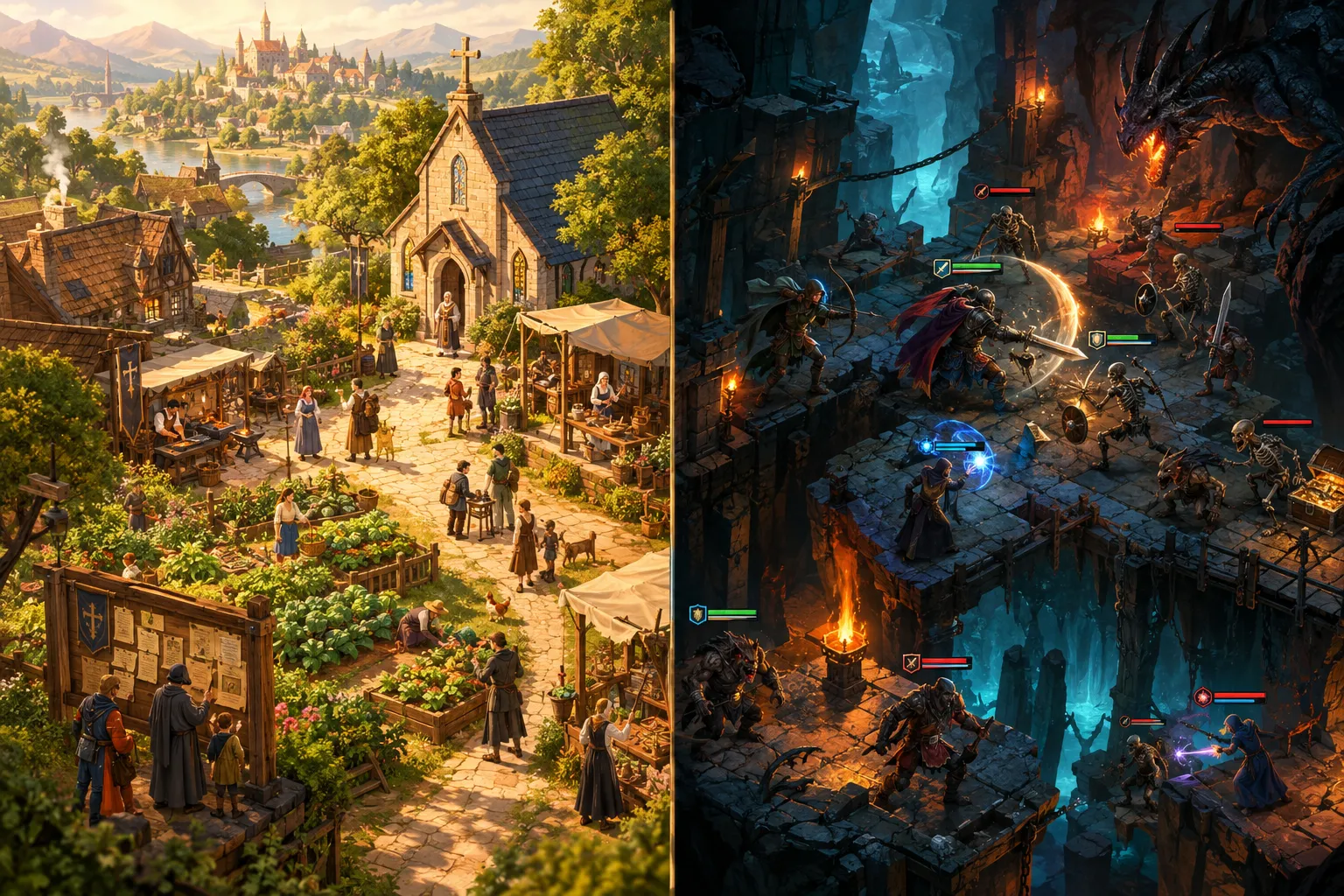
The distinction runs deeper than content filtering. In mainstream progression fantasy, power is the point, the numbers go up, the enemies get bigger, and the protagonist’s dominance is the reward. In cozy LitRPG, the reward is belonging: a village that trusts you, a craft you’ve mastered through failure, a community that needed what you built. [6]
When faith enters that framework, the mechanics themselves become theological. A crafting system that requires patience and repeated failure mirrors the shape of sanctification. A quest that costs the protagonist something real before grace arrives, that’s not a game mechanic dressed up in Christian vocabulary. That’s earned grace working through the story’s own logic.
The key differences at a glance:
| Feature | Standard LitRPG | Christian Cozy LitRPG |
|---|---|---|
| Progression goal | Power, dominance | Community, craft, calling |
| Romance | Often harem-structured | Absent or secondary |
| Combat | Central, graphic | Minimal or non-graphic |
| Faith | Absent or incidental | Load-bearing to the plot |
| Tone | Escalating tension | Warm, earned resolution |
| Stakes | World-ending threats | Personal, relational, moral |
For a fuller introduction to how faith integrates with game mechanics, see What Is Christian LitRPG and Why Readers Are Discovering It.
LitRPG Without Harem Romance Subplots, Is That Actually a Searchable Category?
Yes, and in 2026, it’s a more useful filter than ever. The LitRPG market now releases an estimated 532 titles per month, and a significant portion of mainstream releases carry harem or explicit romance subplots as genre conventions. [LitRPG Critic] Readers who want to avoid those elements need more than a “clean” label, they need specific vocabulary.
The terms that work as filters: harem-free LitRPG, cozy LitRPG, slice-of-life progression fantasy, and crafting LitRPG. Each of these signals a different relationship to the romance-and-combat defaults of mainstream progression fantasy. Christian LitRPG adds a further layer: faith as a structural element, not a background detail.
What “harem-free” actually means in practice:
- No romantic subplot where the protagonist accumulates multiple love interests
- Female characters with agency and purpose beyond romantic function
- Community relationships built on trust, shared mission, or covenant, not attraction
- Emotional stakes that don’t resolve through romantic conquest
For readers who also want to avoid explicit content across other Christian fiction genres, Non-Romance Christian Epic Fantasy for Kindle Unlimited Readers covers the same filtering logic applied to high fantasy.
Best Christian LitRPG Books With Crafting Systems and Faith Themes
The clearest current example of overt Christian LitRPG is Kenneth Bliss’s Canthany Rising, reviewed in July 2026 as a clean Christian LitRPG novelette for TTRPG and MMORPG readers, no profanity, no explicit content, non-graphic battles, with creation magic, angels, and consequential progression rather than “cheat” mechanics. The theological premise is unusually direct: seven animals sent by God (called “the Three-Who-Are-One”) become humanoid and oppose a fallen angel named Ashtoreth. That’s not merely clean secular fantasy with a cross on the cover, it’s overt Christian worldbuilding. [Julie Arduini, 2026]
Silas Bellhaven’s The Measured Debt series takes a different approach. Set at Federated Record, a world where collapse events are documented and assigned blame through a position series, the protagonist Eamon Kersey is the strongest hand in every wrecked corridor he enters. The game mechanics are accountability structures: records, ledgers, position series. The faith question isn’t announced; it’s built into what the system measures and what it can’t.
- The Cost of Being Chosen, Amazon: Eamon’s name keeps clearing every collapse, until the record starts asking why he’s always the one left standing.
- The Remembered Route, Amazon: A corridor route he swears he never walked appears twice in the record.
- The Borrowed Yield, Amazon: The numbers he built his reputation on were never fully his, and the debt has come due.
For readers who want crafting specifically, herbalism, smithing, settlement building, the cozy LitRPG category on Goodreads and community-maintained lists at sites like Fantasy Ranked and ProgressReads are the most reliable discovery tools. [8] [6]
For a broader look at faith-integrated quest design, Designing Faith-Integrated Quest Lines in Christian LitRPG walks through how spiritual milestones can function as quest structure without becoming sermon scenes.
Cozy LitRPG Community Building Storylines, What to Expect
Cozy LitRPG is defined by its social architecture. The progression isn’t just about the protagonist’s stats, it’s about what they build with other people. [2] Community-building storylines typically involve:
- Settlement development: founding or restoring a village, inn, farm, or guild hall
- Relationship progression: earning trust, resolving conflict, restoring broken community bonds
- Shared craft: characters contributing different skills toward a collective goal
- Low-threat stakes: the danger is loss of belonging or failure of the community, not world-ending combat
In Christian cozy LitRPG, these elements carry theological weight without announcing it. A community that has to decide whether to shelter someone dangerous is working through mercy and justice in real time. A crafting system that rewards patience and penalizes shortcuts is telling a story about character formation. The faith isn’t decorating the plot, it’s load-bearing.
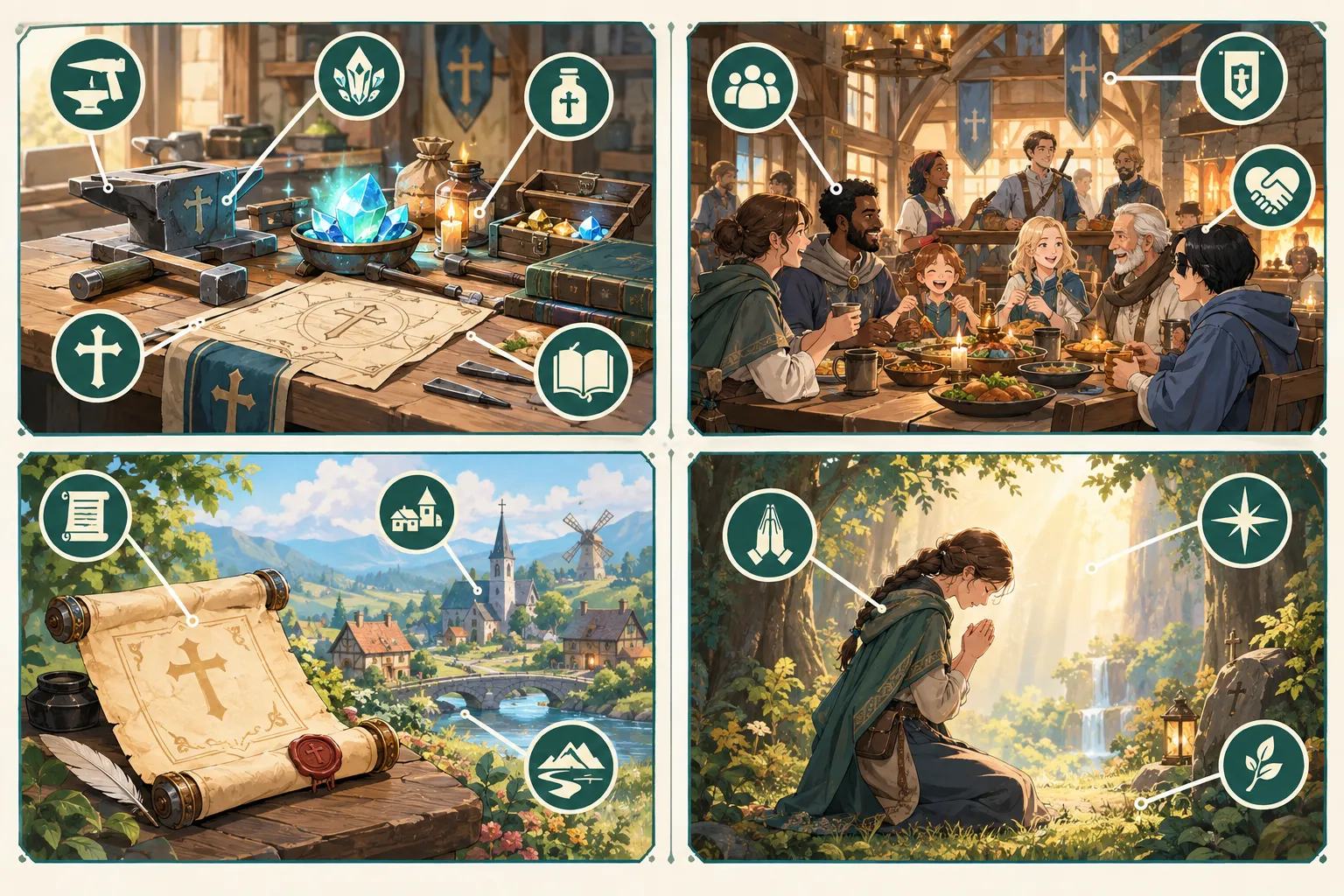
This is why Christian cozy LitRPG for readers who want quests, crafting, and community without harem tropes lands differently than a standard “clean” label. The community isn’t just a setting, it’s the point. And the faith isn’t a content filter, it’s what makes the community’s choices matter.
For readers who enjoy this community-centered warmth in other genres, Christian Cozy Mystery Tropes Readers Love covers the same emotional architecture applied to small-town mystery fiction.
Can You Read Cozy LitRPG If You’re Not Religious?
Yes. The best Christian cozy LitRPG doesn’t require the reader to share the protagonist’s faith, it requires the reader to follow the story’s internal logic, and that logic includes faith as a real force with real consequences.
Think of it the way a non-Catholic reader can follow The Name of the Rose without converting, the theology shapes the world, the stakes, and the characters’ choices, and that’s what makes the story work. Faith under fire is more interesting to read than faith as decoration, regardless of the reader’s own beliefs.
What non-religious readers should expect:
- Characters who doubt, fail, and work through belief rather than performing it
- Moral stakes that feel earned rather than imposed
- No altar-call moments or conversion scenes as plot resolution
- Worldbuilding where faith is structural, not ornamental
What they won’t find:
- Preachy narration or scripture-dropping
- Clean content as a disclaimer, the tone carries it without announcing it
- Characters whose faith makes them invulnerable or morally perfect
Who Should Read Cozy LitRPG vs. Hardcore LitRPG?
Choose cozy LitRPG if: you want progression that feels earned rather than explosive, you’re drawn to domestic or rural settings, you care more about relationships than combat stats, and you want to finish a book feeling settled rather than wired.
Choose hardcore LitRPG if: you want rapid power escalation, complex combat systems, high-stakes dungeon runs, and a protagonist who becomes increasingly dominant over the world around them.
Christian cozy LitRPG specifically fits readers who:
- Already read Christian cozy mystery or Christian fantasy and want game-mechanic storytelling
- Are Kindle Unlimited subscribers looking for clean progression fantasy
- Want faith represented as lived experience, not as a content warning
- Prefer community and craft over conquest
The overlap with the Christian cozy mystery audience is real. Readers who love the Mercy House Mysteries, set in Juniper Gap, Tennessee, where Nora Bell Hartley keeps finding bodies where she meant to find donations, often respond to the same emotional architecture in LitRPG: a protagonist with a moral compass, a community with real stakes, and grace that costs something before it arrives.
LitRPG Series Focused on Crafting, Not Combat
Crafting LitRPG is now a recognized sub-category distinct from dungeon-core, combat progression, and isekai. [2] The defining features:
- Protagonist’s primary skill is a craft (smithing, herbalism, cooking, enchanting, building)
- Progression is measured through craft mastery, not kill count
- Failure is part of the system, bad batches, broken items, wasted materials
- Community depends on what the protagonist makes, not how many enemies they defeat
In Christian terms, a crafting system built this way is already telling a story about vocation, the idea that work done faithfully, with skill and care, is itself a form of worship. That doesn’t need to be stated. It just needs to be built into the mechanics.
Crafting-focused titles worth searching:
- Settlement-building LitRPG (farming, inn management, village restoration)
- Herbalist or alchemist protagonists in low-combat worlds
- Blacksmith or enchanter progression with community dependency
- Any series tagged “slice-of-life progression fantasy” on community lists [8]
For readers building a broader clean-read TBR, Christian LitRPG on Kindle Unlimited: Hidden Faith-Forward Game Worlds covers discovery strategies specifically for faith-filtered progression fantasy.
How Much Do Christian LitRPG Ebooks Cost, and Where Do You Find Them?
Most Christian LitRPG titles are available on Kindle Unlimited, which means KU subscribers read them at no additional cost beyond the subscription. Individual ebook purchases typically range from $2.99 to $5.99 for novelette-length entries and $4.99 to $9.99 for full novels, consistent with indie Christian fiction pricing across genres.
Where to find them:
- Kindle Unlimited, primary platform; use filters for “clean,” “Christian,” and “LitRPG” or “progression fantasy”
- Goodreads lists, community-curated cozy LitRPG lists are the most reliable filter [10]
- r/litrpg release calendars, monthly community-maintained lists; September 2026 alone tracked approximately 110 ebook and audiobook releases [1]
- LitRPG Radar, release calendar with genre and content filters [3]
- Fantasy Ranked and ProgressReads, editorial recommendation sites with cozy and clean filters [6] [8]
The discovery problem: LitRPG’s top 10 works capture roughly 30% of tracked consumption, and 76.3% of consumption goes to Book 2 or later in a series. This means algorithm-driven browsing will almost never surface a small Christian title. Deliberate search using specific vocabulary, “Christian cozy LitRPG,” “harem-free crafting LitRPG,” “faith-based progression fantasy”, is the only reliable path.
For a broader guide to building a clean Christian TBR across genres on KU, see Kindle Unlimited Christian Reads: How to Build a Clean Faith-Filled TBR.
Common Mistakes in Writing (and Reading) Christian LitRPG
For writers:
- Making faith a content filter rather than a structural element, characters who are clean but not tested
- Resolving the faith question with a dramatic conversion scene instead of through accumulated cost
- Using game mechanics as decoration rather than as theological metaphor
- Writing community as backdrop rather than as the actual stakes
For readers choosing titles:
- Trusting “Christian” as a label without checking whether faith is load-bearing or merely atmospheric
- Assuming “cozy” means low stakes, cozy means intimate stakes, which can be harder to resolve than world-ending ones
- Skipping Book 1 of a series because it’s shorter or cheaper, 76.3% of LitRPG consumption happens in Book 2 and beyond, which means the series has to earn that read-through in Book 1
- Conflating “no harem” with “no romance”, some harem-free LitRPG still carries explicit content under a different label
The clearest signal a title is doing it right: faith shows up when the protagonist has to make a choice that costs them something, not when the narration explains their beliefs.
For more on how faith-rooted character development works without sermonizing, Faith-Rooted Character Development in Christian Fiction covers the craft mechanics directly.
FAQ
What is Christian cozy LitRPG? Christian cozy LitRPG is a subgenre combining game-mechanic storytelling (quests, crafting, skill progression) with faith-rooted themes and a warm, low-stakes tone. It prioritizes community building and earned progression over combat and romantic conquest.
Does Christian LitRPG have to be preachy? No. The best Christian LitRPG lets faith show through character choice and consequence rather than narration or scripture-quoting. If the protagonist’s belief is only visible when they announce it, the faith isn’t load-bearing.
What makes LitRPG “cozy”? Cozy LitRPG features domestic or rural settings, relationship-centered progression, crafting and settlement building, minimal graphic violence, and stakes that are personal and relational rather than world-ending. [6]
Is there LitRPG that avoids romance entirely? Yes. Some series carry a romance-absent content contract, meaning no romantic subplot at all, not just a clean one. Silas Bellhaven’s Mercy Line western series uses this contract explicitly, and The Measured Debt LitRPG series follows the same principle.
Can non-Christians enjoy Christian cozy LitRPG? Yes, provided the faith is woven into the story’s logic rather than imposed on the reader. Readers who don’t share the protagonist’s beliefs can still follow the internal stakes, doubt, cost, and grace work as narrative forces regardless of the reader’s own convictions.
What’s the difference between crafting LitRPG and dungeon-core LitRPG? Crafting LitRPG centers on a protagonist whose primary skill is making things, smithing, herbalism, enchanting, building. Dungeon-core LitRPG centers on managing a dungeon as a system. Both can be low-combat, but they have different structural focuses.
Where is the best place to find cozy LitRPG recommendations? Community-curated Goodreads lists [10], Fantasy Ranked [6], and ProgressReads [8] are the most reliable. General bestseller algorithms rarely surface niche-filtered titles.
How long are Christian LitRPG books? They range from novelette length (15,000-30,000 words, common for series openers) to full novels (70,000-100,000 words). Kenneth Bliss’s Canthany Rising is novelette-length; Silas Bellhaven’s Measured Debt novels are full-length.
What is earned progression in LitRPG? Earned progression means the protagonist’s growth comes through genuine cost, failure, sacrifice, moral choice, rather than cheat mechanics or arbitrary power boosts. In Christian LitRPG, this mirrors the theological shape of sanctification: grace arrives after cost, not instead of it.
Is The Measured Debt series available on Kindle Unlimited? Yes. The full Measured Debt series, The Cost of Being Chosen, The Remembered Route, and The Borrowed Yield, is available through Kindle Unlimited via the series page.
Conclusion
The LitRPG market in 2026 is enormous, fast-moving, and genuinely hard to filter. With an estimated 532 releases per month, the problem isn’t availability, it’s finding the right book without wading through a hundred wrong ones. [LitRPG Critic]
For readers who want quests, crafting, and community without harem tropes, Christian cozy LitRPG offers something the general market rarely delivers: game mechanics that carry moral weight, communities where belonging is earned rather than conquered, and faith that shows up when it costs something rather than when it’s convenient.
Actionable next steps:
- Start with a series, not a standalone. Over 76% of LitRPG consumption happens in Book 2 and beyond, which means Book 1 is the audition. Read it fully before deciding whether the series earns your time.
- Use specific vocabulary when searching. “Christian cozy LitRPG,” “harem-free crafting LitRPG,” and “faith-based progression fantasy” will surface different results than “clean LitRPG” alone.
- Check community lists. Goodreads cozy LitRPG lists [10] and sites like Fantasy Ranked [6] and ProgressReads [8] are curated by readers with the same filters you’re using.
- Try The Measured Debt. The Cost of Being Chosen is the clearest available example of LitRPG built on earned grace and faith under fire, start with Book 1 and see whether the mechanics match what you’re looking for.
- Browse the Canthany Rising universe. Kenneth Bliss’s series offers overt Christian worldbuilding with a connected universe planned across multiple genres, a different approach to the same faith-forward promise.
Hope in the dark is a real thing. So is a crafting system that rewards patience. When those two ideas live in the same book, that’s Christian cozy LitRPG for readers who want quests, crafting, and community without harem tropes, and it’s worth the search.
References
[1] September 2026 LitRPG Release Calendar – https://www.reddit.com/r/litrpg/comments/1w4e2al/september_2026_litrpg_release_calendar/
[2] Cozy LitRPG: The Complete Guide to Low-Stakes Progression Fantasy – https://fantasyranked.com/blog/2026-04-29-cozy-litrpg-the-complete-guide-to-low-stakes-progression-fantasy/
[3] LitRPG Radar Release Calendar – https://www.litrpgradar.com/release-calendar
[6] Cozy Fantasy LitRPG: The Complete Guide to the Genre – https://fantasyranked.com/blog/2026-06-12-cozy-fantasy-litrpg-the-complete-guide-to-the-genre/
[8] Best Cozy LitRPG Progression – https://progressreads.com/lists/best-cozy-litrpg-progression
[10] Cozy LitRPG Goodreads List – https://www.goodreads.com/list/show/224156.Cozy_LitRPG