
Last updated: September 17, 2026
Quick Answer: Christian cozy LitRPG is an emerging micro-niche that combines the low-violence puzzle-solving of cozy mysteries with the XP-driven progression systems of LitRPG fiction, set inside virtual or secondary worlds shaped by Christian ethics and grace. Characters solve whodunits, earn faith-rooted skill points, and face moral stakes, not combat fatalities, as the primary engine of tension. It’s clean, it’s earned, and the game mechanics serve the story rather than the other way around.
Key Takeaways
- Christian cozy LitRPG merges three distinct traditions: cozy mystery’s amateur sleuth structure, LitRPG’s explicit game mechanics, and Christian fiction’s commitment to faith as a lived, tested reality, not a backdrop.
- Cozy LitRPG differs from standard LitRPG primarily in tone and stakes: puzzles and relationships replace combat as the primary progression drivers.
- What makes a LitRPG “Christian” is not scripture-dropping, it’s a moral framework where grace costs something, choices carry spiritual weight, and the system itself reflects a theology of earned redemption.
- The LitRPG market grew from 917 tracked releases in 2023 to 2,642 in 2025, a 188% increase, making niche differentiation increasingly important for discoverability. [4]
- 76.3% of LitRPG consumption goes to Book 2+ in a series, which means cozy LitRPG readers who find a series they trust will stay. [4]
- Mystery-solving game mechanics, clue inventories, deduction skill trees, NPC relationship scores, translate naturally into cozy whodunit structures.
- The audience skews toward women 35-65 who read Kindle Unlimited, already comfortable with both cozy mystery and Christian fiction; LitRPG game logic is the new ingredient.
- Preachy theology is the single biggest failure mode in Christian LitRPG, faith works best when it shows up as character choice and consequence, not narration.
- Silas Bellhaven’s The Measured Debt series demonstrates that Christian LitRPG can carry real moral weight through progression mechanics without a single sermon.
- The cozy mystery market on Kindle currently shows approximately 6,899 competing titles with 59% in Kindle Unlimited, confirming strong serial viability for hybrid structures. [22]
What Is a Cozy LitRPG and How Does It Differ From Regular LitRPG
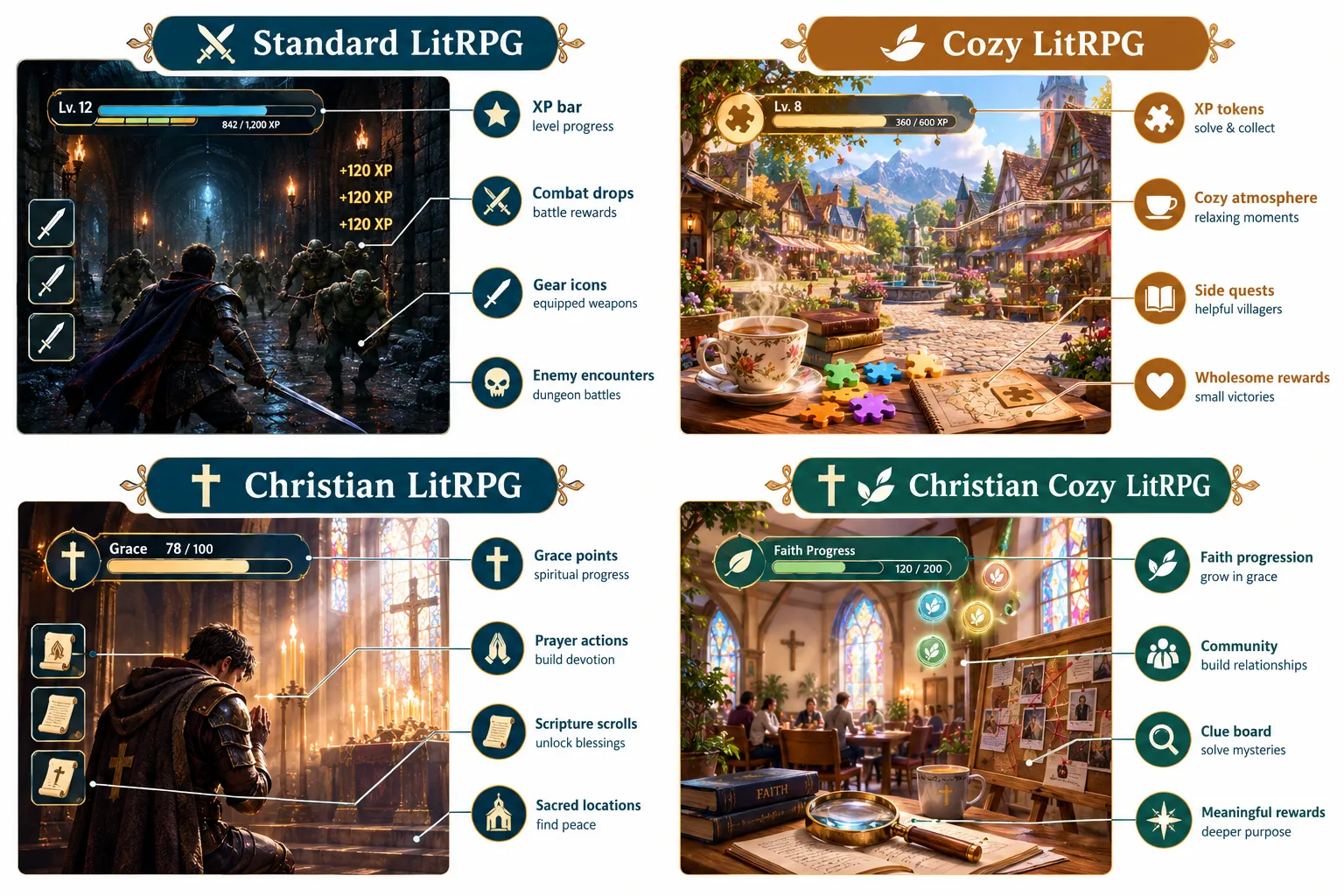
Cozy LitRPG is a subgenre where the game-world mechanics, stat screens, skill trees, XP gains, drive a story built around low-violence problem-solving rather than combat. Regular LitRPG typically centers on dungeon crawls, monster fights, and power escalation. Cozy LitRPG replaces the sword with a magnifying glass.
The distinction matters more than it sounds. In standard LitRPG, progression is measured in enemies defeated and levels gained through violence. In cozy LitRPG, progression is measured in:
- Mysteries solved (clues gathered, suspects cleared, truth revealed)
- Relationships deepened (NPC trust scores, community standing)
- Skills earned through discernment (observation, deduction, empathy as leveled abilities)
- Moral choices made (decisions that cost something and register in the system)
The “cozy” qualifier also signals a content contract to readers: no graphic violence, no explicit content, and a setting that feels warm even when something terrible has happened. Think small-town church social, not blood-soaked dungeon corridor.
A cozy LitRPG still has stakes. Someone died. A secret is buried. The game world is watching. But the reader isn’t asked to sit with gore, they’re asked to sit with the weight of what people do to each other when they think no one is recording it.
For more on how the broader LitRPG market is structured and where faith-based variants fit, see Christian LitRPG and Progression Fantasy Explained.
What Makes a LitRPG Christian and What Themes Does It Explore
A LitRPG becomes Christian not by inserting Bible verses into the stat screen, but by building a game world where the moral architecture reflects a Christian understanding of grace, accountability, and earned redemption. The system itself becomes a kind of ledger, and what gets recorded matters.
Core themes in Christian LitRPG:
- Earned grace, progression isn’t free. Every skill point costs something real: a sacrifice, a confession, a choice to act rightly when the wrong choice was easier.
- Mercy and justice held in tension, the game world doesn’t let characters off the hook, but it also doesn’t leave them without a path back.
- Faith under fire, the virtual world tests belief through event, not through sermon. A character’s faith is proven or shaken by what the plot puts in front of them.
- The record as moral weight, in the best Christian LitRPG, what gets logged in the system mirrors the theological idea that actions have permanent consequence. The ledger doesn’t lie.
- Hope in the dark, even when the dungeon is genuinely dangerous, the narrative holds open the possibility of redemption that costs something rather than cheap grace that costs nothing.
This is distinct from a story that simply features a Christian character. The whole system, the game world’s logic, reflects a theology. For a deeper look at how this works across the broader genre, The Rise of Christian LitRPG is worth reading alongside this.
How Do Whodunit Mystery Elements Work in a Game Mechanics Framework
Whodunit mystery structures translate into LitRPG game mechanics more naturally than most readers expect, because both systems are built on the same core logic: gather evidence, test hypotheses, and reach a verifiable conclusion.
The mechanical translation looks like this:
| Mystery Element | LitRPG Mechanic Equivalent |
|---|---|
| Clue discovery | Item pickup / inventory log |
| Suspect interview | NPC relationship check / dialogue tree |
| Deduction leap | Skill check (Observation, Insight) |
| Red herring | Failed skill roll / misleading quest marker |
| Revelation scene | Quest completion / truth-unlock event |
| Justice served | Reputation score / moral alignment shift |
The game mechanics don’t just decorate the mystery, they make the reader feel the detective’s growing competence. When a character’s Observation skill reaches Level 4 because she spent three chapters noticing what others missed, the reader has tracked that growth. The revelation lands harder because the progression was earned.
Common mistake: Letting the mechanics do the mystery-solving for the character. If the game system simply flags the killer at a high enough skill level, the whodunit collapses. The best Christian cozy LitRPG uses mechanics to surface clues, not to hand over answers. The character still has to choose what to do with the truth once she’s holding it.
For how amateur sleuth archetypes function in faith-based fiction more broadly, Christian Cozy Mystery and the Private Investigator Archetype covers the structural reasons these protagonists work so well in clean Christian fiction.
Best Christian Cozy LitRPG Books to Start With
The Christian cozy LitRPG micro-niche is genuinely new in 2026, which means the reading list is short but growing. Here are the most relevant starting points.
Silas Bellhaven, The Measured Debt series This is the clearest existing example of Christian LitRPG built on earned-progression theology rather than combat escalation. The series follows Eamon Kersey inside Federated Record, a corporate dungeon environment where the position series, the system’s ledger, becomes the moral battleground. Books:
- The Cost of Being Chosen, Book 1
- The Remembered Route, Book 2
- The Borrowed Yield, Book 3
The series page is at The Measured Debt on Amazon.
Kenneth Bliss, Canthany Rising Released June 22, 2026, this novelette explicitly combines biblical allegory, psionics, and game-inspired mechanics in a clean, faith-driven framework where “prayer shapes destiny.” It’s positioned as Christian LitRPG for TTRPG and MMORPG gamers who want action without profanity or explicit content, and it’s the first in a planned trilogy. [32]
For readers new to the LitRPG side of this hybrid: Christian LitRPG Kindle Unlimited: What to Expect gives a practical orientation before you commit to a series.
Can You Have Violence and Combat in a Cozy LitRPG, or Is It Supposed to Be Low-Stakes
Cozy LitRPG can include conflict and even danger, but graphic violence is off the table, and combat is never the primary progression driver. The “cozy” qualifier is a content signal, not a promise that nothing bad happens.
What’s allowed in cozy LitRPG:
- Characters in genuine peril (threat of harm, not graphic depiction)
- Consequences that feel real (someone died before the story began; the mystery is why)
- Moral danger (a character tempted to use the system dishonestly)
- Emotional stakes that hit hard (betrayal, grief, broken trust)
What cozy LitRPG avoids:
- Graphic combat descriptions
- Gore or visceral injury detail
- Violence as spectacle or entertainment
The stakes in a well-built Christian cozy LitRPG are actually higher in some ways than in a combat-heavy LitRPG, because the jeopardy is moral and relational rather than physical. A character who discovers the killer is someone she trusted, and has to decide whether to speak the truth or protect a friendship, is under more pressure than a character fighting a dungeon boss.
Low-stakes is a misread of the genre. The stakes are simply located in a different place.
What’s the Difference Between Christian LitRPG and Regular Fantasy With Faith Themes
Christian LitRPG and Christian epic fantasy both handle faith seriously, but they use different structural tools to do it.
Christian epic fantasy (like Silas Bellhaven’s The Kethara Chronicles or The Sarel Chronicles) builds faith into the world’s cosmology, covenants, prophecy, a Maker who is present and active. Faith shows up in the architecture of the world itself.
Christian LitRPG externalizes moral and spiritual reality through game mechanics. The system, the XP counter, the skill tree, the reputation log, becomes a kind of visible ledger of the character’s choices. Faith under fire shows up not as a cosmological event but as a progression decision: does the character spend their hard-earned grace points on personal power, or on mercy for someone who can’t repay it?
The key difference:
- Fantasy with faith themes: faith is woven into the world’s history and cosmology
- Christian LitRPG: faith is tested and proven through the mechanics themselves, the system is the arena
For readers who want both, Christian LitRPG: Gamification Meets Grace is a useful deep-dive on how the two approaches can coexist.
Who Reads Christian Cozy LitRPG and What Audience Is It For
The core audience for Christian cozy LitRPG sits at the intersection of three existing reader communities: Christian cozy mystery readers, Christian LitRPG readers, and Kindle Unlimited subscribers who want clean speculative fiction.
Primary audience profile:
- Women 35-65, Kindle Unlimited subscribers
- Already reading Christian cozy mystery series (Hope Callaghan, Maggie Blaine, or Silas Bellhaven’s Mercy House Mysteries)
- Open to speculative elements when the faith content is handled honestly, not preached
- Prefer earned progression over power fantasy
Secondary audience:
- Christian gamers (TTRPG/MMORPG players) looking for fiction that reflects their values [33]
- LitRPG readers who are tired of graphic content and want a clean alternative
- Readers of Christian epic fantasy who want something more puzzle-driven
Is it appropriate for young adults? Yes, with caveats. The content is clean by definition. The thematic complexity, moral ambiguity, spiritual doubt, the cost of grace, may land better with adult readers who’ve lived some of those questions. Teen readers with mature reading habits will find it rewarding; younger YA readers may want something with a lighter moral weight.
The cozy mystery market currently shows roughly 6,899 competing Kindle titles with 59% in Kindle Unlimited [22], which tells you the readership for cozy structures is large, serial, and digitally native. That’s the audience Christian cozy LitRPG is reaching into.
How Do You Balance Preachy Theology With Actual Story in Faith-Based Fiction
The short answer: faith belongs in the choices, not the narration. The moment a character stops acting and starts explaining what their faith means, the story stops.
This is the central craft challenge in all Christian fiction, and it’s sharpest in LitRPG because the game mechanics already carry a kind of explicit moral accounting. The temptation is to double down, to have the system and the narrator and the character all confirm the same spiritual lesson at once.
What works:
- A character chooses mercy when the system would reward revenge, and pays a real cost for it
- The skill tree has a “Forgiveness” branch that unlocks something unexpected, without the story explaining why forgiveness is important
- An NPC’s faith is shown through what they do when no one is watching, not through what they say about God
- The game world’s logic quietly mirrors grace: you can’t buy back what you spent dishonestly, but you can earn something new
What doesn’t work:
- A character pausing mid-quest to reflect on a Bible verse
- The system rewarding virtue with a visible “Faith Bonus” and then the narrator explaining what that means
- Conversion moments that arrive without cost or complication
- Any scene where the moral of the story is stated out loud
The brand principle that applies here across all of Silas Bellhaven’s fiction: walking with the reader, not talking at them. Faith in the dark is more convincing than faith explained in the light.
For a broader look at this craft question across genres, Faith in Fiction Without Preaching and Faith in Fiction Across Genres: How Much Is Too Much both address the balance directly.
How Does the Progression System in a Cozy LitRPG Keep Stakes High Without Violence
The progression system in a cozy LitRPG keeps stakes high by making moral and relational choices the primary currency of advancement, and by ensuring those choices have permanent, visible consequences inside the game world.

Mechanics that carry genuine weight in a non-combat cozy LitRPG:
- Reputation systems: NPC trust scores that change based on whether the character told the truth or protected herself. A broken trust doesn’t repair automatically.
- Discernment skill trees: Branching paths where choosing one skill forecloses another. A character who maxes out Observation may find her Mercy skill has atrophied.
- Clue permanence: Evidence that can be used or suppressed, and the system logs which choice was made. The ledger doesn’t forget.
- Grace point economies: A limited resource earned through sacrifice and spent on acts of mercy, not power. Spending grace on yourself costs differently than spending it on someone else.
- Consequence cascades: A wrong deduction doesn’t just fail the quest, it damages a relationship, shifts a reputation score, and closes a dialogue branch permanently.
The LitRPG market data supports why this matters structurally: 76.3% of consumption in the genre goes to Book 2+ in a series. [4] Readers who feel the weight of their protagonist’s choices in Book 1 come back for Book 2 to see what those choices cost. That’s the engine of a healthy series, and it runs entirely on consequence, not combat.
Common Mistakes New Authors Make Writing Christian LitRPG
Christian cozy LitRPG is a small enough niche that most authors entering it are building their approach from scratch. These are the failure modes that show up most often.
1. Using the game system as a sermon delivery mechanism If the skill tree has a “Faith” stat that the narrator keeps explaining, the mechanics have become a pulpit. The system should reflect theology structurally, not announce it.
2. Cheap grace in the progression If a character can fail morally and recover their stats without real cost, the Christian framework collapses. Earned progression means the debt is real. The borrowed yield always comes due.
3. Treating “cozy” as “low-consequence” Cozy means clean content and warm setting, it doesn’t mean nothing matters. A mystery where the answer is obvious and the stakes are trivial isn’t cozy, it’s dull.
4. Forgetting the game world needs internal logic Faith-rooted game mechanics still have to be consistent. If grace points work one way in Chapter 3 and differently in Chapter 7 because the plot needed it, readers notice.
5. Writing a Christian character inside a secular LitRPG framework A character who prays occasionally inside a system that otherwise functions on pure power fantasy isn’t Christian LitRPG. The system itself needs to reflect the moral architecture, not just one character’s personal habits.
6. Resolving mystery too quickly to let the moral weight land The whodunit structure exists to put the protagonist in the position of holding a truth that will cost someone something. Rushing to the reveal skips the most important moment in a faith-rooted mystery: the pause before she speaks.
FAQ
What exactly is Christian cozy LitRPG? It’s a fiction subgenre combining LitRPG’s explicit game mechanics (XP, skill trees, stat screens) with cozy mystery’s low-violence puzzle-solving, set in a world where the moral framework reflects Christian ethics, grace costs something, choices are recorded, and faith shows up through character action rather than narration.
Does Christian cozy LitRPG require a virtual reality or video game setting? Not necessarily. LitRPG mechanics can appear in secondary fantasy worlds, corporate dungeon environments, or any setting where the game-system logic is made visible to the reader. The “virtual world” framing is common but not required.
Is The Measured Debt series a cozy LitRPG? The Measured Debt is Christian LitRPG with strong mystery and moral-thriller elements. It leans toward corporate dungeon tension rather than small-town cozy warmth, but it demonstrates the earned-progression theology that cozy Christian LitRPG builds on. It’s the closest existing series to the hybrid.
Can cozy LitRPG have a romance subplot? It can, though some Christian LitRPG series (including The Measured Debt) operate on a romance-absent content contract. Whether romance is included depends on the author’s specific content framework.
Why is the LitRPG market growing so fast? Tracked LitRPG releases grew from 917 in 2023 to 2,642 in 2025, a 188% increase, driven by Kindle Unlimited’s serial model, reader appetite for progression fantasy, and the format’s natural fit with binge-reading behavior. [4]
What’s the difference between Christian LitRPG and Christian progression fantasy? LitRPG specifically uses visible game mechanics (stat screens, skill trees, explicit XP). Progression fantasy is the broader category, characters grow in power or wisdom over time, without necessarily showing the numbers. Christian LitRPG is a subset of Christian progression fantasy.
How do I find Christian cozy LitRPG on Kindle Unlimited? Search for “Christian LitRPG” and filter by Kindle Unlimited. The niche is small enough in 2026 that you’ll exhaust the available titles quickly, which is also an opportunity if you’re an author. Christian LitRPG Kindle Unlimited: What to Expect gives practical guidance on navigating the catalog.
Are there Christian cozy LitRPG series that don’t feel preachy? Yes. The best ones, including The Measured Debt, let the system carry the theology. When the game mechanics themselves reflect grace and consequence, the author doesn’t need to explain anything. The story does the work.
What game mechanics work best for mystery-solving in a virtual world? Clue-inventory systems, NPC relationship scores, branching deduction skill trees, and consequence-logging (where the system records what the character did with evidence) all translate naturally into whodunit structures. The key is that mechanics surface information without solving the mystery for the character.
Is Christian cozy LitRPG appropriate for young adults? The content is clean by design. The thematic depth, moral ambiguity, the cost of grace, spiritual doubt, may resonate more with adult readers, but mature teen readers will find it accessible and engaging.
Conclusion
Christian cozy LitRPG is a small niche with a large structural argument behind it. The cozy mystery format already trains readers to care about moral weight, who knew, who chose, who stayed silent. LitRPG mechanics already externalize consequence in visible, trackable form. And Christian fiction, at its best, holds both of those things together under the conviction that grace is real but never free.
The genre is still being built. The reading list is short. The craft questions are genuinely open. But the readers are already there, they’re the women who finish a Mercy House Mystery and wonder what it would feel like if Nora Bell Hartley’s deduction skills had a level counter. They’re the Christian gamers who want the moral architecture of their faith reflected in the game-world logic of their fiction. They’re the LitRPG readers who are tired of graphic content and want a system that rewards mercy as much as power.
Actionable next steps:
- Start with The Cost of Being Chosen to see how Christian LitRPG handles earned progression in practice
- Read Christian LitRPG: Gamification Meets Grace for a genre-level orientation
- If you’re an author, study how the cozy mystery structure handles moral stakes before you add game mechanics, the mystery has to work first
- Browse the Kindle Unlimited Christian Reads TBR guide to find the full range of clean faith-rooted fiction available right now
The record is still being written. What gets logged in it, and what it costs to tell the truth once you’re holding it, is exactly the question this genre was built to ask.
References
[4] 2026 08 10 State Of Litrpg 2026 Discovery Crisis Market Analysis – https://litrpgcritic.com/blog/2026-08-10-state-of-litrpg-2026-discovery-crisis-market-analysis/ [8] Litrpg – https://tropesmith.com/trope-demand/fantasy.dragons_mythical/litrpg