
Last updated: September 14, 2026
Quick Answer: Christian psychological thriller films remain a rare breed on screen, even as faith-based entertainment has become a commercially proven force in 2026. The gap isn’t a lack of source material, there are faith-rooted suspense novels with genuine cinematic potential sitting on Kindle Unlimited shelves right now. The real barrier is industry hesitation to trust that spiritual tension can drive a thriller without becoming a sermon. It can. And the books that prove it deserve a camera pointed at them.
Key Takeaways
- Faith-based films and streaming content are growing fast in 2026, but psychological thrillers with Christian themes remain underrepresented on screen [3][5]
- The best Christian suspense novels work cinematically because they build tension through moral choice and spiritual consequence, not graphic content
- Adapting faith-rooted fiction for film requires treating theology as character pressure, not backstory exposition
- The primary audience, Christian women 35-65, is already proven at the box office and on streaming platforms [7][8]
- Earned grace and faith under fire translate directly into the kind of moral jeopardy that makes psychological thrillers compelling
- Production companies like Pure Flix and Angel Studios have demonstrated that faith content can achieve strong ROI [8]
- The biggest adaptation mistake is softening spiritual conflict to make it “accessible”, that removes the very tension that makes the story work
- Several existing Christian thriller series, including Silas Bellhaven’s The Gathering Light, have the structure, stakes, and clean content profile that streaming adaptations need
What Makes a Psychological Thriller Work on Film vs. the Page
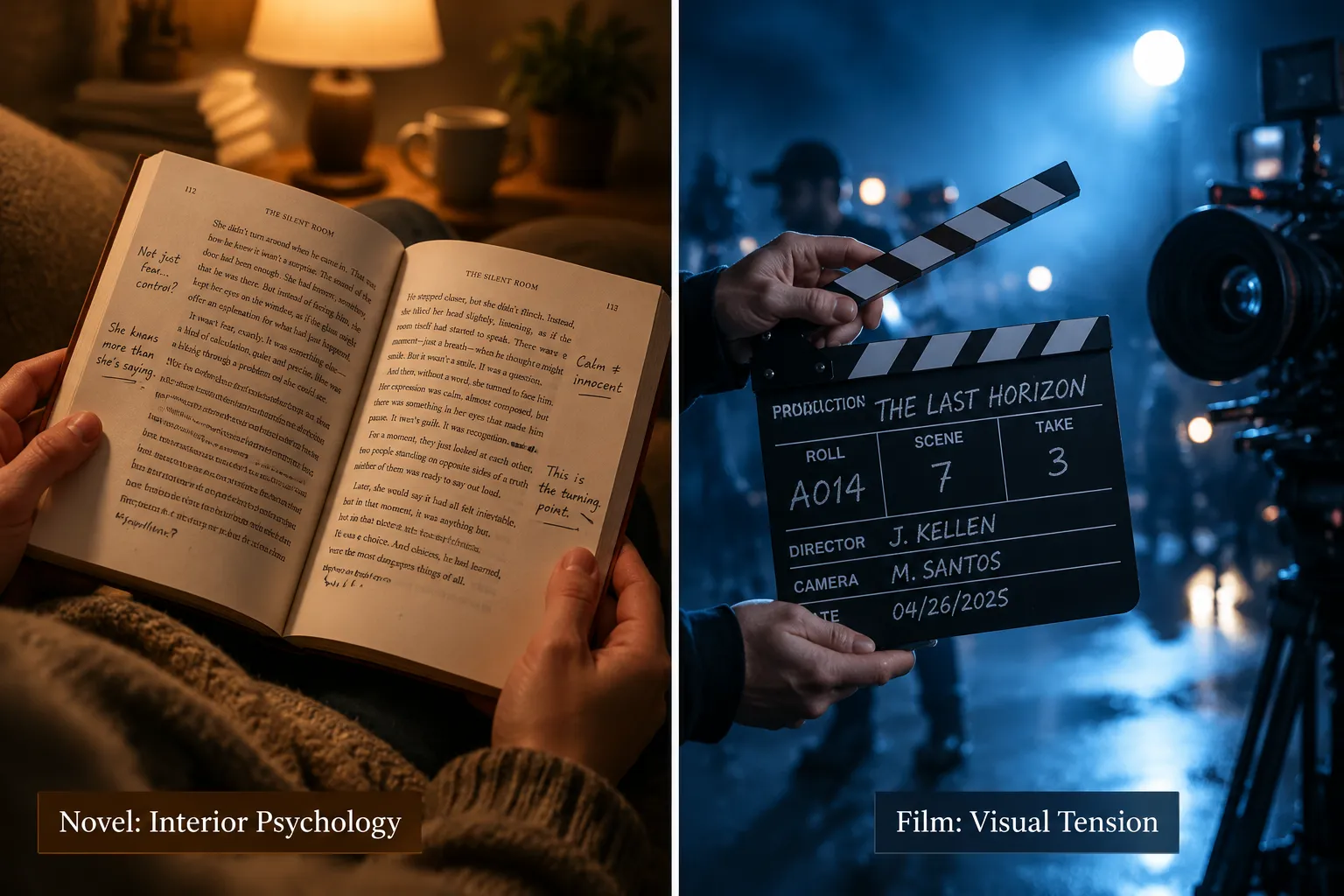
A psychological thriller works on screen when the audience can feel the protagonist’s doubt without being told what to think. In a novel, interiority carries the suspense, the reader lives inside a character’s fractured perception. On film, that same work must happen through visual cues, silence, and the gap between what a character says and what the camera shows.
The transition from page to screen isn’t just a format change. It’s a translation of trust.
- On the page: Unreliable narration, internal monologue, and slow revelation of withheld information create dread
- On screen: Framing, sound design, performance, and editing carry that same weight
- The faith dimension: In a Christian psychological thriller, the protagonist’s spiritual state becomes a visual language, a woman who stops praying, a Bible left unopened, a church she drives past without stopping
For a deeper look at how this interiority functions in the genre, the psychology of faith in thriller narratives is worth reading before any adaptation conversation starts.
The key question for any adaptation: what does the character believe, and what is the story doing to that belief? That question is cinematic. It doesn’t require a sermon. It requires a character whose faith is load-bearing, and then a plot that tests the load.
Why Are There So Few Christian Psychological Thriller Movies?
The short answer: the industry has historically treated “Christian film” and “genre thriller” as separate markets that don’t overlap. That assumption is changing, but slowly.
Faith-based films have proven their commercial strength. Movieguide’s research shows that redemptive content consistently outperforms at the box office [4], and a 2026 report from ibelieve.com lists a growing slate of Christian films and shows demonstrating audience demand [5]. Pure Flix has built an entire streaming library around faith content, including thriller-adjacent titles [8]. But the psychological thriller, with its moral ambiguity, unreliable characters, and slow-burn dread, has been treated as too dark for Christian audiences and too niche for mainstream ones.
That’s a false binary. The audience for Christian psychological thrillers vs. secular thrillers already exists and is actively reading. They want hope in the dark, not darkness avoided.
Three real barriers to more Christian thriller films:
- Greenlight hesitation, studios associate “Christian film” with inspirational drama, not suspense
- Script development gap, faith-rooted thriller novels aren’t being optioned because acquisition teams aren’t reading in that lane
- Tone miscalibration, when adaptations do happen, producers often strip the spiritual tension to broaden appeal, which removes the story’s actual engine
Best Christian Suspense Novels That Haven’t Been Adapted Yet
Several faith-rooted suspense novels have exactly the structure, stakes, and clean content profile that streaming adaptations need, and none of them have been optioned.
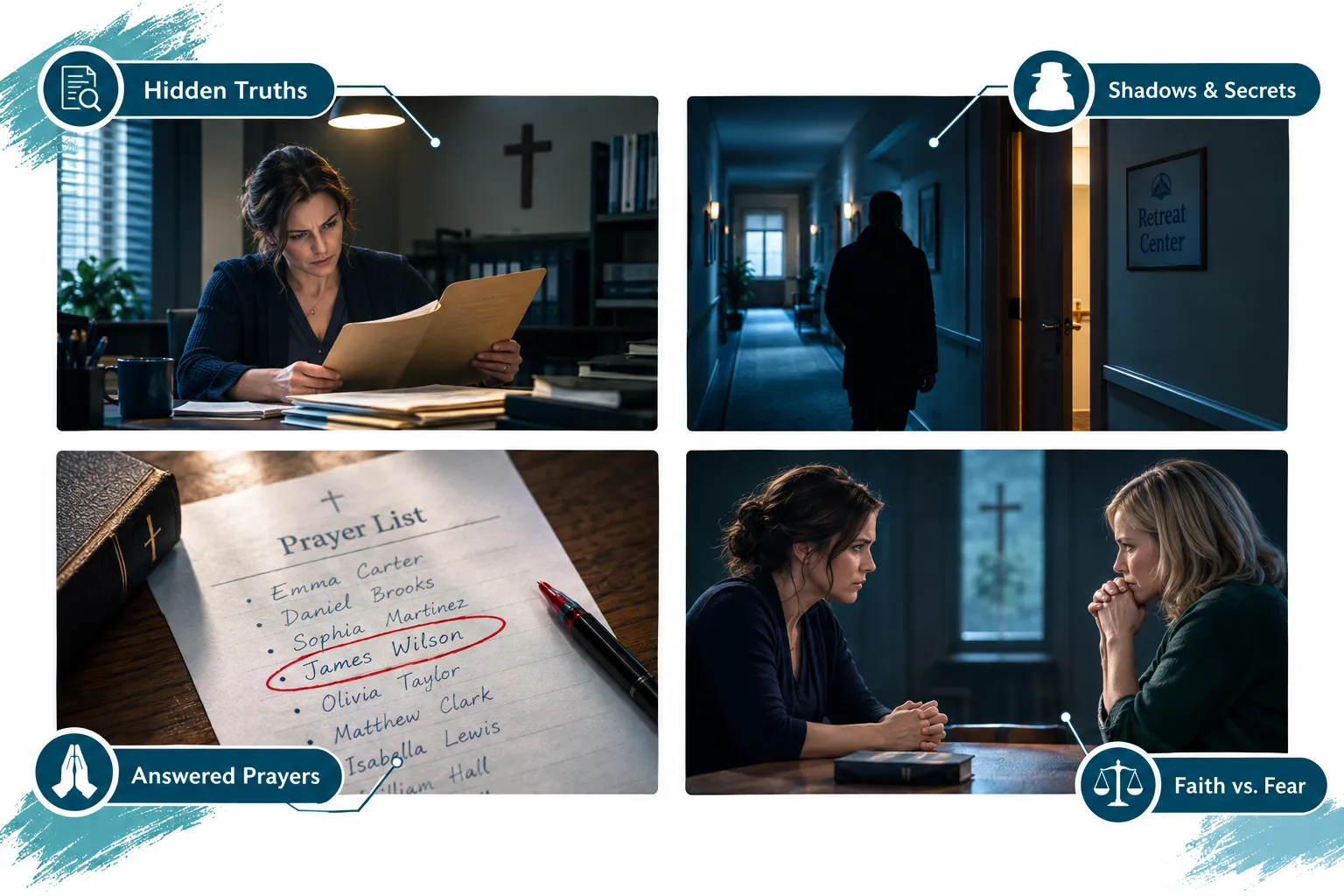
Silas Bellhaven’s The Gathering Light series is the clearest example. The three-book series, When Hannah Sleeps, When the Voice Breaks, and When the Prayer List Opens, is built around a Christian retreat center where testimonies are recorded, archived, and eventually weaponized. Each book follows a different woman whose own words are turned against her by a system she trusted.
That premise is cinematic on its face:
- A controlled institutional setting (the retreat center) that doubles as a threat environment
- A protagonist whose faith is genuine but whose trust has been misplaced
- Suspense built from paperwork, language, and recorded testimony, not violence
- A spine question that works as a logline: Who controls the record of someone’s truth?
The series also solves one of the hardest adaptation problems, it’s non-violent suspense that raises stakes without graphic content, which makes it immediately viable for faith-friendly streaming platforms.
Other novels worth watching in this space include works by Brandilyn Collins (Seatbelt Susie, the Kanner Lake series) and Terri Blackstock’s Moonlighters series, both of which blend genuine faith with real thriller mechanics.
How Do Faith Themes Work in Psychological Thrillers Without Being Preachy?
Faith works in a psychological thriller when it functions as pressure, not explanation. The moment a character stops to articulate their theology, the tension drops. The moment their theology is tested by what the plot forces them to do, the tension rises.
The rule is simple: show faith through choice and consequence, never through narration.
In When Hannah Sleeps, Hannah Garrick’s faith isn’t explained, it’s demonstrated by what she’s willing to risk when she finds her own testimony in someone else’s file. The spiritual weight of that moment comes from the cost, not the commentary. That’s earned grace, mercy that shows up after cost, not instead of it.
For screen adaptation, this translates directly:
- Don’t write a prayer scene that explains the character’s faith, write a scene where the character doesn’t pray and let the audience feel the absence
- Don’t use scripture as dialogue, use it as set dressing, as a prop the character interacts with physically
- Don’t resolve spiritual doubt with a conversion moment, let the doubt remain present even after the plot resolves
Director Scott Derrickson has argued that psychological thriller and horror are “the perfect genre for a person of faith” precisely because they take spiritual reality seriously without domesticating it. That instinct is right, and it’s exactly what the best Christian suspense novels already do on the page.
Who Is the Audience for Christian Psychological Thriller Movies?
The core audience is Christian women 35-65 who read clean fiction and watch faith-based streaming content, and who are consistently underserved by the thriller genre. They want real stakes and genuine suspense. They don’t want graphic violence or explicit content. And they don’t want their faith treated as a character quirk.
This audience is already proven. Faith-based films have demonstrated strong ROI across theatrical and streaming [4][7], and platforms like Pure Flix have built subscriber bases specifically around this demographic [8]. The Faith & Entertainment Index 2026 research indicates audiences want nuanced, non-preachy faith portrayals, which is exactly what a well-adapted Christian psychological thriller delivers.
Secondary audiences that expand the market:
- Mainstream thriller fans who prefer clean content (a growing segment on Kindle Unlimited)
- Church small groups looking for discussion-worthy film content
- Younger Christian viewers (25-35) who engage with prestige TV and streaming drama
The commercial case is real. The audience is waiting. What’s missing is the content itself.
How to Adapt Religious Tension Into Cinematic Suspense
Religious tension becomes cinematic when the institution, the church, the retreat center, the prayer group, becomes the source of threat rather than the source of safety. That inversion is the engine of the genre.
Step-by-step framework for adaptation:
- Identify the institution, what structure does the protagonist trust, and why?
- Map the record, what testimony, document, or ledger holds power in this world?
- Find the inversion point, when does the trusted thing become the threatening thing?
- Locate the cost, what does the protagonist have to give up to tell the truth?
- Resist the clean exit, grace arrives, but not without something being permanently changed
In The Gathering Light series, the retreat center’s testimony archive is the record. The inversion happens when Hannah realizes her own words have been entered into someone else’s file. The cost is her credibility, her relationships, and her sense of safety in the one place she thought was safe. That’s not a sermon. That’s a thriller.
For writers and producers thinking about how Christian psychological thrillers use unreliable perception without undermining hope, the key is that hope must be earned through the plot, not delivered as a reset button at the end.
What Christian Authors Write Suspense Novels Worth Adapting?
Several Christian authors are writing suspense with genuine cinematic potential, though most remain undiscovered by film and television development teams.
| Author | Notable Work | Why It’s Adaptable |
|---|---|---|
| Silas Bellhaven | The Gathering Light series | Institutional setting, clean content, strong spine question |
| Brandilyn Collins | Kanner Lake series | Small-town suspense, faith under pressure, ensemble cast |
| Terri Blackstock | Moonlighters series | Family dynamics, investigative structure, moral stakes |
| Frank Peretti | This Present Darkness | Spiritual warfare framing, already has a film development history |
Silas Bellhaven’s work stands out specifically because the Gathering Light series is structured for adaptation from the ground up, new protagonist each book, contained setting, and a spine question that works as a logline without requiring franchise mythology to understand.
For a broader reading list across the genre, best Christian fiction authors across cozy mystery, western, fantasy, thriller, and LitRPG covers the landscape well.
Christian Psychological Thrillers That Actually Exist and Are Worth Watching
The screen landscape for Christian psychological thrillers is thin but not empty. A few titles demonstrate what the genre can do when it’s handled with conviction.
- Pure Flix’s thriller catalog includes several suspense titles that handle faith as a genuine story element rather than a backdrop [8]
- Plugged In’s 2026 best Christian movies list highlights a growing number of films with moral and spiritual complexity [3]
- Rhemalogy’s 2026 roundup of five Christian films shows the genre expanding beyond inspirational drama [10]
The Swedish adaptation of Doktor Glas, a classic psychological novel transformed into a modern thriller film, offers a useful model for how literary source material with moral and spiritual weight can translate to screen with its tension intact [6].
What’s still missing is the specific combination: a clean, faith-rooted thriller with a female protagonist, institutional setting, and genuine psychological suspense. That gap is exactly what The Gathering Light series fills on the page.
Common Mistakes When Adapting Faith-Based Stories for Film
The most damaging mistake is treating faith as a filter rather than a force. When a production team asks “how do we make this Christian enough?” instead of “how does faith drive this character’s choices?”, the result is a story where belief is decorative rather than structural.
Mistakes that kill the adaptation:
- Softening the antagonist to avoid portraying a Christian institution negatively, this removes the inversion that makes the story work
- Adding a conversion scene to signal resolution, faith earned through cost doesn’t need a dramatic moment to prove itself
- Cutting the doubt, a protagonist who never wavers isn’t under pressure, and pressure is the whole genre
- Over-explaining the spiritual stakes through dialogue, if a character has to say “this is a test of my faith,” the screenplay hasn’t done its job
- Casting faith as the solution rather than the context, the story should be hard because the character believes, not easy despite it
The balance between theology and plot in a thriller adaptation is always about proportion: faith should be load-bearing, not decorative, and never louder than the story itself.
What Production Companies Make Faith-Based Thrillers?
A small number of production companies are actively working in faith-based genre content, and the list is growing as the commercial case becomes clearer.
- Angel Studios has demonstrated that faith-content audiences will show up theatrically in large numbers
- Pure Flix maintains an active streaming library with thriller-adjacent content and has shown interest in expanding genre offerings [8]
- Affirm Films (Sony) has backed faith-adjacent content with mainstream distribution
- Kingdom Story Company produced I Can Only Imagine and has moved toward more dramatic, story-driven content
The Producers Guild’s 2025 white paper framed faith-based content as a low-risk, high-appeal strategy for streamers, and that framing is now influencing development conversations at mid-tier studios. The commercial infrastructure exists. What the industry still needs is a pipeline of optionable source material with the right combination of clean content, genuine suspense, and faith that functions as story engine rather than genre label.
How Would You Adapt a Christian Suspense Novel to Appeal to Mainstream Audiences?
The adaptation strategy that works is the same one that made Room, Gone Girl, and Sharp Objects crossover hits: trust the psychological complexity, don’t explain the moral stakes, and let the audience sit with discomfort longer than feels comfortable.
A Christian psychological thriller adaptation succeeds with mainstream audiences when:
- The faith is specific, not generic, a character who prays a particular prayer in a particular way is more compelling than one who is simply “religious”
- The institution is recognizable, a retreat center, a church office, a prayer group are settings mainstream audiences understand even without personal faith
- The threat is institutional, not supernatural, the danger comes from people and systems, not from evil as an abstraction
- The resolution is earned, not tidy, grace that costs something reads as dramatically satisfying to any audience, not just Christian ones
The Doktor Glas adaptation model is instructive here [6]: a morally complex source text, handled with conviction and without apology, translates to a modern audience precisely because the moral weight is taken seriously rather than softened.
For Christian fiction readers who want to understand why this matters for the books they’re already reading, how Kindle Unlimited changed Christian fiction publishing gives useful context on how the indie publishing landscape is producing exactly the kind of source material that adaptation pipelines need.
Frequently Asked Questions
Are there any Christian psychological thriller films currently available to watch? Yes, though the catalog is limited. Pure Flix offers thriller-adjacent faith content [8], and the 2026 Christian film slate includes several titles with moral complexity [3][5]. True psychological thrillers with Christian themes at the level of prestige TV remain rare.
What makes a Christian thriller “clean”? Clean content means no graphic violence, no explicit sexual content, and no profanity, but it doesn’t mean low stakes. The tension in a clean Christian thriller comes from moral jeopardy, psychological pressure, and spiritual consequence, not from shock value.
Can faith-based films compete commercially with mainstream thrillers? Yes. Movieguide’s research shows redemptive content consistently performs well at the box office [4], and faith-based streaming content is described as a “commercially viable powerhouse” in 2026 market analysis. The audience is large and loyal.
Why is The Gathering Light series a good candidate for adaptation? Each book features a new protagonist in a contained institutional setting, a clear spine question (Who controls the record of someone’s truth?), and clean content that fits faith-friendly streaming platforms. The series is structured for adaptation without requiring franchise mythology.
What’s the difference between a faith-based film and a Christian psychological thriller? A faith-based film uses faith as a backdrop or resolution. A Christian psychological thriller uses faith as structural pressure, the protagonist’s belief is what makes the threat meaningful and the cost real.
Do mainstream audiences watch Christian thriller films? When the storytelling is strong and the faith is handled as character depth rather than message delivery, yes. The crossover audience for clean, morally serious thrillers is larger than the industry has historically assumed.
What’s the biggest risk in adapting a Christian suspense novel for film? Removing the spiritual tension to broaden appeal. That tension is the story’s engine. Without it, you have a generic thriller with religious set dressing, which satisfies neither the Christian audience nor the mainstream one.
Which streaming platforms are most likely to produce Christian psychological thrillers? Pure Flix is the most active [8], but Angel Studios and Affirm Films have shown interest in more dramatically complex faith content. The growing commercial case for faith-based genre content makes this an active space in 2026.
How long does a novel-to-film adaptation typically take? From option to release, most adaptations take three to seven years. The option phase, where a producer secures rights, is often where faith-rooted novels stall, because acquisition teams aren’t actively reading in that lane.
What’s the best entry point for readers new to Christian psychological thrillers? When Hannah Sleeps by Silas Bellhaven is a strong starting point, a clean, contained thriller with a female protagonist, institutional setting, and faith that functions as genuine story pressure rather than genre decoration.
Conclusion: The Films That Should Exist Already Have Source Material
The conversation about Christian psychological thriller films we wish existed doesn’t have to stay hypothetical. The source material is already written. The Gathering Light series, along with works by Brandilyn Collins, Terri Blackstock, and others, proves that faith-rooted suspense can carry the weight of a screen adaptation without losing either its spiritual conviction or its thriller mechanics.
What the industry needs to catch up to what readers already know: that hope in the dark is more compelling than hope that never got dark in the first place. That earned grace, mercy that arrives after cost, is exactly the kind of resolution that satisfies both a Christian audience and a mainstream one. And that a woman whose faith is tested by the very institution she trusted is one of the most cinematic premises available right now.
Actionable next steps:
- Read When Hannah Sleeps (available on Amazon) as a case study in what a clean Christian psychological thriller looks like at the structural level
- Explore the full Gathering Light series (series page) to see how the spine question scales across three books
- For context on how faith works in thriller narratives without preaching, read the psychology of faith in thriller narratives
- For writers and producers thinking about adaptation, non-violent suspense in Christian psychological thrillers is the most practical resource available
The films we wish existed are waiting. The books are already rooted in faith. Someone just needs to point a camera at them.
References
[1] Cineuropa – https://cineuropa.org/en/newsdetail/483807/ [3] Plugged In Movie Awards Best Christian Movies 2026 – https://www.pluggedin.com/blog/plugged-in-movie-awards-best-christian-movies-2026/ [4] How Movieguide Helped Transform Hollywood – https://www.movieguide.org/news-articles/how-movieguide-helped-transform-hollywood.html [5] 8 Christian Movies And Shows To Watch In 2026 – https://www.ibelieve.com/food-home/8-christian-movies-and-shows-to-watch-in-2026.html [6] Doktor Glas Transformed Into Modern Psychological Thriller Film – https://swedenherald.com/article/doktor-glas-transformed-into-modern-psychological-thriller-film [7] Faith Based Movies – https://www.tasteray.com/articles/faith-based-movies [8] Christian Thrillers – https://www.pureflix.com/insider/christian-thrillers [10] 5 Christian Films Of 2026 – https://rhemalogy.com/2026/04/10/5-christian-films-of-2026/