
Last updated: October 12, 2026
Quick Answer
Short-form and serialized Christian fiction about grief, loss, and forgiveness refers to novellas, short stories, anthologies, and chapter-by-chapter serials that handle bereavement and reconciliation as lived experience rather than doctrine. These stories typically run 5,000 to 40,000 words per installment, which makes them easier to finish during a hard season. The October 2026 anthology Pieces of Us gathers 11 authors and 11 stories on forgiveness, fractured trust, and unexpected loss [1], and industry coverage reports that chapter-by-chapter Christian fiction is growing through mobile reading and reader communities [2]. Read them when you want honesty about grief with hope that isn’t rushed.
Key Takeaways
- Length is the point. A 90-minute novella can be finished in one sitting, which matters when concentration is the first thing grief takes.
- Serialized faith fiction delivers one chapter at a time on platforms like Substack and Ream, with regular release schedules and reader discussion built in [2][5].
- The strongest grief stories don’t cure pain with a prayer. Fall 2026 Christian fiction coverage specifically praises books where faith is not a quick fix.
- Christian publishers have widened their range into depression, abuse, trafficking, and bereavement rather than avoiding them [4].
- Anthologies are the fastest entry point, multiple voices, short commitments, no 400-page obligation [1].
- Non-believers can read these honestly if the book shows doubt instead of smoothing it over.
- The core audience skews adult, roughly 35-65, though grief fiction crosses into YA and older-adult readership.
- Price is low and discovery is active. Discounted Christian fiction titles at $0.99 are routinely promoted through newsletter retailers [8].
- The most common writing mistake is resolving grief with a conversion scene instead of a cost.
What Is Christian Fiction About Grief and Loss?
Christian fiction about grief and loss is story-driven fiction where a character’s bereavement, betrayal, or guilt is worked through inside a framework of belief, God is present, prayer happens, church exists, and where the spiritual outcome is earned through plot events rather than announced by the narrator.
The category has shifted noticeably. Publishers Weekly has documented Christian publishers moving into mental illness, sexual abuse, trafficking, domestic abuse, and grief, with titles like Cynthia Ruchti’s Facing the Dawn handling depression and bereavement directly [4]. A parallel shift moved the genre away from overt religious messaging toward faith embedded in character struggle, forgiveness, hope, doubt, moral choice, rather than continuous explanation [6].
What that looks like on the page:
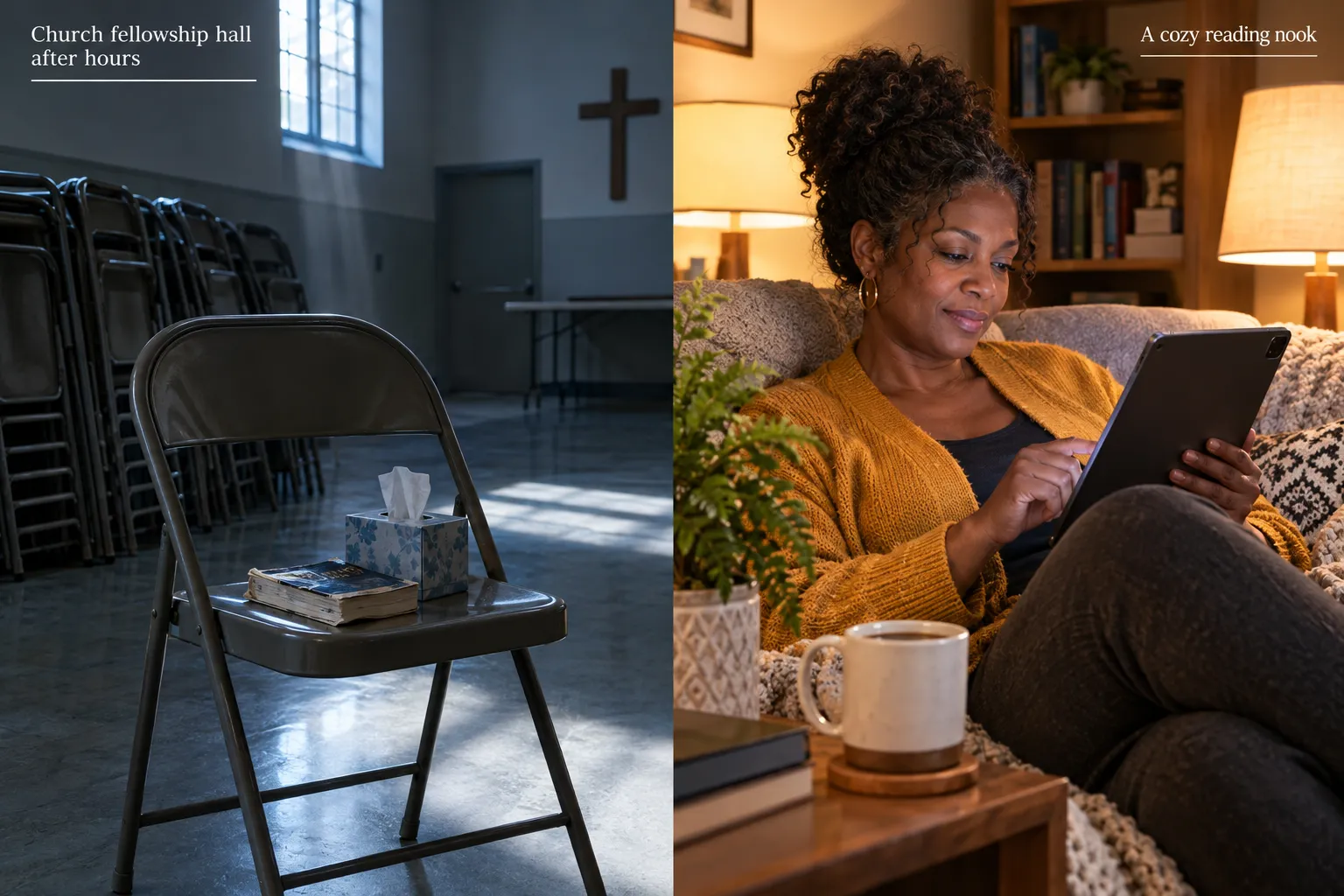
- A widow who can’t say grace out loud anymore, and the sister-in-law who sits with her anyway
- A man holding a letter that would clear his name and destroy someone else’s family
- A church prayer list that becomes evidence of who was ignored
)
Decision rule: if you want grief treated as something God walks through with people rather than something God removes on request, you want this category. If you want guaranteed comfort by chapter three, you want devotional writing instead.
How Long Are Typical Christian Grief Stories?
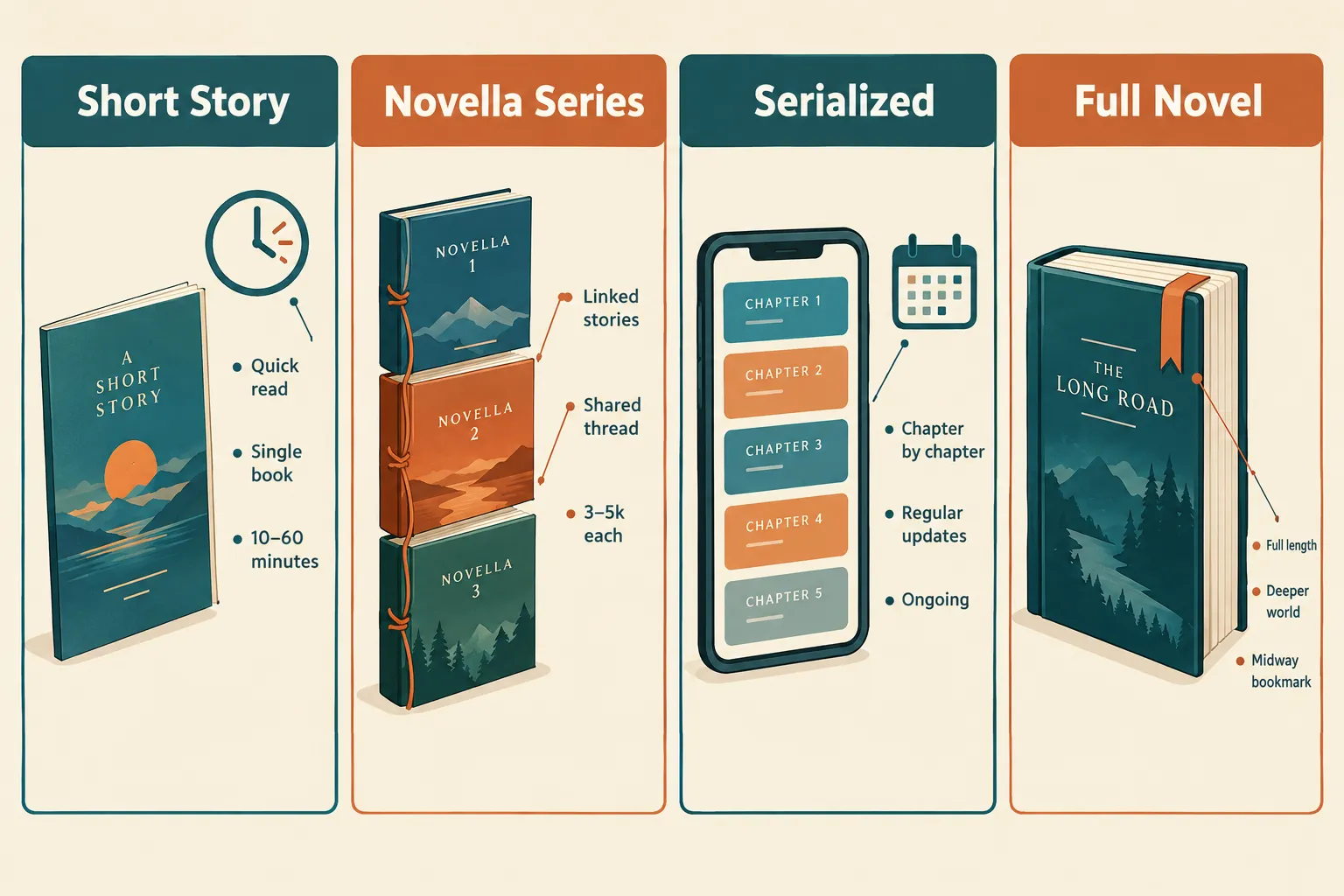
Most short-form Christian grief fiction falls into four recognizable lengths. Pick by how much attention you actually have.
| Format | Typical length | Reading time | Best for |
|---|---|---|---|
| Short story | 2,000-7,500 words | 15-40 minutes | Anthology sampling, one emotional idea |
| Novella | 15,000-40,000 words | 1.5-3 hours | A full grief arc in one sitting |
| Serial chapter | 1,500-4,000 words | 10-20 minutes | Weekly reading with a community |
| Linked series book | 40,000-70,000 words | 4-7 hours | Binge readers who want continuity |
Common mistake: assuming short means shallow. A 6,000-word story can carry one unresolved question better than a novel can, because it doesn’t have time to flinch. Edge case: readers in acute grief often do better with short stories than serials, because a weekly cliffhanger can feel like one more thing to carry.
For more on how length shapes tension, see this look at pacing, tension, and emotional stakes in clean Christian fiction.
Best Short-Form Christian Stories About Forgiveness
The strongest short-form Christian stories about forgiveness make it cost something. Start with anthologies and multi-author collections, where the format forces compression and the theme has to land fast.
Current and recent examples worth knowing:
- Pieces of Us (released October 8, 2026), 11 authors, 11 stories on healing, forgiveness, unexpected loss, fractured trust, and second chances. First volume of The Story of Us Anthology Series, positioned toward inspirational contemporary fiction [1].
- Delivered by David Gibides (announced October 1, 2026), historical Christian fiction following Saphira after her infant brother’s death during Herod’s decree, tying grief and sacrifice to the ministry of Jesus. Note that the available description comes from a publicity release, so treat the thematic framing as promotional [7].
- Discounted contemporary titles, October 2026 listings at Bargain Booksy included $0.99 Christian fiction centered on parental death, illness, prayer, and family survival, such as Fields of Promise and Keep on Asking [8]. These listings show active discounting, not audited sales.
Quick example of the pattern that works: a character forgives, and then has to live beside the person they forgave. The reconciliation isn’t the ending, it’s the beginning of the harder half.
Where to Read Serialized Christian Fiction Online, and on Which Platforms
Serialized Christian fiction lives mainly on Substack, Ream, Kindle Vella-style serial readers, and author-run newsletters. Pick the platform based on what kind of story you want, not which is most popular.
- Substack, best for essay-forward or literary serials. A chapter can sit next to the author’s own reflection on loss, which suits pastoral or meditative grief fiction.
- Ream, purpose-built for genre fiction and chapter delivery, better for an ongoing story library than for commentary.
- Kindle Unlimited, not a serial platform technically, but functions like one for readers who binge linked series. See how Kindle Unlimited reshaped Christian fiction publishing for indie authors.
- Author newsletters, often where free introductory chapters live before a book launches.
)
Platform guidance for serialists consistently recommends a predictable release cadence, free introductory material, and early access or bonus content for paying subscribers. That advice is operational rather than tested against a large Christian-fiction dataset. Industry coverage from ChristShare reports growth in chapter-by-chapter Christian fiction and projects a 9.2% annual growth rate for digital religious content through 2034 [2][5]. Because ChristShare promotes the trend it measures, treat that figure as an industry claim, not independent market data [3][10].
Decision rule: choose Substack if you want the author’s voice alongside the story. Choose Ream or KU if you just want the next chapter.
Free Christian Fiction Series About Loss and Healing
Free and near-free access is genuinely easy to find in this category, mostly through three routes: free first installments, library lending, and newsletter deals.
- Free opening chapters or Book 1, standard practice for serialized authors building readership.
- Library ebook apps, Libby and Hoopla carry large Christian fiction catalogs at no cost with a library card.
- Newsletter bargain lists, Bargain Booksy’s Christian fiction listings regularly feature $0.99 and free titles dealing with parental death, illness, and threatened loss [8].
- Subscription reading, Kindle Unlimited makes whole series effectively free at the margin, which is why so much short-form faith fiction publishes there.
- Directory browsing, catalogs like FictionFinder let readers filter faith-based fiction by theme [9].
Common mistake: downloading twelve free grief books in one evening. Pick one. Finish it. Grief reading works better slow.
Christian Fiction vs Secular Grief Books: The Real Differences
The difference isn’t sadness, secular literary fiction handles grief brilliantly. The difference is what the story assumes is true about the universe, and therefore what counts as resolution.
| Element | Christian grief fiction | Secular grief fiction |
|---|---|---|
| Source of meaning | God is real inside the story’s world | Meaning is built by the characters |
| Role of prayer | A plot action with consequence | Usually a psychological coping image |
| Forgiveness | A moral and spiritual obligation with cost | A personal choice for one’s own peace |
| Typical ending | Hope in the dark, not full repair | Acceptance, ambiguity, or endurance |
| Content | Generally clean; no graphic or explicit material | No standard |
Both can be honest. The failure mode differs: secular grief fiction risks nihilism, and Christian grief fiction risks cheap grace. A fuller breakdown of content standards and reader expectations appears in this comparison of clean Christian fiction versus inspirational romance.
How Does Faith Play a Role in Christian Grief Stories?
Faith functions best as pressure, not as answer. In well-built short-form and serialized Christian fiction about grief, loss, and forgiveness, belief is what makes the character’s choice harder, because mercy and justice are pulling in opposite directions and both have a claim.
Three mechanisms that work:
- Faith under fire. The character believes, and the belief doesn’t help yet, and they keep showing up anyway.
- Earned grace. Forgiveness arrives after a real price has been paid, reputation, money, safety, a relationship.
- Community as instrument. The casserole, the ride to the cemetery, the deacon who tells the truth when it costs him.
Fall 2026 Christian fiction coverage has specifically praised books where faith is not offered as a quick cure for pain, a family of professional mourners in one novel, a mother rebuilding after her infant daughter’s death in another.
Writers working this territory should read up on faith-rooted character development and authentic spiritual arcs without sermonizing.
How to Find Christian Grief Stories That Aren’t Preachy
Test the first three pages. If the narration explains the lesson instead of showing a choice, the rest of the book will too.
Fast screening checklist:
- ✔️ Does a character do something costly, or just realize something?
- ✔️ Is doubt given real lines, or dismissed in a paragraph?
- ✔️ Does scripture appear in a character’s mouth, or in the narrator’s?
- ✔️ Does the ending repair everything, or repair one thing honestly?
- ✔️ Do reviews say “didn’t feel preached at”? That phrasing is a reliable signal.
Edge case: some readers want the sermon, and that’s fine, Love Inspired-style lines that combine faith, forgiveness, and hope remain commercially durable precisely because they deliver reassurance on schedule [6]. Know which you’re buying.
Related: how much faith is too much is examined genre by genre in balancing spiritual themes with story across Christian mystery, western, fantasy, and LitRPG.
Common Mistakes in Writing Christian Grief Fiction
The biggest mistake is treating grief as a problem the plot solves. Grief is a condition the plot moves through.
- Conversion as resolution. A dramatic altar moment in the final chapter erases the cost the whole book was building.
- Scripture as shortcut. A quoted verse can’t do the work a scene refuses to do.
- Villainizing doubt. The doubting character has to be right about something, or the book is rigged.
- No material cost. Forgiveness with no consequence isn’t forgiveness, it’s forgetting.
- Sanitized sorrow. Clean content doesn’t mean sanded-down emotion. Honesty about hard things is what makes the comfort land.
- Inconsistent serial cadence. For serialized work, a missed release week breaks trust faster than a weak chapter.
Who Is Christian Grief Fiction For, and Can You Read It While Struggling?
The core readership is adults roughly 35 to 65, weighted toward women and toward subscription readers, though grief fiction reaches teens through YA faith titles and older readers through large-print and audio. It’s also increasingly read alongside faith memoir, Diane Owen Connelly’s September 2026 memoir about her daughter’s death, grief, and forgiveness sits in the same reader space as the fiction.
Can you read it if you’re struggling right now? Often yes, with two cautions. Short-form is safer than serialized: one sitting, one closed cover, no weekly reopening of the wound. And check the loss type, a reader who has lost a child should know in advance whether the book contains infant loss. Reviews and book descriptions usually say.
Is it good for non-believers? Yes, when the book shows faith being tested rather than asserted. A skeptical reader can follow a character who prays and gets silence, because that’s a recognizable human experience. The same reader will put down a book that treats their skepticism as a plot flaw. Broader context matters here: Publishers Weekly reported religion publishers seeing anxious readers turn toward Bibles, devotionals, and study guides amid instability, with Circana BookScan data showing combined print sales in those categories rising from 16.6 million units in 2019 to 30.8 million in 2025. That’s not fiction-specific, but it describes the emotional market these stories are published into.
FAQ
What counts as short-form Christian fiction? Short stories (2,000-7,500 words), novellas (15,000-40,000 words), and single serial installments (1,500-4,000 words). Anything readable in one or two sittings.
Is serialized Christian fiction actually growing? Industry reporting says yes, citing chapter-by-chapter release, reader communities, and mobile reading [2][5]. The most-quoted growth figure comes from a company promoting the trend, so treat it as an industry claim [3][10].
Where can I read serialized Christian fiction online for free? Free opening chapters on Substack and author newsletters, library apps like Libby and Hoopla, and free or $0.99 promotions listed through newsletter retailers [8].
What’s the best platform for serialized Christian fiction? Substack for literary or reflective serials, Ream for genre chapter delivery, Kindle Unlimited for binge-reading linked series.
Are these books clean? The category standard is no profanity, no graphic violence, and no explicit content. Individual titles vary, so check the description.
Do Christian grief novels always end happily? No. The better ones end with hope in the dark, one thing repaired honestly, not everything fixed.
How is Christian grief fiction different from a devotional? A devotional addresses the reader directly with application. Fiction dramatizes a character’s choice and lets the reader draw their own conclusion.
Can grief fiction help someone actually grieving? Many readers say it helps to see sorrow named accurately. It isn’t therapy, and it isn’t a substitute for pastoral care or counseling.
What’s a good first book in this category? A multi-author anthology. Short commitment, several voices, and you learn fast which tone fits you [1].
Conclusion
Short-form and serialized Christian fiction about grief, loss, and forgiveness earns its place by being finishable. A novella gets read when a novel sits unopened, and a weekly chapter builds company into the reading itself. The category is wider than it was a decade ago, with publishers willing to name depression, abuse, and bereavement plainly [4], and with faith appearing through character struggle instead of exposition [6].
Next steps:
- Start with one anthology or novella, not a stack.
- Apply the three-page test, look for a costly choice, not an explained lesson.
- If you want community with the reading, subscribe to one serialized author on Substack or Ream and follow their release schedule.
- If you want to binge, browse five Christian fiction trilogies worth a Kindle Unlimited subscription.
- Check content notes for your specific loss before you start.
Grief doesn’t read a schedule, and neither does grace. But a story that tells the truth about the first can make room for the second, and sometimes a hundred pages is exactly enough room.
References
[1] Anthology Pieces Of Us – https://www.victoriousbydesign.com/anthology-pieces-of-us [2] Short Form Serial Christian Fiction Growth Reshapes Digital Reading – http://prsync.com/ink-marks-the-spot-llc-dba-christshare/short-form-serial-christian-fiction-growth-reshapes-digital-reading-5183119/ [3] ChristShare Highlights Rise Of Short Form Christian Fiction – https://markets.chroniclejournal.com/chroniclejournal/article/marketersmedia-2026-2-18-christshare-highlights-rise-of-short-form-christian-fiction [4] Christian Publishers Tap Into Grittier Side Of Fiction – https://www.publishersweekly.com/pw/by-topic/industry-news/religion/article/86032-christian-publishers-tap-into-grittier-side-of-fiction.html [5] ChristShare Highlights Growth Of Serialized Christian Fiction Content – https://markets.chroniclejournal.com/chroniclejournal/article/marketersmedia-2026-4-26-christshare-highlights-growth-of-serialized-christian-fiction-content [6] Publishers Remain Faithful To Fiction – https://www.publishersweekly.com/pw/by-topic/industry-news/religion/article/91841-publishers-remain-faithful-to-fiction.html [7] Historical Christian Novel Delivered Explores Hope And Healing – https://www.news-press.com/press-release/story/126559/historical-christian-novel-delivered-explores-hope-and-healing/ [8] Christian Fiction – https://www.bargainbooksy.com/read/genre/christian-fiction/ [9] FictionFinder – https://www.fictionfinder.com/ [10] ChristShare Releases Report On Christian Reading Trends In 2026 – https://www.financialcontent.com/article/marketersmedia-2026-4-17-christshare-releases-report-on-christian-reading-trends-in-2026