
{“cover”:”Editorial still-life hero, landscape 1536×1024: a worn wooden reading table beside a rain-streaked window at late afternoon, one closed paperback with a plain dark cover pushed aside, and three stacked clean-edged hardcovers with muted linen spines pulled close under a small brass lamp. A folded church bulletin and a pair of reading glasses rest nearby. Palette of deep navy, warm amber lamplight, and soft bone-white. Shallow depth of field, rule-of-thirds composition, moody-but-hopeful magazine lighting, no text anywhere on the image.”,”content”:[“Four-panel labelled comparison guide, landscape 1536×1024, clean bone-white background with navy and muted teal accents: panel one shows an illustrated close-up of a cracked door with light behind it labelled ‘Dread’; panel two shows a spattered broken window labelled ‘Gore’; panel three shows an open journal with crossed-out lines labelled ‘Unreliable Memory’; panel four shows a locked filing cabinet drawer labelled ‘Withheld Record’. Thin callout lines point to small details in each panel, 2-4 short labels per panel, editorial field-guide polish, flat vector illustration style, no sentences.”,”Annotated documentary-style photograph, landscape 1536×1024, bright natural daylight: an older Black woman in a cardigan sits in a small-town library aisle holding a paperback open to the back matter, a handwritten checklist on an index card tucked between her fingers, a second stack of candidate books on the floor beside her. Soft slim callout lines point to the index card, the book’s final chapters, and the stack, each with a short 2-3 word label. Warm oak shelving, green and cream palette, high-contrast editorial framing, no paragraphs of text.”}

Last updated: November 6, 2026
Quick Answer
Stephen King books alternatives for Christian readers who want psychological depth without graphic horror do exist, and they aren’t watered down. The reading experience you’re after, dread, unreliable narrators, moral weight, a house that remembers something, comes from withheld information and character pressure, not from what the camera shows. Look for clean Christian psychological thrillers, dual-timeline “time-slip” suspense, gothic-tinged Christian mystery, and classic detective fiction. All four deliver tension through conscience instead of carnage.
Key Takeaways
- Psychological depth comes from what a character knows, hides, or can’t trust, not from graphic violence.
- Graphic horror shows the harm. Psychological suspense makes you dread it and then holds the moment.
- Dual-timeline Christian fiction is one of the strongest current options for inherited trauma and grief without gore [1][2].
- Mysteries are becoming a credible niche inside Christian fiction, with new series launching through 2026 and 2027.
- Not every Christian suspense author is a safe swap, Dekker, Peretti, and Klavan carry real violence and need title-by-title screening.
- Religious-press sales rose 9.3% to $2.2 billion in 2025, so the shelf is growing, not shrinking.
- The most common mistake is assuming “Christian label” equals “no disturbing content.” Read the back third, not the blurb.
- Broken-character redemption stories satisfy King readers best when grace costs something.
What Makes a Book Psychologically Deep Without Being Graphic
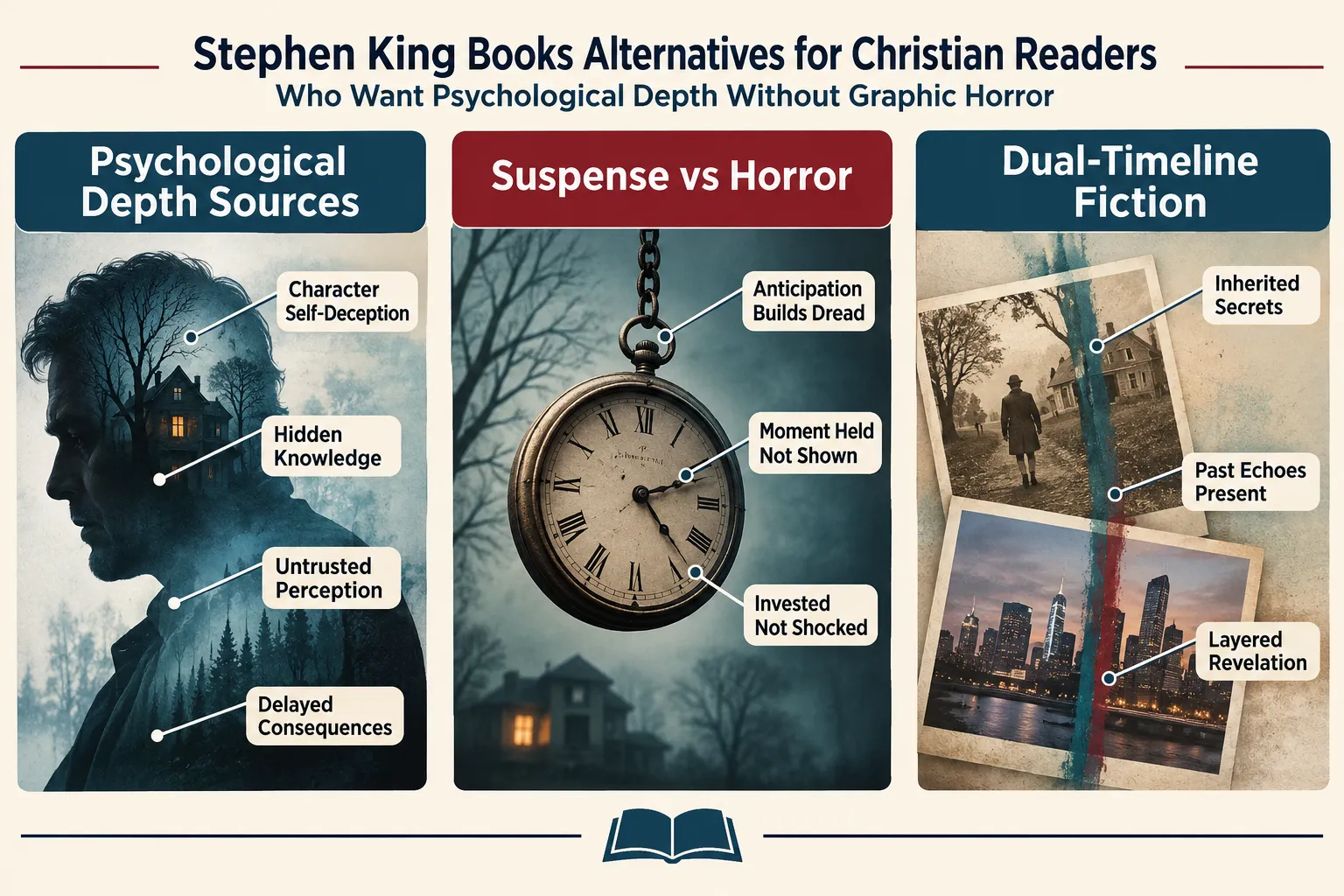
Depth comes from interiority and consequence. A novel is psychologically deep when the reader has to track a character’s self-deception, when the reader knows something the protagonist doesn’t, and when a choice made in chapter three costs someone in chapter twenty.
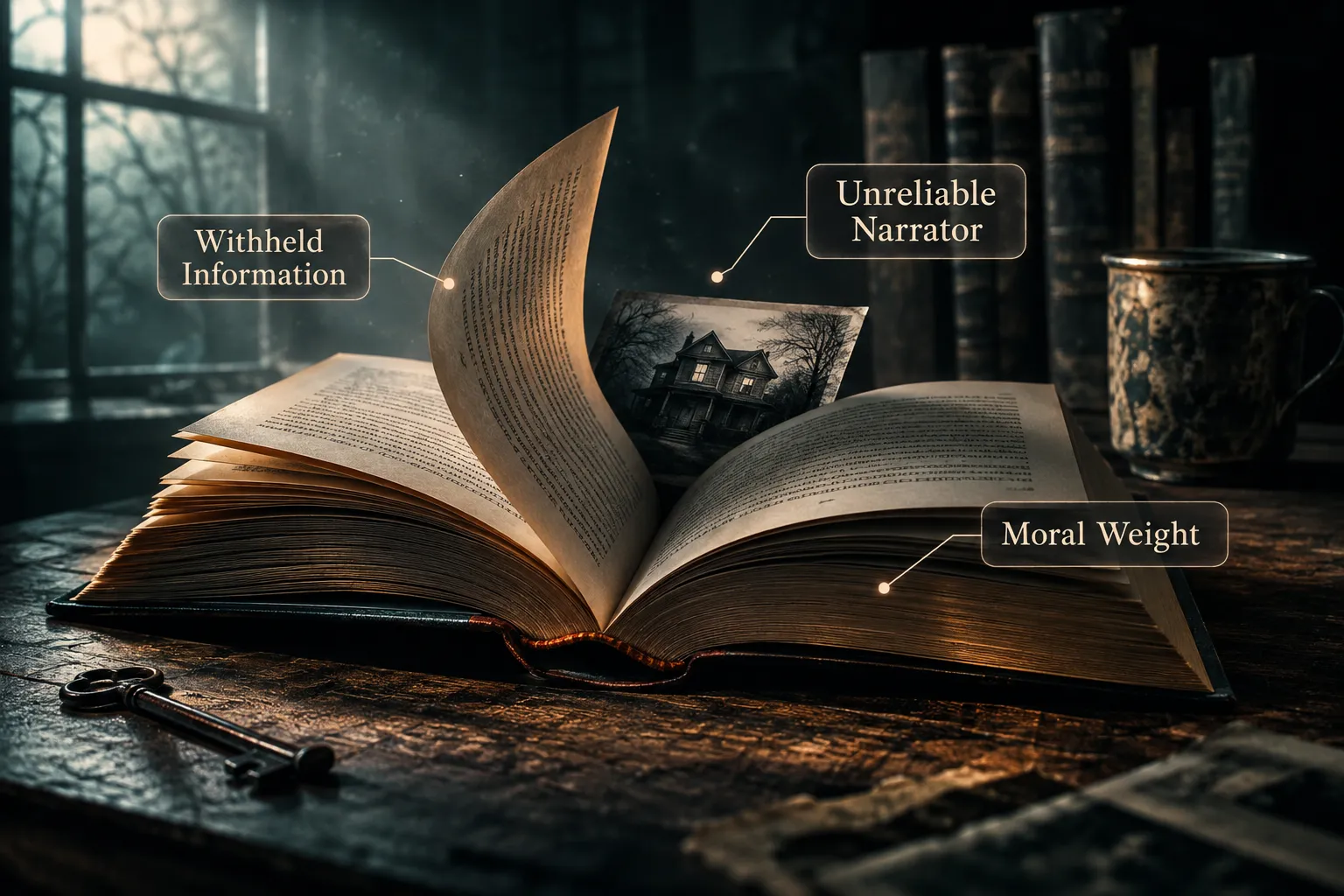
Graphic content is a delivery method, not a depth requirement. The devices that actually produce unease:
- Withheld information. The reader sees the shape of the thing before it’s named.
- Unreliable perception. Memory gaps, medication, exhaustion, a transcript that doesn’t match what someone remembers saying.
- Contaminated safe spaces. A church kitchen, a retreat center, a family Bible. Danger inside the familiar hits harder than danger in a swamp.
- Moral jeopardy. The protagonist can tell the truth and lose everything, or stay quiet and keep it.
)
Quick example: A woman finds her own words inside another woman’s case file. Nothing violent has happened yet. The dread is total. That’s the engine behind the clean Christian psychological thriller structures built on trauma, memory, and grace.
What’s the Difference Between Psychological Suspense and Graphic Horror
Psychological suspense builds anticipation and dread; graphic horror delivers explicit depiction. The emotional target is different, suspense wants you anxious and invested, horror wants you shocked and repulsed.
| Psychological suspense | Graphic horror | |
|---|---|---|
| Primary tool | Anticipation, doubt, withheld facts | Explicit depiction of harm |
| Where the fear lives | In the reader’s head | On the page |
| Pacing | Slow pressure, tightening | Spikes and escalation |
| Aftermath | Moral reckoning | Body count |
| Reread value | High, clues reframe | Lower, shock spends itself |
Decision rule: If you can remove a scene’s explicit detail and the dread survives, it’s suspense. If the scene only works because of the detail, it’s horror.
Are There Books Like Stephen King but Without the Horror Elements
Yes, but match the experience you liked, not the author name. King readers usually come for one of four things, and each maps to a different clean lane.
- Small-town rot under a friendly surface → Christian cozy mystery with real moral stakes, or small-town suspense.
- Unreliable minds and identity collapse → clean Christian psychological thrillers.
- Haunted houses and inherited dread → gothic-tinged Christian historical suspense, including Jaime Jo Wright’s 2026 release The Resurrection of Evania James, which links two women across time through a house tied to grave robbers.
- Institutional conspiracy and pursuit → Christian FBI/profiling suspense, covered in this guide to Christian psychological thriller novels like Criminal Minds.
Stephen King Books Alternatives for Christian Readers: The Best Authors With Dark Themes
The strongest Christian authors writing darkness honestly fall into tiers by how much graphic content they carry. Screen accordingly.
- Jaime Jo Wright, gothic atmosphere, dual timelines, missing persons, spiritual questions. Best fit for atmosphere-without-splatter readers.
- Dani Pettrey and Colleen Coble, the commercially strongest mainstream Christian suspense lane. Coble was the bestselling fiction author at participating Christian retailers in 2025. Pettrey’s Two Seconds Too Late (April 2025) centers on a disappearance at a New Mexico spa.
- Dana Mentink and the new Christian mystery wave, Love Inspired Trade’s Murder Most Fowl Mysteries began with Murders in the Marquee in September 2026; the Christie Club Mystery series continues with All the Suspects on Campus in January 2027 [3].
- Ted Dekker, closest analogue to King’s conceptual intensity: unstable realities, faith questions, moral darkness. But Thr3e and The Bride Collector contain disturbing violence. Screen individually.
- Frank Peretti, spiritual and supernatural suspense. Monster‘s final third includes conspirators stabbing and shooting witnesses, so it fails a strict no-graphic-violence standard.
- Andrew Klavan, identity, memory, pursuit, prayer. The Homelanders books include bombings, gunfire, beatings, and physical agony. Tension without horror, not gentle suspense.
- Dorothy L. Sayers and P. D. James, classic detective fiction may offer the best ratio of intellectual depth to graphic content. Gaudy Night handles trauma, vocation, and conscience almost entirely through investigation.
Psychological Thrillers for Faith-Based Readers and Where Mental Health Themes Live
Faith-based psychological thrillers work best when the spiritual question is load-bearing rather than decorative. The strongest ones ask who controls the record of someone’s truth, then let a believing character pay for answering honestly.
Mental health themes, dissociation, grief, caregiving burnout, spiritual abuse, appear most often in:
- Time-slip / dual-timeline novels. Publishers Weekly reported in March 2026 that Christian publishers were seeing strong sales for time-slip fiction. The structure is ideal for inherited trauma and delayed consequence.
- Counseling, retreat, and ministry settings, where language itself becomes the weapon.
- Cold-case and institutional-failure plots, where the harm is historical and the reckoning is present.
Silas Bellhaven’s The Gathering Light sits squarely here. When Hannah Sleeps follows a woman who has transcribed a hundred other women’s worst nights until her own testimony turns up in someone else’s file. No gore. Plenty of dread.
How to Find Books With Tension and Complex Characters for Christian Readers
Use a five-point screen before you commit. It takes about four minutes per book.
)
- Read the last three chapters’ content reviews, not the blurb. Violence usually clusters in the final third.
- Check content guides like Plugged In for specific titles, not just authors.
- Scan reviews for “disturbing,” “graphic,” “couldn’t finish.” Three mentions is a pattern.
- Check the series contract. Some series guarantee no romance, no profanity, no explicit content across every book.
- Sample the opening page. If the first paragraph is shock, the book is shock. If it’s contradiction, you’re in suspense territory.
This pairs well with building a clean, faith-filled Kindle Unlimited TBR across mystery, western, fantasy, and thriller.
Psychological Depth Without Occult or Demonic Content
Yes, you can have intensity without spiritual warfare imagery. Substitute human systems for supernatural ones: a falsified ledger, a sealed adoption file, a transcript that was quietly edited, a prayer list used as surveillance.
Who this matters for: readers who found Peretti-style demonic conflict overwhelming, or who don’t want possession and ritual on the page at all. Where to look instead: record-based suspense, frontier justice, and covenant fantasy where evil is institutional rather than infernal, the pattern behind The Mercy Line, where land claims and buried records decide who gets justice.
Danger that comes from a signature on a document is no less frightening than danger that comes from a cellar. It’s just harder to look away from.
Who Shouldn’t Read Stephen King, and What to Read Instead
Skip King if explicit violence, profanity, sexual content, or extended body horror genuinely harms your reading experience, or if you’ve found that the images stay with you for weeks. That’s not squeamishness; it’s knowing your own threshold.
| If you liked King for… | Try instead |
|---|---|
| Misery (captivity, control) | Clean psychological thriller with institutional captivity |
| The Shining (haunted place, family unraveling) | Gothic Christian time-slip suspense |
| 11/22/63 (time, consequence) | Dual-timeline Christian historical mystery |
| The Stand (moral clash at scale) | Christian epic fantasy with covenant stakes |
| Small-town ensemble dread | Christian cozy mystery with real consequence |
Books About Broken Characters and Redemption for Christian Audiences
Redemption arcs satisfy former King readers when the grace costs something. Cheap conversion endings are the fastest way to lose a reader who came for psychological realism.
Look for stories where the character:
- Fails in a way that has lasting consequences
- Tells the truth while it’s still expensive
- Receives mercy after the cost, not instead of it
- Doesn’t get their reputation back
That’s earned grace. It’s the difference between comfort by avoidance and comfort by honesty, explored further in this piece on keeping story first while exploring spiritual themes without preaching.
Common Mistakes When Picking Christian Fiction With Darker Themes
- Trusting the label. Christian publishing includes real violence. The imprint isn’t a filter.
- Buying by author instead of title. Dekker’s range is enormous. One book clears your standard, the next doesn’t.
- Confusing “no gore” with “no stakes.” Low-content books can still be brutal emotionally, which is often what you want.
- Expecting a sermon or fearing one. The best clean suspense does neither; it shows belief through choice and consequence.
- Assuming secular domestic suspense is a safe middle ground. Several 2026 releases marketed as psychological rather than horror still contain disturbing experimentation, dementia-related violence, and macabre atmosphere.
- Skipping the content contract. Series-level promises about what “clean” actually means to readers are more reliable than any single blurb.
FAQ
Do all psychologically intense books have to have graphic content? No. Intensity comes from withheld information, unreliable perception, and moral cost. Graphic depiction is one optional technique among many.
Is Ted Dekker a safe Stephen King substitute for Christian readers? Partially. Dekker delivers comparable conceptual and psychological intensity, but titles like Thr3e and The Bride Collector include disturbing violence. Screen each book individually.
What about Frank Peretti? Peretti is excellent for supernatural and spiritual suspense but not for a strict no-graphic-violence standard. Monster includes witnesses being stabbed and shot in the final third.
Which Christian suspense authors sell best right now? Colleen Coble was the bestselling fiction author at participating Christian retailers in 2025, with Dani Pettrey also leading the mainstream Christian suspense lane.
Is the Christian fiction market actually growing? Religious-press sales rose 9.3% to $2.2 billion in 2025, while print suspense/thriller units fell 2.2%. Faith-based suspense is growing inside an expanding religious market [1][4].
What’s the best entry point for gothic atmosphere without gore? Dual-timeline Christian historical suspense. Jaime Jo Wright’s The Resurrection of Evania James (October 2026) is a current example built on atmosphere and unease rather than explicit violence [2].
Are classic mysteries a good option? Yes. Dorothy L. Sayers’s Gaudy Night handles trauma, vocation, and conscience with almost no graphic content, and P. D. James explores guilt and institutional failure with literary weight.
Where do mental health themes show up most in clean Christian fiction? In time-slip novels, counseling and retreat settings, and cold-case plots where harm is historical and the reckoning is present.
Conclusion
The trade most readers assume they have to make, depth for darkness, isn’t a real trade. Dread is built out of what a reader doesn’t yet know and what a character can’t afford to say. Both survive perfectly well without a single explicit page.
Next steps:
- Name the experience you want from King: haunted place, unreliable mind, small-town rot, or conspiracy.
- Pick one matching lane from the comparison table above.
- Screen two titles using the five-point method before you buy.
- Start with a single-protagonist thriller like When Hannah Sleeps to test the fit, then widen out.
Some stories comfort you by looking away. The better ones look straight at the hard thing and then refuse to leave you there alone.
References
- Christian Reading Trends 2026: Devotional Fiction Dominance Revealed. wboc.com.
- 3 Thrilling Christian Suspense Novels for Spring 2026. bookpage.com.
- ChristShare Highlights Clean Fiction as Cozy Mysteries Gain Interest. news.marketersmedia.com.
- Best Selling Christian Novels 2026: Data-Driven Market Analysis. alibaba.com.