Last updated: September 2, 2026
Quick Answer: Stephen King’s The Long Walk is a psychologically intense dystopian thriller with genuine moral weight, but it also carries significant content concerns for Christian readers, graphic violence, profanity, and a bleak, largely hopeless worldview. Christian readers drawn to its tension and human stakes have better options: clean psychological thrillers and faith-rooted suspense that deliver the same grip without the darkness that costs more than it gives back.
Key Takeaways
- The Long Walk (1979, published as Richard Bachman) is a standalone novel, no knowledge of The Dark Tower series is required to read it.
- The book and its 2025 film adaptation are both rated for mature audiences; content warnings include sustained graphic violence, profanity, and nihilistic themes.
- King’s fiction does engage religious and spiritual themes, but his treatment of faith is complex, often skeptical of institutions while leaving room for grace [7].
- Christian readers are not wrong to find King compelling, the moral questions in his work are real, but many find the content cost too high for regular reading.
- Clean Christian psychological thrillers can deliver equal tension through moral and spiritual conflict rather than graphic content.
- The Gathering Light series (When Hannah Sleeps, When the Voice Breaks, When the Prayer List Opens) is a direct alternative for readers who want the psychological pressure of King without the content concerns.
- The Christian suspense market is growing: one 2026 industry report projected the religious publishing market at $1.409 billion in 2026, with 5.5% annual growth, clean suspense is a major driver.
- “Fiction Christians can read” and “Christian fiction” are not the same category, the distinction matters when choosing what to recommend.
What Is The Long Walk by Stephen King About?
The Long Walk is a dystopian novel set in a near-future America where 100 teenage boys compete in a government-sponsored event: walk continuously at a minimum pace of four miles per hour. Fall below the pace three times without recovering, and you receive your “ticket”, a bullet. The last boy walking wins anything he wants for the rest of his life.
Published in 1979 under King’s pen name Richard Bachman, the book follows Ray Garraty, a Maine teenager, as he and the other walkers move south through crowds of spectators who treat the event as entertainment. The story is less about plot twists and more about what happens inside a person when death becomes inevitable and the only question left is what you’ll do with the miles you have.
It is a book about endurance, about the cruelty of systems, about what boys talk about when they know they are going to die. It is psychologically relentless.
Is The Long Walk Appropriate for Christian Readers?
For most Christian readers, The Long Walk presents real content concerns that go beyond personal preference. The book contains sustained graphic violence (boys are shot repeatedly throughout the narrative), significant profanity, and a worldview that offers almost no redemptive resolution. The ending is deliberately ambiguous and bleak.
That said, the moral questions the book raises, the worth of a human life, the corruption of spectacle, what a person owes to a stranger dying beside them, are not trivial. Some Christian readers engage with it as a serious moral text. Others find the content cost too high to justify.
A practical guide for Christian readers considering The Long Walk:
| Content Area | What to Expect | Faith-Reader Impact |
|---|---|---|
| Violence | Repeated, graphic, sustained | High concern |
| Profanity | Frequent | Moderate-high concern |
| Sexual content | Minimal | Low concern |
| Spiritual themes | Absent/implicit | Neutral |
| Redemptive arc | Largely absent | High concern |
| Worldview | Dystopian, nihilistic | High concern |
Choose to read it if: You engage with dark literary fiction as moral examination and can separate content from endorsement. Skip it if: You read for hope, for faith under pressure, or for stories where the cost of grace is shown but grace still arrives.
Does The Long Walk Have Religious Themes?
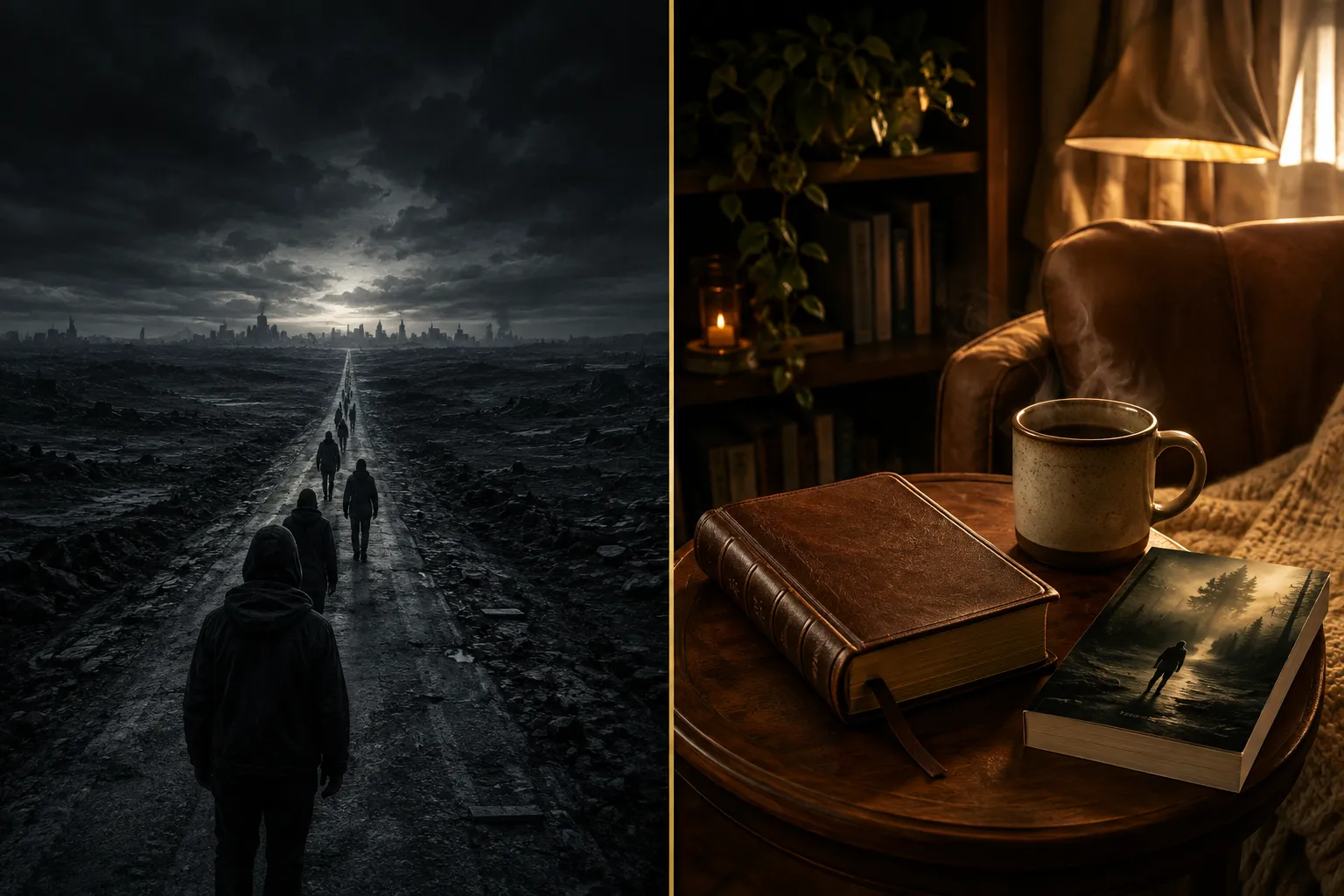
The Long Walk does not carry overt religious themes the way some of King’s other work does. There is no church, no prayer, no direct engagement with faith. What it does carry is a moral architecture, questions about sacrifice, about the value of human life, about complicity, that a Christian reader will recognize as spiritually adjacent even without explicit religious framing.
King’s broader catalog is a different story. Catholic World Report has described King as a kind of “dark theologian,” arguing that his horror repeatedly functions as a morality tale reinforcing biblical categories of good, evil, pride, and redemption [7]. King himself called The Stand a “dark Christianity” story and said he wanted to “give God his due” [7]. Christianity Today’s David Zahl notes that King handles Christian faith “as the motivator for bravery just as often as cruelty,” and that belief is “almost always there in some way” across King’s fiction [2].
The Long Walk sits at the quieter end of that spectrum. The spiritual weight is there, but it’s buried under concrete and asphalt.
Why Do Christians Read Stephen King Despite Violent Content?
Christian readers engage with King for the same reason they engage with Dostoevsky or Flannery O’Connor: the questions are real, and the darkness is not decorative. King takes evil seriously. He takes human weakness seriously. He does not let his characters off easy.
Credo Magazine has published thoughtful discussions on what Christians can actually learn from King, noting that his fiction forces readers to confront moral categories that sanitized fiction often avoids [5]. The Mockingbird blog has written about King’s “parables of grace in action,” arguing that grace shows up in his work precisely because the cost of not having it is so visible [4].
The honest answer is this: some Christians read King because the moral seriousness in his work is harder to find in fiction that was designed to be safe. That is a legitimate hunger. The question worth asking is whether the content cost is the only way to meet it, and the answer, increasingly, is no.
For a deeper look at how Christian authors build suspense through moral and spiritual conflict without that content cost, see Christian Psychological Thriller: How Authors Build Suspense Through Moral and Spiritual Conflict.
Stephen King Books With Redemption or Spiritual Themes
If you want to explore King with faith-aware eyes, these titles carry the most genuine spiritual weight:
- The Stand, King’s own “dark Christianity” label applies here. Good versus evil, a literal prophet figure, and a plague that forces every character to choose what they answer to [7].
- Desperation, Explicitly engages with prayer, God’s silence, and whether faith holds when the answer is no.
- The Green Mile, A Christ-figure narrative with mercy, sacrifice, and the cost of institutional cruelty.
- Bag of Bones, Grief, guilt, and whether the dead can hold the living accountable.
The Long Walk is not on this list. Its moral weight is real, but it does not reach toward grace.
Christian Alternatives to Stephen King Psychological Thrillers
This is where the conversation gets genuinely useful for Christian readers. The demand for psychological thrillers that deliver real tension without graphic content or nihilism is not a niche request, it is a growing market, and the books exist.
The key distinction, drawn from how Christian review communities actually talk about this, is between “Christian fiction” (faith is an explicit, foregrounded element) and “fiction Christians can read” (clean content, moral seriousness, but faith may be background). Both categories serve different readers.
For readers who want faith foregrounded:
The Gathering Light series by Silas Bellhaven is the most direct structural alternative to King’s psychological pressure. Each book follows a new protagonist inside a Christian retreat system where testimony, language, and institutional power are weaponized. The spine question, who controls the record of someone’s truth?, runs through all three books:
- When Hannah Sleeps, Hannah Garrick has transcribed a hundred women’s worst nights, until her own testimony starts appearing in someone else’s file.
- When the Voice Breaks, Caris Weller built her career on careful language, until the retreat’s system starts speaking for her instead.
- When the Prayer List Opens, Taryn Vickers finds her own name on the prayer list, written in the hand of a woman who was supposed to be safe.
No graphic violence. No profanity. The tension comes entirely from moral and spiritual pressure, which is, when done well, more unsettling than anything graphic.
For more options in this space, see Christian Psychological Thrillers That Don’t Rely on Graphic Violence and Christian Psychological Thrillers: Doubt, Redemption, and Moral Complexity for Readers Who Want Suspense With Hope.
Psychological Thrillers Without Graphic Content for Religious Readers
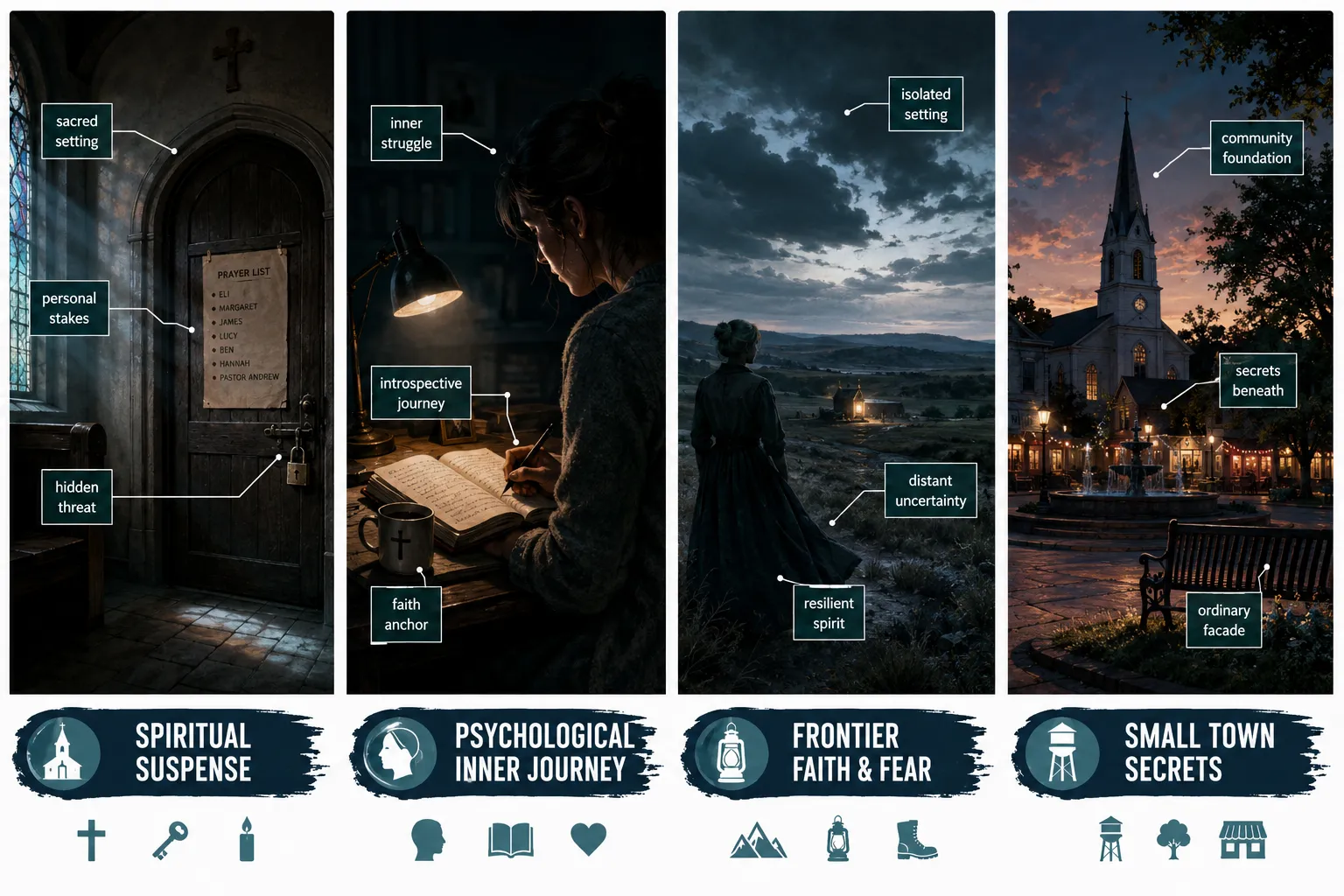
Clean Christian psychological thrillers work by replacing graphic content with a different kind of pressure: the weight of a secret, the cost of silence, the moment a character realizes that the institution they trusted has been using their own words against them.
The best examples in the genre share these structural qualities:
- A protagonist with something real to lose, not just their life, but their testimony, their community, their sense of what is true
- An antagonist who uses legitimate systems, institutions, language, records, prayer, as instruments of control
- Faith under fire rather than faith as decoration, belief gets tested, not just referenced
- Earned grace, mercy arrives after cost, not instead of it
This is the content contract that The Gathering Light series maintains. It is also the framework discussed in The Role of Prayer and Discernment in Christian Thriller Plots.
The Long Walk Movie vs. Book: Which Is Better for Faith Audiences?
The Long Walk film adaptation released theatrically on September 12, 2025, and began streaming on HBO Max on July 10, 2026, after moving through digital and Starz windows. It earned approximately $63.1 million worldwide against a reported $20 million budget, making it one of the more profitable recent King adaptations. Stephen King’s own film page described it as an “intense, chilling, and emotional thriller.”
For faith audiences, neither the book nor the film is a comfortable watch. The film carries the same content concerns as the source material, sustained violence, bleak worldview, no redemptive resolution, and the visual medium makes the violence more immediate, not less.
If the question is which is better for a faith audience: neither is designed with faith audiences in mind. The book at least allows the reader to pace the darkness internally. The film removes that buffer.
The more useful question is: what draws you to this story? If it’s the psychological pressure of a character forced to confront mortality and meaning with no exit, that hunger can be fed by fiction that doesn’t require the content cost.
How Long Does It Take to Read The Long Walk?
The Long Walk runs approximately 370 pages in most editions. At an average adult reading pace of 250-300 words per minute, most readers finish it in 6 to 8 hours. It reads faster than its page count suggests because the prose is stripped and urgent, King wrote it as a teenager, and the voice is relentless rather than layered.
Many readers report finishing it in a single sitting or across two evenings. The pacing is designed to mirror the walk itself: no natural stopping points, no relief.
Can You Read The Long Walk as a Standalone?
Yes, completely. The Long Walk requires no knowledge of The Dark Tower series or any other King work. It was written and published as a standalone novel under the Bachman name, and the story is entirely self-contained. There are no shared characters, no mythology to track, no prior reading required.
This is one reason it remains one of King’s most accessible entry points, and one reason it comes up so often when Christian readers ask whether there is a King title they could try without committing to a larger universe.
The Long Walk Content Warnings and Trigger Topics
For readers who need specific content information before deciding:
- Violence: Repeated, graphic depictions of boys being shot. The violence escalates as the walk continues and is not softened or cut away from.
- Death: Sustained, cumulative. Characters the reader has come to know die throughout the narrative.
- Profanity: Frequent throughout.
- Hopelessness: The worldview is bleak. There is no clear redemptive arc, and the ending offers no conventional resolution.
- Themes: Government cruelty, complicity, the spectacle of suffering, adolescent mortality, the meaning of sacrifice.
Sensitive readers should know: This is not a book that resolves its darkness. If you need hope in the dark to be earned and present by the final page, The Long Walk will not deliver that.
Christian Authors Who Write Psychological Thrillers Like Stephen King
Several authors in the Christian fiction space are writing psychological suspense that carries genuine moral weight without King’s content concerns:
- Silas Bellhaven (The Gathering Light series), institutional gaslighting, testimony as weapon, faith under systemic pressure. Closest structural parallel to King’s psychological method.
- Lynette Eason, Christian romantic suspense with real stakes and clean content.
- Colleen Coble, Suspense with faith threads, accessible pacing, no graphic content.
- DiAnn Mills, FBI and law enforcement thrillers with Christian protagonists.
The Silas Bellhaven approach is distinct in that faith is not a comfort layer added to a thriller plot, it is the pressure point the plot turns on. The retreat system in The Gathering Light uses the language of faith as a mechanism of control, which means the spiritual stakes and the thriller stakes are the same stakes. That is what King does at his best: the horror and the moral question are the same question.
For readers exploring this space on Kindle Unlimited, Clean Christian Fiction for Kindle Unlimited: How Authors Can Meet Reader Expectations Without Losing Tension is worth reading.
Frequently Asked Questions
Is The Long Walk a horror novel? It is classified as dystopian fiction and psychological thriller more than horror. There is no supernatural element. The dread comes from the premise itself and from watching characters face inevitable death.
Does The Long Walk have a happy ending? No. The ending is deliberately ambiguous and widely interpreted as bleak. It is not a book that offers conventional resolution or hope.
Is the Long Walk film appropriate for Christian viewers? The film carries the same content concerns as the book, graphic violence, a nihilistic worldview, with the added immediacy of visual medium. Most Christian viewers who are sensitive to graphic content will find it difficult.
What is the best Stephen King book for Christian readers? The Green Mile and The Stand are most frequently cited by Christian readers as carrying genuine spiritual weight. Both deal with sacrifice, grace, and the cost of mercy in ways that resonate with Christian themes [7].
Can a Christian enjoy Stephen King without compromising their faith? That is a personal discernment question, not a doctrinal one. Many thoughtful Christians engage with King as serious moral literature [5]. The question is whether the specific content cost of a given book is worth what it offers.
What makes a psychological thriller “faith-friendly”? Faith-friendly psychological thrillers deliver real tension through moral and spiritual conflict rather than graphic violence or explicit content. The stakes are just as high, often higher, because they involve conscience, testimony, and the cost of truth, but the content contract is clean.
Is The Gathering Light series similar to King in tone? Structurally, yes. The psychological pressure, the institutional antagonist, the protagonist who cannot trust what they thought was safe, these are King’s tools. The content is entirely different: no graphic violence, no profanity, faith as load-bearing rather than background.
Do I need to be a Christian to enjoy Christian psychological thrillers? No. Readers who want moral seriousness, real stakes, and clean content often find Christian psychological thrillers satisfying regardless of their own faith background. The stories work because the stakes are human, not because the theology is explicit.
How is “earned grace” different from a tidy resolution? Earned grace means mercy arrives after the character has paid a real cost, not as a rescue from consequence, but as something that holds alongside consequence. It is the opposite of a clean exit. The character still carries what happened; grace is what makes it bearable rather than erasing it.
Where do I start with Silas Bellhaven’s psychological thrillers? Start with When Hannah Sleeps, the first book in The Gathering Light series. Each book follows a new protagonist, so they can be read independently, but Book 1 establishes the retreat system and its mechanisms most fully.
Conclusion
The interest in The Long Walk among Christian readers makes sense. King’s novel takes human life seriously, asks hard questions about complicity and meaning, and does not let anyone off easy. Those are not small things. But the content cost, sustained graphic violence, pervasive profanity, a worldview that offers no redemptive resolution, is real, and for many Christian readers it is simply too high.
The good news is that the hunger The Long Walk represents, for psychological pressure, for moral weight, for fiction that does not flinch from hard questions, can be fed by stories built on a different foundation. Clean Christian psychological thrillers like The Gathering Light series deliver the same grip through spiritual and moral conflict rather than graphic content. Faith under fire. Earned grace. Hope in the dark that costs something before it arrives.
That is not a lesser version of what King does. In the best cases, it is a more honest one.
Next steps for Christian readers:
- Browse The Gathering Light series and start with When Hannah Sleeps
- Explore the full range of Christian psychological thrillers available in the genre
- Read Christian Psychological Thrillers: Doubt, Redemption, and Moral Complexity for a broader map of the category
References
[1] Stephen King Best Selling Author Horror Novelist And Christian Moralist – https://www.catholicworldreport.com/2015/03/20/stephen-king-best-selling-author-horror-novelist-and-christian-moralist/
[2] Water If God It 17097727 – https://www.patreon.com/posts/water-if-god-it-17097727
[4] Do Ya Ken It Stephen Kings Parables Of Grace In Action – https://mbird.com/literature/do-ya-ken-it-stephen-kings-parables-of-grace-in-action/
[5] What Can Christians Learn From Stephen King Jared Wilson And Matthew Barrett – https://credomag.com/2022/04/what-can-christians-learn-from-stephen-king-jared-wilson-and-matthew-barrett/
[7] Stephen King Best Selling Author Horror Novelist And Christian Moralist – https://www.catholicworldreport.com/2015/03/20/stephen-king-best-selling-author-horror-novelist-and-christian-moralist/